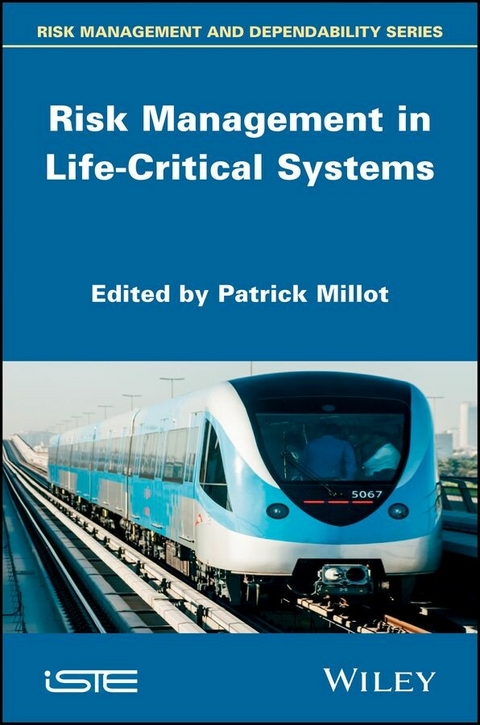
Risk Management in Life Critical Systems (eBook)
100 Seiten
Wiley-Iste (Verlag)
978-1-118-63936-8 (ISBN)
Risk management deals with prevention, decision-making, action taking, crisis management and recovery, taking into account the consequences of unexpected events. The authors of this book are interested in ecological processes, human behavior, as well as the control and management of life-critical systems, which are potentially highly automated. Three main attributes define life-critical systems, i.e. safety, efficiency and comfort. They typically lead to complex and time-critical issues and can belong to domains such as transportation (trains, cars, aircraft), energy (nuclear, chemical engineering), health, telecommunications, manufacturing and services.
The topics covered relate to risk management principles, methods and tools, and reliability assessment: human errors as well as system failures, socio-organizational issues of crisis occurrence and management, co-operative work including human−machine cooperation and CSCW (computer-supported cooperative work): task and function allocation, authority sharing, interactivity, situation awareness, networking and management evolution and lessons learned from Human-Centered Design.
Patrick Millot has been Full Professor at the University of Valenciennes in France since 1989. He conducts research on Automation Sciences, Artificial Intelligence and Human-Machine Systems (HMS). He is the author of approximately 200 publications and collective books. He has led several regional, national and international projects on supervisory control and transport safety.
Part 1. General Approaches for Crisis Management
1. Dealing with the Unexpected
Guy A. Boy
2. Vulnerability and Resilience Assessment of Infrastructures
and Networks: Concepts and Methodologies
Eric Châtelet
3. The Golden Hour Challenge: Applying Systems Engineering to
Life-Critical System of Systems
Jean-René Ruault
4. Situated Risk Visualization in Crisis Management
Lucas Stéphane
5. Safety Critical Elements of the Railway System: Most Advanced
Technologies and Process to Demonstrate and Maintain Highest Safety
Performance
Stéphane Romei
6. Functional Modeling of Complex Systems
Morten Lind
Part 2. Risk Management and Human Factors
7. Designing Driver Assistance Systems in a Risk-based
Process
Pietro Carlo Cacciabue
8. Dissonance Engineering for Risk Analysis: A Theoretical
Framework
Frédéric Vanderhaegen
9. The Fading Line Between Self and System
René van Paassen
10. Risk Management: A Model for Procedure Use Analysis
Kara schmitt
11. Driver-Assistance Systems for Road Safety Improvement
Serge Boverie
Part 3. Managing Risk Via Human-Machine Cooperation
12. Human-Machine Cooperation Principles to Support
Life-Critical Systems Management
Marie-Pierre Pacaux-Lemoine
13. Cooperative Organization for Enhancing Situation
Awareness
Patrick Millot
14. A Cooperative Assistant for Deep Space Exploration
Donald Platt
15. Managing the Risks of Automobile Accidents Via
Human-Machine Collaboration
Makoto Itoh
16. Human-Machine Interaction in Automated Vehicles: The
ABV Project
Chouki Sentouh and Jean Christophe Popieul
17. Interactive Surfaces, Tangible Interaction: Perspectives For
Risk Management
Christophe Kolski, Catherine Garbay, Yoann Lebrun, Fabien
Badeig, Sophie Lepreux, René Mandiau and
Emmanuel Adam
List of Figures
1.1. Expected and actual situation showing small and bigger variations
2.1. Factors shaping the risks faced to critical infrastructures [KRO 08]
2.2. A proposition of risk situations and relevant risk assessment strategies
3.1. eCall: the crashed car calls 112! [EC 13e]
3.2. N² matrix of pairings of different systems within the system of systems [RUA 11]
3.3. Functional model of the accident detection system architecture [RUA 11]
4.1. RTO and maximum tolerable period of disruption [COR 07]
4.2. Global view of the 3D interactive scene – Unity 3D [STE 13] (For a color version of this figure, see www.iste.co.uk/millot/riskmanagement)
5.1. Range of order that has been observed for the last decade
5.2. Main components of a railway system
5.3. The bogie integrating six safety critical functions
5.4. Classical development V-cycle
5.5. Risk management organization in European Union
5.6. Technics for identification and evaluation of hazards and their subsequent risks
5.7. European safety management system
5.8. Safety authorization and safety management system
6.2. Means-end structure showing the possible combinations of means-end relations
6.5. MFM of heat transfer loop without control
6.6. MFM of heat transfer loop with flow and temperature control
6.7. MFM model of heat transfer loop with a protection system suppressing high temperature in HE2
7.1. Risk-based design methodology flowchart
7.2. Sheridan’s five levels of “supervisory control” (adapted from [SHE 97])
7.3. A generic operator model (adapted from [CAR 07])
7.4. Essential nature of human–machine interaction
7.5. Error propensity (EP) and dynamic generation of sequences
7.6. General structure of the quasi-static methodology for RBD
7.7. Expanded human performance event tree (adapted from [CAC 12])
7.8. Generic risk matrix. For a color version of this figure, see www.iste.co.uk/millot/riskmanagement.zip
7.9. ADAS at level of driving task a) and temporal sequence of intervention b)
7.10. EHPET for the case study with ADAS
8.2. Stable and unstable level of a dissonance dimension
8.3. The theoretical framework based on human– machine learning to control dissonances
8.4. The reverse comic strip-based approach to identify dissonances
8.5. Examples of emotion and sound variation images
8.6. The knowledge analysis algorithm
8.7. The dissonance evaluation algorithm
8.8. The generic reinforcement based on learning process
8.9. A reinforcement algorithm by case-based reasoning
8.10. The interpretation of pictures from rail platform signaling systems
8.11. The associated reverse comic strip for dissonance identification
8.12. The associated rule analysis for dissonance identification and evaluation
8.13. A prediction process based on the knowledge reinforcement
8.14. The correct prediction rate by reinforcing the knowledge base
9.1. Depiction of Peirce’s triadic relationship between object, sign and interpretation
10.1. A model for procedure analysis
11.1. Examples of driver-assistance systems
11.2. Vehicle/driver/environment system
11.3. T involuntary transition from waking to sleeping (from Alain Muzet)
11.5. Classification principles for visual distraction detection
12.1. Attributes of cooperative agent
12.3. Fighter aircraft CWS (example of the tactical situation SITAC). For a color version of this figure, see www.iste.co.uk/millot/riskmanagement
12.6. Robotics CWS. For a color version of this figure, see www.iste.co.uk/millot/riskmanagement
12.7. Example of agents’ abilities identification for task sharing and authority management (red arrows). For a color version of this figure, see www.iste.co.uk/millot/riskmanagement.zip
13.1. Allocation of functions among humans and machines (adapted from [BOY 11])
13.2. SA three-level model adapted from [END 95a]
13.3. Team-SA adapted from [SAL 08]
13.4. The three forms for task distribution according to agents KH and related tasks to share
13.5. Task distribution and related SA distribution, in the augmentative and integrative forms
13.6. Task distribution and related SA distribution, in the debative form
13.7. CWS principle for team SA [MIL 13]
14.2. Virtual camera data feedback loop
14.3. The human-centered design process for the development of the virtual camera
14.5. Horizontal prototype for the VC showing icons and interface. For a color version of this figure, see www.iste.co.uk/millot/riskmanagement
14.6. The VC vertical prototype with icons labeled. For a color version of this figure, see www.iste.co.uk/millot/riskmanagement
15.3. a) Pressure distribution sensors and b) the obtained data. For a color version of this figure, see www.iste.co.uk/millot/riskmanagement
15.4. Pressure distribution sensors and the obtained data [ISH 13]. For a color version of this figure, see www.iste.co.uk/millot/riskmanagement
15.5. Model of driver lane change intent emergence [ZHO 09]
15.6. a) The attention arousing display and b) its effects on THW [ITO 13a]. For a color version of this figure, see www.iste.co.uk/millot/riskmanagement
15.7. Driver reaction against the rapid deceleration of the forward vehicle [ITO 08b]
16.1. Structure of the ABV project
16.2. Graph of the different modes of the ABV system
16.3. Graph of the different modes of the ABV system. For a color version of this figure, see www.iste.co.uk/millot/riskmanagement
16.4. Driver monitoring system from Continental. For a color version of this figure, see www.iste.co.uk/millot/riskmanagement
16.5. Shared driving control architecture
16.6. Experimental results on the SHERPA simulator. For a color version of this figure, see www.iste.co.uk/millot/riskmanagement
16.7. Evaluation of the sharing quality. For a color version of this figure, see www.iste.co.uk/millot/riskmanagement
17.1. Two configurations for risk management UI: a) centralized distribution of U; b) network of distributed UI [LEP 11]. For a color version of this figure, see www.iste.co.uk/millot/riskmanagement.zip
17.2. Crisis unit using TangiSense and other platforms (adapted from [LEP 11]). For a color version of this figure, see www.iste.co.uk/millot/riskmanagement.zip
17.3. A road traffic simulation on two TangiSense interactive tables. For a color version of this figure, see www.iste.co.uk/millot/riskmanagement.zip
17.4. Use of zoom tangible object, without effect on the other table. For a color version of this figure, see www.iste.co.uk/millot/riskmanagement.zip
17.5. Tangiget synchronization with effect on TangiSense 2. For a color version of this figure, see www.iste.co.uk/millot/riskmanagement.zip
| Erscheint lt. Verlag | 10.10.2014 |
|---|---|
| Sprache | englisch |
| Themenwelt | Naturwissenschaften |
| Wirtschaft ► Betriebswirtschaft / Management ► Allgemeines / Lexika | |
| Wirtschaft ► Betriebswirtschaft / Management ► Finanzierung | |
| Betriebswirtschaft / Management ► Spezielle Betriebswirtschaftslehre ► Versicherungsbetriebslehre | |
| Wirtschaft ► Betriebswirtschaft / Management ► Unternehmensführung / Management | |
| Schlagworte | Business & Management • Risikomanagement • Risiko-, Notfall- u. Krisenmanagement • Risk, Contingency & Crisis Management • Wirtschaft u. Management |
| ISBN-10 | 1-118-63936-7 / 1118639367 |
| ISBN-13 | 978-1-118-63936-8 / 9781118639368 |
| Informationen gemäß Produktsicherheitsverordnung (GPSR) | |
| Haben Sie eine Frage zum Produkt? |
 EPUB (Adobe DRM)
Kopierschutz: Adobe-DRM
Adobe-DRM ist ein Kopierschutz, der das eBook vor Mißbrauch schützen soll. Dabei wird das eBook bereits beim Download auf Ihre persönliche Adobe-ID autorisiert. Lesen können Sie das eBook dann nur auf den Geräten, welche ebenfalls auf Ihre Adobe-ID registriert sind.
Details zum Adobe-DRM
Dateiformat: EPUB (Electronic Publication)
EPUB ist ein offener Standard für eBooks und eignet sich besonders zur Darstellung von Belletristik und Sachbüchern. Der Fließtext wird dynamisch an die Display- und Schriftgröße angepasst. Auch für mobile Lesegeräte ist EPUB daher gut geeignet.
Systemvoraussetzungen:
PC/Mac: Mit einem PC oder Mac können Sie dieses eBook lesen. Sie benötigen eine
eReader: Dieses eBook kann mit (fast) allen eBook-Readern gelesen werden. Mit dem amazon-Kindle ist es aber nicht kompatibel.
Smartphone/Tablet: Egal ob Apple oder Android, dieses eBook können Sie lesen. Sie benötigen eine
Geräteliste und zusätzliche Hinweise
Buying eBooks from abroad
For tax law reasons we can sell eBooks just within Germany and Switzerland. Regrettably we cannot fulfill eBook-orders from other countries.
aus dem Bereich