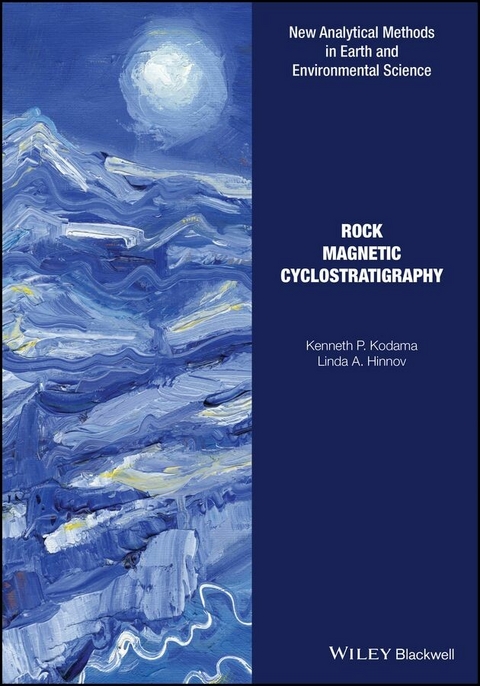
Rock Magnetic Cyclostratigraphy (eBook)
John Wiley & Sons (Verlag)
978-1-118-56132-4 (ISBN)
Rock magnetic cyclostratigraphy merges environmental magnetism, in which rock magnetic measurements are used to detect past environmental change, and cyclostratigraphy, in which cyclic variations of lithology or a sedimentary rock’s physical properties are related to astronomically-forced paleoclimate change. In addition to providing paleoclimate data, cyclostratigraphy can establish high-resolution chronostratigraphy for a sequence of sedimentary rocks, even at distant times in Earth’s history. This book provides an overview of concepts underlying these two techniques, recipes for the time series analysis of cyclostratigraphy, and case studies to illustrate the variety and breadth of problems addressed by rock magnetic cyclostratigraphy.
New Analytical Methods in Earth and Environmental Science
Because of the plethora of analytical techniques now available, and the acceleration of technological advance, many earth scientists find it difficult to know where to turn for reliable information on the latest tools at their disposal, and may lack the expertise to assess the relative strengths or limitations of a particular technique. This new series will address these difficulties by providing accessible introductions to important new techniques, lab and field protocols, suggestions for data handling and interpretation, and useful case studies. The series represents an invaluable and trusted source of information for researchers, advanced students and applied earth scientists wishing to familiarise themselves with emerging techniques in their field.
All titles in this series are available in a variety of full-colour, searchable e-book formats.
Kenneth P. Kodama is Professor of Earth and Environmental Sciences at Lehigh University, USA. He has taught Earth sciences and conducted paleomagnetic and rock magnetic research with his students at Lehigh for the past 36 years. In his time away from paleomagnetism he enjoys playing music.
Linda A. Hinnov is a research Professor at Johns Hopkins University, USA specializing in the astronomical forcing of Earth’s paleoclimate system. She has longstanding interests in cyclostratigraphy, and its implications for the evolution of Earth’s geophysical and astronomical parameters and the geologic time scale.
Rock magnetic cyclostratigraphy merges environmental magnetism, in which rock magnetic measurements are used to detect past environmental change, and cyclostratigraphy, in which cyclic variations of lithology or a sedimentary rock s physical properties are related to astronomically-forced paleoclimate change. In addition to providing paleoclimate data, cyclostratigraphy can establish high-resolution chronostratigraphy for a sequence of sedimentary rocks, even at distant times in Earth s history. This book provides an overview of concepts underlying these two techniques, recipes for the time series analysis of cyclostratigraphy, and case studies to illustrate the variety and breadth of problems addressed by rock magnetic cyclostratigraphy. New Analytical Methods in Earth and Environmental Science Because of the plethora of analytical techniques now available, and the acceleration of technological advance, many earth scientists find it difficult to know where to turn for reliable information on the latest tools at their disposal, and may lack the expertise to assess the relative strengths or limitations of a particular technique. This new series will address these difficulties by providing accessible introductions to important new techniques, lab and field protocols, suggestions for data handling and interpretation, and useful case studies. The series represents an invaluable and trusted source of information for researchers, advanced students and applied earth scientists wishing to familiarise themselves with emerging techniques in their field. All titles in this series are available in a variety of full-colour, searchable e-book formats.
Kenneth P. Kodama is Professor of Earth and Environmental Sciences at Lehigh University, USA. He has taught Earth sciences and conducted paleomagnetic and rock magnetic research with his students at Lehigh for the past 36 years. In his time away from paleomagnetism he enjoys playing music. Linda A. Hinnov is a research Professor at Johns Hopkins University, USA specializing in the astronomical forcing of Earth's paleoclimate system. She has longstanding interests in cyclostratigraphy, and its implications for the evolution of Earth's geophysical and astronomical parameters and the geologic time scale.
1 Introduction 1
1.1 Rock Magnetic Cyclostratigraphy 1
1.2 Basic Steps of a Rock Magnetic Cyclostratigraphy Study 4
1.3 The Significance of Rock Magnetic Cyclostratigraphy 6
1.4 Layout of the Book 7
References 8
2 Rock Magnetism 10
2.1 Introduction 10
2.2 Types of Magnetism 12
2.3 Ferromagnetic Minerals 16
2.4 Fine Particle Magnetism 20
2.4.1 Hysteresis 20
2.4.2 Magnetic Particle Anisotropy 24
2.4.3 Domain State 25
2.5 Environmental Magnetic Parameters 26
2.5.1 Individual Environmental Magnetic Parameters 26
2.5.2 Ratios of Environmental Magnetic Parameters 29
2.6 Identification of Magnetic Mineralogies and Choosing a Rock Magnetic Parameter for Cyclostratigraphy 31
References 32
3 Magnetostratigraphy 35
3.1 Introduction 35
3.2 Measuring Magnetostratigraphy 37
3.2.1 Sampling Strategy 37
3.2.2 Sample Collection 37
3.2.3 Measurement and Demagnetization 38
3.2.4 Tests to Constrain the Age of Remanence 41
3.2.5 Plotting of Magnetostratigraphic Data and Determining a Reversal Stratigraphy 42
3.3 Tying to the GPTS 46
3.4 Providing the Best Time Resolution from Magnetostratigraphy 49
References 49
4 Time Series Analysis for Cyclostratigraphy 52
4.1 Introduction 52
4.2 Geological Time Series 53
4.3 Time Series Analysis Tools and Eocene Arguis Rock Magnetic Cyclostratigraphy 54
4.3.1 Sampling and Interpolation 54
4.3.2 Detrending, Smoothing, and "Prewhitening" 56
4.3.3 Filtering Basics 56
4.3.4 Digital Filters 58
4.3.5 Spectral Analysis 58
4.3.6 Hypothesis Testing and Noise Modeling 73
4.3.7 Time-Frequency Analysis 81
4.3.8 Coherency and Cross-Phase Analysis 83
References 87
5 Milankovitch Forcing Theory 90
5.1 Introduction 90
5.2 Astronomical Parameters 90
5.3 Insolation 93
5.4 Astronomical Tuning and Timescales 93
5.4.1 The Initial Timescale 93
5.4.2 Traditional Astronomical Tuning 96
5.4.3 Objective Astronomical Tuning 97
References 97
6 Case Studies of Rock Magnetic Cyclostratigraphy 99
6.1 Introduction and Environmental Shredding 99
6.2 Stirone River Section, Northern Italy 101
6.3 Arguis Formation, Spanish Pyrenees 104
6.4 Cupido Formation Platform Carbonates, Northeastern Mexico 107
6.5 Latemar Massif, Triassic Carbonates, Northern Italy 111
6.6 Daye Formation, Triassic Carbonates, South China 113
6.7 Mauch Chunk Formation: Mississippian Red Beds, Pottsville, Pennsylvania 117
6.8 Rainstorm Member of the Neoproterozoic Johnnie Formation, Death Valley, California 119
6.9 Encoding of Orbitally Forced Climate Signals 123
References 124
7 Doing Rock Magnetic Cyclostratigraphy 128
7.1 Study Design 128
7.2 Field Sampling 131
7.3 Laboratory Preparation 132
7.4 Remanence Measurements 134
7.5 Time Series Analysis: Summary of Procedures 137
7.5.1 Preparation of the Data Series 138
7.5.2 Spectral Estimation 138
7.5.3 Significance of the Spectral Peaks 139
7.5.4 Evolutionary Spectrogram 140
7.5.5 Tuning and Filtering 140
7.6 Identifying Astronomically Forced Climate Cycles 141
References 143
Appendix 145
Glossary 157
Index 161
1
Introduction
Abstract:
Rock magnetic cyclostratigraphy is a new technique that allows a high-resolution chronostratigraphy to be assigned to a sequence of sedimentary rocks. Concentration variations of magnetic minerals in a sedimentary rock can be tied to astronomically forced global climate cycles with little or no facies interpretation needed. The rock magnetic measurements are nondestructive, relatively quick, and inexpensive. This chapter outlines the basic steps of a rock magnetic cyclostratigraphy study and serves as an introduction to the monograph.
1.1 Rock Magnetic Cyclostratigraphy
The purpose of this monograph is to provide an overview and the practical “how to” for a relatively new technique that can yield high-resolution chronostratigraphy for sequences of sedimentary rocks. Rock magnetic cyclostratigraphy is the result of the merging of environmental magnetism, in which rock magnetic measurements can detect past environmental conditions, and cyclostratigraphy, in which cyclic variations of lithology or a rock's physical properties are tied to orbitally forced changes in global climate. Orbitally forced cyclic variations in the lithology of sedimentary sequences has been an important research focus for stratigraphers since Hays et al.'s (1976) pioneering study of Late Pleistocene marine sediments. The main reason for this intense interest is that if lithologic variations can be tied to the well-known cyclic variations of solar insolation at periods of ~20 kyr, ~40 kyr, ~100 kyr, and 405 kyr, a detailed and high-resolution chronostratigraphy can be established for the rocks, even at distant times in Earth's history.
Lithologic cyclostratigraphy relies on identifying facies changes in a rock sequence and interpreting them as indicators of cyclic variations in the rock's depositional environment. These cyclic variations are then tied to astronomically forced climate change. Deep-sea cyclostratigraphy has been vital in supplying pristine records of astronomically forced signals from the Cenozoic and Late Mesozoic eras. For earlier times, however, pelagic marine organisms had not yet evolved in sufficient “rock-forming” numbers. For the early Mesozoic and earlier times, researchers must rely on shallow marine, hemipelagic, and continental cyclostratigraphy for astronomically forced paleoclimate data. While continental facies preserve high fidelity records of astronomical forcing, e.g., the Newark Basin lacustrine rocks (Olsen & Kent 1996), such facies are in short supply compared with the marine record. Shallow-marine cyclostratigraphy, principally from carbonate-rich peritidal facies, is the main source of astronomical forcing and global climate change data prior to the Jurassic Period (>200 million years ago). However, in any lithologic, facies-based cyclostratigraphic study, the work always involves interpretation, both in the identification of a given facies and in the interpretation of what that facies indicates about the depositional environment.
To advance the study of cyclostratigraphy, stratigraphers have searched for techniques that could provide stable and well-behaved paleoclimatic or paleoenvironmental proxies at high resolution and could be collected over reasonably thick sedimentary sequences. The Holy Grail would be a simple, low cost and fairly quick measurement that would be amenable to time series analysis and require minimal interpretation. For instance, in the recognition of astronomically forced cycles in the Late Triassic lake sediments of the Newark Basin, Olsen & Kent (1996) assigned depth ranks to quantify the depositional environment interpreted from the facies changes in the rocks. With the construction of a rock magnetic time series, the facies/depositional environment interpretation could be short-circuited, and the rock magnetics would directly quantify the paleoenvironmental/paleoclimate change.
Rock magnetics and rock magnetic cyclostratigraphy can fulfill many of these needs. Rock magnetic parameters are used in the subdiscipline of environmental magnetism to detect the ancient depositional environment. Rock magnetic parameters can measure variations in the concentration, particle size, and mineralogy of magnetic minerals in a sedimentary rock. These measurements are relatively quick and, therefore, inexpensive, so 1000s of samples can be collected and measured for a rock magnetic cyclostratigraphic study to document magnetic variations at high resolution. The measurements are also nondestructive, so the samples can be retained for other nonmagnetic measurements and examination. The variations in magnetic mineral concentration and particle size can be tied to changes in the depositional environment and hence to changes in paleoclimate or paleoenvironment. Since magnetic minerals in Earth's crust all contain iron, either as oxides, oxyhydroxides, or sulfides, and iron is the fourth most common element in the crust, magnetic minerals can sensitively delineate the cycling of this ubiquitous element through Earth's atmosphere, biosphere, lithosphere, and hydrosphere. Furthermore, very small concentrations of magnetic minerals (<0.01%) are easily and accurately measured with modern superconducting rock magnetometers, making rock magnetic measurements very sensitive measures of paleoenvironmental conditions. In one of the case studies presented in Chapter 6, the sensitivity of rock magnetics to paleoclimatic variations will be demonstrated by a study of the Cretaceous Cupido Formation from Mexico in which rock magnetics can detect astronomically forced cycles, even though the repeating, shallowing-upward facies cannot.
Rock magnetic parameters have been successful measures of glacial–interglacial cycles in loess, mainly in the Chinese Loess Plateau, but also in Eastern Europe and Alaska (summarized in Evans & Heller 2003). Rock magnetic measurements of European maar lake sediments have also detected glacial–interglacial climate cycles. Susceptibility variations from Lac Du Bouchet in France have been directly correlated to δ18O records of glacial–interglacial cycles from the Pacific and Indian Oceans and Greenland ice cores (Heller et al. 1998). Terrigenous input into the northwestern Indian Ocean can be tracked by magnetic susceptibility, and the cyclic variations in susceptibility can be directly correlated to astronomical calculations for northern hemisphere insolation (deMenocal & Bloemendal 1995). Susceptibility variations have also detected changes in paleoclimate in Eocene marine sediments off Antarctica (Sagnotti et al. 1998). Various studies of North Atlantic marine sediments have used rock magnetics to study deglaciation (Stoner et al. 1995) and North Atlantic Deep Water circulation (Kissel et al. 1999). These examples show that rock magnetic parameters that measure a quantity as simple as the concentration of magnetic minerals in sediment can easily detect changes as profound as global paleoclimate.
Conducting a rock magnetic cyclostratigraphic study of a sedimentary sequence is fairly straightforward. Most rock magnetic cyclostratigraphic studies measure variations in the concentration of a depositional magnetic mineral in a sequence of rocks. Magnetite (Fe3O4) is, in most cases, a primary, depositional magnetic mineral. Therefore, erosional, transport, and depositional processes as well as the depositional environment affect its concentration, making magnetite the preferred target of cyclostratigraphic studies. Furthermore, magnetite has a relatively low magnetic coercivity (for magnetic hardness, see Chapter 2) and its concentration is easily measured by applying an anhysteretic remanent magnetization (ARM) (for more details, see Chapter 2) to the cyclostratigraphy samples. ARM, as will be shown in Chapter 2, also allows the researcher to target the concentration variations of only one magnetic mineral (magnetite) in the rock compared to the multiple mineral sources for magnetic susceptibility, so the interpretation of any rock magnetic cycles recorded by an ARM will be straightforward. However, as shown in the case studies presented in Chapter 6, other rock parameters can be used with equal success for identifying astronomically forced cycles in a sedimentary sequence. The rock magnetic parameters used must be chosen on a case-by-case basis.
1.2 Basic Steps of a Rock Magnetic Cyclostratigraphy Study
The steps to a rock magnetic cyclostratigraphy are summarized in Figure 1.1. The first step in conducting a rock magnetic cyclostratigraphy is to select the stratigraphic section for study and estimate its sediment accumulation rate, so that the correct sampling interval can be chosen. The frequencies that can be detected by the time series analysis are limited by the Nyquist frequency . The shortest cycle that can be observed by time series analysis must be sampled at least twice per cycle; therefore, if precession (nominally a 20 kyr period) is to be captured, the rocks should be sampled at least once every 10 kyr of stratigraphic thickness. In some cases, previous work, either biostratigraphy, magnetostratigraphy , or geochronology of ash layers, can be used to calculate the sediment accumulation rate. In most...
| Erscheint lt. Verlag | 6.10.2014 |
|---|---|
| Reihe/Serie | Analytical Methods in Earth and Environmental Science |
| Analytical Methods in Earth and Environmental Science | Analytical Methods in Earth and Environmental Science |
| Sprache | englisch |
| Themenwelt | Naturwissenschaften ► Geowissenschaften ► Geologie |
| Technik | |
| Schlagworte | Addition • astronomicallyforced • Change • cyclic • cyclostratigraphy • earth sciences • environmental • Geochemie, Mineralogie • Geochemistry & Minerology • Geowissenschaften • Magnetic • magnetism • measurements • Merges • paleoclimate • paleoclimate data • Physical • Properties • Rock • sedimentary • Sedimentary rocks • Sedimentologie u. Stratigraphie • Sedimentology & Stratigraphy • Sequence • Variations |
| ISBN-10 | 1-118-56132-5 / 1118561325 |
| ISBN-13 | 978-1-118-56132-4 / 9781118561324 |
| Informationen gemäß Produktsicherheitsverordnung (GPSR) | |
| Haben Sie eine Frage zum Produkt? |
 EPUB (Adobe DRM)
Kopierschutz: Adobe-DRM
Adobe-DRM ist ein Kopierschutz, der das eBook vor Mißbrauch schützen soll. Dabei wird das eBook bereits beim Download auf Ihre persönliche Adobe-ID autorisiert. Lesen können Sie das eBook dann nur auf den Geräten, welche ebenfalls auf Ihre Adobe-ID registriert sind.
Details zum Adobe-DRM
Dateiformat: EPUB (Electronic Publication)
EPUB ist ein offener Standard für eBooks und eignet sich besonders zur Darstellung von Belletristik und Sachbüchern. Der Fließtext wird dynamisch an die Display- und Schriftgröße angepasst. Auch für mobile Lesegeräte ist EPUB daher gut geeignet.
Systemvoraussetzungen:
PC/Mac: Mit einem PC oder Mac können Sie dieses eBook lesen. Sie benötigen eine
eReader: Dieses eBook kann mit (fast) allen eBook-Readern gelesen werden. Mit dem amazon-Kindle ist es aber nicht kompatibel.
Smartphone/Tablet: Egal ob Apple oder Android, dieses eBook können Sie lesen. Sie benötigen eine
Geräteliste und zusätzliche Hinweise
Buying eBooks from abroad
For tax law reasons we can sell eBooks just within Germany and Switzerland. Regrettably we cannot fulfill eBook-orders from other countries.
aus dem Bereich