Forensic photography plays a vitally important part in the investigation of crime and the subsequent administration of justice, Written by a practitioner with many years professional experience, this book provides an overview of the most common forensic photography techniques in use today for those readers who may not have a detailed understanding of camera techniques and who need to get to grips with the use of light and other key scientific aspects of the job, It covers image capture issues, file handling and relevant equipment, such as lasers and UV lights, and explores how they work,
The predominance of the digital camera has resulted in an increasing trend for police forces across the world to use untrained camera users, rather than expert photographers, Therefore, this book will prove invaluable for those practitioners who need to produce accurate and clear photographic evidence, above and beyond the point and shoot mode on their cameras,
Nick Marsh is the author of Forensic Photography: A Practitioner's Guide, published by Wiley,
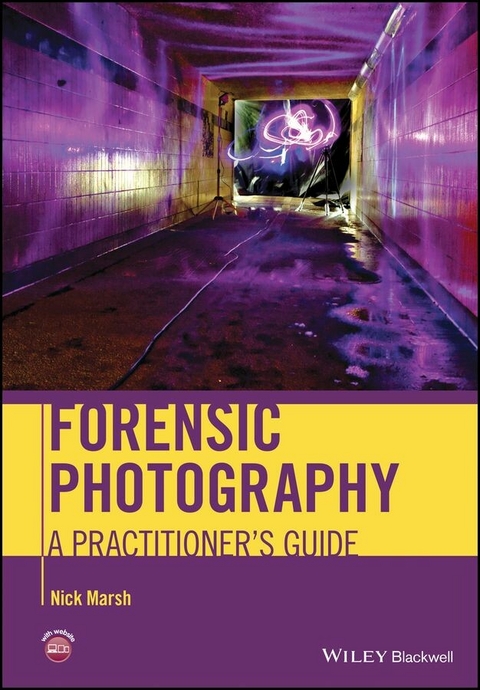
Forensic photography plays a vitally important part in the investigation of crime and the subsequent administration of justice. Written by a practitioner with many years professional experience, this book provides an overview of the most common forensic photography techniques in use today for those readers who may not have a detailed understanding of camera techniques and who need to get to grips with the use of light and other key scientific aspects of the job. It covers image capture issues, file handling and relevant equipment, such as lasers and UV lights, and explores how they work. The predominance of the digital camera has resulted in an increasing trend for police forces across the world to use untrained camera users, rather than expert photographers. Therefore, this book will prove invaluable for those practitioners who need to produce accurate and clear photographic evidence, above and beyond the point and shoot mode on their cameras.
Nick Marsh is the author of Forensic Photography: A Practitioner's Guide, published by Wiley.
"An ideal and comprehensive textbook on the subject, "Forensic Photography: A Practitioner's Guide" is especially recommended for academic library Photography and Forensic Science reference collections and supplemental studies reading lists." (Midwest Book Reviews, 1 March 2015)
Preface
The last 10 years has seen a massive surge of interest in forensics, due to the CSI effect both in television and film. [1] This is generally focused on pathologists, crime scene examiners or investigating personal. Unfortunately, the forensic photographer is often portrayed in these programmes as an extra, running around in the background, their input reduced to providing a few background flashes to the story line.
I hope that within the confines of this book, and I can fly the flag for the forensic photography within the evidential environment, and also share my passion for forensic photography as a very particular and important line of work.
I will point out at this point that I am not an academic, nor a teacher; I am a practitioner, so this book is based on the personal experiences of last 25 years of forensic photography and observations from an operational perspective. It is aimed, I hope, at readers who already have a general interest in forensic photography or are studying it. Those of you who wish to improve your techniques or are involved in imaging, and finally those of you that use forensic imaging to support your casework, such as Crime Scene Managers or Senior Investigating Officers.
I will go into depth where needed and lay out ground rules. But this book should not be seen as a replacement for Langford's basic or advanced photography.1 Also, any opinions expressed are purely my own and not necessarily those representing the Metropolitan Police or others within the photographic industry. I apologise in advance for any technical mistakes within the text, as although every attempt is made to ensure facts are correct, mistakes sometimes happen. Finally the illustrations and guidance within this book are based on my own experiences; therefore your own agency may undertake or approach casework in a different way. The important thing to remember is we are all trying to achieve the same end result.
A bit about me: I studied Scientific and Technical photography at Berkshire College of Art and Design in Reading in the early 1980s. After taking a year or so out, working in the ‘real world’, an ex student colleague of mine suggested I apply to the Metropolitan Police where he was now working. Although I did not like the sight of blood, I somewhat reluctantly applied, was interviewed, and in March 1986 I joined the Metropolitan Police photographic branch based at Scotland Yard.
Over these past 25 years plus, I have photographed or been involved in many of the highest profile cases in London and at least seven bombings, including the Bishopsgate bombing.2 I have also worked on many major incidents and disasters, such as the Clapham rail accident and Windsor Castle fire, through to the more recent – the 7/7 suicide bombing scenes. I have also attended well over 1000 murder scenes or post mortems and have attended more assault, fatal accident and other types of scenes than I care to consider.
I am currently the Consultant Practitioner of the Evidence Recovery Unit, co-running a team of 18 photographers, undertaking evidential photography, particularly in use of specialist light sources for the retrieval of latent evidence. I have also undertaken casework and training in countries as far flung as St Vincent's in the Caribbean, to Hanoi in Vietnam. I give numerous talks a year to a variety of audiences as diverse as the Forensic Science Society, universities and secondary schools, through to other police forces and government agencies. I often host visitors from imaging units and forensic units both within the UK and overseas, and am also listed on the Centrex database at the National Policing Improvement Agency (NPIA) as a contact for forensic imaging and specialist lighting for the detection of latent evidence. I have also written or contributed to a number of published papers, articles and books on various photographically related subjects.
It is safe to say that when I started my photography career in the 1980s I had no idea of the route in which it would take me. During my career I have had a remarkable and unrepeatable journey through forensic photography, not only in London but also all round the world. This book has been written drawing on those experiences.
I certainly don't know it all, and after 20 years I'm still learning, but I am a problem solver and, more importantly, I have empathy for what the customer requires and how to photographically achieve it.
It is sad to say that with the advent of digital capture in the United Kingdom, photography seems to have taken a back step in the forensic strategy and now stands at a crossroads. Film in its many guises had been the preserve of the trained photographer, but as Sandford L. Weiss points out in his book, Forensic Photography: The Importance of Accuracy,3 digital imaging is the way of today's world. You do not often hear officers asking specifically for the photographer, now they are more likely to ask for a Crime Scene examiner who has a camera. This is understandable and in many circumstances common sense, after all it is questionable as to whether you need a professional photographer to photograph a car in car pound. Indeed this crossover of basic skills is a necessity of modern policing; hence I am also trained in the relevant skills of scene examination.
The problem as I see it, however, is that this scaling down of skills has had the effect that the photographer's knowledge and all he or she has to give is lost over time. Indeed within many forces, the simple use of cross-polarising filters for the removal of reflections or enhancing an injury, a bread and butter technique for us, has virtually died out. This I believe has led to a misconception that a trained and skilled photographer is no longer required within the policing arena. Yet photography is a science, when scrutinised, it relies on the principles of light and physics and is repeatable time and time again. No court would dream of allowing a non-qualified practitioner to comment on blood pattern distribution or DNA analysis. Because photography is now perceived as a mass media product, it is taken for granted that any images produced must be a representation of reality. But I would argue in many cases that this couldn't be further from the truth. Indeed, in the last few years I have been involved in a number of cases from the high courts, where it could be argued that the quality of photography was directly contributable to questionable judicial findings.
In today's world, the forensic photographer's skills lie well beyond just recording the crime scene; it should be instrumental and woven into the investigation. We provide the visualisation of both visible and invisible evidence, from the recording of latent finger marks, to the infrared capture of the blood on the clothing.
A senior member of staff once told me that my work was not as important as my colleagues, the forensic scientists, because I don't produce a 20-page statement. He is right, I don't normally produce a 20-page statement, but as the saying goes ‘a picture says a thousand words’ and in a court trial an album of accurately taken photographs can and does have far more impact than any number of hesitant or mumbling expert witnesses.
Regardless of your imaging background, or level of photographic knowledge, I hope that by writing this book, I can underpin your understanding of the importance of forensic photography and support those of you who wish to build on, or increase, your knowledge in this field.
On a number of occasions during the compilation of this book, I have been asked why I should bother to write a book on forensic photography. After all there are plenty of photography books and websites dedicated to photography out there already. If I walk into my nearest bookshop, there are numerous books on how to take good photographs. Many are written by acclaimed academics or professional photographers and all have something to offer. I believe, however, that in the main they are aimed towards recreational and artistic demands. They are trying to be creative, innovative and more importantly to produce a pleasing image on the eye. You never see a photograph in a book that doesn't look artistically constructed, correctly colour balanced and most importantly interesting. Indeed if they weren't, they wouldn't sell any books. Yet forensic photography isn't about creating pleasing images (although that is a bonus if you can achieve it), it is about either trying to capture the moment as it exists, warts and all or revealing evidence which the eye cannot see, such as a fluorescent finger mark at a murder scene.
Within this book I clearly cannot cover all the disciplines that a forensic photographer may require over his professional career, and to some extent these will be driven by your own force's requirements. Indeed, technology is changing so fast that some topics covered within this book may be obsolete or undertaken in a radically different way within a few years. I am, however, going to look at those techniques and skills which I believe are the most useful to all.
I have had the privilege of delivering training both here in the UK and on occasions overseas and have witnessed the enthusiasm of staff when they learn the impact of a new technique. I have also realised, though, that unless the technique is practised is can be quickly forgotten. So I have written this book as a practical support to problems, for those working in the field.
As I have already stated, this is not a book on the...
| Erscheint lt. Verlag | 24.9.2014 |
|---|---|
| Sprache | englisch |
| Themenwelt | Naturwissenschaften ► Biologie |
| Recht / Steuern ► EU / Internationales Recht | |
| Recht / Steuern ► Strafrecht ► Kriminologie | |
| Sozialwissenschaften | |
| Technik | |
| Schlagworte | Analytische Chemie / Forensik • artefacts • Bad • Biowissenschaften • Capture • Chemie • Chemistry • Common • Companion • correct • Forensics • Forensic Science • Forensik • Foreword • Good • Image • Image Processing • incident • Life Sciences • light • operations • Processing • Properties • Subject • Thirds • versatility • Website |
| ISBN-10 | 1-118-85273-7 / 1118852737 |
| ISBN-13 | 978-1-118-85273-6 / 9781118852736 |
| Informationen gemäß Produktsicherheitsverordnung (GPSR) | |
| Haben Sie eine Frage zum Produkt? |
 EPUB (Adobe DRM)
Kopierschutz: Adobe-DRM
Adobe-DRM ist ein Kopierschutz, der das eBook vor Mißbrauch schützen soll. Dabei wird das eBook bereits beim Download auf Ihre persönliche Adobe-ID autorisiert. Lesen können Sie das eBook dann nur auf den Geräten, welche ebenfalls auf Ihre Adobe-ID registriert sind.
Details zum Adobe-DRM
Dateiformat: EPUB (Electronic Publication)
EPUB ist ein offener Standard für eBooks und eignet sich besonders zur Darstellung von Belletristik und Sachbüchern. Der Fließtext wird dynamisch an die Display- und Schriftgröße angepasst. Auch für mobile Lesegeräte ist EPUB daher gut geeignet.
Systemvoraussetzungen:
PC/Mac: Mit einem PC oder Mac können Sie dieses eBook lesen. Sie benötigen eine
eReader: Dieses eBook kann mit (fast) allen eBook-Readern gelesen werden. Mit dem amazon-Kindle ist es aber nicht kompatibel.
Smartphone/Tablet: Egal ob Apple oder Android, dieses eBook können Sie lesen. Sie benötigen eine
Geräteliste und zusätzliche Hinweise
Buying eBooks from abroad
For tax law reasons we can sell eBooks just within Germany and Switzerland. Regrettably we cannot fulfill eBook-orders from other countries.
aus dem Bereich