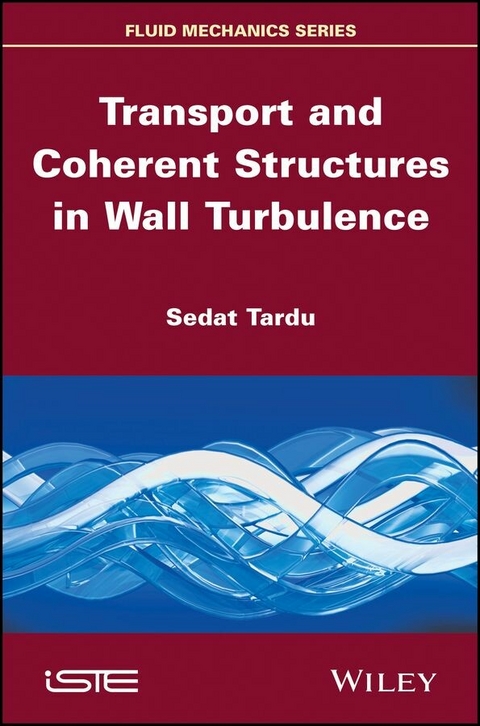
Transport and Coherent Structures in Wall Turbulence (eBook)
John Wiley & Sons (Verlag)
978-1-118-57681-6 (ISBN)
Wall bounded turbulent flows are of major importance in industrial and environmental fluid mechanics. The structure of the wall turbulence is intrinsically related to the coherent structures that play a fundamental role in the transport process. The comprehension of their regeneration mechanism is indispensable for the development of efficient strategies in terms of drag control and near wall turbulence management. This book provides an up-to-date overview on the progress made in this specific area in recent years.
Sedat TARDU is Associate Professor at Grenoble University in France where he teaches turbulent shear flows, heat transfer, fluid dynamics and chaos. His research area includes canonical and non-canonical wall turbulence, active and passive control of near-wall turbulence, unsteady wall layers, mixing and micro mixing and microfluidics. He has been a visiting researcher in several universities (Ecole Polytechnique Fédérale de Lausanne, Imperial College London, Beihang Un. Beijing). He is the author of more than 250 papers in peer-reviewed journals, and international conferences as well as several chapters in books.
Wall bounded turbulent flows are of major importance in industrial and environmental fluid mechanics. The structure of the wall turbulence is intrinsically related to the coherent structures that play a fundamental role in the transport process. The comprehension of their regeneration mechanism is indispensable for the development of efficient strategies in terms of drag control and near wall turbulence management. This book provides an up-to-date overview on the progress made in this specific area in recent years.
Sedat TARDU is Associate Professor at Grenoble University in France where he teaches turbulent shear flows, heat transfer, fluid dynamics and chaos. His research area includes canonical and non-canonical wall turbulence, active and passive control of near-wall turbulence, unsteady wall layers, mixing and micro mixing and microfluidics. He has been a visiting researcher in several universities (Ecole Polytechnique Fédérale de Lausanne, Imperial College London, Beihang Un. Beijing). He is the author of more than 250 papers in peer-reviewed journals, and international conferences as well as several chapters in books.
Chapter 1: Introduction and basic concepts
Chapter 2: Transport in wall bounded turbulent flows (Reynolds shear stress transport equations, rapid and slow terms, pressure fluctuations)
Chapter 3: Dissipation (Kolmogoroff scale distribution near the wall; Modeling dissipation in the inner layer; Zero-crossings and Liepmann scale.
Chapter 4: Closures (one and multi point closures in wall bounded turbulent flows)
Chapter 5: Wall coherent structures and their detection (historical outline of the discovery of wall coherence, streaks, quasi-streamwise vortices, one point detection (VITA, u, modified u-level and quadrant analysis, conditional averaging, Q2 and Lambda2 techniques).
Chapter 6: Genesis of coherent wall structures (streak instability, regeneration of wall quasi-streamwise vortices, self-sustaining mechanism, quasi-deterministic approach)
Chapter 7: Packets and very large structures (regeneration of packets of quasi-streamwise vortices and their amalgamation into very large outer structures; their comprehension and dynamical impact on the wall turbulence).
Chapter 8: Dynamical system approach to wall turbulence (proper orthogonal decomposition, low order wall models, chaotic synchronization with impact to wall turbulence control).
| Erscheint lt. Verlag | 10.9.2014 |
|---|---|
| Sprache | englisch |
| Themenwelt | Naturwissenschaften ► Physik / Astronomie ► Strömungsmechanik |
| Technik ► Bauwesen | |
| Schlagworte | Bauingenieur- u. Bauwesen • Bauphysik • Civil Engineering & Construction • coherent wall structures • Constructional Physics • Dissipation • near wall closures • quasi-deterministic approach • regeneration of wall quasi-streamwise vortices • Sedat Tardu • self-sustaining mechanism • streak instability • Transport and Coherent Structures in Wall Turbulence • Wall bounded turbulent flows • wall coherent structures and their one and multi-point detection |
| ISBN-10 | 1-118-57681-0 / 1118576810 |
| ISBN-13 | 978-1-118-57681-6 / 9781118576816 |
| Informationen gemäß Produktsicherheitsverordnung (GPSR) | |
| Haben Sie eine Frage zum Produkt? |
 PDF (Adobe DRM)
Kopierschutz: Adobe-DRM
Adobe-DRM ist ein Kopierschutz, der das eBook vor Mißbrauch schützen soll. Dabei wird das eBook bereits beim Download auf Ihre persönliche Adobe-ID autorisiert. Lesen können Sie das eBook dann nur auf den Geräten, welche ebenfalls auf Ihre Adobe-ID registriert sind.
Details zum Adobe-DRM
Dateiformat: PDF (Portable Document Format)
Mit einem festen Seitenlayout eignet sich die PDF besonders für Fachbücher mit Spalten, Tabellen und Abbildungen. Eine PDF kann auf fast allen Geräten angezeigt werden, ist aber für kleine Displays (Smartphone, eReader) nur eingeschränkt geeignet.
Systemvoraussetzungen:
PC/Mac: Mit einem PC oder Mac können Sie dieses eBook lesen. Sie benötigen eine
eReader: Dieses eBook kann mit (fast) allen eBook-Readern gelesen werden. Mit dem amazon-Kindle ist es aber nicht kompatibel.
Smartphone/Tablet: Egal ob Apple oder Android, dieses eBook können Sie lesen. Sie benötigen eine
Geräteliste und zusätzliche Hinweise
Buying eBooks from abroad
For tax law reasons we can sell eBooks just within Germany and Switzerland. Regrettably we cannot fulfill eBook-orders from other countries.
aus dem Bereich