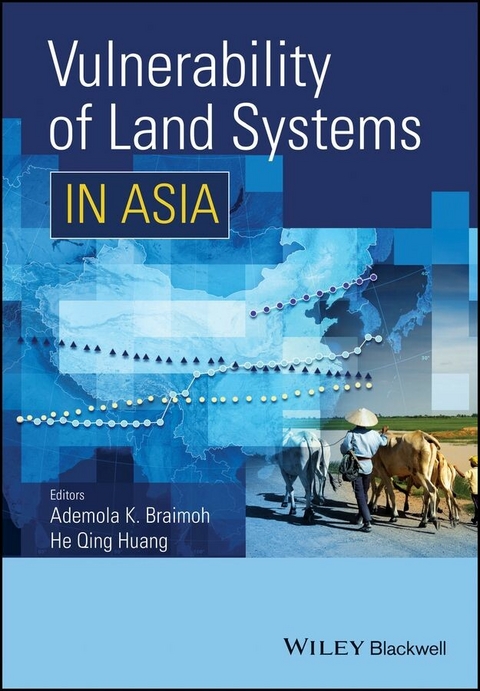
Vulnerability of Land Systems in Asia (eBook)
John Wiley & Sons (Verlag)
978-1-118-85491-4 (ISBN)
• Addresses the complex issues arising from human–environment interactions that cannot be satisfactorily dealt with by core disciplinary methods alone.
• Key coverage of a variety of topics from the vulnerability of smallholder agriculture and urban systems to the impact of socioeconomic processes at the sub-regional level.
• Coverage of the causal processes that affect land systems vulnerability and capacity to cope with different perturbations are documented.
• Focus on integrating vulnerability assessment into policies and decision-making
• Includes contributions from leading academics in the field.
Dr Ademola K. Braimoh
Senior Natural Resources Management Specialist, The World Bank
Prof. He Qing Huang
Institute of Geographic Sciences and Natural Resources Research, Chinese Academy of Sciences
This book provides a comprehensive yet accessible overview of land systems vulnerability assessment in Asia - fundamental to the understanding of the link between global change, environmental sustainability and human wellbeing. The extent and intensity of human interactions with the environment have increased spectacularly since the Industrial Revolution. Thus, the global change research community and development practitioners increasingly recognize the need to address the adverse consequences of changes taking place in the structure and function of the biosphere and the implications for society. With a focus on Asia, this book provides an overview of the vulnerability of land systems and the subsequent multiple stressors in this region. The book offers a discussion surrounding the potential causal processes that affect land systems vulnerability and our capacity to cope with different perturbations. It also identifies factors that help to integrate vulnerability assessment into policy and decision-making. Addresses the complex issues arising from human environment interactions that cannot be satisfactorily dealt with by core disciplinary methods alone. Key coverage of a variety of topics from the vulnerability of smallholder agriculture and urban systems to the impact of socioeconomic processes at the sub-regional level. Coverage of the causal processes that affect land systems vulnerability and capacity to cope with different perturbations are documented. Focus on integrating vulnerability assessment into policies and decision-making Includes contributions from leading academics in the field.
Dr Ademola K. Braimoh Senior Natural Resources Management Specialist, The World Bank Prof. He Qing Huang Institute of Geographic Sciences and Natural Resources Research, Chinese Academy of Sciences
1
Land Systems Vulnerability
Ademola K. Braimoh1 and He Qing Huang2
1 The World Bank, Washington DC, USA
2 Institute of Geographic Science and Natural Resources Research, Chinese Academy of Sciences, Beijing, China
1.1 Introduction
Land-change science is an interdisciplinary field that seeks to understand the dynamics of the land system as a coupled human-environment system (CHES). A CHES is one in which the societal and biophysical subsystems of the land system are so intertwined that the system's condition, function, and responses to a perturbation depend on the synergy of the two subsystems (Turner et al., 2010). Although humans have interacted with their biophysical environment since the beginning of human history, the extent and intensity of these interactions have increased spectacularly since the Industrial Revolution (Liu et al., 2007; Steffen et al., 2004). Therefore, the global change research community and development practitioners increasingly recognize the need to address the adverse consequences of changes taking place in the structure and function of the biosphere and the implications for human wellbeing (IPCC, 2007). Assessing land system dynamics requires detailed analysis of processes operating at different spatial and temporal scales, and the interactions between different drivers including policy shifts that often lead to emergent properties and nonlinear outcomes (Dearing et al., 2010). As it becomes more obvious that, in future, human societies will be exposed to multiple interacting stressors, emphases on the means to understand and manage land systems are becoming stronger (Global Land Project, 2005; Turner et al., 2007).
Land system vulnerability assessment is fundamental to the understanding of the link between global change, environmental sustainability and human wellbeing (Braimoh & Osaki, 2010; Leichenko & O'Brien 2008; Turner et al., 2007). While the world faces up to the realities of a changing climate, coping with its adverse consequences constitutes an additional challenge to socioeconomic development. It is predicted that by 2050, agricultural production will need to increase by 60% to feed the world's population of over 9 billion people (Food and Agriculture Organization, 2012), whereas the accelerating pace of climate change is a further challenge to meeting the food security needs of the increasing population. Global surface temperatures have increased by 0.8°C since the late 19th century, with an average rate of increase of 0.15°C per decade since 1975 (IPCC, 2007). The Earth's mean temperature is projected to increase by 1.5–5.8°C during the 21st century (IPCC, 2001). Future global warming will exacerbate hydrologic scarcity and variability such that crops will have to grow in hotter and drier conditions. Higher temperatures and shorter growing seasons will reduce the yields of most food crops, and promote the spread of weeds and pests. Changes in precipitation patterns will also increase the likelihood of short-run crop failures and long-run productivity decline. Although there will be productivity gains in some crops in certain regions of the world, the overall impact of climate change on agriculture is expected to be negative, threatening global food security (Nelson et al., 2009).
There is an urgent need to initiate measures that reduce vulnerability and increase the resilience of the CHES to climate change and other stressors. A recent study shows that between 2010 and 2050 the cost of adapting to a 2°C warmer world ranges between $75 billion and $100 billion per year, an amount equivalent to the Overseas Development Assistance received by the developing countries (World Bank, 2010b). Countries urgently need to shift development patterns or manage environmental resources in a manner that accounts for the potential impacts of global change.
Land system vulnerability assessment is fundamental to these issues. It identifies the consequences of interacting natural and socioeconomic stressors on exposed human groups and provides strategies for reducing exposure and sensitivity, whilst increasing adaptability to change. It answers questions such as how is the land system vulnerable to a given stressor, what is the level of vulnerability of different social groups, how are the changes induced by stressors alleviated by different conditions, what is the quality of coping capacity linked to different stressors, how do vulnerabilities of different places compare, and to what extent do vulnerable ecosystems produce vulnerable human conditions and vice-versa (Brooks et al., 2005; Eakin & Luers, 2006; Leary et al., 2008; Polsky et al., 2007). Assessment of land system vulnerability requires approaches that treat the coupling of the land system as a human-environment system explicitly (Dearing et al., 2010; Turner, 2010). Such integrated studies of coupled human-environment systems help to reveal new and complex patterns and processes not evident when studied by social or natural scientists separately (Liu et al., 2007), deal with tradeoffs within and between the human and environmental subsystems (Braimoh et al. 2009; Carpenter et al. 2008; Rodriguez et al., 2006), and facilitate the design of effective policies for ecological and socioeconomic sustainability (Braimoh & Huang, 2009; Tallis et al., 2009).
Close to two-thirds of Asia's 4 billion people live in rural areas and depend on natural resources for their livelihood. The Asian continent is physiographically diverse – its northern part is located in the boreal climatic zone, the west and central part is predominantly arid, part of the eastern region is characterized by temperate rainforest, and the south is notably rich in agrobiodiversity, whereas the southeast is typified by tropical rainforests and monsoon climates with high rainfall (Galloway & Melillo, 1998; IPCC, 2007). Since the 1990s, Asia has witnessed impressive economic growth accompanied by diverse environmental management problems. Population growth and socioeconomic activities are important drivers of demand for ecosystem services, whereas climate change has adversely affected food and water security of the growing populace. Future climate change is predicted to profoundly affect agriculture, exacerbate water resource scarcity, and increase the threats to biodiversity as it compounds the pressure on ecosystem resources associated with urbanization and economic growth (Braimoh et al., 2010; IPCC, 2007; World Bank, 2010a).
1.2 Overview of the book
This book integrates knowledge of the vulnerability of land systems to multiple stressors in Asia. It seeks to improve knowledge of the causal processes that affect land systems' vulnerability and capacity to cope with different perturbations. It also identifies factors that can help in integrating vulnerability assessment into policies and decision-making with the hope that countries with similar environmental conditions can learn from the Asian experience. The book is divided into three sections, namely ‘Hazards and Vulnerability’, ‘Modeling and Impact Assessment’, and ‘Institutions’. The studies on hazards and vulnerability were carried out in the deserts of Mongolia and China, Rajasthan in India, and Kazakhstan, where changes in climate variability, ecosystem dynamics and social factors are interacting in remarkable ways to influence land-use systems and livelihood.
In Chapter 2, Sternberg shows that contrary to the prevailing concept of drought influencing severe winters, there are no connections between the two hazards. Rather, the major long-term correlation of drought is with human populations and their adaptation strategies. Public support in the form of risk management strategies should therefore take cognizance of the decoupling of extreme winters from droughts. This will improve the coping capacity of nomads in these arid environments. In Chapters 3 and 4, Ojima et al. show that the vulnerability of Mongolian rangelands to climate and land-use changes has increased since the transition to a market economy. To ensure a viable land-use system, adaptation options should include, among others, the development of cultural landscape restoration that incorporates community-based conservation and sustainable use of natural resources. In Chapter 5, Liu et al. construct a vulnerability profile for Middle Inner Mongolia by integrating biophysical and social datasets. The uneven development of the region is clearly reflected in the overall vulnerability across the landscape, but also indicates that irrespective of exposure to perturbations, actions that increase adaptive capacity at the local level can significantly mitigate vulnerability. In Chapter 6, Singh and Kumar's study highlights the importance of traditional water harvesting and appropriate tillage techniques for climate change adaptation in an area profoundly affected by wind erosion in India. In Chapter 7, Winchester et al. combine dendrogeomorphological techniques and sedimentological analysis with archival records to date debris flows in the Bolshaa Almatinka basin and Ozernaya valley floor in Kazakhstan....
| Erscheint lt. Verlag | 12.9.2014 |
|---|---|
| Sprache | englisch |
| Themenwelt | Naturwissenschaften ► Biologie ► Ökologie / Naturschutz |
| Naturwissenschaften ► Geowissenschaften | |
| Technik ► Umwelttechnik / Biotechnologie | |
| Schlagworte | accessible overview • adverse • asia fundamental • Asien • Assessment • Book • Change • changes • Community • Environment • Environmental Science • Environmental Studies • Global • Human • Industrial • intensity • Interactions • Land • Research • Revolution • spectacularly • systems vulnerability • Umweltforschung • Umweltwissenschaften • Understanding |
| ISBN-10 | 1-118-85491-8 / 1118854918 |
| ISBN-13 | 978-1-118-85491-4 / 9781118854914 |
| Informationen gemäß Produktsicherheitsverordnung (GPSR) | |
| Haben Sie eine Frage zum Produkt? |
 EPUB (Adobe DRM)
Kopierschutz: Adobe-DRM
Adobe-DRM ist ein Kopierschutz, der das eBook vor Mißbrauch schützen soll. Dabei wird das eBook bereits beim Download auf Ihre persönliche Adobe-ID autorisiert. Lesen können Sie das eBook dann nur auf den Geräten, welche ebenfalls auf Ihre Adobe-ID registriert sind.
Details zum Adobe-DRM
Dateiformat: EPUB (Electronic Publication)
EPUB ist ein offener Standard für eBooks und eignet sich besonders zur Darstellung von Belletristik und Sachbüchern. Der Fließtext wird dynamisch an die Display- und Schriftgröße angepasst. Auch für mobile Lesegeräte ist EPUB daher gut geeignet.
Systemvoraussetzungen:
PC/Mac: Mit einem PC oder Mac können Sie dieses eBook lesen. Sie benötigen eine
eReader: Dieses eBook kann mit (fast) allen eBook-Readern gelesen werden. Mit dem amazon-Kindle ist es aber nicht kompatibel.
Smartphone/Tablet: Egal ob Apple oder Android, dieses eBook können Sie lesen. Sie benötigen eine
Geräteliste und zusätzliche Hinweise
Buying eBooks from abroad
For tax law reasons we can sell eBooks just within Germany and Switzerland. Regrettably we cannot fulfill eBook-orders from other countries.
aus dem Bereich