


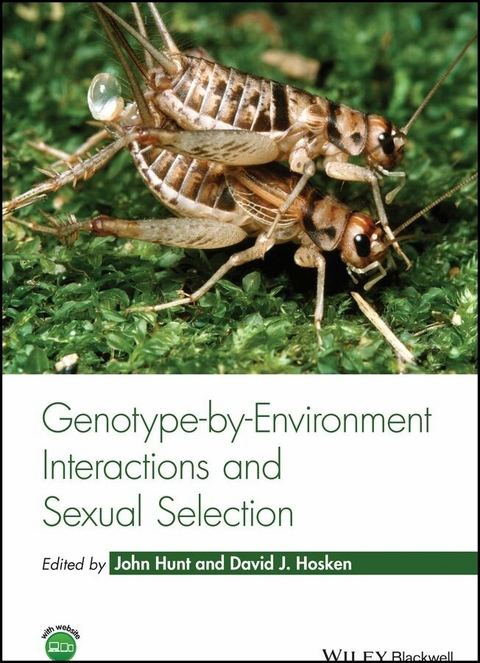
Genotype-by-Environment Interactions and Sexual Selection (eBook)
John Wiley & Sons (Verlag)
978-1-118-91262-1 (ISBN)
Sexual selection is recognized as being responsible for some of the most extravagant morphologies and behaviors in the natural world, as well as a driver of some of the most rapid evolution. While Charles Darwin’s theory is now a fundamental component of modern evolutionary biology, the impact of genotype-by-environment interactions on sexual selection has thus far received little attention.
This book represents the first comprehensive analysis of the role genotype-by-environment interactions play in sexual selection and the potential implications that they have for the evolutionary process. The Editors have identified 13 topics that currently define the field and shed light on the impacts of these interactions on sexual selection. This includes key topics, such as resolving the lek paradox and how genotype-by-environmental interactions can compromise the honesty of sexual signals. The volume also outlines key questions that remain unanswered and provides a comprehensive guide to analyzing genotype-by-environment interactions.
The mix of theory, empirical studies, and practical instructions from world leading experts make this book a particularly potent and definitive guide on the topic. It will be of interest to evolutionary biologists, spanning from genomicists to behaviorists.
“This is a very timely book, covering a topic that should change the way we think about sexual selection. The contributors are all leaders and the topics should provide guidance to many PhD projects in the years to come. GEI is increasingly shown to be important, and it seems likely that it is critical in species where sexual selection is operating. This book is likely to help revitalize the study of sexual selection.” Professor Allen Moore, The University of Georgia
“GEIs fascinate evolutionary biologists, but the unique consequences for sexually selected traits have been neglected - until now. This multi-authored book comprehensively explains key theoretical concepts, handles practical ‘how to’ issues and uses classic case studies to illustrate the value of studying GEIs. It is a must read for everyone interested in sexual selection.” Professor Michael Jennions, The Australian National University
John Hunt is a Royal Society Research Fellow and Associate Professor in the Centre for Ecology and Conservation at the University of Exeter.
David J. Hosken is a Professor in the Centre for Ecology and Conservation at the University of Exeter.
John Hunt is a Royal Society Research Fellow and Associate Professor in the Centre for Ecology and Conservation at the University of Exeter. David J. Hosken is a Professor in the Centre for Ecology and Conservation at the University of Exeter.
List of Contributors xiii
Preface xv
About the Companion Website xix
Part I INTRODUCTION AND THEORETICAL CONCEPTS 1
1 Genotype-by-Environment Interactions and Sexual Selection:
Female Choice in a Complex World 3
Michael J. Wade
2 GEIs when Information Transfer is Uncertain or Incomplete
19
Thomas Getty
3 Local Adaptation and the Evolution of Female Choice 41
Luke Holman and Hanna Kokko
4 Genotype-by-Environment Interactions when the Social
Environment Contains Genes 63
Jason B. Wolf, Nick J. Royle, and John Hunt
Part II PRACTICAL ISSUES FOR MEASURING GEIs 99
5 Quantifying Genotype-by-Environment Interactions in Laboratory
Systems 101
Derek A. Roff and Alastair J. Wilson
6 Influence of the Environment on the Genetic Architecture of
Traits Involved in Sexual Selection within Wild Populations
137
Matthew R. Robinson and Anna Qvarnström
7 From Genotype × Environment to Transcriptome ×
Environment: Identifying and Understanding Environmental Influences
in the Gene Expression Underlying Sexually Selected Traits
169
Jennifer C. Perry and Judith E. Mank
Part III EMPIRICAL STUDIES ON GEIs AND SEXUAL SELECTION
189
8 Phenotypic Plasticity and Genotype × Environment
Interactions in Animal Communication 191
Michael D. Greenfield
9 The Use of Inbreeding to Assess the Genetic Component of
Condition Underlying GEIs in Sexual Traits 213
Lawrence Bellamy, Kevin Fowler, and Andrew Pomiankowski
10 Genotype-by-Environment Interactions and Reliable Signaling
of Male Quality in Bank Voles 241
Suzanne C. Mills, Mikael Mokkonen, Esa Koskela, and Tapio
Mappes
11 Sexual Selection and Genotype-by-Environment Interactions in
Drosophila Cuticular Hydrocarbons 265
Fiona C. Ingleby, David J. Hosken, and John Hunt
12 Genotype-by-Environment Interactions and Sexual Selection in
Guppies 282
Gita R. Kolluru
13 Signal Reliability, Sex-Specific Genotype-by-Environment
Interactions in Cuticular Hydrocarbon Expression, and the
Maintenance of Polyandry through Chemosensory Self-Referencing in
Decorated Crickets, Gryllodes sigillatus 312
Scott K. Sakaluk, Carie Weddle, and John Hunt
Conclusions and Final Thoughts 331
Index 335
Preface
Much of the early history of evolutionary genetics was focused on understanding the relative contribution of genes and the environment to observed levels of phenotypic variation. Chief in this pursuit was Ronald A. Fisher who, amongst his many achievements, developed a statistical framework for partitioning these sources of phenotypic variance in a population. Underlying this framework was the idea that genetic and environmental sources of phenotypic variance in a population could be summed as long as they act independently, providing a simple method to statistically partition the relative effects of these sources of variation in phenotype. This logic is easy to follow if (as Fisher believed) the environment has negligible effects on phenotype and is distributed at random across individuals (and genotypes) in the population. Other researchers at the time (led most notably by Lancelot T. Hogben), however, argued that this framework under-estimated the importance of the environment and also missed a third and important source of phenotypic variation: that which arises from the combination of a particular genetic constitution with a particular kind of environment. Nowadays, we refer to this differential response of genotypes to environmental variation as genotype-by-environment interactions (GEIs) and know that this source of phenotypic variance is almost ubiquitous in most animal and plant populations.
Unfortunately, most researchers in the early part of the twentieth century viewed GEIs as an annoying departure from Fisher's additive framework. This view was particularly evident in agricultural genetics where the presence of GEIs often meant that a good genotype (or crop variety) in one environment may perform poorly in another environment. In such instances, the predictive power of genotypes across environments is greatly reduced, which has obvious consequences for the efficiency of selective breeding programs. It was not until the mid-1980s, however, that the explicit role of GEIs in the evolutionary process was considered. GEIs are now known to play a key role in a number of different evolutionary processes including the maintenance of genetic variation, driving population divergence and speciation, as well as directing the evolutionary response of phenotypes to changing environments.
Over the last decade or so, researchers have started examining the more specific role of GEIs in sexual selection. There is little question that females preferentially mate with some males in the population but exactly why females are choosing these males is more debatable. “Good genes” models of sexual selection have featured prominently in this debate and assume that females prefer males of high genetic quality to gain genetic benefits for their offspring via enhanced viability. The problem with this logic, however, is that a female can only assess a male's phenotype not his genotype. In an ideal world where a male's phenotype maps perfectly onto his genotype, preferentially mating with a male of high genetic quality should be relatively easy for a female to achieve: choose the male with the most elaborate sexual trait or most vigorous sexual display that reliably reflects his underlying genetic quality. However, if the expression of these sexual traits or displays is heavily influenced by GEIs and males disperse freely between environments, the genotype-phenotype map will be considerable weakened making it difficult (if not impossible) for females to assess male genetic quality based on these traits. The operation of sexual selection will be further complicated if GEIs also exist for female mate choice, as appears the case for the few systems where this has been examined. Collectively, this suggests that “good genes” arguments are likely to be overly simplistic when GEIs are present and may go some way to explaining why their effects (although taxonomically widespread) appear to be relatively minor.
Although there is currently an explosion of theoretical and empirical research on the role of GEIs in sexual selection, no single volume has attempted to compile this work or highlight the key findings in this area. Our goal was therefore to produce a volume that provides a clear overview of the importance of GEIs to sexual selection. As many of the leading researchers working on this topic have contributed to this volume, we hope that it will serve as both a primer on the role of GEIs in sexual selection and a guide to help direct future research. We believe this book will be of broad interest to established researchers working on sexual selection, as well as undergraduate and postgraduate students starting their research careers.
We have divided the book into three main sections that we believe cover the key developments on the role of GEIs in sexual selection. Part 1 lays the theoretical foundations outlining the importance of GEIs for sexual selection. Mike Wade (Chapter 1) starts with a general overview of the many problems with “good-genes” models of sexual selection when male genetic quality is correctly viewed as a complex trait that is influenced by GEIs, interactions between genes, as well genes provided by the social environment. Next, Thomas Getty (Chapter 2) examines the role of uncertainty and incomplete information transfer using a simple optimality model that focusses on female choosiness when searching for mates is costly and males of different genotypes are only partially discriminable (due to crossover GEIs and dispersal between environments). Following a similar theme, Luke Holman and Hanna Kokko (Chapter 3) use a genetically explicit individual-based simulation to examine how dispersal, signal reliability and spatial variation affect the evolution of female mate choice for locally adapted genes. Importantly, this simulation does not vary the form of GEIs (whether there is crossover or no crossover) directly. Rather dispersal is varied across a continuous distribution of environments with locally varying phenotypic optima so that dispersing individuals experience weaker correspondence between environmental conditions at their natal and their breeding sites the further they disperse. They then extend this logic to ask how spatial variation creates differences in local adaptation, and whether female choice can persist when females encounter males from diverse natal environments. Finally, building on some of the key ideas introduced by Mike Wade (Chapter 1), Jason Wolf, Nick Royle, and John Hunt (Chapter 4) use a series of quantitative genetic models to examine how genotype by social environment interactions (GSEIs) influence the operation of sexual selection, when the social environment contains genes. They also provide a guide to measuring GSEIs, as well as an overview of empirical studies measuring this process within the context of sexual selection.
A necessary (and critical) first step for empiricists examining the role of GEIs in sexual selection is to formally demonstrate their existence and quantify their strength. Section 2 therefore provides an overview of the experimental and statistical approaches that can be used to quantify GEIs. Derek Roff and Alastair Wilson (Chapter 5) start by providing an overview of the breeding and statistical methods used to estimate GEIs in laboratory studies where the pedigree structure of the organism being studied is under the control of the experimenter. Matthew Robinson and Anna Qvarnström (Chapter 6) then extend this framework by providing an overview of the numerous of statistical approaches that can be used to quantify GEIs in natural populations when pedigree structure is not controlled by the experimenter. Finally, Jennifer Perry and Judith Mank (Chapter 7) review the application of gene expression approaches to understanding GEIs in sexually selected traits. They place particular emphasis on recent transcriptomic methods and outline some of the methodological concerns with this approach, as well as ways to optimize experimental designs to detect transcriptome by environment interactions (TEIs).
In Part 3 we provide an overview of empirical studies examining the role of GEIs in sexual selection. To start, Michael Greenfield (Chapter 8) provides an overview of his research on GEIs and sexual selection in the lesser waxmoth (Achroia grisella). This chapter represents the culmination of over a decade worth of empirical research on the topic and therefore represents one of the best studied systems on how GEIs influence the operation of sexual selection. Next Lawrence Bellamy, Kevin Fowler, and Andrew Pomiankowski (Chapter 9) discuss the potential use of inbreeding to assess GEIs in sexual traits. Inbreeding offers a moderately simple but powerful way to alter the genetic quality of individuals and demonstrating inbreeding by environment interactions (IEIs) is therefore functionally equivalent to GEIs. Reviewing the literature, they then show that sexual traits show clear inbreeding depression but this does not appear any greater than for nonsexual traits and there is little evidence suggesting that inbreeding reveals GEIs. This undoubtedly reflects the current lack of empirical tests. Suzanne Mills, Mikael Mokkonen, Esa Koskela, and Tapio Mappes (Chapter 10) provide an overview of their research on GEIs and signal reliability in bank voles (Myodes glareolus). A variety of male signals exhibit GEIs in this species, challenging signal reliability, and potentially disrupting the covariance between male signal and female preference. Mills and colleagues discuss a number of mechanisms that may help mitigate these problems, including parallel reaction norms for male signal and female preference, assortative dispersal and sexual antagonism....
| Erscheint lt. Verlag | 3.9.2014 |
|---|---|
| Sprache | englisch |
| Themenwelt | Naturwissenschaften ► Biologie ► Evolution |
| Naturwissenschaften ► Biologie ► Genetik / Molekularbiologie | |
| Technik | |
| Schlagworte | Ãkologische Genetik • attention • Behavior & Behavioral Ecology • behaviors • Biowissenschaften • Charles • Component • Darwins theory • Driver • ecological genetics • Evolution • Evolutionary • evolutionary biology • Evolutionsbiologie • Extravagant • fundamental • genotypebyenvironment • Impact • Life Sciences • Little • Modern • morphologies • NATURAL • Ökologische Genetik • recognized • responsible • selection • sexual • Verhalten, Verhaltensökologie • Verhalten, Verhaltensökologie • World |
| ISBN-10 | 1-118-91262-4 / 1118912624 |
| ISBN-13 | 978-1-118-91262-1 / 9781118912621 |
| Informationen gemäß Produktsicherheitsverordnung (GPSR) | |
| Haben Sie eine Frage zum Produkt? |
 EPUB (Adobe DRM)
Kopierschutz: Adobe-DRM
Adobe-DRM ist ein Kopierschutz, der das eBook vor Mißbrauch schützen soll. Dabei wird das eBook bereits beim Download auf Ihre persönliche Adobe-ID autorisiert. Lesen können Sie das eBook dann nur auf den Geräten, welche ebenfalls auf Ihre Adobe-ID registriert sind.
Details zum Adobe-DRM
Dateiformat: EPUB (Electronic Publication)
EPUB ist ein offener Standard für eBooks und eignet sich besonders zur Darstellung von Belletristik und Sachbüchern. Der Fließtext wird dynamisch an die Display- und Schriftgröße angepasst. Auch für mobile Lesegeräte ist EPUB daher gut geeignet.
Systemvoraussetzungen:
PC/Mac: Mit einem PC oder Mac können Sie dieses eBook lesen. Sie benötigen eine
eReader: Dieses eBook kann mit (fast) allen eBook-Readern gelesen werden. Mit dem amazon-Kindle ist es aber nicht kompatibel.
Smartphone/Tablet: Egal ob Apple oder Android, dieses eBook können Sie lesen. Sie benötigen eine
Geräteliste und zusätzliche Hinweise
Buying eBooks from abroad
For tax law reasons we can sell eBooks just within Germany and Switzerland. Regrettably we cannot fulfill eBook-orders from other countries.
aus dem Bereich


