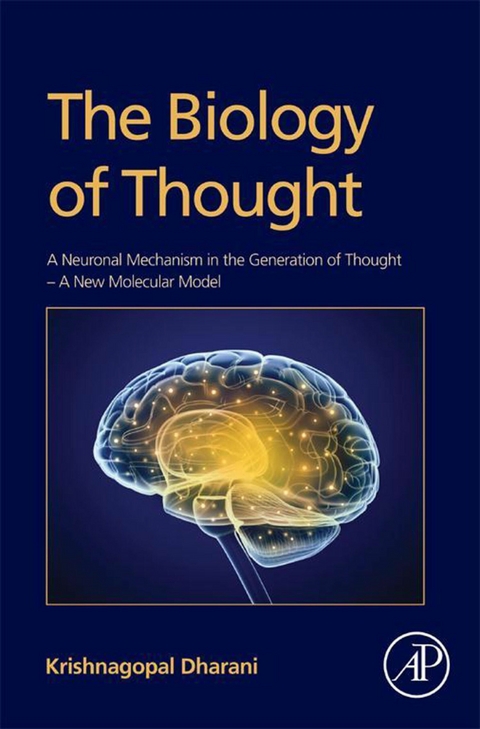
Biology of Thought (eBook)
248 Seiten
Elsevier Science (Verlag)
978-0-12-801161-4 (ISBN)
Dr. Dharani graduated from Kurnool Medical College, Kurnool (Andhra Pradesh) in 1987, and did his Master of Surgery from Kasturba Medical College, Manipal (South Karnataka) in 1992. He completed his Senior Residency in Vascular Surgery from Nizam's Institute of Medical Sciences, Hyderabad (Andhra Pradesh) and is presently working as a Senior Civil Servant in AP Medical Services. He is also a science promotional writer, and has written a locally published book titled 'The Role of Cell Membrane in the Origin of Life. His articles have been published in various Indian Science Journals such as ScienceIndia, Amity College of Biotechnology (Noida), local magazines and others. He can be contacted with queries at kgdharanidr@gmail.com."
The question of "e;what is thought"e; has intrigued society for ages, yet it is still a puzzle how the human brain can produce a myriad of thoughts and can store seemingly endless memories. All we know is that sensations received from the outside world imprint some sort of molecular signatures in neurons - or perhaps synapses - for future retrieval. What are these molecular signatures, and how are they made? How are thoughts generated and stored in neurons? The Biology of Thought explores these issues and proposes a new molecular model that sheds light on the basis of human thought. Step-by-step it describes a new hypothesis for how thought is produced at the micro-level in the brain - right at the neuron. Despite its many advances, the neurobiology field lacks a comprehensive explanation of the fundamental aspects of thought generation at the neuron level, and its relation to intelligence and memory. Derived from existing research in the field, this book attempts to lay biological foundations for this phenomenon through a novel mechanism termed the "e;Molecular-Grid Model"e; that may explain how biological electrochemical events occurring at the neuron interact to generate thoughts. The proposed molecular model is a testable hypothesis that hopes to change the way we understand critical brain function, and provides a starting point for major advances in this field that will be of interest to neuroscientists the world over. - Written to provide a comprehensive coverage of the electro-chemical events that occur at the neuron and how they interact to generate thought- Provides physiology-based chapters (functional anatomy, neuron physiology, memory) and the molecular mechanisms that may shape thought- Contains a thorough description of the process by which neurons convert external stimuli to primary thoughts
Front Cover 1
The Biology of Thought 4
Copyright Page 5
Contents 6
Preface 10
Introduction 12
What is ‘The Biology of Thought’? 12
How is This Book Organized? 13
Authors’ Note: On the Uses of the Molecular-Grid Model 15
Sources and Acknowledgments 18
I. Basic Concepts in Neurobiology 20
1 Functional Anatomy of the Brain 22
Overview 22
General Plan of the Nervous System 22
Anatomical Considerations 22
Types of Neurons 24
Structure of the Brain 28
Cerebral Cortex 28
Lobes of the Brain 29
Cortical Connectivity 33
Cortical Plasticity 35
Cerebral Asymmetry 35
Microscopic Anatomy of Cortex 36
Neuron 36
Neuroglia 37
Structural Types of Neurons 37
Pyramidal Cells 37
Laminar Organization of Cortex 38
Rebirth of Neurons 39
Diencephalon 39
Thalamus 40
Hypothalamus 41
Pituitary Gland 42
Pineal Gland 43
Basal Ganglia 43
Parkinson’s Disease 44
Brainstem 44
Cerebellum 45
Parts of Cerebellum 45
Cerebellar Circuits 46
Spinal Cord 47
Peripheral Nerves 47
Cranial Nerves 48
Spinal Nerves 48
2 Physiology of the Neuron 50
Overview 50
General Plan of Nervous System 50
Physiological Considerations 50
External Stimuli 50
Internal Stimuli 51
Signals That ‘Pass Up’ 51
Interneurons 53
Signals That ‘Pass Down’ 54
Complexity of Connections 54
Mechanism of Neuronal Electrical Activity 54
The Electrical Signal 54
Polarization, Depolarization and Hyperpolarization 55
Types of Ion Channels 57
Action Potentials 58
Graded Potentials 59
Unidirectional Flow of Information 61
Soma 61
Cytoskeleton 61
Dendrites 62
Axon 63
Myelinated Axons 63
Synapse 64
Types of Synapses 65
Signaling Activity of Neurons: A Summary 66
Neurotransmitters 68
A Few Examples of NTs 69
Energetics 71
3 Memory 72
Overview 72
How is Memory Initiated? 73
General Mechanism of Vision 73
Visual Neural Pathways 74
Other Sensations 75
Formation of Memory 76
Sensory Memory 76
Short-Term Memory 77
Working Memory 77
Long-Term Memory 78
Explicit Memory 79
Implicit Memory 81
Mechanism of LTM Formation 81
Outlines of LTM Formation 81
Hippocampus 82
The Papez Circuit 84
Neuronal Basis of Memory 85
Synapses and Neuronal Networks 85
Synaptic Plasticity: The Role of NTs 87
Synaptic Plasticity: The Role of Dendritic Spines 89
Factors Affecting Memory 90
Some Phenomena Related to the Brain 91
Language 91
Sleep and Dreams 92
II. The Molecular-Grid Model 94
4 Primary Thoughts and Ideas 96
Overview 96
Concept of Primary Thought 96
Primary Thought as a Fundamental Unit 97
What Is a Primary Thought? 97
What is an Idea? 98
Characteristics of Primary Thoughts 99
Characteristics of Ideas 100
Examples of Primary Thoughts and Ideas 102
Primary Thoughts and Memory 103
Primary Thoughts and Molecular Gadgets 103
Primary Thought and Memory are Interdependent 103
A Few Examples 104
Sensory Experience is the Same Irrespective of Stimulus 104
Explanation 104
One Interesting Phenomenon is That of Phosphenes 105
Why are There so Many Receptors? 105
We Can Only Sense What our Mind Knows 106
Explanation 106
How Innovative is Human Thought? 107
Explanation 107
The Alien 108
Dreams and Hallucinations 108
Fiction is No More Fiction 109
Primary Thoughts are Inherited 109
Explanation 109
5 The Perceptual Neurons 112
Overview 112
Pathways of Perception 113
Touch Sensation 113
Pain Sensation 115
Perceptual Neurons 117
The Generation of Primary Thoughts 118
Referral Actions 119
Interneurons 120
Simple Ideas and Complex Ideas 121
The Human Sensory Cortex 122
Generation of Simple Ideas and Complex Ideas 122
Information Processing in Other Cortical Areas 124
Locating Perceptual Neurons in the Cortex 125
Transmission of Signals in the Neocortex 125
Level-IV Neurons as Perceptual Neurons 127
6 Dendrites and Primary Thoughts 128
Overview 128
General Outlines 128
Events at Synapses 129
Axodendritic Synapses 129
Events at Axons 131
‘Labeled Line’ Principle 132
Events at Dendrites 132
Dendritic Spines 133
Protein Synthesis and Dendrites 134
Pruning of Dendrites 134
Electrical Activity at Dendrites 134
Where in The Neuron? 136
Refuting ‘The Whole Neuron Concept’ 136
Dendrites Generate Primary Thoughts 137
Conclusion 138
Which Portion of Neuron? 139
The Final Conclusion 141
7 Molecular-Grid Model 142
Overview 142
Cell Membrane 142
Structure of Cell Membrane 143
Selective Permeability 145
Types of Transport 145
Lipid Rafts and Microdomains 146
The Lipid Component 147
The Protein Component 148
Signal Transduction in Neurons 148
Receptors in Neurons 149
Ion Channel-Linked Receptors and Graded Potentials 151
Anatomy of Molecular Grid 152
What is a Molecular Grid? 152
Proofs of Molecular Grids 154
Mechanism of Generation of Primary Thoughts 155
The ‘Thought-Potentials’ 156
What is a Primary Thought? 158
Genetic Basis of Primary Thoughts 159
Molecular Grids as ‘Biological Transistors’ 160
8 Memory, Intelligence and Molecular Grid 162
Overview 162
Memory: A Review 162
Progression of Memory 163
Molecular Mechanism of Memory 164
Formation of Memory Traces 164
Dendrodendritic Synapses 166
The Role of Electrical Synapses 167
Chemical Synapses 168
Storage of Memory and Recall 170
Dendritic Pleats 170
Dendritic Pleats and Progression of Memory 172
Memory Recall 173
Mechanism of Durability of Memory 174
Dendritic Plasticity: Formation of New Memories 175
Protein Synthesis and Memory 175
Evidence for Dendritic Pleats 176
Forgetfulness 176
Intelligence 177
Proteins and Intelligence 178
Lipids and Intelligence 178
Some Weird but Explainable Phenomena 178
Are There Memory Traces at Birth? (Memory Traces sans Memories) 179
Child Prodigy 179
Hallucinations and Déjà vu 180
III. The Evolution of Human Mind 182
9 Mind and Consciousness 184
Overview 184
Evolution of the Human Mind 184
Perception as Awareness 185
Origin of Consciousness and Mind 186
The Human Mind 187
Evolution of the Central Executive 190
The Unique Central Executive! 191
Will and Volition 193
The Will in Plants and Microorganisms 196
Can the Will Be Conquered? 197
The Phenomenon of Reproduction 198
Volition, Memory and Central Executive 198
Memory and Central Executive 199
Evolution of Central Executive 199
Will Versus Volition 201
The Conflict between Will and Volition: The Origin of Emotions 201
When the Will Loses the Battle! 203
The Wine-Glass Analogy! 204
10 Metaphysics of Thought 206
Overview 206
The Problem of the Observed: The Enigma of the External World 207
Determinism 207
Indeterminism 209
The Problem of the Observer: The Paradox of the Human Mind 210
Realism versus Idealism 210
How Dependable are Our Senses? 211
The Paradox of Free Will 213
The Illusion of Free Will (No Free Will) 215
Man, The Super Animal (Free Will Present) 216
Free Will in Animals 216
How is Thought Initiated? 217
A de novo Thought 217
Externally-Induced Thoughts 217
A Third Type of Thought Inducement 218
Who am ‘I’? 218
Neuron as the Observer 219
The Ultimate Paradox 221
A Final Note: Roads to Quantum Consciousness 222
IV. The Computer and the Brain 224
11 Molecular Grids and Computers 226
Overview 226
The Essentials of a Computer 226
Transistors 227
Diodes and Triodes 227
THE Neuron as The Chip 229
‘Bio-electrical Supply’ 230
‘Biological Transistor’ 230
‘Biological Chips’ 231
RAM and STM 231
Input/Output Devices 231
Some Highlights in the Comparison 232
Processing Speed and Memory Capacity 232
Artificial Intelligence: Do Computers Surpass Human Brain? 232
References 234
Glossary 236
Index 240
Introduction
What is ‘The Biology of Thought’?
The human brain is the thinking organ, and neurons are its fundamental units. The myriad thoughts emanating from the magnificent human brain, minute after minute, are the products of the functioning neurons – and therefore we can say that neurons are the thinking machinery of the brain. However, it is still a puzzle how these neurons are designed to produce cascades of thoughts and can store them up in seemingly endless memory – all we know is that the sensations we receive from the outside world leave some sort of molecular signatures inside our brains that are imprinted in some form for future retrieval. What are these molecular signatures, and how are they made? How are these memory traces stored in the neurons? Our present science has no comprehensive answer – not yet.
The question of ‘what is thought’ is almost as ancient as human civilization. Thought is an abstract phenomenon occurring in the human brain. Thoughts underlie all human actions and interactions, and they make up the core of human mind and the background of human consciousness. The idea of ‘thought’ may mean so many different things to each of us. We have thoughts of material things such as flowers and mountains; or we may think of such abstract things such as the beauty of nature, solution to a problem, principle of a theory, etc.; or we have thoughts related to the past or future, and so on. These mental processes are so varied and diverse that it is impossible to group all these thoughts into a single definition. And all these thoughts are complex cerebral events requiring several areas of the brain operating together to produce coherent ideas. However, we are not concerned with such complex thoughts here in this work.
‘Thought’, in this book, means the most fundamental unit of mental processes happening in the brain. This work is concerned with the generation of the most basic unit of thought right at the level of neurons. There is no current theory in modern neuroscience as to how a stimulus from the external world is converted into a perception in the brain. Clearly, the human brain has some mechanism for this conversion. For example, we can perceive the color blue only when we are capable of converting the color blue we receive from the external world into internal thoughts of blue color in the brain. On the other hand, we fail to perceive ultraviolet light (or infrared rays, for that matter) because we do not possess the necessary mechanism to convert the UV light wavelengths into internal signals (as bats and butterflies do). Where is this mechanism located in the neurons? And how does this mechanism function? These questions are left unexplored and unanswered by modern science, and thus have remained a mystery until now.
This book, The Biology of Thought, is about the mechanism by which thought is generated and stored in the human brain. It describes a new molecular model by which thought is generated at the micro level in the human brain – right at the level of neurons. This work demonstrates how the biological electrochemical events occurring at the neuron interact with its molecular mechanisms to generate thoughts. In other words, here we have laid biological foundations for the generation of thought, hence the title of this book, The Biology of Thought. Thus, the hitherto abstract thought is shown to have a solid physical origin in the neuron, and this is showcased in a hypothesis called the ‘Molecular-grid Model’.
How is This Book Organized?
Now we can see that to study such a complex issue as the generation of thought in the brain, the reader must have an overall idea of the anatomical and functional aspects of the brain to assist him/her to fully understand the mechanism. For easy sailing, the book is presented in four parts.
Part I (Basic Concepts in Neurobiology). Part I of the book consists of three chapters which gives us some basic information on the structure of the brain and its functioning. Chapter 1 deals with the general plan of the human nervous system and the anatomy of the brain. Chapter 2 deals with the functioning of neurons – all the complicated electrochemical events occurring in a neuron are discussed in a simple and lucid way so that even a non-physiologist can grasp the electrical properties of neurons. Chapter 3 discusses the phenomenon of memory – the current concepts of the formation of memory along with the molecular basis of its storage are described briefly. Part I is obviously meant for those readers who want to brush up their knowledge on these basic concepts of the brain; however, this discussion may also interest a neuro-academic, because the presentation is a little out of the ordinary, to suit the purpose of the book.
Part II (The Molecular-Grid Model). This part of the book deals with the crux of the problem of the generation of thought by neurons. It consists of five chapters which attempt to answer the following three questions:
1. What is the fundamental unit of thought?
2. Where is it generated in the neurons?
3. How is it generated?
The sensory receptors sense various stimuli from the external world and send them up to the neurons in the brain, where they are converted into perceptions. This initial step generates the most fundamental units of thought in the neurons. Chapter 4 examines these fundamental units of thought (called the ‘primary thoughts’), and describes the properties of these primary thoughts. In Chapter 5 it is shown conclusively that only certain types of sensory neurons are designed to convert the external stimuli into primary thoughts (thus introducing the concept of ‘perceptual neurons’). In Chapter 6 it is shown that neurons have a certain molecular mechanism to receive the external stimuli and convert them into primary thoughts. A scientific discussion is undertaken to study the precise location of these molecular gadgets in the neurons. Chapter 7 examines the structure of these molecular gadgets (now called the molecular grids) and shows how they operate to generate primary thoughts. Chapters 4–7 take all the well-established concepts in neuroscience and show them in a new light, which helps us reach some far-reaching conclusions – and this can finally lead us to the concept of the molecular-grid model.
Having proposed a working model for the generation of thought by the neurons, we should now see how it works – now the molecular-grid model has to pass the acid test. As with any good scientific model, it must be able to explain at least a majority (if not all) of the concerned phenomena, and thus our new model must now explain the most obvious phenomenon of the brain, that is the phenomenon of memory. Therefore, Chapter 8 applies the molecular-grid model to explain the molecular basis of memory and its storage – and alongside, also explains other equally intriguing features of the brain, such as forgetfulness, intelligence, and such others. Part II is the work-book of a theoretical scientist – because it consists of all the new concepts in the field of neuroscience, which can open new vistas in the field of neuroscience.
Throughout Part II, thought is dealt with as an electrochemical process – i.e., a stimulus traveling to the neurons, exciting them electrochemically and generating primary thoughts. But it should be pointed out to the reader that the phenomenon of thought is far more elusive. We have seen, in the preceding chapters, only a physical mechanism by which thoughts are generated, but we have studied nothing about mind and consciousness or about the exact nature of thought itself.
Part III (The Evolution of Human Mind). The human mind is not a single entity but has many varied aspects – such as perceptions, cognition, memory, reasoning, emotions, desires, etc. Likewise, consciousness is also a vague phenomenon. Historically, mind and consciousness have eluded a precise definition, mostly because they cannot be examined by a strict scientific method. Part III consists of two chapters. Chapter 9 engages the reader in a scientific discussion of mind and consciousness, and arrives at important definitions. Alongside, we also examine intriguing aspects of the human mind, like intelligence and emotions.
Chapter 10 treats thought as a metaphysical entity (in contrast to the electrochemical process described in Part II). The ambiguous issues dealt with here are very complex; however, we will deal with them in a stepwise fashion to unravel the mystery of thought, and we approach these philosophical aspects of thought in a strictly scientific manner (or, at least, as strictly as abstract philosophical thought allows). At the end, we will examine the perplexing metaphysical conundrum that has bothered philosophers for ages – the mind-and-matter problem – and see how the molecular grids become relevant in this discussion.
The philosophical presentation in Chapter 10 may appear a little out-of-place to a student of biology, but even a pragmatic biologist who studies human thought dispassionately must be aware of these hard questions to remind him/her of the limitations of human knowledge. And biologists must also realize that there are a lot of loose ends in the fabric of our knowledge in the field of...
| Erscheint lt. Verlag | 28.8.2014 |
|---|---|
| Sprache | englisch |
| Themenwelt | Geisteswissenschaften ► Psychologie ► Allgemeine Psychologie |
| Geisteswissenschaften ► Psychologie ► Verhaltenstherapie | |
| Medizin / Pharmazie ► Medizinische Fachgebiete ► Neurologie | |
| Studium ► 1. Studienabschnitt (Vorklinik) ► Physiologie | |
| Naturwissenschaften ► Biologie | |
| ISBN-10 | 0-12-801161-0 / 0128011610 |
| ISBN-13 | 978-0-12-801161-4 / 9780128011614 |
| Informationen gemäß Produktsicherheitsverordnung (GPSR) | |
| Haben Sie eine Frage zum Produkt? |
 EPUB (Adobe DRM)
Kopierschutz: Adobe-DRM
Adobe-DRM ist ein Kopierschutz, der das eBook vor Mißbrauch schützen soll. Dabei wird das eBook bereits beim Download auf Ihre persönliche Adobe-ID autorisiert. Lesen können Sie das eBook dann nur auf den Geräten, welche ebenfalls auf Ihre Adobe-ID registriert sind.
Details zum Adobe-DRM
Dateiformat: EPUB (Electronic Publication)
EPUB ist ein offener Standard für eBooks und eignet sich besonders zur Darstellung von Belletristik und Sachbüchern. Der Fließtext wird dynamisch an die Display- und Schriftgröße angepasst. Auch für mobile Lesegeräte ist EPUB daher gut geeignet.
Systemvoraussetzungen:
PC/Mac: Mit einem PC oder Mac können Sie dieses eBook lesen. Sie benötigen eine
eReader: Dieses eBook kann mit (fast) allen eBook-Readern gelesen werden. Mit dem amazon-Kindle ist es aber nicht kompatibel.
Smartphone/Tablet: Egal ob Apple oder Android, dieses eBook können Sie lesen. Sie benötigen eine
Geräteliste und zusätzliche Hinweise
Buying eBooks from abroad
For tax law reasons we can sell eBooks just within Germany and Switzerland. Regrettably we cannot fulfill eBook-orders from other countries.
aus dem Bereich