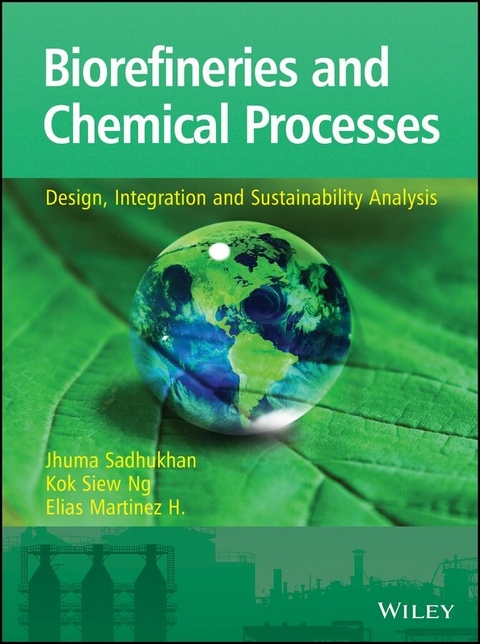
Biorefineries and Chemical Processes (eBook)
1424 Seiten
John Wiley & Sons (Verlag)
978-1-118-69816-7 (ISBN)
As the range of feedstocks, process technologies and products expand, biorefineries will become increasingly complex manufacturing systems. Biorefineries and Chemical Processes: Design, Integration and Sustainability Analysis presents process modelling and integration, and whole system life cycle analysis tools for the synthesis, design, operation and sustainable development of biorefinery and chemical processes.
Topics covered include:
Introduction: An introduction to the concept and development of biorefineries.
Tools: Included here are the methods for detailed economic and environmental impact analyses; combined economic value and environmental impact analysis; life cycle assessment (LCA); multi-criteria analysis; heat integration and utility system design; mathematical programming based optimization and genetic algorithms.
Process synthesis and design: Focuses on modern unit operations and innovative process flowsheets. Discusses thermochemical and biochemical processing of biomass, production of chemicals and polymers from biomass, and processes for carbon dioxide capture.
Biorefinery systems: Presents biorefinery process synthesis using whole system analysis. Discusses bio-oil and algae biorefineries, integrated fuel cells and renewables, and heterogeneous catalytic reactors.
Companion website: Four case studies, additional exercises and examples are available online, together with three supplementary chapters which address waste and emission minimization, energy storage and control systems, and the optimization and reuse of water.
This textbook is designed to bridge a gap between engineering design and sustainability assessment, for advanced students and practicing process designers and engineers.
Jhuma Sadhukhan Centre for Environmental Strategy, University of Surrey, UK
Kok Siew Ng Centre for Process Integration, The University of Manchester, UK
Elias Martinez H. Centre for Environmental Strategy, University of Surrey, UK
As the range of feedstocks, process technologies and products expand, biorefineries will become increasingly complex manufacturing systems. Biorefineries and Chemical Processes: Design, Integration and Sustainability Analysis presents process modelling and integration, and whole system life cycle analysis tools for the synthesis, design, operation and sustainable development of biorefinery and chemical processes. Topics covered include: Introduction: An introduction to the concept and development of biorefineries. Tools: Included here are the methods for detailed economic and environmental impact analyses; combined economic value and environmental impact analysis; life cycle assessment (LCA); multi-criteria analysis; heat integration and utility system design; mathematical programming based optimization and genetic algorithms. Process synthesis and design: Focuses on modern unit operations and innovative process flowsheets. Discusses thermochemical and biochemical processing of biomass, production of chemicals and polymers from biomass, and processes for carbon dioxide capture. Biorefinery systems: Presents biorefinery process synthesis using whole system analysis. Discusses bio-oil and algae biorefineries, integrated fuel cells and renewables, and heterogeneous catalytic reactors. Companion website: Four case studies, additional exercises and examples are available online, together with three supplementary chapters which address waste and emission minimization, energy storage and control systems, and the optimization and reuse of water. This textbook is designed to bridge a gap between engineering design and sustainability assessment, for advanced students and practicing process designers and engineers.
Jhuma Sadhukhan Centre for Environmental Strategy, University of Surrey, UK Kok Siew Ng Centre for Process Integration, The University of Manchester, UK Elias Martinez H. Centre for Environmental Strategy, University of Surrey, UK
"In conclusion, this book introduces the reader to the rapidly-developing industry of biorefineries, with a multi-disciplinary approach. It is a good resource for undergraduate and post-graduate students who want to learn about biorefineries; it can also be valuable for researchers who are looking to practically apply these analytical tools in their work." (Green Process Synth, 4 February 2015)
Preface
Transformation of fossil resources, coal, crude oil and natural gas into useful products was arguably what allowed chemical engineering to emerge as an essential discipline for industrial and socioeconomic development. Fossil derived fuels, petrochemicals and products have decided the lifestyle and comfort of our civilization. Although the life of fossil resources may be extended by the discovery of shale oil and gas reserves, they will always be finite and will continue to get depleted due to the increasing consumption by a growing world population. The chemical engineering discipline continues to evolve, as scientific and engineering fundamentals are discovered for renewable carbon feedstock: biomass and its conversion processes. This evolution is needed not only because the renewable resources are different from the fossil resources but also because of concerns about sustainability of new supply chains and emergence of a bio- and renewable economy. In the same way as traditional chemical engineering helped to create highly efficient and integrated crude oil refineries, the newly evolved discipline will be key to the advancement of more sustainable biorefineries, in order to supply daily life goods and services. Chemical engineering as a result will extend its reach to cross-disciplinary tools from physical, environmental, biological and material sciences, mathematics, economics and social science.
Some of the major questions that the newly evolved discipline needs to respond to include: How can the renewable resources and biomass be effectively used without depleting land, water, mineral and fossil resources? What are the processes to be integrated to economically produce chemicals and energy with least environmental impact? How can the sustainability of a biorefinery system be achieved? Even more importantly, how can chemical engineers be trained to deal with so many complex challenges? This book and the companion website (referred collectively here as textbook) provides modern multidisciplinary tools and methods to equip chemical engineers with analytical and synthesis skills essential for tackling sustainable design challenges. Holistic and integrative approaches enriched with life cycle thinking are presented towards novel and effective solutions to the above questions.
This textbook is intended for educators, postgraduate and final year undergraduate students in chemical engineering, as well as researchers and practitioners in industry. The main feature of this textbook is the presentation of process modeling and integration and whole system life cycle analysis tools for the synthesis, design, operation and sustainable development of biorefinery and chemical processes.
The book has the following structure.
Part I: Introduction
This gives an opening introduction on the concept, development and tools for sustainable design of biorefineries and utilization of biomass. Biomass can be used for the generation of liquid transportation fuels, that is, biofuels; gaseous fuels; chemicals – commodity as well as specialty; and materials – polymers; alongside combined heat and power (CHP) generation. The integration between biomass feedstocks, processes and products results in complex site configurations for biorefineries. Renewable carbon resources are the waste and lignocellulosic materials. Lignocellulose conversion processes into products need to be synthesized using fundamental chemistry, physics and engineering principles and tools. Insights and suggestions for research into cross-disciplinary areas are also given.
Part II: Tools
This section includes the fundamental methods for economic and environmental impact analyses; combined economic value and environmental impact (EVEI) analysis; life cycle assessment (LCA); multicriteria analysis; heat integration and utility system design; value analysis; mathematical programming based optimization and genetic algorithms. These tools can be taught as individual topics as well as part of computer-aided process design subjects.
Chapters 2 to 8 focus on acquiring fundamental engineering skills. Models for estimating the economics of biomass conversion processes and ways to reduce the costs are shown with example problems. Heat integration using pinch analysis, a well-established methodology in process engineering, is shown not only in the traditional form but also with the adaptation for practical and workable solutions. Life cycle assessment (LCA) considers whole system environmental impacts from element and primary energy resource extraction through conversion to end of life (‘cradle to grave’). Following the ISO standards 14040, 14041 and 14044, LCA can be done for the cradle to grave whole system environmental impact analysis, much beyond a chemical plant's boundary. A wide range of biorefinery and energy system LCA problem formulations and solution approaches are shown. Data uncertainty analysis, sensitivity analysis and Monte Carlo simulations, the essential tools in LCA studies to minimize error in estimation, to identify more important indicators, and emission hotspots, and to present results in an accessible and transparent way, are discussed.
Designing a biorefinery according to both economic and environmental objectives is a challenging task due to the wide range of alternatives. In practice, it is essential to be able to prioritize the most promising process pathways for integration into a biorefinery process network. The value analysis approach shown is a powerful tool for differential marginal analysis of process networks. It enables evaluation and graphical presentation of the cost of production (COP), value on processing (VOP) and margins of individual components in a network. Equivalent to COP and VOP, the environmental impact (EI) cost and credit value can be evaluated to analyze the environmental performance of new products and processes quantitatively and select an optimal biorefinery configuration. The EVEI analysis tool gives a fresh perspective to multicriteria analysis.
This section also discusses optimization as a core activity in chemical process design. The linear programming (LP), nonlinear programming (NLP), mixed integer LP (MILP), MINLP and stochastic search methodologies are discussed with example problems. Problem formulations and recognition of the type of algorithm and solution strategy to solve a problem are important. For this, the search techniques need to be understood.
Part III: Process Synthesis and Design
Conventional unit operations face the challenge of slow reactions, lower conversions and purity of desired products when processing lignocellulose as feedstocks. Engineers need to be trained to use a whole range of fundamental tools, such as reaction thermodynamics, reaction engineering, product and process synthesis, unit operations and multiscale simulation, to be able to design products and processes with desired performances. This section gives teaching materials on chemical, polymer, biorefinery and energy systems, reaction engineering and unit operations, synthesis and design subjects.
In this part, biomass based products identified as potential building blocks for chemical synthesis are shown from process synthesis perspectives. Modern process technologies, such as pyrolysis, gasification, catalytic fast pyrolysis, fermentation, crystallization, membrane, membrane filtration, electrodialysis, extraction, reactive extraction, reactive distillation, crystallization and multifunctional catalytic reaction processes, etc., for production of such fuels, chemicals and their subsequent derivatives, are shown alongside design, modeling and simulation frameworks. The exercise problems range from simple flowsheeting through reaction thermodynamic, kinetic and reactor modeling to GHG emission balances and economic analysis. A whole range of biopolymer synthesis processes is discussed from reactor, separator and combined reactor and separator process design, modeling, integration and LCA perspectives. This part also features robust, insightful and accessible process modeling frameworks for CO2 capture by absorption, adsorption, refrigeration and chemical looping combustion processes. Modern, innovative process flowsheets are illustrated. Examples of economic and life cycle assessments are included, where an opportunity arises to reinforce and encourage life cycle and integrative thinking.
Part IV: Biorefinery Systems
The first chapters in this section deal with the synthesis of bio-oil and algae-based biorefineries as well as hybrid systems integrating fuel cells and renewable energy. The last chapter in this section shows material pertaining to various aspects of multiscale modeling of heterogeneously catalyzed reaction systems, taking transesterification and esterification reactions as an example. Modeling of the intrinsic kinetics, multicomponent diffusion coefficients, effective diffusivities and dynamic multiscale simulation framework is shown. This section can be taught as part of several postgraduate and final year undergraduate level courses including design project, computer-aided process design, process synthesis, reaction engineering, biorefinery engineering and sustainability analysis modules.
Part V: Interacting Systems of Biorefineries (available on the companion website)
This looks at minimizing waste and emissions (Web Chapter 1), energy storage systems, materials and process control (Web Chapter 2) and the optimization and reuse of water (Web Chapter 3). The texts give insights into research in these areas. Sustainability of biorefinery systems needs to draw upon the interactions...
| Erscheint lt. Verlag | 25.8.2014 |
|---|---|
| Sprache | englisch |
| Themenwelt | Naturwissenschaften ► Chemie ► Technische Chemie |
| Technik ► Elektrotechnik / Energietechnik | |
| Schlagworte | Analyses • Analysis • Bioraffinerie • Biorefineries • Biorefinery • chemical engineering • Chemie • Chemische Verfahrenstechnik • Chemistry • Complex • Concept • Cycle • Design • Feedstocks • Genetic algorithms • Industrial Chemistry • Integration • Introduction • Life • Manufacturing • Methods • Nachhaltige u. Grüne Chemie • Nachhaltige u. Grüne Chemie • Operation • Process Intensification & Integration • Prozessintensivierung u. -integration • Range • Sustainable Chemistry & Green Chemistry • synthesis • Systems • Technische u. Industrielle Chemie • Tools • Topics • Umweltchemie • whole system |
| ISBN-10 | 1-118-69816-9 / 1118698169 |
| ISBN-13 | 978-1-118-69816-7 / 9781118698167 |
| Informationen gemäß Produktsicherheitsverordnung (GPSR) | |
| Haben Sie eine Frage zum Produkt? |
 EPUB (Adobe DRM)
Kopierschutz: Adobe-DRM
Adobe-DRM ist ein Kopierschutz, der das eBook vor Mißbrauch schützen soll. Dabei wird das eBook bereits beim Download auf Ihre persönliche Adobe-ID autorisiert. Lesen können Sie das eBook dann nur auf den Geräten, welche ebenfalls auf Ihre Adobe-ID registriert sind.
Details zum Adobe-DRM
Dateiformat: EPUB (Electronic Publication)
EPUB ist ein offener Standard für eBooks und eignet sich besonders zur Darstellung von Belletristik und Sachbüchern. Der Fließtext wird dynamisch an die Display- und Schriftgröße angepasst. Auch für mobile Lesegeräte ist EPUB daher gut geeignet.
Systemvoraussetzungen:
PC/Mac: Mit einem PC oder Mac können Sie dieses eBook lesen. Sie benötigen eine
eReader: Dieses eBook kann mit (fast) allen eBook-Readern gelesen werden. Mit dem amazon-Kindle ist es aber nicht kompatibel.
Smartphone/Tablet: Egal ob Apple oder Android, dieses eBook können Sie lesen. Sie benötigen eine
Geräteliste und zusätzliche Hinweise
Buying eBooks from abroad
For tax law reasons we can sell eBooks just within Germany and Switzerland. Regrettably we cannot fulfill eBook-orders from other countries.
aus dem Bereich