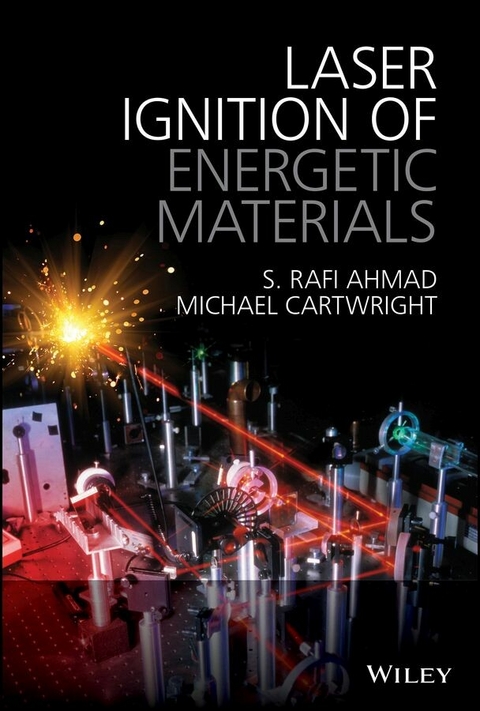
Laser Ignition of Energetic Materials (eBook)
John Wiley & Sons (Verlag)
978-1-118-68350-7 (ISBN)
The book gives an introduction to energetic materials and lasers, properties of such materials and the current methods for initiating energetic materials. The following chapters and sections highlight the properties of lasers, and safety aspects of their application. It covers the properties of in-service energetic materials, and also materials with prospects of being used as insensitive ammunitions in future weapon or missiles systems or as detonators in civilian (mining) applications. Because of the diversity of the topics some sections will naturally separate into different levels of expertise and knowledge.
Dr S Rafi Ahmad founded and led the Centre for Applied Laser Spectroscopy (CALS) within the Department of Applied Science, Security and Resilience, Cranfield University from 1988 to 2013. He has been active for the last 3 decades in managing/supervising many R&D projects and PhD research students in the field of directed laser and applied laser spectroscopy. Dr Ahmad has authored 52 peer-reviewed publications in scientific journals, and co-authored a book with Dr Cartwright. Dr Michael Cartwright works on novel explosive compounds and the design of safer formulations and disposal of time expired and unexploded ordnance. He graduated in Chemistry from London University in the 1960s. His first employment was with the UKAEA at Windscale and Calder Hall establishment examining analytical methods for novel nuclear fuels and processing technologies. He researched on sterilisation methods for the Milton Division of Vick International followed by research in nuclear damage processes in solids and organo-metallic chemistry at the University of Bath before moving to Cranfield University at the Royal Military College of Science in 1986. Dr Cartwright has authored over 80 papers in refereed journals and published conference proceedings, and a co-authored book.
1
Historical Background
1.1 Introduction
Historically, mankind has tried to dominate both fellow human beings and other animals for as long as humans have been around. Some of this domination was achieved by killing other species. This had two aspects; survival and providing food.
Survival was dictated by the fact that many animals regarded humans as excellent sources of food and were quite capable of killing humans. Humans could have two approaches; avoid areas known to contain threatening species or produce devices – weapons – which would enable humans to kill the threatening animals. Humans then developed a taste for the flesh of some of the animals they had killed, thus increasing the sources of food available. As the human population increased, conflict between humans for food and territory increased, and so humans started to fight amongst themselves. By using weapons, humans could overcome physical disadvantages, and the optimum situation was to be able to kill your opponent before they could kill you.
The sword and lance effectively extended the human arm and kept your opponent at bay but, as lances became longer and longer, they became more unwieldy. A remote killing weapon was required. Simple javelins, which could be thrown at the opposition, extended the distance between opponents but required considerable physical stature and skill to achieve the correct flight trajectory for the javelin. Therefore, in order to overcome human physical limitations, mechanical advantage devices were used. The earliest weapons for remote killing were simple slings. These could carry a stone and were capable of accelerating it to high velocity by spinning the sling in a circle. When one of the supporting thongs was released, the stone would travel in an almost straight line from the point of release. Impact of the stone with an animal or human was capable of killing or injuring the animal.
With the development of wood manufacturing skills, bows and arrows became individual weapons or, when grouped together became a lethal hail of arrows which did not depend on the individual accuracy of the archer. The longbow was the ultimate in these weapons. Improved performance came when mankind developed stored energy devices, such as the ballista and crossbows, both of which stored mechanical energy in wooden elements but required winding up before loading the stone or arrow projectile. These overcame the limitations of physical stature required to effectively use the longbow. The ballista, Figure 1.1, was also used to fire barrels of burning oil at the enemy when they had formed shield walls against arrows. The oil container burst on impact and was one of the first deployments of pyrotechnics weapons.
Figure 1.1 Small-scale basic ballista. Reproduced with permission from Cranfield University © 2014.
1.2 The Gunpowder Era
Meanwhile, the Chinese were developing the first chemical explosive gunpowder. The earliest record of this was around 800 AD. Initially, the mixture was for use as a medicine but, as with all good inventions, serendipity intervened and a batch of the medicine fell on to the fire over which it was been cooked; it very rapidly burnt with a flash, smoke and rushing sound. The potential for this was recognized, and the Chinese started to use the mixture as a propellant for their lances/javelins. When attached to the normal throwing spear, these early rockets could extend the useful range of the javelin by as much as a factor of two.
It took about 400 years for the technology to appear in Europe, when a cleric Roger Bacon was credited with discovering the properties of gunpowder. He was so afraid of its properties that he hid the details of the composition in code in religious manuscripts. The recognition of its propellant properties resulted in the manufacture of muzzle-loaded cannons.
An idea of the chronology of the development of the science is given in Table 1.1 on page 3.
Table 1.1 Some significant discoveries in the history of explosives.
| Explosive | Credited to | Nationality | Date |
| Gunpowder | {Anon {R. Bacon | (Probably Chinese) English | Before 1000 c.1246 |
| First battlefield cannon | Italian | c 1326 |
| Crecy bombard | English | 1346 |
| Hand cannon | Italian | c 1364 |
| Leonardo's mortar | Leonardo da Vinci | Italian | c 1483 |
| Mercury fulminate | Kunckel | German | c.1690 |
| Picric acid1 | Woulff | German | 1771 |
| Mercury fulminate percussion cap | Forsyth | Scottish | 1825 |
| Nitrocellulose2 | {Pelouze {Schonbein | French German | 1838 1845 |
| Nitroglycerine | Sobrero | Italian | 1846 |
| TNT | Wilbrand | German | 1863 |
| The fulminate detonator | Nobel | Swedish | 1865 |
| Dynamite | Nobel | Swedish | 1867 |
| Ammonium nitrate mixtures | Ohlsson & Norrbin | Swedish | 1867 |
| Tetryl | Mertens | German | 1877 |
| N.C. propellants3 | {Schultze {Vieille | German French | 1864 1884 |
| Ballistite | Nobel | Swedish | 1883 |
| Cordite | Abel & Dewar | British | 1889 |
| Lead azide | Curtius | German | 1890 |
| PETN | Rheinisch-Westfaelische Sprengstoff A.G | German | 1894 |
| RDX | Henning (patented by Herz) | German German | 1899 1920 |
| NTO | von Manchot and Noll | German | 1905 |
| Tetrazene | Hoffman & Roth | German | 1910 |
| HMX |
| Slurry explosives | Cook | USA | 1957 |
| Emulsion explosives |
| PBX |
1 Explosive properties of Picric acid were not investigated for a further 100 years.
2 Pelouze produced NC but did not understand the chemistry whereas Schonbein correctly identified the chemistry and made some propellant uses.
3 Schultze produced the first successful powdered NC propellants and Vielle was credited with the first NC propellants for rifled barrel guns.
1.3 Cannons, Muskets and Rockets
The barrels of the first cannon systems were simple wooden devices made from hollowed-out tree trunks, which were wrapped with wet ropes for added strength. The development of bronze and cast iron technology led to the production of iron-barrelled guns, such as the Bombard, used at the battle of Crecy in 1346 (shown in Figure 1.2). This weapon used solid projectiles in the form of either suitable stone or cast metal (e.g. iron) spheres. The development of these weapons resulted in the foundation of the Board of Ordinance in 1414. The operators of these weapons were known as Bombardiers – a term still used for an artilleryman with the rank of corporal in the British Army.
In the fifteenth century, cannon were also deployed at sea on warships and these enabled the opposition to be destroyed at distance without needing to engage in hand to hand combat. A number of cannons were deployed along each side of the ship, and a broadside could be loosed at the opposition. Typical cannons are shown in Figure 1.3, which displays a typical army cannon in the foreground and a naval cannon in the background.
Figure 1.2 Crecy bombard 1346. Reproduced with permission from Cranfield University © 2014.
The naval cannon was mounted on a four-wheeled trolley rather than the two wheels of the army. This provided better stability onboard a ship in heavy seas. The iron guns were made of a number of staves, or bars, of iron which were formed into a cylinder around a mandrel. Collars and hoops of wrought iron were heated and slipped over the cylinder. As these cooled, they contracted to form a reinforced tube. Surprisingly, breech-loaded cannon (often regarded as a modern invention, introduced when screw cutting technology was developed during the Industrial Revolution) were available in the early fifteenth century. The early systems used a simple hollow steel tube mounted on a wooden trough, with a space between the end of the metal tube and the end of the wooden support. A closed metal cup containing the propellant charge was then inserted into the gap and rammed into the rear open end of the barrel. The system was then sealed by inserting a wooden plug behind the...
| Erscheint lt. Verlag | 27.8.2014 |
|---|---|
| Sprache | englisch |
| Themenwelt | Naturwissenschaften ► Chemie ► Physikalische Chemie |
| Naturwissenschaften ► Chemie ► Technische Chemie | |
| Technik | |
| Schlagworte | acknowledgements xvii historical background • Authors • Bibliography • Characteristics • Chemie • Chemistry • Container • Definition • Explosives • Industrial Chemistry • Initiation • initiations • Laser • laser irradiation • light • Materials Science • Materialwissenschaften • Physics • Physik • References • Research Bibliography • Review • Science • Strength • Technische u. Industrielle Chemie |
| ISBN-10 | 1-118-68350-1 / 1118683501 |
| ISBN-13 | 978-1-118-68350-7 / 9781118683507 |
| Informationen gemäß Produktsicherheitsverordnung (GPSR) | |
| Haben Sie eine Frage zum Produkt? |
 EPUB (Adobe DRM)
Kopierschutz: Adobe-DRM
Adobe-DRM ist ein Kopierschutz, der das eBook vor Mißbrauch schützen soll. Dabei wird das eBook bereits beim Download auf Ihre persönliche Adobe-ID autorisiert. Lesen können Sie das eBook dann nur auf den Geräten, welche ebenfalls auf Ihre Adobe-ID registriert sind.
Details zum Adobe-DRM
Dateiformat: EPUB (Electronic Publication)
EPUB ist ein offener Standard für eBooks und eignet sich besonders zur Darstellung von Belletristik und Sachbüchern. Der Fließtext wird dynamisch an die Display- und Schriftgröße angepasst. Auch für mobile Lesegeräte ist EPUB daher gut geeignet.
Systemvoraussetzungen:
PC/Mac: Mit einem PC oder Mac können Sie dieses eBook lesen. Sie benötigen eine
eReader: Dieses eBook kann mit (fast) allen eBook-Readern gelesen werden. Mit dem amazon-Kindle ist es aber nicht kompatibel.
Smartphone/Tablet: Egal ob Apple oder Android, dieses eBook können Sie lesen. Sie benötigen eine
Geräteliste und zusätzliche Hinweise
Buying eBooks from abroad
For tax law reasons we can sell eBooks just within Germany and Switzerland. Regrettably we cannot fulfill eBook-orders from other countries.
aus dem Bereich