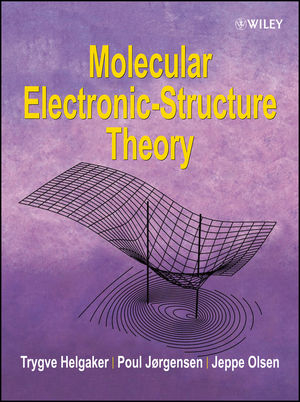
This is the first comprehensive, up-to-date and technical work to cover all the important aspects of modern molecular electronic-structure theory. Topics covered in the book include:
* Second quantization with spin adaptation
* Gaussian basis sets and molecular-integral evaluation
* Hartree-Fock theory
* Configuration-interaction and multi-configurational self-consistent theory
* Coupled-cluster theory for ground and excited states
* Perturbation theory for single- and multi-configurational states
* Linear-scaling techniques and the fast multipole method
* Explicity correlated wave functions
* Basis-set convergence and extrapolation
* Calibration and benchmarking of computational methods, with applications to moelcular equilibrium structure, atomization energies and reaction enthalpies.
Molecular Electronic-Structure Theory makes extensive use of numerical examples, designed to illustrate the strengths and weaknesses of each method treated. In addition, statements about the usefulness and deficiencies of the various methods are supported by actual examples, not just model calculations. Problems and exercises are provided at the end of each chapter, complete with hints and solutions.
This book is a must for researchers in the field of quantum chemistry as well as for nonspecialists who wish to acquire a thorough understanding of ab initio molecular electronic-structure theory and its applications to problems in chemistry and physics. It is also highly recommended for the teaching of graduates and advanced undergraduates.
Trygve Helgaker, Department of Chemistry, University of Oslo, Norway.
Poul Jorgensen and Jeppe Olsen Department of Chemistry, University of Aarhus, Denmark.
Ab initio quantum chemistry has emerged as an important tool in chemical research and is appliced to a wide variety of problems in chemistry and molecular physics. Recent developments of computational methods have enabled previously intractable chemical problems to be solved using rigorous quantum-mechanical methods. This is the first comprehensive, up-to-date and technical work to cover all the important aspects of modern molecular electronic-structure theory. Topics covered in the book include: * Second quantization with spin adaptation * Gaussian basis sets and molecular-integral evaluation * Hartree-Fock theory * Configuration-interaction and multi-configurational self-consistent theory * Coupled-cluster theory for ground and excited states * Perturbation theory for single- and multi-configurational states * Linear-scaling techniques and the fast multipole method * Explicity correlated wave functions * Basis-set convergence and extrapolation * Calibration and benchmarking of computational methods, with applications to moelcular equilibrium structure, atomization energies and reaction enthalpies. Molecular Electronic-Structure Theory makes extensive use of numerical examples, designed to illustrate the strengths and weaknesses of each method treated. In addition, statements about the usefulness and deficiencies of the various methods are supported by actual examples, not just model calculations. Problems and exercises are provided at the end of each chapter, complete with hints and solutions. This book is a must for researchers in the field of quantum chemistry as well as for nonspecialists who wish to acquire a thorough understanding of ab initio molecular electronic-structure theory and its applications to problems in chemistry and physics. It is also highly recommended for the teaching of graduates and advanced undergraduates.
Trygve Helgaker, Department of Chemistry, University of Oslo, Norway. Poul Jorgensen and Jeppe Olsen Department of Chemistry, University of Aarhus, Denmark.
2
SPIN IN SECOND QUANTIZATION
In the formalism of second quantization as presented in the previous chapter, there is no reference to electron spin – the intrinsic angular momentum of the electron. In nonrelativistic theory, many important simplifications follow by taking spin explicitly into account. In the present chapter, we develop the theory of second quantization further so as to allow for an explicit description of electron spin. Although no fundamentally new concepts of the second-quantization formalism are introduced, the results obtained here are essential for an efficient description of molecular electronic systems in the nonrelativistic limit.
2.1 Spin functions
The spin orbitals introduced in Chapter 1 are functions of three continuous spatial coordinates r and one discrete spin coordinate ms. The spin coordinate takes on only two values, representing the two allowed values of the projected spin angular momentum of the electron: . The spin space is accordingly spanned by two functions, which are taken to be the eigenfunctions α(ms) and β(ms) of the projected spin angular-momentum operator
(2.1.1)
(2.1.2)
These spin functions – which we shall generically denote by σ, τ, μ and v – are eigenfunctions of the total-spin angular-momentum operator as well with quantum number s =
(2.1.3)
in accordance with the general theory of angular momentum in quantum mechanics. The functional form of the spin functions is given by the equations
(2.1.4)
(2.1.5)
Completeness of the spin basis leads to the following resolution of the identity
(2.1.6)
as may be verified from relations (2.1.4) and (2.1.5). It should be noted that we have for convenience written the first-quantization spin operators as operating on the spin function of a single electron. The generalization to an N-electron system is simple and requires no comment except to note that, whereas is a true one-electron operator, the operator for the total spin (2.1.3) is a two-electron operator in the sense that it is a linear combination of terms involving two electrons although no physical interactions occur.
We shall occasionally find it convenient to use for the discrete spin functions the same notation as for continuous spatial functions, interpreting integration in spin space as summation over the two discrete values of ms:
(2.1.7)
Thus, we may write the orthonormality conditions of the spin functions in the form
(2.1.8)
Like the resolution of the identity (2.1.6), this relationship is easily verified by reference to (2.1.4) and (2.1.5).
The spin-orbital space is spanned by the direct product of a basis for the orbital space and a basis for the spin space. Thus, a general spin orbital may be written as
(2.1.9)
In nonrelativistic theory, it is common to use spin orbitals of the more restricted form
(2.1.10)
so that a given spin orbital consists of an orbital part multiplied by a spin eigenfunction. This simple product form is acceptable since the nonrelativistic Hamiltonian operator does not involve spin and thus cannot couple the spatial and spin parts of the spin orbitals. We note that spin orbitals (2.1.10) with the same orbital parts but different spins are orthogonal.
We shall in this book use lower-case indices for orbitals, reserving upper-case indices for spin orbitals. For spin orbitals ϕpσ of the form (2.1.10), we shall usually employ a composite index, where the first index p refers to the orbital part and the second index σ to the spin part. The total number of orbitals is denoted by n. Thus, for a basis of n orbitals, there are a total of M = 2n independent spin orbitals of the form (2.1.10). With the necessary elaboration of notation to accommodate composite indices of the spin orbitals, the theory of second quantization presented in Chapter 1 holds unchanged in the product basis (2.1.10). For example, the anticommutator between creation and annihilation operators (1.2.29) now becomes
(2.1.11)
where for example is the creation operator associated with the product spin orbital ϕpσ.
2.2 Operators in the orbital basis
Quantum-mechanical operators may be classified according to how they affect the orbital and spin parts of wave functions. Thus, we classify operators as spin-free or spinless if they work in ordinary space only without affecting the spin part of a function. Conversely, an operator that works in spin space only, without affecting the spatial part of a function, is termed a pure spin operator or simply a spin operator. Finally, an operator is mixed if it affects both the spatial and spin parts of a function. We shall in this section investigate how each of these three classes of operators is represented in second quantization.
2.2.1 SPIN-FREE OPERATORS
Let us first consider one-electron operators. Following the general discussion in Section 1.4.1, a spin-free one-electron operator of the form
(2.2.1)
may in the spin-orbital basis be written as
(2.2.2)
The integrals entering the second-quantization operator vanish for opposite spins since the first-quantization operator fc is spin-free:
(2.2.3)
Here we use the notation
(2.2.4)
for the integrals over spatial coordinates and note that these integrals display the usual Hermitian permutational symmetry:
(2.2.5)
The second-quantization representation of the spin-free one-electron operator (2.2.1) now becomes
(2.2.6)
where we have introduced the singlet excitation operators
(2.2.7)
as a linear combination of the spin-orbital excitation operators of Section 1.3.3. The singlet excitation operator is discussed in detail in Sections 2.3.4 and 2.3.5.
We now turn our attention to spinless two-electron operators. According to the discussion in Section 1.4.2, the second-quantization representation of a general spin-free two-electron operator of the form
(2.2.8)
is given by
(2.2.9)
Most of the terms in this operator vanish because of the orthogonality of the spin functions
(2.2.10)
where we have introduced two-electron integrals in ordinary space
(2.2.11)
Let us consider the permutational symmetries of these integrals. The symmetry
(2.2.12)
follows from the symmetry of the interaction operator in (2.2.8) and is always present in the integrals. The remaining symmetries are different for real and complex orbitals. For complex orbitals, we have the Hermitian symmetry
(2.2.13)
whereas for real orbitals we have the following permutational symmetries
(2.2.14)
For real orbitals, therefore, there are a total of eight permutational symmetries present in the integrals, obtained by combining (2.2.12) with (2.2.14).
Inserting the integrals (2.2.10) in (2.2.9), the second-quantization representation of a spin-free two-electron operator can be written as
(2.2.15)
where for convenience we have introduced the two-electron excitation operator
(2.2.16)
Note the permutational symmetry
(2.2.17)
which follows directly from the last expression in (2.2.16). There are no permutational symmetries analogous to (2.2.14) for the two-electron excitation operator.
We are now in a position to write up the second-quantization representation of the nonrelativistic and spin-free molecular electronic Hamiltonian in the orbital basis:
(2.2.18)
This expression should be compared with the operator in the spin-orbital basis (1.4.39), where each summation index runs over twice the number of orbitals. The one- and two-electron integrals in (2.2.18) are the same as those in (1.4.40) and (1.4.41) except that the integrations are over the spatial coordinates only:
(2.2.19)
(2.2.20)
The scalar nuclear-repulsion term hnuc in (2.2.18) was defined in (1.4.42).
2.2.2 SPIN OPERATORS
We now consider the representation of first-quantization operators fc that work in spin space only. The associated second-quantization operators may be written in the general form
(2.2.21)
Three important examples of pure spin operators are the raising and lowering operators and (also known as the step-up and step-down operators or as the shift operators) and the operator for the z component of the spin angular momentum . From the effect of these operators on the spin functions (again assuming a one-particle state)
(2.2.22)
(2.2.23)
(2.2.24)
we obtain the following matrix elements
(2.2.25)
(2.2.26)
(2.2.27)
using the same notation for the matrix elements as in Section 1.5.2. Inserting the integrals (2.2.25)–(2.2.27) in the operator (2.2.21), we arrive at the following expressions for the basic spin operators:
(2.2.28)
(2.2.29)
(2.2.30)
The second-quantization lowering operator is readily seen to be the Hermitian adjoint of the raising operator:
(2.2.31)
For the operators for the x and y components of the spin angular momentum
(2.2.32)
(2.2.33)
we obtain from (2.2.28) and (2.2.29) the following expressions for their second-quantization...
| Erscheint lt. Verlag | 11.8.2014 |
|---|---|
| Sprache | englisch |
| Themenwelt | Naturwissenschaften ► Chemie ► Physikalische Chemie |
| Technik ► Maschinenbau | |
| Schlagworte | ab initio • atomic and molecular physics • Atom- u. Molekülphysik • Atom- u. Molekülphysik • Chemical • Chemie • Chemistry • Computational • Computational Chemistry & Molecular Modeling • Computational Chemistry u. Molecular Modeling • electronicstructure • first comprehensive • Hartree-Fock-Methode • important • Methods • Molekularelektronik • Physical Chemistry • Physics • Physik • Physikalische Chemie • previously intractable • Problems • Quantenchemie • quantum • quantummechanical • Recent Developments • Research • Rigorous • Tool • variety • wide • Work |
| ISBN-13 | 9781119019558 / 9781119019558 |
| Informationen gemäß Produktsicherheitsverordnung (GPSR) | |
| Haben Sie eine Frage zum Produkt? |
 EPUB (Adobe DRM)
Kopierschutz: Adobe-DRM
Adobe-DRM ist ein Kopierschutz, der das eBook vor Mißbrauch schützen soll. Dabei wird das eBook bereits beim Download auf Ihre persönliche Adobe-ID autorisiert. Lesen können Sie das eBook dann nur auf den Geräten, welche ebenfalls auf Ihre Adobe-ID registriert sind.
Details zum Adobe-DRM
Dateiformat: EPUB (Electronic Publication)
EPUB ist ein offener Standard für eBooks und eignet sich besonders zur Darstellung von Belletristik und Sachbüchern. Der Fließtext wird dynamisch an die Display- und Schriftgröße angepasst. Auch für mobile Lesegeräte ist EPUB daher gut geeignet.
Systemvoraussetzungen:
PC/Mac: Mit einem PC oder Mac können Sie dieses eBook lesen. Sie benötigen eine
eReader: Dieses eBook kann mit (fast) allen eBook-Readern gelesen werden. Mit dem amazon-Kindle ist es aber nicht kompatibel.
Smartphone/Tablet: Egal ob Apple oder Android, dieses eBook können Sie lesen. Sie benötigen eine
Geräteliste und zusätzliche Hinweise
Buying eBooks from abroad
For tax law reasons we can sell eBooks just within Germany and Switzerland. Regrettably we cannot fulfill eBook-orders from other countries.
aus dem Bereich