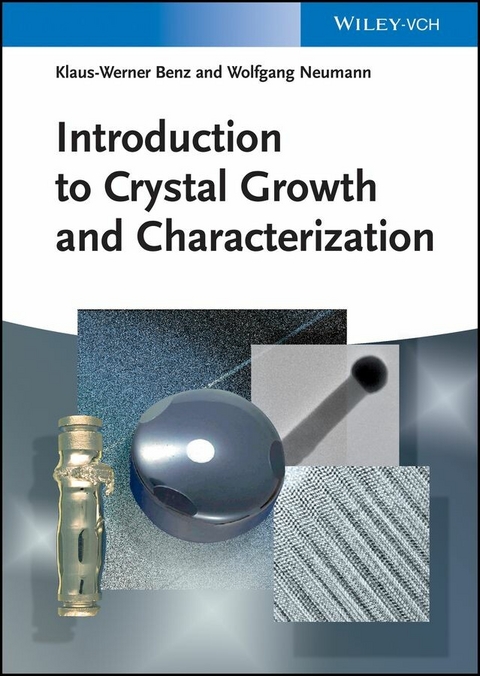
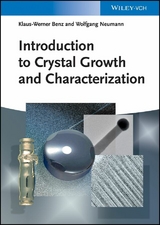
Nucleation processes, their kinetics and main growth mechanism will be introduced in fundamentals of crystal growth. Some phase diagrams in the solid and liquid phases in correlation with the segregation of dopants are treated on a macro- and microscale. Fluid dynamic aspects with different types of convection in melts and solutions are discussed. Various growth techniques for semiconducting materials in connection with the use of external field (magnetic fields and microgravity) are described.
Crystal characterization as the overall assessment of the grown crystal is treated in detail with respect to
- crystal defects
- crystal quality
- field of application
Introduction to Crystal Growth and Characterization is an ideal textbook written in a form readily accessible to undergraduate and graduate students of crystallography, physics, chemistry, materials science and engineering. It is also a valuable resource for all scientists concerned with crystal growth and materials engineering.
Klaus-Werner Benz, Emeritus, was Head of the Crystallographic Institute of the University of Freiburg, Germany, and Founding-Director at the Freiburg Materials Research Center, FMF until September 2003. Prof. Benz was a member of the scientific project management of the German Spacelab Missions D1 and D2 and the European Space Mission EURECA1. From 1999 on he served as Vice-President for Communication Technologies and Science Transfer of the University of Freiburg. He is a member of the International Academy of Astronautics and has authored more than 300 publications in the field of material science, crystal growth and characterization, semiconductor physics and semiconductor technology and fluid dynamics in melts and metallic solutions of semiconducting materials.
Wolfgang Neumann was full professor of Crystallography at the Institute of Physics at Humboldt University Berlin from 1996 to 2010. Before that, he was a staff scientist at the Institute of Solid State Physics and Electron Microscopy of the Academy of Sciences in Halle (Saale) and since 1992 at the Max Planck Institute of Microstructure Physics at the same place. From 1985 onwards, he was a member of the Scientific Council of the 'International Centre for Electron Microscopy' in Halle and mainly involved in the organization of international schools on electron microscopy and materials science. Prof. Neumann was the Director of this international Centre in Berlin from 2001 until his retirement from Humboldt University Berlin in 2010. His fields of scientific interests include: Structure investigations of nanostructured materials by means of analytical high-resolution electron microscopy, the study of defect formation during crystal growth and device processing as well as the analysis of order-disorder phenomena in crystals.
Wolfgang Neumann (Editor-in-Chief) and Klaus W. Benz (Consulting Editor) have collaborated for many years as main scientific editors of the materials science journal 'Crystal Research and Technology'.
Professor Emeritus Klaus-Werner Benz was Head of the Crystallographic Institute of the University of Freiburg, Germany, and Director at the Freiburg Materials Research Center until September 2003. From 1999 on he served as Vice-President of the University of Freiburg for Communication Technologies and Science Transfer. He is a member of the International Academy of Astronautics and has authored more than 300 publications in the field of material science, crystal growth and characterization, semiconductor technology and fluid dynamics. Wolfgang Neumann is Professor of Crystallography at the Institute of Physics of the Humboldt University of Berlin, Germany. He studied mineralogy in Berlin and obtained his Ph.D. and Habilitation degrees in Applied Physics from the Martin Luther University in Halle-Wittenberg. Since 1997, he is Editor-in-Chief of Crystal Research and Technology. He became Director of the International Centre of Advanced Materials and Electron Microscopy in 2001 and serves as Chairman of the German Society for Crystallography since 2006. His research interests focus on crystallography, materials science and electron microscopy. He performs structure investigations of nanostructured materials by means of analytical high-resolution electron microscopy. Wolfgang Neumann (Editor-in-Chief) and Klaus W. Benz (Consulting Editor) have collaborated for many years as main scientific editors of the materials science journal "Crystal Research and Technology".
Preface
FUNDAMENTALS OF CRYSTALLINE MATERIALS
Crystalline State
Fundamentals of Geometrical Crystallography
Morphological Symmetry of Crystals
Structural Symmetry
Crystal Structures
Crystallographic Databases and Crystallographic Computer Programs
BASICS OF GROWTH MECHANISM AND SOLIDIFICATION
Nucleation Processes
Kinetic Processes and Growth Mechanism
Phase Diagrams and Principles of Segregation
Principles of Flow Regimes in Growth Melts
GROWTH TECHNIQUES IN CORRELATION WITH RELATED GROWTH MECHANISM
Overview on Main Growth Techniques
Principles of Melt Growth Techniques
Bulk Crystal Growth of II-VI Compounds from the Vapor
Epitaxial Growth Techniques
Supplementary Material: Principles of Verneuil Technique, Growth from High and Low Temperature, Nonmetallic Solutions
CHARACTERIZATION OF CRYSTALS
Crystal Defects
Crystal Quality
Selected Methods of Crystal Characterization
Materials Engineering by Correlation of Crystal Growth and Characterization
Index Preface
FUNDAMENTALS OF CRYSTALLINE MATERIALS
Crystalline State
Fundamentals of Geometrical Crystallography
Morphological Symmetry of Crystals
Structural Symmetry
Crystal Structures
Crystallographic Databases and Crystallographic Computer Programs
BASICS OF GROWTH MECHANISM AND SOLIDIFICATION
Nucleation Processes
Kinetic Processes and Growth Mechanism
Phase Diagrams and Principles of Segregation
Principles of Flow Regimes in Growth Melts
GROWTH TECHNIQUES IN CORRELATION WITH RELATED GROWTH MECHANISM
Overview on Main Growth Techniques
Principles of Melt Growth Techniques
Bulk Crystal Growth of II-VI Compounds from the Vapor
Epitaxial Growth Techniques
Supplementary Material: Principles of Verneuil Technique, Growth from High and Low Temperature, Nonmetallic Solutions
CHARACTERIZATION OF CRYSTALS
Crystal Defects
Crystal Quality
Selected Methods of Crystal Characterization
Materials Engineering by Correlation of Crystal Growth and Characterization
Index
1
Fundamentals of Crystalline Materials
Es liegt etwas Atemberaubendes in den Grundgesetzen der Kristalle. Sie sind keine Schöpfungen des menschlichen Geistes. Sie sind – sie existieren unabhängig von uns. In einem Moment der Klarheit kann der Mensch höchstens entdecken, dass es sie gibt und sich Rechenschaft davon ablegen
M.C. Escher (1959)
There is something breathtaking about the basic laws of crystals. They are in no sense a discovery of the human mind; they just “are” – they exist quite independently of us. The most that man can do is become aware, in a moment of clarity, that they are there, and take cognizance of them.M.C. Escher (1959)
The beauty of natural crystals as caused by the regular polyhedral shape, their symmetry, beautiful color, brightness, and, in some cases, clarity has been fascinating human beings all the time. Nowadays, a wide range of modern materials can be synthesized or grown artificially as crystals. The broad spectrum of crystalline materials includes metals, semiconductors, superconductors, ceramics, polymers, organic molecular crystals, proteins, and so on. First of all, we have to answer the following fundamental questions: What are the characteristic features of the crystalline state? What is a crystal? What defines the degree of crystallinity?
1.1 Crystalline State
Our fundamental knowledge about crystals on a macroscopic scale goes back to the early extensive studies of the morphology of natural crystals, the minerals. Historically, these studies of external faces and the measurement of the precise angles between them were the key for the derivation of the fundamental laws of morphological symmetry of crystals. However, we should be aware of the fact that the regular polyhedral shape of a crystal (form or a combination of them) is, of course, a major characteristic macroscopic feature of crystals but not a proper feature for their definition. Both natural as well as synthetic crystals will grow only with an idiomorphic shape under definite growth conditions. Figure 1.1 shows examples of individual gypsum crystals that illustrate the variety of different crystal “habits,” which define the general shape. The collection of synthetic single crystals shown in Figure 1.2 were grown using a growth technology that do not allow for a polyhedral growth of the crystals.
Figure 1.1 (a–c) Gypsum crystals shown in the world-renowned mineral collection “terra mineralia” in castle Freudenstein Freiberg/Saxonia, Germany (www.terra-mineralia.de).
Figure 1.2 Collection of synthetic single crystals (Leibniz Institute for Crystal Growth Berlin, Germany).
The most fundamental macroscopic properties of crystals are
- homogeneity
- anisotropy
- symmetry.
Macroscopic homogeneity means the crystal is chemically and physically uniformly built. We can consider it as a continuum. The physical properties in different volume elements will show equal characteristics in parallel directions. It is obvious that this treatment is an abstraction and approximation that is applicable only at the macroscopic scale. Anisotropy means for us directional dependence of physical properties. All crystals are anisotropic with respect to some of their physical properties. When we try to determine the thermal expansion of a calcite crystal along the threefold c-axis and perpendicular to it, we will measure different values of different signs. Along the c-axis, we will find an expansion of the calcite crystal, and perpendicular to it, the crystal shows the anomaly of thermal dilatation with increasing temperature. Anisotropy of crystals does not mean that all crystal properties have to show a different physical behavior in different directions. For example, cubic crystals are optically isotropic. They will, therefore, show neither polarization nor double refraction.
In general, the concept of symmetry is a key to the description of crystals. When we consider “symmetry” as one of the main macroscopic features of crystals, we mean the symmetry concept (symmetry operations and symmetry elements) for describing external forms of crystals, the morphological symmetry of crystals. It is quite clear that there is a basic correspondence between the morphological symmetry (outer symmetry) and the structural symmetry (inner symmetry) of crystals. The fundamentals for the description of the outer and inner symmetries of a crystal will be outlined in Sections 1.2–1.4.
Strictly speaking, all the fundamental macroscopic features of crystals such as homogeneity, anisotropy, and morphological symmetry are the result of the internal order of the crystals at the microscopic level. It should be noted that a periodic arrangement of building units (atoms, groups of atoms, ions, and molecules) of crystals was already predicted by scientists from their comprehensive studies of macroscopic properties of crystals long before von Laue, Friedrich, and Knipping confirmed the periodic order of crystals experimentally by their famous X-ray diffraction experiments in 1912. A year later, father William H. Bragg and son William L. Bragg solved the first crystal structures (NaCl, KCl, CaF2, ZnS, FeS2, NaNO3, and CaCO3) from X-ray data (for comprehensive historical survey of crystallography, see, e.g., [1–4]). Nowadays, crystal structure analysis by means of X-ray and electron and neutron diffraction is well developed and routinely applied. Furthermore, modern microscopic techniques such as high-resolution transmission electron microscopy (HRTEM) allow the direct imaging of the atomic arrangement in crystalline structures. Figure 1.3a shows a HRTEM image of a (100) oriented GaAs crystal and the corresponding electron diffraction pattern. For the applied imaging conditions and the specimen thickness given, the white spots represents the projected atomic rows along the [100] zone axis. We can easily construct a lattice were the nodes are occupied by atoms, reflecting their periodic arrangement. The corresponding diffraction pattern (Figure 1.3b) consists of sharp spots (Bragg peaks) situated also on a lattice. This is the so-called reciprocal lattice of the crystal.
Figure 1.3 HRTEM micrograph of [001] oriented GaAs (a) and the corresponding electron diffraction pattern (b).
With respect to the macroscopic features, we can simply define crystals as homogeneous anisotropic solids. These solids are composed of a three-dimensional periodic arrangement of matter, which forms the microscopic structure of the crystal. As we will show in Sections 1.2 and 1.4, the periodic order can mathematically be described by translation lattices. A “decoration” of the lattice points with matter (atoms, ions, and molecules) generates then the crystal structure. So far, such a definition of crystals is strictly connected with order and periodicity. Periodicity means a periodic infinite repetition of some basic structural unit in all directions by translation. The macroscopic feature of homogeneity is only strictly fulfilled when we consider an infinite space lattice with identical lattice points and identical surrounding. The definition given above within the framework of “classical crystallography” describes what we mean with the term ideal crystal. The following questions arise when we are dealing with real crystals, which are finite: What are the boundary conditions that allow for the application of the symmetry concept of an ideal crystal for the description of real crystals? How has one to define ordered structures that lack three-dimensional periodicity within our concept of crystalline matter?
A real crystal is always finite. When we have large-sized crystals, the deviations from the infinity of the underlying lattice concept are negligible. The separation of the matter decorating the lattice points is in the order of 10−8 cm (1 Å). Thus, for a crystal size of 1 cm, we have ∼108 periodically arranged atoms. However, our real crystal may contain local deviations of chemical composition and various kinds of crystal imperfections (crystal defects) of different dimensions, which may disturb or even destroy the symmetry of our crystal.
A real crystal consisting ideally of only one grain (a continuous lattice without any grain boundary) is called a perfect single crystal. Practically, all single crystals are imperfect crystals, containing various kinds of crystal defects. A crystal containing a few grain boundaries is still a single, however imperfect, crystal. Contrary to this, a polycrystal is composed of many crystallites (grains) of different size and orientations with an equal probability for all possible orientations. The entity of crystallite orientations is called texture. The different stages of crystallinity from single crystalline via a texture to polycrystalline can be determined by means of diffraction as shown in Figure 1.4.
Figure 1.4 Correlation of real structure of crystals and the corresponding diffraction patterns.
Another important classification criteria for real crystals is connected to their grain size, where the terms microcrystalline (diameter of the grains, d > 1 µm), subfine grain-sized crystals (d < 1 µm), and nanocrystalline (d < 100 nm) are...
| Erscheint lt. Verlag | 28.7.2014 |
|---|---|
| Co-Autor | Anna Mogilatenko |
| Sprache | englisch |
| Themenwelt | Naturwissenschaften ► Chemie |
| Technik | |
| Schlagworte | Architecture • Basics • chemical engineering • Chemie • Chemische Verfahrenstechnik • Chemistry • Comprehensive • Concepts • Contemporary • Crystal • crystallography • crystals • Description • Electrical & Electronics Engineering • Elektrotechnik u. Elektronik • familiarized • Festkörperphysik • Festkörperphysik • First • growth • Illustrated • Kristallisation • Kristallographie • Kristallphysik • materials characterization • Materials Science • Materialwissenschaften • MEMS • molecular • Nanomaterialien • nanomaterials • nanomedicine • Nanomedizin • Nanotechnologie • nanotechnology • New • provides • Reader • Strömungsdynamik • Strömungsdynamik • Structural • Structures • symmetry • Textbook • Time • Treatment • Werkstoffprüfung • Werkstoffprüfung |
| ISBN-13 | 9783527684342 / 9783527684342 |
| Informationen gemäß Produktsicherheitsverordnung (GPSR) | |
| Haben Sie eine Frage zum Produkt? |
 EPUB (Adobe DRM)
Kopierschutz: Adobe-DRM
Adobe-DRM ist ein Kopierschutz, der das eBook vor Mißbrauch schützen soll. Dabei wird das eBook bereits beim Download auf Ihre persönliche Adobe-ID autorisiert. Lesen können Sie das eBook dann nur auf den Geräten, welche ebenfalls auf Ihre Adobe-ID registriert sind.
Details zum Adobe-DRM
Dateiformat: EPUB (Electronic Publication)
EPUB ist ein offener Standard für eBooks und eignet sich besonders zur Darstellung von Belletristik und Sachbüchern. Der Fließtext wird dynamisch an die Display- und Schriftgröße angepasst. Auch für mobile Lesegeräte ist EPUB daher gut geeignet.
Systemvoraussetzungen:
PC/Mac: Mit einem PC oder Mac können Sie dieses eBook lesen. Sie benötigen eine
eReader: Dieses eBook kann mit (fast) allen eBook-Readern gelesen werden. Mit dem amazon-Kindle ist es aber nicht kompatibel.
Smartphone/Tablet: Egal ob Apple oder Android, dieses eBook können Sie lesen. Sie benötigen eine
Geräteliste und zusätzliche Hinweise
Buying eBooks from abroad
For tax law reasons we can sell eBooks just within Germany and Switzerland. Regrettably we cannot fulfill eBook-orders from other countries.
aus dem Bereich