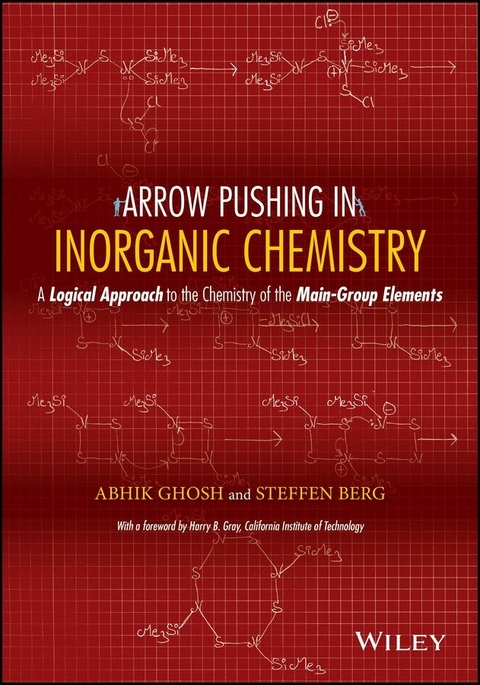
Arrow Pushing in Inorganic Chemistry (eBook)
John Wiley & Sons (Verlag)
978-1-118-92454-9 (ISBN)
Involved as it is with 95% of the periodic table, inorganic chemistry is one of the foundational subjects of scientific study. Inorganic catalysts are used in crucial industrial processes and the field, to a significant extent, also forms the basis of nanotechnology. Unfortunately, the subject is not a popular one for undergraduates. This book aims to take a step to change this state of affairs by presenting a mechanistic, logical introduction to the subject.
Organic teaching places heavy emphasis on reaction mechanisms - 'arrow-pushing' - and the authors of this book have found that a mechanistic approach works just as well for elementary inorganic chemistry. As opposed to listening to formal lectures or learning the material by heart, by teaching students to recognize common inorganic species as electrophiles and nucleophiles, coupled with organic-style arrow-pushing, this book serves as a gentle and stimulating introduction to inorganic chemistry, providing students with the knowledge and opportunity to solve inorganic reaction mechanisms.
• The first book to apply the arrow-pushing method to inorganic chemistry teaching
• With the reaction mechanisms approach ('arrow-pushing'), students will no longer have to rely on memorization as a device for learning this subject, but will instead have a logical foundation for this area of study
• Teaches students to recognize common inorganic species as electrophiles and nucleophiles, coupled with organic-style arrow-pushing
• Provides a degree of integration with what students learn in organic chemistry, facilitating learning of this subject
• Serves as an invaluable companion to any introductory inorganic chemistry textbook
Steffen Berg and Abhik Ghosh are chemists based at UiT - The Arctic University of Norway. They share a passion for chemical education, and are particularly interested in developing methods to help high school students and undergraduates understand difficult concepts.
Involved as it is with 95% of the periodic table, inorganic chemistry is one of the foundational subjects of scientific study. Inorganic catalysts are used in crucial industrial processes and the field, to a significant extent, also forms the basis of nanotechnology. Unfortunately, the subject is not a popular one for undergraduates. This book aims to take a step to change this state of affairs by presenting a mechanistic, logical introduction to the subject. Organic teaching places heavy emphasis on reaction mechanisms - "e;arrow-pushing"e; - and the authors of this book have found that a mechanistic approach works just as well for elementary inorganic chemistry. As opposed to listening to formal lectures or learning the material by heart, by teaching students to recognize common inorganic species as electrophiles and nucleophiles, coupled with organic-style arrow-pushing, this book serves as a gentle and stimulating introduction to inorganic chemistry, providing students with the knowledge and opportunity to solve inorganic reaction mechanisms. The first book to apply the arrow-pushing method to inorganic chemistry teaching With the reaction mechanisms approach ("e;arrow-pushing"e;), students will no longer have to rely on memorization as a device for learning this subject, but will instead have a logical foundation for this area of study Teaches students to recognize common inorganic species as electrophiles and nucleophiles, coupled with organic-style arrow-pushing Provides a degree of integration with what students learn in organic chemistry, facilitating learning of this subject Serves as an invaluable companion to any introductory inorganic chemistry textbook
Steffen Berg and Abhik Ghosh are chemists based at UiT - The Arctic University of Norway. They share a passion for chemical education, and are particularly interested in developing methods to help high school students and undergraduates understand difficult concepts.
| Erscheint lt. Verlag | 25.7.2014 |
|---|---|
| Sprache | englisch |
| Themenwelt | Naturwissenschaften ► Chemie ► Anorganische Chemie |
| Technik | |
| Schlagworte | Anorganische Chemie • Chemie • Chemistry • Inorganic Chemistry • inorganic chemistry, teaching inorganic chemistry, reaction mechanisms, arrow-pushing, reaction mechanisms approach, arrow-pushing approach, recognizing inorganic species, recognizing electrophiles, recognizing nucleophiles • Materials Science • Materialwissenschaften • Metallorganische Verbindungen • Organometallchemie • Organometallic Chemistry |
| ISBN-10 | 1-118-92454-1 / 1118924541 |
| ISBN-13 | 978-1-118-92454-9 / 9781118924549 |
| Informationen gemäß Produktsicherheitsverordnung (GPSR) | |
| Haben Sie eine Frage zum Produkt? |
 PDF (Adobe DRM)
Kopierschutz: Adobe-DRM
Adobe-DRM ist ein Kopierschutz, der das eBook vor Mißbrauch schützen soll. Dabei wird das eBook bereits beim Download auf Ihre persönliche Adobe-ID autorisiert. Lesen können Sie das eBook dann nur auf den Geräten, welche ebenfalls auf Ihre Adobe-ID registriert sind.
Details zum Adobe-DRM
Dateiformat: PDF (Portable Document Format)
Mit einem festen Seitenlayout eignet sich die PDF besonders für Fachbücher mit Spalten, Tabellen und Abbildungen. Eine PDF kann auf fast allen Geräten angezeigt werden, ist aber für kleine Displays (Smartphone, eReader) nur eingeschränkt geeignet.
Systemvoraussetzungen:
PC/Mac: Mit einem PC oder Mac können Sie dieses eBook lesen. Sie benötigen eine
eReader: Dieses eBook kann mit (fast) allen eBook-Readern gelesen werden. Mit dem amazon-Kindle ist es aber nicht kompatibel.
Smartphone/Tablet: Egal ob Apple oder Android, dieses eBook können Sie lesen. Sie benötigen eine
Geräteliste und zusätzliche Hinweise
Buying eBooks from abroad
For tax law reasons we can sell eBooks just within Germany and Switzerland. Regrettably we cannot fulfill eBook-orders from other countries.
aus dem Bereich