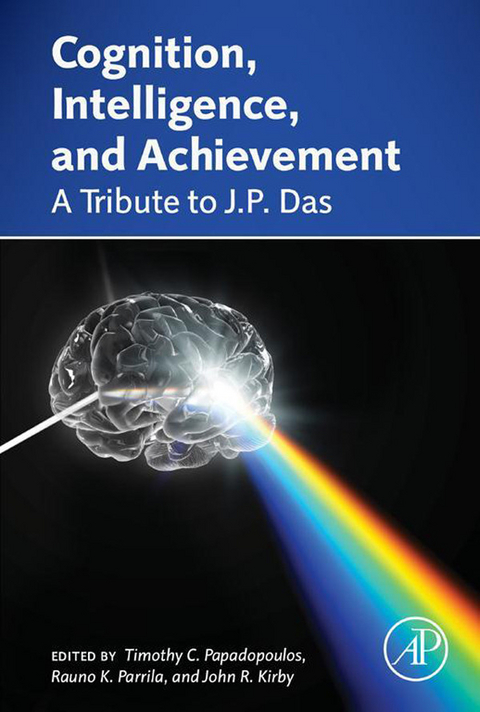
Cognition, Intelligence, and Achievement (eBook)
532 Seiten
Elsevier Science (Verlag)
978-0-12-410444-0 (ISBN)
Cognition, Intelligence, and Achievement is motivated by the work of the renowned Professor J. P. Das on the PASS (Planning, Attention, Simultaneous and Successive Processing) theory of intelligence and CAS measures (Cognitive Assessment System) of cognitive processes. This book reviews current research using this and other frameworks in understanding the relationships among cognition, intelligence, and achievement. The assessment and diagnosis of learning disabilities, mental retardation, and ADHD are addressed, and the interrelationships among cognition, culture, neuropsychology, academic achievement, instruction, and remediation are examined. No other book has presented such an integrated view across these domains, from such a diverse array of internationally known and respected experts from psychology, education, and neuroscience. - Summarizes decades of research on PASS theory and use of CAS- Discusses how findings in the neuropsychology of intelligence speak to PASS theory use and application- Covers use of PASS and CAS for assessing and treating a variety of learning disabilities- Outlines use of PASS and CAS for enhancing learning and cognitive processes
Front Cover 1
Cognition, Intelligence, and Achievement 4
Copyright Page 5
Contents 6
Foreword 14
List of Contributors 18
I. Introductory Chapters 20
1 Cognition, Intelligence, and Achievement: A Tribute to J. P. Das 22
The Rationale for This Book 24
Organization of the Text 24
Foreword and Introductory Chapters 25
Intelligence as a Cognitive Process 25
Developmental and Learning Disabilities 27
Enhancing Learning and Cognitive Processes 29
References 30
2 Glimpses into the Personal Life of J. P. Das 32
3 Three Faces of Cognitive Processes: Theory, Assessment, and Intervention 38
Origin and History of PASS Cognitive Processes 38
PASS Prehistory 38
Its Roots: Sechenov, Pavlov, and Luria 40
Simultaneous and Successive Information Integration: The 1975 Model 41
Socioeconomic Status (SES) and Simultaneous-Successive Processing 43
Factor Stability Across Cultures 44
The Invariance of Two Factors, Even When a Completely Different Set of Tests Is Used 45
The PASS Model 45
Arousal-Attention 45
Planning 47
Knowledge Base 48
Evidence for the PASS Model: A Cognitive Universal 48
Factor Analysis and Factorial Invariance 48
General Intelligence and Diverse Cognitive Processing: Does Factor Analysis Provide Any New Insights? 49
The Das-Naglieri CAS: Its Inception and Brief History of Applications 50
Construct Fidelity vs. Factor Purity 51
Construct Validity of CAS: Neuropsychological Evidence 53
Cognitive Remediation 56
PASS Reading Enhancement Program (PREP) 57
Cognition Enhancement Training (COGENT) 58
PASS Theory and Assessment Then and Now: Frozen Dinner or a Moving Feast? 60
Math Boosting: The Pivotal Role of Planning 60
Planning, Attention, and Executive Functions 61
Conclusion 63
References 63
II. Topic Area 1: Intelligence as a cognitive process 68
4 A Janus View: J. P. Das’s Ideas in Retrospect and Prospect 70
Legacies Entwined: Alexander Luria and Lev Vygotsky 70
The Brain and Psychometrics: PASS to CAS 71
The Hemet Study 73
Interventions: From PASS/CAS to Remediation 74
Reading Intervention in PREP 75
Other Intervention Studies 78
Mathematics and Planning 79
The Modernization of PASS 80
Theoretical Basis 80
Planning and Attention: P, A, and g 82
Arousal 86
Simultaneous and Successive Processing: The SS in PASS is Retained but Reinterpreted 86
Language 88
Orientation 89
Summary 90
References 92
5 Cognitive Processes and Academic Achievement: Multiple Systems Model of Reading 98
Introduction 98
Theories of Reading Disabilities 99
Multiple Systems Model of Reading 102
Research Implications 105
Some Educational Implications 111
Conclusions 113
References 114
6 Culture and Cognition: A Forty-Year Overview 120
Introduction 120
Conceptual Issues 121
Process, Competence, and Performance 122
The Universalist Perspective 124
The Ecocultural Perspective 124
Empirical Studies of Perception and Cognition 127
Conclusions 131
References 131
7 Reading Comprehension and PASS Theory 136
Introduction 136
Reading Comprehension 137
PASS Theory 139
Relevance of PASS Theory to Reading Comprehension 140
The Role of Planning 141
The Role of Attention 142
The Role of Simultaneous Processing 142
The Role of Successive Processing 143
Empirical Evidence: PASS Processes and CBM-Maze 144
Conclusions 147
Final Thoughts 148
Acknowledgments 149
References 149
8 Establishing Measurement Invariance of the Cognitive Assessment System Across Cultures 156
Method 159
Participants 159
Materials 160
Procedures 161
Data Scoring 161
Results 162
Measurement Invariance of D-N CAS Across Cultures 162
Discussion 164
References 165
9 Functional Components of Reading with Reference to Reading Chinese 168
Componential Approach to Reading Acquisition 168
Linguistic Principles in Reading Chinese Characters and Words 170
Direct Pronunciation, Use of Homophones, and Fanqie Principle 171
Pinyin and Zhuyin Fuhao Phonetic Systems 172
Phonological Processing 174
Orthographic Processing 177
Structural and Positional Constraints of Characters 177
Chinese Children’s Orthographic Knowledge 178
Morphological Knowledge 179
Morphological Compounding in Chinese 179
Summary Statement on Morphological Processing 180
Handwriting Strengthens the Connections of Reading Components 181
Sample Lesson: Linking Phonology, Orthography, Morphology, and Meaning 182
Reading, Writing Practice, and Statistical Learning 183
Summary and Conclusions 184
Acknowledgments 185
References 185
III. Topic Area 2: Developmental and learning disabilities 192
10 Intelligence, Working Memory, and Learning Disabilities 194
Intelligence, Working Memory, and Learning Disabilities 194
Definition of Terms 195
Theoretical Framework 198
Phonological System 199
Summary 200
Visual-Spatial Sketchpad 200
Summary 201
Executive System 201
Summary 204
Paradoxical Findings 204
Summary 207
Acknowledgments 209
References 209
11 Cognitive Constructs and Individual Differences Underlying ADHD and Dyslexia: A Cognitive Mosaic Approach 216
The Constructs of Planning and Attention 217
Planning and Attention in ADHD and Dyslexia 219
The Present Study 221
Method 221
Participants 221
Attention Measures 222
Reading-Related Measures 224
Executive Functions Measures 224
Results 225
Factor Analysis 226
Group Differences 228
Profile Analysis 228
Discussion 232
Attention and Executive Functions in University Students with ADHD and/or Dyslexia 233
Planning, Executive Functions, and Attention 237
References 238
12 Is Intelligence Relevant in Reading “µ..a” and in Calculating “3 + 5”? 244
PASS Processes and Reading 245
PASS Processes and Mathematics 246
The Present Study 247
Method 248
Participants 248
Measures 248
Beginning of Kindergarten 248
End of Kindergarten 250
End of Grade 1 251
Procedures 252
Results 252
Preliminary Data Analysis 252
Correlations between the Measures 253
Predicting Reading and Mathematics 255
Discussion 255
References 259
13 PASS Theory and Special Educational Needs: A European Perspective 264
Introduction 264
Mathematical Learning Disabilities 266
Nonverbal Learning Disabilities 268
Mild Mental Retardation 269
Gifted Children 271
ADHD 273
Ethnic Minority Children 276
Discussion 278
References 280
14 Cognitive Processes in Children with Developmental Coordination Disorder 286
Developmental Coordination Disorder and Cognitive-Motor Development 286
The Knowledge-Based Approach to Motor Development 289
Information Processing Model and DCD 292
PASS, CAS, and DCD 295
Cognitive Process-Based Subtypes of DCD 299
Intervention Practices 302
Conclusions 303
References 304
15 Equitable Assessment for Hearing and Deaf English Language Learners: An Investigation of the Impact of Verbal Load on PA... 310
Introduction 310
Theoretical Framework 313
Computerized Cognitive Assessment Battery (CCAB) Instrument Description and Development 315
Pilot Study 1 318
Participants 319
Procedures 319
Results and Discussion 319
Pilot Study 2 320
Participants 320
Procedures 320
Results and Discussion 321
Conclusion 324
Acknowledgments 325
References 325
IV. Topic Area 3: Enhancing learning and cognitive processes 328
16 Cognitive and Linguistic Dynamics of Reading Remediation 330
Instruction versus Remediation 331
Cognitive and Linguistic Correlates of Reading Development 332
PASS Theory and Reading Ability 335
Remediation Studies 337
The PASS Reading Enhancement Program (PREP) 338
The Graphogame Intervention 339
The Present Study 340
Preliminary Results on Word Reading Fluency Performance 340
Microgenetic Data Analysis 343
Microgenetic Data Encoding Model 344
Microgenetic Data Metrics Model 345
Instantaneous Development Stage Metric for a Group 347
Instantaneous Developmental Stage Metric for an Individual 348
Developmental Stage Dynamics for Group and Individuals 349
Approaches to Using Developmental Stage Metric 350
An Illustration of Applying the Microgenetic Data Encoding Model 351
Conclusions 353
Acknowledgments 356
References 356
17 The Effects of the Seria-Think Program (STP) on Planning, Self-Regulation, and Math Performance Among Grade 3 Children w... 364
Introduction 364
Characteristics of ADHD 365
The Importance of Self-Regulation and Planning for School Achievement 366
Intervention Programs for Children with ADHD 367
The Seria-Think Program (STP) 368
The Current Study 371
Method 372
Participants 372
Measures 372
Procedure 375
Results 375
Complex Figure Test 375
Matching Familiar Figures Test 375
Strategic Planning Math Exam 376
Discussion 379
References 381
18 Concerns About the Quality and Quantity of Students' Knowledge About Learning 388
Introduction 388
The Issue: The State of Students’ Knowledge about Learning 389
Students Need to Direct Their Own Learning 390
Graduating University Students’ Knowledge About Learning 393
Senior High School Students’ Advice to Students About How to Learn Well 396
Senior High School Students’ Advice to Teachers About Supporting Learning 398
Student Use of Strategy Knowledge Across Time 401
The Quality and Quantity of Students’ Knowledge about Learning 406
Knowledge About Learning Will Develop Naturally? 406
Teacher Knowledge About Learning 407
The Status of Learning as a Domain of Knowledge 408
Conclusion: The Need for Sustained Teaching about Learning 409
References 410
19 Understanding Developmental and Learning Disabilities within Functional-Systems Frameworks: Building on the Contribution... 416
Legacy of J. P. Das 417
Cross-Disciplinary Framework for Assessing, Teaching, and Learning Language 417
Differentiating Developmental and Specific Learning Disabilities 418
Evolution in Understanding and Assessing Working Memory and Executive Functions 421
Building Bridges between Das’s PASS Model and the Cognitive Writing Processes Model 426
Relevance of Executive Functions to Special Populations 427
Conclusions 430
Notes 431
References 431
20 Intelligent Behavior and Neuroscience: What We Know—and Don’t Know—About How We Think 438
Our Research on PASS 438
The Cognitive-Emotional Brain and Neuroscience 441
How We Think About the Way We Think 441
Conscious and Unconscious Processing 445
Cognition–Emotion Interaction 448
What Exactly Is an Emotion as Distinct from a Thought or Cognition? 448
Cognitive Remediation Based on the PASS Model 450
Golden Rules 453
Holistic Cognitive–Emotional Intervention 454
Conclusions 455
References 456
V. Final Chapter 460
21 Retrospect and Prospect 462
T.C.P. 463
Maxims 463
Shaping My Research 465
The Way Forward 466
R.K.P. 468
J.R.K. 471
Meeting Das 472
Shaping My Research 473
Current and Future Theory and Practice 474
References 475
Appendix A: J. P. Das: Vita 478
Degrees 478
Academic and Research Experience 478
Short Appointments 479
Listed in Biographical Directories 479
Awards 479
Professional Associations 479
Editorial Consultation 480
International Activities 480
Publications 480
Appendix B: Das’s Ph.D. Students 500
Postdoctoral Students and Research Associates 501
Author Index 502
Subject Index 520
Cognition, Intelligence, and Achievement
A Tribute to J. P. Das
Timothy C. Papadopoulos1, Rauno K. Parrila2 and John R. Kirby3, 1Department of Psychology & Centre for Applied Neuroscience, University of Cyprus, Nicosia, Cyprus, 2Department of Educational Psychology, University of Alberta, Edmonton, Alberta, Canada, 3Faculty of Education, Department of Psychology, and Centre for Neuroscience Studies, Queen’s University, Kingston, Ontario, Canada
Cognition, Intelligence, and Achievement is a Festschrift volume to honor the career and the contributions of Professor Jagannath Prasad Das of the University of Alberta in education and psychology. Understanding the concepts of cognition, intelligence, and achievement requires the creation of theories and models that rely on data from the real world. J. P. Das (or Das, as he is known to his friends and close collaborators) has made major contributions to our understanding of the relationships among these concepts through a well-grounded neurocognitive theory and a solid empirical base. During his almost 60-year academic career, J. P. Das has published a great number of influential papers in the broad field of cognitive psychology and special education. For many, his work on the Planning, Attention-Arousal, Simultaneous, and Successive (PASS) theory of intelligence, first proposed in 1975 (Das, Kirby, & Jarman, 1979), and later elaborated by Das, Naglieri, and Kirby (1994), and Das, Kar, and Parrila (1996), advanced our knowledge by broadening the concept of intelligence and how to assess it. Motivated by the theoretical propositions of Soviet neuropsychologist Alexander Luria, the PASS theory studied human intelligence in the context of learning and cognition rather than with a predominant focus on test construction and the structure of intellect. This is the reason that makes Professor Das one of the most widely recognized scholars related to Luria’s seminal neuropsychological work on brain functioning.
Keywords
cognition; intelligence; achievement; Planning; Attention-Arousal; Simultaneous and Successive theory; Das-Naglieri Cognitive Assessment System
Cognition, Intelligence, and Achievement is a Festschrift volume to honor the career and the contributions of Professor Jagannath Prasad Das of the University of Alberta in education and psychology. Understanding the concepts of cognition, intelligence, and achievement requires the creation of theories and models that rely on data from the real world. J. P. Das (or Das, as he is known to his friends and close collaborators) has made major contributions to our understanding of the relationships among these concepts through a well-grounded neurocognitive theory and a solid empirical base. During his almost 60-year academic career, J. P. Das has published a great number of influential papers in the broad field of cognitive psychology and special education. For many, his work on the Planning, Attention-Arousal, Simultaneous, and Successive (PASS) theory of intelligence, first proposed in 1975 (Das, Kirby, & Jarman, 1979), and later elaborated by Das, Naglieri, and Kirby (1994), and Das, Kar, and Parrila (1996), advanced our knowledge by broadening the concept of intelligence and how to assess it. Motivated by the theoretical propositions of Soviet neuropsychologist Alexander Luria, the PASS theory studied human intelligence in the context of learning and cognition rather than with a predominant focus on test construction and the structure of intellect. This is the reason that makes Professor Das one of the most widely recognized scholars related to Luria’s seminal neuropsychological work on brain functioning.
In 1972, J. P. Das became the Director of the newly formed Centre for Mental Retardation at the University of Alberta; this center was later renamed the Developmental Disabilities Centre, and more recently the J. P. Das Centre on Developmental and Learning Disabilities. Das’s extensive research since then covers three broad areas, all of which are represented in this volume: intelligence as a cognitive process, developmental and learning disabilities, and remediation of learning and cognitive processes. In research and practice, Das has always adopted an international and cross-cultural perspective and demonstrated great concern for the most vulnerable and disadvantaged children, trying particularly to improve the lives of those with developmental and learning disabilities.
Das’s work on the conceptualization and measurement of intelligence challenged theories of general intelligence (g) on the grounds that the brain is made up of interdependent but distinct functional systems. Das was one of the leaders in the 1970s, offering theoretical interpretations of the cognitive processes that comprised intelligence (others represented in this volume include Earl Hunt and Robert Sternberg). Whereas the construction of intelligence tests and the mathematical analysis of the relations among measures had dominated the research on intelligence until then, Das and others began to reintegrate the study of intelligence with the study of cognition (e.g., Hunt, Frost, & Lunneborg, 1973; Sternberg, 1977). Instead of viewing intelligence simply as being whatever IQ tests measure, they studied the processes by which intelligent behavior was produced. As a result, they were far more focused on how to improve intelligence and its consequences. Many of the papers in this volume address issues regarding the cognitive conceptualization of intelligence.
The second major area of Das’s work focused on the diagnosis of different learning and developmental disabilities. The four PASS cognitive processes helped further understand and better define some of the most common categories of special populations including children with specific learning disabilities, attention and planning deficits, reading comprehension deficits, mathematics deficits, or individuals with intellectual disabilities. The application of the PASS theory to practical assessment strategies has been achieved through the Das-Naglieri Cognitive Assessment System (D-N CAS; Naglieri & Das, 1997), a cross-culturally applicable battery of tests of intelligence and cognitive processes. As a result, the PASS theory and the CAS have helped make the assessment of intelligence useful for the differential diagnosis of learning and developmental disorders. Examples of this research are included in the present volume.
Das’s research on the remediation of learning and cognitive deficits is a third major area of his work: the PASS theory of cognitive processes has proven useful for designing educational and cognitive interventions. The theory has provided the framework for the development of two intervention programs: (a) the PASS Reading Enhancement Program (PREP), and (b) Cognition Enhancement Training (COGENT). The development of these intervention programs involved extensive efforts at tracking the short- and long-term effects of treatment with studies carried out with young children in Canada, the United States, Australia, Europe, China, and South Africa. It is expected that this line of research will stimulate much new empirical research in the area of cognitive intervention. All these issues and many others relating to cognition, intelligence, and achievement are addressed in the chapters ahead.
The Rationale for this Book
To honor Professor J. P. Das, we invited scholars who are familiar with his work to contribute chapters in one of the three thematic areas described below. This resulting collection of 20 essays by researchers in the fields of educational, developmental, and cognitive psychology and special education is rich and diverse, illustrating how Das’s contributions continue to guide or shape psychological research.
As noted previously, Das has been instrumental in relating work from neuropsychology and cognition to intelligence and school achievement. Our intention, therefore, was to bring together researchers who know or have been influenced by Das’s work to contribute chapters which focus on the themes that Das had studied. The goal was not to focus only on Das’s contributions, but rather to see how his contributions stimulated or are related to the thinking and research of other researchers in education and psychology. As such, we hope that the book will become a valuable resource for scholars, graduate students, practicing educational psychologists, and special education teachers. We believe that the chapters transcend the boundaries of Das’s work to investigate the emergence of a range of new ideas in the fields of cognition, assessment, intelligence, and intervention.
Organization of the Text
The book is organized around three broad research themes, which correspond to J. P. Das’s major research interests: intelligence as a cognitive process (Chapters 4–9), developmental and learning disabilities (Chapters 10–15), and the enhancement of learning and cognitive processes (Chapters 16–20). Because of the nature of these fields and the goal to integrate them, the three sections necessarily overlap extensively. Next, we briefly overview the chapters that follow.
Foreword and Introductory Chapters
The book begins with a foreword by Robert J. Sternberg, who portrays the outstanding career of J. P. Das. Sternberg places emphasis on how the work of Das has motivated researchers, psychologists, and educators to...
| Erscheint lt. Verlag | 19.7.2014 |
|---|---|
| Sprache | englisch |
| Themenwelt | Geisteswissenschaften ► Psychologie ► Allgemeine Psychologie |
| Geisteswissenschaften ► Psychologie ► Entwicklungspsychologie | |
| Geisteswissenschaften ► Psychologie ► Verhaltenstherapie | |
| Naturwissenschaften ► Biologie ► Humanbiologie | |
| Naturwissenschaften ► Biologie ► Zoologie | |
| ISBN-10 | 0-12-410444-4 / 0124104444 |
| ISBN-13 | 978-0-12-410444-0 / 9780124104440 |
| Informationen gemäß Produktsicherheitsverordnung (GPSR) | |
| Haben Sie eine Frage zum Produkt? |
 EPUB (Adobe DRM)
Kopierschutz: Adobe-DRM
Adobe-DRM ist ein Kopierschutz, der das eBook vor Mißbrauch schützen soll. Dabei wird das eBook bereits beim Download auf Ihre persönliche Adobe-ID autorisiert. Lesen können Sie das eBook dann nur auf den Geräten, welche ebenfalls auf Ihre Adobe-ID registriert sind.
Details zum Adobe-DRM
Dateiformat: EPUB (Electronic Publication)
EPUB ist ein offener Standard für eBooks und eignet sich besonders zur Darstellung von Belletristik und Sachbüchern. Der Fließtext wird dynamisch an die Display- und Schriftgröße angepasst. Auch für mobile Lesegeräte ist EPUB daher gut geeignet.
Systemvoraussetzungen:
PC/Mac: Mit einem PC oder Mac können Sie dieses eBook lesen. Sie benötigen eine
eReader: Dieses eBook kann mit (fast) allen eBook-Readern gelesen werden. Mit dem amazon-Kindle ist es aber nicht kompatibel.
Smartphone/Tablet: Egal ob Apple oder Android, dieses eBook können Sie lesen. Sie benötigen eine
Geräteliste und zusätzliche Hinweise
Buying eBooks from abroad
For tax law reasons we can sell eBooks just within Germany and Switzerland. Regrettably we cannot fulfill eBook-orders from other countries.
aus dem Bereich