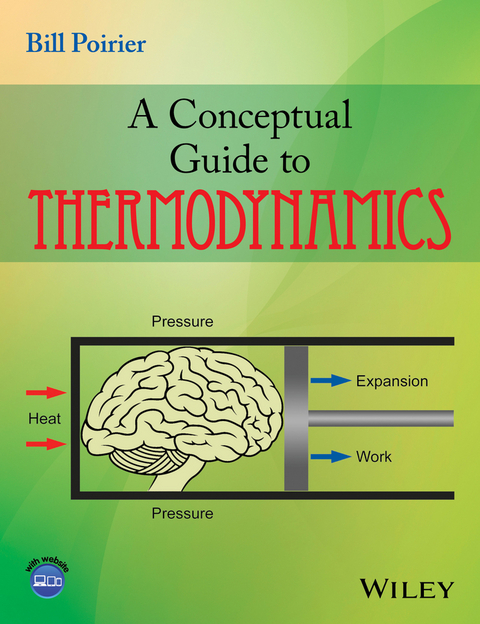
A Conceptual Guide to Thermodynamics (eBook)
John Wiley & Sons (Verlag)
978-1-118-84048-1 (ISBN)
Thermodynamics is the science that describes the behavior of matter at the macroscopic scale, and how this arises from individual molecules. As such, it is a subject of profound practical and fundamental importance to many science and engineering fields. Despite extremely varied applications ranging from nanomotors to cosmology, the core concepts of thermodynamics such as equilibrium and entropy are the same across all disciplines.
A Conceptual Guide to Thermodynamics serves as a concise, conceptual and practical supplement to the major thermodynamics textbooks used in various fields. Presenting clear explanations of the core concepts, the book aims to improve fundamental understanding of the material, as well as homework and exam performance.
Distinctive features include:
- Terminology and Notation Key: A universal translator that addresses the myriad of conventions, terminologies, and notations found across the major thermodynamics texts.
- Content Maps: Specific references to each major thermodynamic text by section and page number for each new concept that is introduced.
- Helpful Hints and Don't Try Its: Numerous useful tips for solving problems, as well as warnings of common student pitfalls.
- Unique Explanations: Conceptually clear, mathematically fairly simple, yet also sufficiently precise and rigorous.
A more extensive set of reference materials, including older and newer editions of the major textbooks, as well as a number of less commonly used titles, is available online at http://www.conceptualthermo.com.
Undergraduate and graduate students of chemistry, physics, engineering, geosciences and biological sciences will benefit from this book, as will students preparing for graduate school entrance exams and MCATs.Professor Bill Poirier, Department of Chemistry & Biochemistry, Texas Tech University, USA
Professor Poirier is Professor of Chemistry and Biochemistry and Joint Professor of Physics at Texas Tech University, where he has held research positions since 2001. His research is concerned with the development and application of new methods for performing accurate quantum dynamics calculations with unprecedented computational efficiency, to allow calculations for larger systems than ever before. This has wide ranging applications in areas including astrophysics, environmental, atmospheric and combustion chemistry, materials, and hydrogen storage.
Professor Poirier has extensive teaching experience at undergraduate and graduate level, teaching undergraduate courses in general chemistry and physical chemistry, and graduate courses in chemical kinetics, molecular spectroscopy and statistical mechanics.
Thermodynamics is the science that describes the behavior of matter at the macroscopic scale, and how this arises from individual molecules. As such, it is a subject of profound practical and fundamental importance to many science and engineering fields. Despite extremely varied applications ranging from nanomotors to cosmology, the core concepts of thermodynamics such as equilibrium and entropy are the same across all disciplines. A Conceptual Guide to Thermodynamics serves as a concise, conceptual and practical supplement to the major thermodynamics textbooks used in various fields. Presenting clear explanations of the core concepts, the book aims to improve fundamental understanding of the material, as well as homework and exam performance. Distinctive features include: Terminology and Notation Key: A universal translator that addresses the myriad of conventions, terminologies, and notations found across the major thermodynamics texts. Content Maps: Specific references to each major thermodynamic text by section and page number for each new concept that is introduced. Helpful Hints and Don t Try Its: Numerous useful tips for solving problems, as well as warnings of common student pitfalls. Unique Explanations: Conceptually clear, mathematically fairly simple, yet also sufficiently precise and rigorous. A more extensive set of reference materials, including older and newer editions of the major textbooks, as well as a number of less commonly used titles, is available online at http://www.conceptualthermo.com. Undergraduate and graduate students of chemistry, physics, engineering, geosciences and biological sciences will benefit from this book, as will students preparing for graduate school entrance exams and MCATs.
Professor Bill Poirier, Department of Chemistry & Biochemistry, Texas Tech University, USA Professor Poirier is Professor of Chemistry and Biochemistry and Joint Professor of Physics at Texas Tech University, where he has held research positions since 2001. His research is concerned with the development and application of new methods for performing accurate quantum dynamics calculations with unprecedented computational efficiency, to allow calculations for larger systems than ever before. This has wide ranging applications in areas including astrophysics, environmental, atmospheric and combustion chemistry, materials, and hydrogen storage. Professor Poirier has extensive teaching experience at undergraduate and graduate level, teaching undergraduate courses in general chemistry and physical chemistry, and graduate courses in chemical kinetics, molecular spectroscopy and statistical mechanics.
"Useful for students and professionals in numerous areas, including biology, chemistry, physics, and engineering. . . Summing Up: Recommended. Upper-division undergraduates and above." (Choice, 1 April 2015)
Textbook Guide
Thermodynamics is a cornerstone of many scientific disciplines. As such, there are many different textbooks that address this important subject—and a corresponding myriad of conventions, terminologies, and notations used. This section is designed to sort all of that out—at least for the specific reference textbooks considered here, listed (by discipline) below.
The list includes the latest edition of the most commonly used texts. Please do not be too discouraged if you do not see your primary text listed below; given the multiple disciplines represented, it is an inevitability that many excellent textbooks have to be omitted. That said, a greatly expanded list of reference texts is available on the companion website (http://www.conceptualthermo.com), which you should also consult. There, you will find customized, textbook-specific materials for the older and (as they are released) newer editions of the textbooks listed below—as well as for many other texts that are less frequently used.
If your favorite book is not listed on the website, please feel free to let me know via the website itself, or by sending an email directly to feedback@conceptualthermo.com. Please send detailed information (including ISBN) for the textbook that you are using, so that I can incorporate it into future book materials. In any case, you can still learn from the conceptual explanations provided in this book, without necessarily having to own any thermodynamics textbook.
Whether you wind up loving or hating this book, or somewhere in between, I certainly would appreciate your feedback—especially in the form of helpful suggestions for making it better. You can submit these via the website and email address above. If you like the book, consider spreading the word—to professors, social media friends, and even real friends, as appropriate.
0.1 List of Thermodynamics Textbooks by Discipline
In the list below, the boldfaced word at the start of each bibliographic entry is the keyword that will be used throughout the rest of this book to refer to that specific reference textbook. (In all but one case, the keyword is simply the first author's last name.) When looking up your primary textbook here, be sure to pay close attention to the edition number and publication year.
Thermodynamics Textbooks
- Biological Sciences:
- Atkins-life: P. Atkins and J. de Paula, Physical Chemistry for the Life Sciences, second edition (W. H. Freeman, 2011).
- Chang: R. Chang, Physical Chemistry for the Biosciences (University Science Books, 2005).
- Tinoco: I. Tinoco, Jr., K. Sauer, J. C. Wang, J. D. Puglisi, G. Harbison, and D. Rovnyak, Physical Chemistry: Principles and Applications in Biological Sciences, fifth edition (Prentice-Hall, 2013).
- Chemistry:
- Atkins: P. Atkins and J. de Paula, Physical Chemistry, ninth edition (W. H. Freeman, 2010).
- Engel: T. Engel and P. Reid, Physical Chemistry, third edition (Pearson, 2013).
- Levine: I. N. Levine, Physical Chemistry, sixth edition (McGraw-Hill, 2009).
- McQuarrie: D. A. McQuarrie and J. D. Simon, Physical Chemistry (University Science Books, 1997).
- Silbey: R. J. Silbey, R. A. Alberty, and M. G. Bawendi, Physical Chemistry, fourth edition (John Wiley & Sons, Inc., 2005).
- Engineering:
- Cengel: Y. A. Çengel and M. A. Boles, Thermodynamics: An Engineering Approach, seventh edition (McGraw-Hill, 2012).
- Elliot: J. R. Elliott and C. T. Lira, Introductory Chemical Engineering Thermodynamics, second edition (Prentice-Hall, 2012).
- Moran: M. J. Moran, H. N. Shapiro, D. D. Boettner, and M. B. Bailey, Fundamentals of Engineering Thermodynamics, seventh edition (John Wiley & Sons, Inc., 2012).
- Prausnitz: J. M. Prausnitz, R. N. Lichtenthaler, and E. Gomes de Azevedo, Molecular Thermodynamics of Fluid-Phase Equilibria, third edition (Prentice-Hall, 1999).
- Sandler: S. I. Sandler, Chemical, Biochemical, and Engineering Thermodynamics, fourth edition (John Wiley & Sons, Inc., 2006).
- Smith: J. M. Smith, H. C. Van Ness, and M. M. Abbott, Introduction to Chemical Engineering Thermodynamics, seventh edition (McGraw-Hill, 2005).
- Geosciences:
- Anderson: G. Anderson, Thermodynamics of Natural Systems, second edition (Cambridge University Press, 2005).
- Faure: G. Faure, Principles and Applications of Geochemistry, second edition (Prentice-Hall, 1998).
- Physics:
- Baierlein: R. Baierlein, Thermal Physics (Cambridge University Press, 1999).
- Callen: H. B. Callen, Thermodynamics and an Introduction to Thermostatistics, second edition (John Wiley & Sons, Inc., 1985).
- Kittel: C. Kittel and H. Kroemer, Thermal Physics, second edition (W. H. Freeman, 1980).
- Reif: F. Reif, Fundamentals of Statistical and Thermal Physics (McGraw-Hill, 1965; reprinted by Waveland Pr, 2008).
- Schroeder: D. Schroeder, An Introduction to Thermal Physics (Addison-Wesley, 2000).
0.2 Terminology and Notation Used in This Book
The terminology and mathematical notation of the most important physical, chemical, and thermodynamic quantities that are employed in this book are listed in the table below. The page on which each quantity is first introduced or defined is also listed.
Terminology and Notation
| Quantity | Symbol | Page Number |
| Amount of Substance (number of moles) | n | 18 |
| Amount of Substance (number of particles) | n | 18 |
| Avogadro’s Number | NA | 18 |
| Boltzmann Constant | k | 30 |
| Chemical Potential | 125 |
| Compressibility Factor | Z | 30 |
| Efficiency (heat engine) | 110 |
| Energy (molecular) | E | 34 |
| Enthalpy | H | 68 |
| Entropy | S | 84 |
| Exergy | E | 121 |
| Expansion Coefficient | 71 |
| Force | F | 28 |
| Fugacity | F | 126 |
| Gas Constant | R | 30 |
| Generic Thermodynamic Quantity (molar) | Xm | 19 |
| Generic Thermodynamic Quantity (surroundings) | Xsur | 50 |
| Generic Thermodynamic Quantity (system) | X | 19 |
| Generic Thermodynamic Quantity (total system) | Xtot | 50 |
| Gibbs Free Energy | G | 117 |
| Heat | Q | 59 |
| Heat Capacity at Constant Pressure | CP | 68 |
| Heat Capacity at Constant Volume | CV | 67 |
| Heat Capacity Ratio (adiabat coefficient) | 70 |
| Helmholtz Free Energy | A | 117 |
| Internal Energy | U | 36 |
| Internal Pressure | 70 |
| Isothermal Compressibility | 71 |
| Mass (per mole) | M | 18 |
| Mass (per particle) | M | 18 |
| Number of Available Molecular States | 81 |
| Position | (x, y, z) | 20 |
| Pressure | P | 17 |
| Temperature | T | 39 |
| Velocity | (vx, vy, vz) | 20 |
| Volume | V | 17 |
| Work | W | 58 |
0.3 Terminology and Notation Used in Textbooks
Consult the key below to “translate” the terminology and notation of this book into that of your primary textbook (or to the IUPAC Gold Book standard). The key is easy to use. Textbooks are listed by keyword, in alphabetical order. Unless stated otherwise, the notation used here, and that of a given text, are presumed to be identical. Where the two notations differ, that of this book appears to the left of the arrows presented in the key, and that of the textbook to the right.
For example, after the Atkins keyword below, the string...
| Erscheint lt. Verlag | 16.7.2014 |
|---|---|
| Sprache | englisch |
| Themenwelt | Naturwissenschaften ► Chemie ► Physikalische Chemie |
| Naturwissenschaften ► Physik / Astronomie ► Thermodynamik | |
| Technik | |
| Schlagworte | arises • Behavior • Bill • Center • Chemical • chemical thermodynamics • Chemie • Chemische Thermodynamik • Chemistry • Conceptual • Engineering • Fields • fundamental • Guide • importance • Individual • Macroscopic • Maschinenbau • matter • mechanical engineering • Molecules • Physics • Physik • Poirier • Practical • scale • Science • Tech • Thermal Physics & Statistical Mechanics • thermodynamics • Thermodynamik • University • Wärmelehre u. Statistische Mechanik • Wärmelehre u. Statistische Mechanik |
| ISBN-10 | 1-118-84048-8 / 1118840488 |
| ISBN-13 | 978-1-118-84048-1 / 9781118840481 |
| Informationen gemäß Produktsicherheitsverordnung (GPSR) | |
| Haben Sie eine Frage zum Produkt? |
 EPUB (Adobe DRM)
Kopierschutz: Adobe-DRM
Adobe-DRM ist ein Kopierschutz, der das eBook vor Mißbrauch schützen soll. Dabei wird das eBook bereits beim Download auf Ihre persönliche Adobe-ID autorisiert. Lesen können Sie das eBook dann nur auf den Geräten, welche ebenfalls auf Ihre Adobe-ID registriert sind.
Details zum Adobe-DRM
Dateiformat: EPUB (Electronic Publication)
EPUB ist ein offener Standard für eBooks und eignet sich besonders zur Darstellung von Belletristik und Sachbüchern. Der Fließtext wird dynamisch an die Display- und Schriftgröße angepasst. Auch für mobile Lesegeräte ist EPUB daher gut geeignet.
Systemvoraussetzungen:
PC/Mac: Mit einem PC oder Mac können Sie dieses eBook lesen. Sie benötigen eine
eReader: Dieses eBook kann mit (fast) allen eBook-Readern gelesen werden. Mit dem amazon-Kindle ist es aber nicht kompatibel.
Smartphone/Tablet: Egal ob Apple oder Android, dieses eBook können Sie lesen. Sie benötigen eine
Geräteliste und zusätzliche Hinweise
Buying eBooks from abroad
For tax law reasons we can sell eBooks just within Germany and Switzerland. Regrettably we cannot fulfill eBook-orders from other countries.
aus dem Bereich