


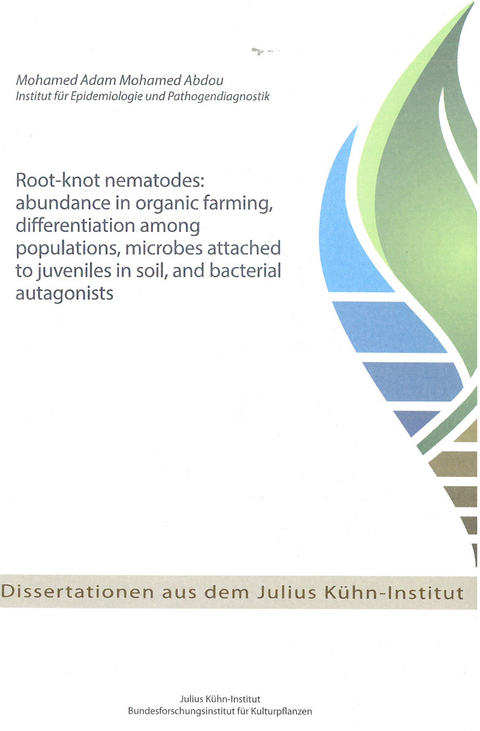
Root-knot nematodes: abundance in organic farming, differentiation among populations, microbes attached to juveniles in soil, and bacterial antagonists
Seiten
2014
Bundesforschungsinstitut für Kulturpflanzen (JKI) (Verlag)
978-3-95547-008-1 (ISBN)
Bundesforschungsinstitut für Kulturpflanzen (JKI) (Verlag)
978-3-95547-008-1 (ISBN)
Two surveys were conducted to determine the frequency and abundance of plantparasitic nematodes associated with different crops at an organic farm in Egypt,
during autumn 2009 and 2011. Eleven genera of plant-parasitic nematodes were
detected. Root-knot nematodes (Meloidogyne spp.) showed the highest abundance
and frequency of all plant-parasitic nematodes during the two surveys. Commonly
detected genera were Tylenchorhynchus, Rotylenchulus, Helicotylenchus and
Pratylenchus. Further studies on Meloidogyne were carried out with regard to
discrimination among populations, attachment of microbes to juveniles (J2) in soil,
and biocontrol through bacterial strains which were known as antagonists of fungal
pathogens
Two surveys were conducted to determine the frequency and abundance of plantparasitic nematodes associated with different crops at an organic farm in Egypt,
during autumn 2009 and 2011. Eleven genera of plant-parasitic nematodes were
detected. Root-knot nematodes (Meloidogyne spp.) showed the highest abundance
and frequency of all plant-parasitic nematodes during the two surveys. Commonly
detected genera were Tylenchorhynchus, Rotylenchulus, Helicotylenchus and
Pratylenchus. Further studies on Meloidogyne were carried out with regard to
discrimination among populations, attachment of microbes to juveniles (J2) in soil,
and biocontrol through bacterial strains which were known as antagonists of fungal
pathogens
during autumn 2009 and 2011. Eleven genera of plant-parasitic nematodes were
detected. Root-knot nematodes (Meloidogyne spp.) showed the highest abundance
and frequency of all plant-parasitic nematodes during the two surveys. Commonly
detected genera were Tylenchorhynchus, Rotylenchulus, Helicotylenchus and
Pratylenchus. Further studies on Meloidogyne were carried out with regard to
discrimination among populations, attachment of microbes to juveniles (J2) in soil,
and biocontrol through bacterial strains which were known as antagonists of fungal
pathogens
Two surveys were conducted to determine the frequency and abundance of plantparasitic nematodes associated with different crops at an organic farm in Egypt,
during autumn 2009 and 2011. Eleven genera of plant-parasitic nematodes were
detected. Root-knot nematodes (Meloidogyne spp.) showed the highest abundance
and frequency of all plant-parasitic nematodes during the two surveys. Commonly
detected genera were Tylenchorhynchus, Rotylenchulus, Helicotylenchus and
Pratylenchus. Further studies on Meloidogyne were carried out with regard to
discrimination among populations, attachment of microbes to juveniles (J2) in soil,
and biocontrol through bacterial strains which were known as antagonists of fungal
pathogens
| Erscheint lt. Verlag | 10.7.2014 |
|---|---|
| Reihe/Serie | Dissertationen aus dem Julius Kühn-Institut |
| Sprache | englisch |
| Maße | 150 x 210 mm |
| Gewicht | 220 g |
| Themenwelt | Naturwissenschaften |
| Weitere Fachgebiete ► Land- / Forstwirtschaft / Fischerei | |
| Schlagworte | Pflanzenpathologie • Plathelminthen • Wurzelgallenälchen |
| ISBN-10 | 3-95547-008-3 / 3955470083 |
| ISBN-13 | 978-3-95547-008-1 / 9783955470081 |
| Zustand | Neuware |
| Informationen gemäß Produktsicherheitsverordnung (GPSR) | |
| Haben Sie eine Frage zum Produkt? |
Mehr entdecken
aus dem Bereich

aus dem Bereich
Buch | Hardcover (2023)
Haymarket Media (Verlag)
CHF 44,50
erfolgreich produzieren & selbst vermarkten
Buch | Hardcover (2023)
Stocker Verlag
CHF 34,95


