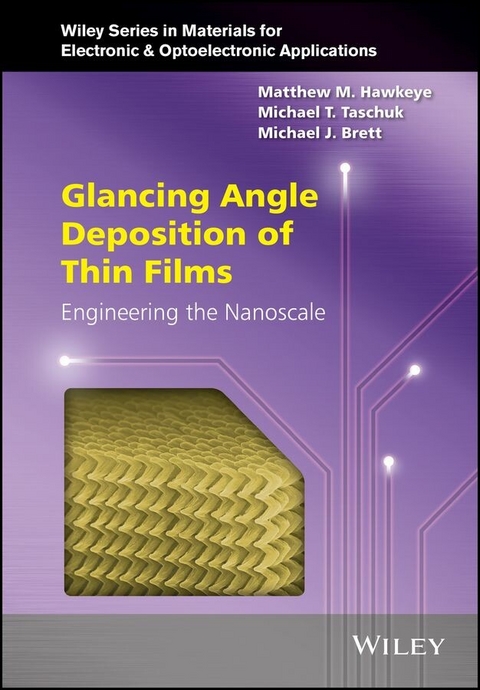
Glancing Angle Deposition of Thin Films (eBook)
John Wiley & Sons (Verlag)
978-1-118-84732-9 (ISBN)
- Development and description of GLAD techniques for nanostructuring thin films
- Properties and characterization of nanohelices, nanoposts, and other porous films
- Design and engineering of optical GLAD films including fabrication and testing, and chiral films
- Post-deposition processing and integration to optimize film behaviour and structure
- Deposition systems and requirements for GLAD fabrication
- A patent survey, extensive relevant literature, and a survey of GLAD's wide range of material properties and diverse applications.
Dr Matthew M. Hawkeye is a postdoc at University of Alberta who earned his Ph.D. in electrical engineering working with the Brett group on GLAD technology and who has worked on the GLAD technique since 2004. From 2010-2012, he worked as a postdoc at the University of Cambridge, during which time he authored numerous articles on nanoscale photonics and contributed to a BBC Horizon series special on synthetic biology. His publications include a review article in Journal of Vacuum Science and Technology A on the GLAD technique which has more than 200 citations to date.
Dr Michael T. Taschuk received his Ph.D. degree in electrical engineering from the University of Alberta in 2006 for his work developing the laser-induced breakdown spectroscopy technique. He has been working as a research associate at Alberta on GLAD since 2007, studying optical and sensor applications of GLAD thin films. He has published 33 peer-reviewed papers on the GLAD technique, as well as a book chapter covering GLAD theory and applications.
Dr Michael J. Brett is Canada Research Chair at the Department of Electrical and Computer Engineering at the University of Alberta, where he has taught since 1986. He also holds an appointment as Program Coordinator (Energy) at the National Institute for Nanotechnology. After commercialization success and worldwide sales of his microelectronics simulation software SIMBAD, his group developed and popularized the GLAD process in 1994, and their research has focused on this technique since that time, leading to over 190 journal papers and 5 patents that deal with GLAD and its applications. He is also the author of 4 book chapters and the acknowledged field leader in GLAD research.
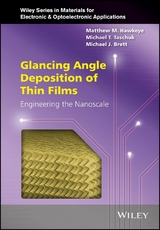
This book provides a highly practical treatment of Glancing Angle Deposition (GLAD), a thin film fabrication technology optimized to produce precise nanostructures from a wide range of materials. GLAD provides an elegant method for fabricating arrays of nanoscale helices, chevrons, columns, and other porous thin film architectures using physical vapour deposition processes such as sputtering or evaporation. The book gathers existing procedures, methodologies, and experimental designs into a single, cohesive volume which will be useful both as a ready reference for those in the field and as a definitive guide for those entering it. It covers: Development and description of GLAD techniques for nanostructuring thin films Properties and characterization of nanohelices, nanoposts, and other porous films Design and engineering of optical GLAD films including fabrication and testing, and chiral films Post-deposition processing and integration to optimize film behaviour and structure Deposition systems and requirements for GLAD fabrication A patent survey, extensive relevant literature, and a survey of GLAD's wide range of material properties and diverse applications.
Dr Matthew M. Hawkeye is a postdoc at University of Alberta who earned his Ph.D. in electrical engineering working with the Brett group on GLAD technology and who has worked on the GLAD technique since 2004. From 2010-2012, he worked as a postdoc at the University of Cambridge, during which time he authored numerous articles on nanoscale photonics and contributed to a BBC Horizon series special on synthetic biology. His publications include a review article in Journal of Vacuum Science and Technology A on the GLAD technique which has more than 200 citations to date. Dr Michael T. Taschuk received his Ph.D. degree in electrical engineering from the University of Alberta in 2006 for his work developing the laser-induced breakdown spectroscopy technique. He has been working as a research associate at Alberta on GLAD since 2007, studying optical and sensor applications of GLAD thin films. He has published 33 peer-reviewed papers on the GLAD technique, as well as a book chapter covering GLAD theory and applications. Dr Michael J. Brett is Canada Research Chair at the Department of Electrical and Computer Engineering at the University of Alberta, where he has taught since 1986. He also holds an appointment as Program Coordinator (Energy) at the National Institute for Nanotechnology. After commercialization success and worldwide sales of his microelectronics simulation software SIMBAD, his group developed and popularized the GLAD process in 1994, and their research has focused on this technique since that time, leading to over 190 journal papers and 5 patents that deal with GLAD and its applications. He is also the author of 4 book chapters and the acknowledged field leader in GLAD research.
| Erscheint lt. Verlag | 30.6.2014 |
|---|---|
| Reihe/Serie | Wiley Series in Materials for Electronic & Optoelectronic Applications | Wiley Series in Materials for Electronic & Optoelectronic Applications |
| Sprache | englisch |
| Themenwelt | Naturwissenschaften ► Chemie |
| Technik ► Elektrotechnik / Energietechnik | |
| Technik ► Maschinenbau | |
| Schlagworte | angle • broad • Calibration • Compatibility • Dünne Schicht • Dünne Schichten, Oberflächen u. Grenzflächen • Deposition • deposition oblique • Dünne Schicht • Dünne Schichten, Oberflächen u. Grenzflächen • Electrical & Electronics Engineering • Electronic materials • Elektronische Materialien • Elektrotechnik u. Elektronik • Experimental • glancing • growth • importance • Introduction • Materials Science • Materialwissenschaften • Microfabrication • Nanotechnologie • nanotechnology • preface • processes • Properties • series • Simulations • Standard • Synthese u. Produktion von Nanosystemen • Synthesis/Production of Nanosystems • Technology • Thin Films, Surfaces & Interfaces |
| ISBN-10 | 1-118-84732-6 / 1118847326 |
| ISBN-13 | 978-1-118-84732-9 / 9781118847329 |
| Informationen gemäß Produktsicherheitsverordnung (GPSR) | |
| Haben Sie eine Frage zum Produkt? |
 PDF (Adobe DRM)
Kopierschutz: Adobe-DRM
Adobe-DRM ist ein Kopierschutz, der das eBook vor Mißbrauch schützen soll. Dabei wird das eBook bereits beim Download auf Ihre persönliche Adobe-ID autorisiert. Lesen können Sie das eBook dann nur auf den Geräten, welche ebenfalls auf Ihre Adobe-ID registriert sind.
Details zum Adobe-DRM
Dateiformat: PDF (Portable Document Format)
Mit einem festen Seitenlayout eignet sich die PDF besonders für Fachbücher mit Spalten, Tabellen und Abbildungen. Eine PDF kann auf fast allen Geräten angezeigt werden, ist aber für kleine Displays (Smartphone, eReader) nur eingeschränkt geeignet.
Systemvoraussetzungen:
PC/Mac: Mit einem PC oder Mac können Sie dieses eBook lesen. Sie benötigen eine
eReader: Dieses eBook kann mit (fast) allen eBook-Readern gelesen werden. Mit dem amazon-Kindle ist es aber nicht kompatibel.
Smartphone/Tablet: Egal ob Apple oder Android, dieses eBook können Sie lesen. Sie benötigen eine
Geräteliste und zusätzliche Hinweise
Buying eBooks from abroad
For tax law reasons we can sell eBooks just within Germany and Switzerland. Regrettably we cannot fulfill eBook-orders from other countries.
aus dem Bereich