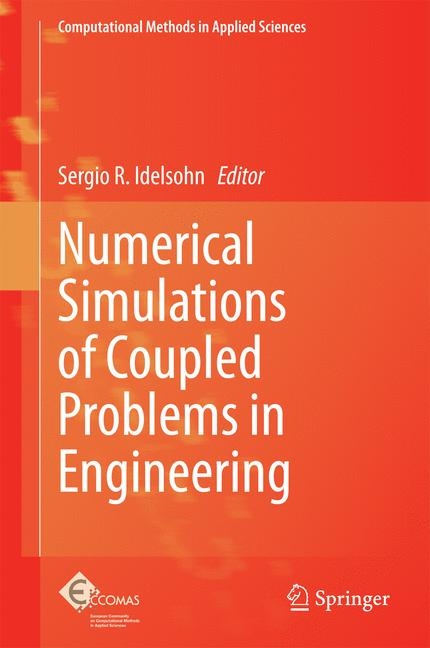
Numerical Simulations of Coupled Problems in Engineering (eBook)
IX, 422 Seiten
Springer International Publishing (Verlag)
978-3-319-06136-8 (ISBN)

This book presents and discusses mathematical models, numerical methods and computational techniques used for solving coupled problems in science and engineering. It takes a step forward in the formulation and solution of real-life problems with a multidisciplinary vision, accounting for all of the complex couplings involved in the physical description. Simulation of multifaceted physics problems is a common task in applied research and industry. Often a suitable solver is built by connecting together several single-aspect solvers into a network. In this book, research in various fields was selected for consideration: adaptive methodology for multi-physics solvers, multi-physics phenomena and coupled-field solutions, leading to computationally intensive structural analysis. The strategies which are used to keep these problems computationally affordable are of special interest, and make this an essential book.
Preface.- I Non-Linear Materials in Coupled Problems: 1 Generalized viscoplasticity based on overstress (GVBO) for large strain single-scale and multi-scale analyses, by Vasilina Filonova, Yang Liu and Jacob Fish.- 2 Numerical simulation of double cup extrusion test using the arbitrary Lagrangian-Eulerian formalism, by Romain Boman, Roxane Koeune and Jean-Philippe Ponthot.- II Cardiovascular Fluid Mechanics: 3 Simplified fluid-structure interactions for hemodynamics, by Olivier Pironneau.- 4 Patient-specific cardiovascular fluid mechanics analysis with the ST and ALE-VMS methods, by Kenji Takizawa, Yuri Bazilevs, Tayfun E. Tezduyar, Christopher C. Long, Alison L. Marsden and Kathleen Schjodt.- III Particle Methods in Coupled Problems: 5 Direct numerical simulation of particulate flows using a fictitious domain method, by Bircan Avci and Peter Wriggers.- 6 A Particle Finite Element Method (PFEM) for Coupled Thermal Analysis of Quasi and Fully Incompressible Flows and Fluid-Structure Interaction Problems, by Eugenio Oñate, Alessandro Franci and Josep M. Carbonell.- 7 Numerical simulation and visualization of material flow in friction stir welding via particle tracing, by N. Dialami, Michelle Chiumenti, Miguel Cervera, Carlos Agelet de Saracibar, Jean-Philippe Ponthot and P. Bussetta.- 8 Some considerations on surface condition of solid in computational fluid-structure interaction, by Masao Yokoyama, Kohei Murotani, Genki Yagawa and Osamu Mochizuki.- IV Reduced Order Models: 9 Reduced-Order Modeling strategies for the finite element approximation of the Incompressible Navier-Stokes equations, by Joan Baiges, Ramon Codina and Sergio R. Idelsohn.- 10 A survey of hierarchical model (Hi-Mod) reduction methods for elliptic problems, by Simona Perotto.- V Multi-fluid Flows: 11 On the application of two-fluid flows solver to the casting problem, by Kazem Kamran, Riccardo Rossi, Pooyan Dadvand, Sergio R. Idelsohn.- 12 Recent advances in the Particle Finite Element Method towards more complex fluid flow applications, by Norberto M. Nigro, Juan M. Gimenez and Sergio R. Idelsohn.- VI Fluid-Structure Interactions Problems: 13 Computational engineering analysis and design with ALE-VMS and ST methods, by Kenji Takizawa, Yuri Bazilevs, Tayfun E. Tezduyar, Ming-Chen Hsu, Ole Øiseth, Kjell M. Mathisen, Nikolay Kostov and Spenser McIntyre.- 14 Computational wind-turbine analysis with the ALE-VMS and ST-VMS methods, by Yuri Bazilevs, Kenji Takizawa, Tayfun E. Tezduyar, Ming-Chen Hsu, Nikolay Kostov and Spenser McIntyre.- VII Partitioned Method and Parallelization Techniques: 15 Scaling up multi-physics, by Rainald Löhner and Joseph D. Baum.- 16 Partitioned solution of coupled stochastic problems, by Mohammad Hadigol, Alireza Doostan, Hermann G. Matthies and Rainer Niekamp.
| Erscheint lt. Verlag | 9.5.2014 |
|---|---|
| Reihe/Serie | Computational Methods in Applied Sciences | Computational Methods in Applied Sciences |
| Zusatzinfo | IX, 422 p. 273 illus. |
| Verlagsort | Cham |
| Sprache | englisch |
| Themenwelt | Mathematik / Informatik ► Informatik |
| Mathematik / Informatik ► Mathematik ► Statistik | |
| Mathematik / Informatik ► Mathematik ► Wahrscheinlichkeit / Kombinatorik | |
| Naturwissenschaften ► Physik / Astronomie | |
| Technik ► Maschinenbau | |
| Schlagworte | Computational Mechanics • coupled problems • Numercial Methods |
| ISBN-10 | 3-319-06136-4 / 3319061364 |
| ISBN-13 | 978-3-319-06136-8 / 9783319061368 |
| Informationen gemäß Produktsicherheitsverordnung (GPSR) | |
| Haben Sie eine Frage zum Produkt? |
 PDF (Wasserzeichen)
DRM: Digitales Wasserzeichen
Dieses eBook enthält ein digitales Wasserzeichen und ist damit für Sie personalisiert. Bei einer missbräuchlichen Weitergabe des eBooks an Dritte ist eine Rückverfolgung an die Quelle möglich.
Dateiformat: PDF (Portable Document Format)
Mit einem festen Seitenlayout eignet sich die PDF besonders für Fachbücher mit Spalten, Tabellen und Abbildungen. Eine PDF kann auf fast allen Geräten angezeigt werden, ist aber für kleine Displays (Smartphone, eReader) nur eingeschränkt geeignet.
Systemvoraussetzungen:
PC/Mac: Mit einem PC oder Mac können Sie dieses eBook lesen. Sie benötigen dafür einen PDF-Viewer - z.B. den Adobe Reader oder Adobe Digital Editions.
eReader: Dieses eBook kann mit (fast) allen eBook-Readern gelesen werden. Mit dem amazon-Kindle ist es aber nicht kompatibel.
Smartphone/Tablet: Egal ob Apple oder Android, dieses eBook können Sie lesen. Sie benötigen dafür einen PDF-Viewer - z.B. die kostenlose Adobe Digital Editions-App.
Buying eBooks from abroad
For tax law reasons we can sell eBooks just within Germany and Switzerland. Regrettably we cannot fulfill eBook-orders from other countries.
aus dem Bereich