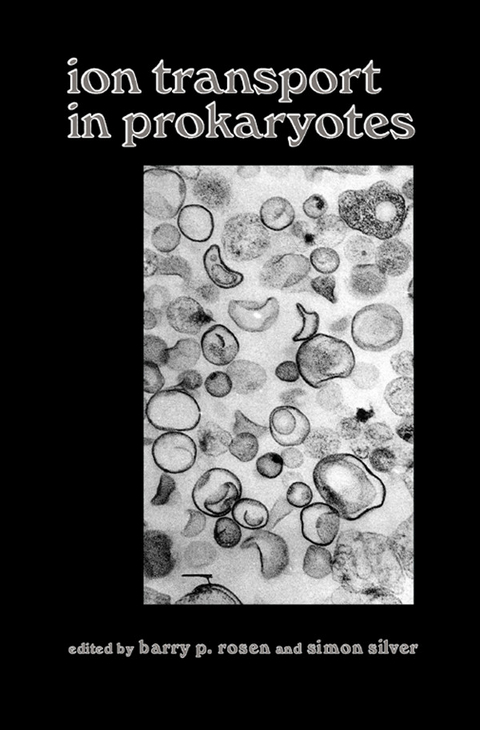
Ion Transport in Prokaryotes (eBook)
346 Seiten
Elsevier Science (Verlag)
978-1-4832-7212-2 (ISBN)
Ion Transport in Prokaryotes provides an advance treatise on ion transport and prokaryotic organisms. This book is divided into three main topics-cation transport systems, anion transport systems, and plasmid-encoded transport systems. This compilation specifically discusses the proton transport and proton-motive force in prokaryotic cells, potassium transport in bacteria, and bioenergetic functions of sodium ions. The calcium transport in prokaryotes, phosphate transport in prokaryotes, and transport of organic acids in prokaryotes are also elaborated. This text likewise covers the chloride, nitrate, and sulfate transport in bacteria and bacterial magnesium, manganese, and zinc transport. This publication is recommended for biologists, specialists, and students interested in the bacterial ion transport system.
Front Cover 1
Ion Transport in Prokaryotes 4
Copyright Page 5
Table of Contents 6
Preface 10
Part I: Cation Transport Systems 16
Chapter 1. Proton Transport and Proton-Motive Force in Prokaryotic Cells 18
I. INTRODUCTION 19
II. GENERATION OF .p IN PROKARYOTIC CELLS 22
III. PROTON-TRANSLOCATING ATPASE (H+-ATPASE) 28
IV. PROTON-TRANSLOCATING ELECTRON TRANSFER CHAINS, INORGANIC PYROPHOSPHATASE, AND BACTERIORHODOPSIN 49
V. PROTON–SOLUTE COTRANSPORT SYSTEMS 55
VI. UTILIZATION OF .p IN PROKARYOTES OTHER THAN FOR ATP SYNTHESIS AND ACTIVE TRANSPORT 69
VII. SUMMARY 72
VIII. RECENT DEVELOPMENTS 73
ACKNOWLEDGMENTS 74
REFERENCES 74
Chapter 2. Potassium Transport in Bacteria 100
I. INTRODUCTION 100
II. STREPTOCOCCUS FAECALIS 109
III. ESCHERICHIA COLI 115
IV. CYANOBACTERIA 125
V. LESS FREQUENTLY STUDIED SPECIES 127
VI. SUMMARY AND CONCLUSIONS 133
REFERENCES 136
Chapter 3.
146
I. INTRODUCTION 146
II. Na+AS A SECONDARY COUPLING ION 147
III. Na+ AS THE PRIMARY COUPLING ION 156
IV. CONCLUSIONS 172
REFERENCES 174
Chapter 4. Bacterial Magnesium, Manganese, and Zinc Transport 180
I. INTRODUCTION 180
II. MAGNESIUM TRANSPORT 182
III. MANGANESE TRANSPORT 185
IV. ZINC TRANSPORT 188
V. NICKEL TRANSPORT 189
VI. CADMIUM TRANSPORT 190
VII. EPILOGUE 190
ACKNOWLEDGMENTS 191
REFERENCES 191
Chapter 5. Calcium Transport in Prokaryotes 196
I. INTRODUCTION 196
II. SECONDARY TRANSPORT SYSTEMS 202
III. PRIMARY CALCIUM TRANSPORT SYSTEMS 209
IV. CONCLUSIONS 212
REFERENCES 213
Part II:
218
Chapter 6. Phosphate Transport in Prokaryotes 220
I. INTRODUCTION 220
II. PHOSPHATE TRANSPORT SYSTEMS OF ESCHERICHIA COLI 222
III. PHOSPHATE TRANSPORT IN OTHER BACTERIA 233
IV. GENETIC STUDIES AND THE IDENTIFICATION OF COMPONENTS OF THE PHOSPHATE TRANSPORT SYSTEMS 236
V. TRANSPORT OF SOME PHOSPHATE ESTERS 243
VI. THE Pst SYSTEM AS AN INTEGRAL PART OF THE pho REGULON OF ESCHERICHIA COLI 251
ACKNOWLEDGMENTS 255
REFERENCES 255
Chapter 7. Chloride, Nitrate, and Sulfate Transport in Bacteria 264
I. INTRODUCTION 264
II. SULFATE TRANSPORT IN SALMONELLA TYPHIMURIUM 265
III. SULFATE TRANSPORT IN DESULFOVIBRIO VULGARIS 266
IV. SULFATE TRANSPORT IN PARACOCCUS DENITRIFICANS 266
V. NITRATE TRANSPORT IN DENITRIFYING BACTERIA 266
VI. CHLORIDE TRANSPORT IN HALOBACTERIA 267
REFERENCES 279
Chapter 8. Transport of Organic Acids in Prokaryotes 284
I. INTRODUCTION 284
II. MONOCARBOXYLATE TRANSPORT 285
III. DICARBOXYLATE TRANSPORT 288
IV. TRICARBOXYLATE TRANSPORT 295
REFERENCES 311
Part III: Plasmid-Encoded Transport Systems 318
Chapter 9.
320
I. ARSENATE TRANSPORT 321
II. CADMIUM EXTRUSION 328
III. CITRATE TRANSPORT 329
IV. IRON TRANSPORT 331
V. MERCURY(II) UPTAKE SYSTEM 332
VI. SUMMARY 337
REFERENCES 338
Index 342
Preface
Although the topic of bacterial ion transport may seem focused and narrow, the need to limit ourselves to ion transport and prokaryotic organisms is the best measure of the rapid progress in this area in the past decade. The modern era of the field of transport began with the classic studies of lactose transport by Monod and co-workers (Rickenberg et al., 1956; Cohen and Monod, 1957). These studies introduced the word and concept of “permease” and initiated the use of genetics as a tool in transport research. Since then progress in bacterial transport has been revolutionary. Thirty years ago the very existence of highly specific transport systems was questioned; the evidence that these were composed of membrane proteins consisted of indirect arguments based on the analysis of mutants. Direct measurement of transport activity awaited the development of isotopic tracers. The use of radioactive substrates to characterize the kinetics of individual systems rapidly became standard.
Recognition of energy coupling mechanisms came later. By 1978, the book “Bacterial Transport” (edited by B. P. Rosen) reported progress in the understanding of a maturing science. The methodologies were diverse and generally appropriate. Several qualitatively different mechanisms of energy coupling were identified. Many transport systems, in particular those for carbohydrates and amino acids, were resolved at a rather sophisticated level. In that book, compiled almost a decade ago, the topic of ion transport was restricted to a single chapter, primarily because of a limited accumulation of knowledge. At that time, the chemiosmotic coupling hypothesis developed by Mitchell (1961, 1966, 1974) had been generally accepted in principle by the scientific community, as evidenced by his being awarded the 1978 Nobel Prize in Chemistry (Mitchell, 1979).
Progress in the past decade in this area has been phenomenal. It is no longer possible to consider all fundamental studies of transport, or even all areas of bacterial transport, in a single volume of reasonable size. We have elected to focus on ion transport systems in prokaryotes because these systems have had less exposure than those for organic compounds, especially sugars and amino acids. In addition, because cells cannot synthesize inorganic ions as they can organic compounds, ion transport is in a sense more “basic” than transport of organics. It seems reasonable to speculate that ion transport systems must have been early adaptations of the original living cellular organisms. All present-day organisms use a few basic types of transport systems with common themes of energy coupling; more unique and bizarre mechanisms have been later adaptations to specialized environments. In general, “uphill” transport of organic nutrients is coupled to “downhill” movement of ions with the ion gradients being established by primary ion pumps.
Our understanding of these chemiosmotically coupled systems—both primary proton pumps and secondary proton- and sodium-coupled cotransport systems—has been based on sound experimental evidence. New types of systems and coupling mechanisms have been identified. For example, two new types of sodium pumps have been reported, one directly coupled to the respiratory chain and the other to decarboxylase enzymes (see Skulachev, this volume). Several novel anion transport systems have been discovered (Part II). A new retinal protein, halorhodopsin, has been shown to catalyze light-driven chloride pumping in Halobacterium halobium (see Lanyi, this volume). An ATP-driven arsenical pump is responsible for plasmid-mediated arsenical resistance (Part III). A newly reported phosphate-sugar phosphate antiport system may prove to be a major sugar phosphate uptake mechanism (see Rosenberg, Part II).
As was true for studies of microbial physiology and biochemistry in general, the use of genetics, with the isolation and characterization of mutant organisms defective in a particular system, was absolutely required for the initial understanding of bacterial transport pathways. These genetic strategies have now been supplemented by the tools of recombinant DNA technology. The genetic determinants for many systems, including a few of those for ion transport, have been isolated. The nucleotide sequence of the genes has allowed deduction of the primary and secondary structure of transport proteins. This information has provided important new insights on mechanism and evolution. The degree of precision in hypotheses and experimental approaches has been radically advanced. This progress is most noticeable in the work described in the chapters on proton transport (Futai and Tsuchiya, Part I) and potassium transport (Walderhaug, et al; Part I). Using genetic and molecular biological tools we have gained more knowledge on the structure and function of the H+-translocating F0F1 ATPase in ten years of study of the Escherichia coli enzyme than in the previous forty years of biochemical analyses of the mitochondrial and chloroplast enzymes. The sequence homology between the Kdp K+ transport protein of Escherichia coli (Hesse et al., 1984) and the eukaryotic ion-motive Ca2+-ATPase of sarcoplasmic reticulum and Na+, K+-ATPase of the eukaryotic plasma membrane demonstrates an evolutionary relationship still discernible after two billion years. Evolutionary relationships are also apparent in relation to the unique plasmid-mediated transport systems for toxic ions (see Mobley and Summers, this treatise). Cells must pump out these toxic materials to maintain resistance; recombinant DNA technology has facilitated much understanding in this area. Genetic cloning has also allowed the overproduction of individual proteins, in this case the components of transport systems. By overexpressing the genes encoding a number of transport proteins, scientists have isolated and purified transport components reconstituting the cloned gene products in proteoliposomes. The ability to isolate single transport proteins in a functional form and to insert them into liposomes in the absence of other proteins has been one of the more gratifying accomplishments of the past decade. Some of the initial successes in this area are reported in this treatise. Considerably more progress is anticipated in the next decade.
What is left to be done? Quite a bit, in fact. We have no comprehension of the molecular mechanism of catalysis for even a single transport system. The progress in the past decade on the isolation and purification of transport proteins, on the one hand, and on primary amino acid sequences through cloning, on the other, has enabled us to tentatively put forth models of secondary structure. We must now determine the three-dimensional structure of these proteins and the manner in which their conformations change during the transport reaction. New approaches only now coming into use imply that a successor monograph ten years from now will of necessity be narrower in scope and more selective in topic in order to, by occasional example, describe in greater depth the general processes of transport.
The ability to map the topographical arrangement of amino acid residues of membrane proteins using antibodies directed against synthetic peptides will quickly tell us which parts of transport proteins are hidden or embedded and which are accessible to large external molecules on either side of the membrane. The use of small, highly specific site-labeling reagents will map functional domains within the proteins. The most powerful method for structure-function determinations is site-directed mutagenesis, which now allows the substitution of any single aminoacyl residue within a transport protein with any other of choice, as well as deletion or insertion of small segments of a protein. More massive reshuffling of transmembrane helical structures and functional domains is technically simple. Chimeric proteins are now being used to elucidate the manner in which proteins get into and through membranes. Potentially one could mix substrate binding domains from two different proteins to create novel transport systems. The impediment is our own lack of awareness of which shuffling steps are likely to illuminate the basic processes. As we gain the ability to isolate massive amounts of membrane proteins, we hope to see the concomitant application of X-ray diffraction to determine their tertiary structures. The eventual definition of mechanism demands familiarity with the three-dimensional structure of the proteins involved. This will be difficult with membrane proteins since methods for crystallizing them are scant.
The first progress in this direction has come from studies of bacteriorhodopsin (Henderson and Unwin, 1975; Engelman et al., 1980), a bacterial transport protein with many advantageous features for such studies. It is not only the simplest photosynthetic system, consisting of a single polypeptide, but it also forms natural two-dimensional crystals in the “purple membrane patches” of the halobacterial cytoplasmic membrane. Our comprehension of this model protein, however, is still limited today by the absence of adequate three-dimensional crystals. The first striking progress in obtaining three-dimensional crystals of a membrane protein has again been with a prokaryotic ion pump, the photosynthetic reaction center complex of Rhodopseudomonas viridis (Deisenhofer et al., 1984; Knapp et al., 1985). The trick for getting crystals may lie in having a small...
| Erscheint lt. Verlag | 28.6.2014 |
|---|---|
| Sprache | englisch |
| Themenwelt | Naturwissenschaften ► Biologie ► Biochemie |
| Naturwissenschaften ► Biologie ► Evolution | |
| Naturwissenschaften ► Physik / Astronomie ► Angewandte Physik | |
| Technik | |
| ISBN-10 | 1-4832-7212-5 / 1483272125 |
| ISBN-13 | 978-1-4832-7212-2 / 9781483272122 |
| Informationen gemäß Produktsicherheitsverordnung (GPSR) | |
| Haben Sie eine Frage zum Produkt? |
 EPUB (Adobe DRM)
Kopierschutz: Adobe-DRM
Adobe-DRM ist ein Kopierschutz, der das eBook vor Mißbrauch schützen soll. Dabei wird das eBook bereits beim Download auf Ihre persönliche Adobe-ID autorisiert. Lesen können Sie das eBook dann nur auf den Geräten, welche ebenfalls auf Ihre Adobe-ID registriert sind.
Details zum Adobe-DRM
Dateiformat: EPUB (Electronic Publication)
EPUB ist ein offener Standard für eBooks und eignet sich besonders zur Darstellung von Belletristik und Sachbüchern. Der Fließtext wird dynamisch an die Display- und Schriftgröße angepasst. Auch für mobile Lesegeräte ist EPUB daher gut geeignet.
Systemvoraussetzungen:
PC/Mac: Mit einem PC oder Mac können Sie dieses eBook lesen. Sie benötigen eine
eReader: Dieses eBook kann mit (fast) allen eBook-Readern gelesen werden. Mit dem amazon-Kindle ist es aber nicht kompatibel.
Smartphone/Tablet: Egal ob Apple oder Android, dieses eBook können Sie lesen. Sie benötigen eine
Geräteliste und zusätzliche Hinweise
Buying eBooks from abroad
For tax law reasons we can sell eBooks just within Germany and Switzerland. Regrettably we cannot fulfill eBook-orders from other countries.
aus dem Bereich