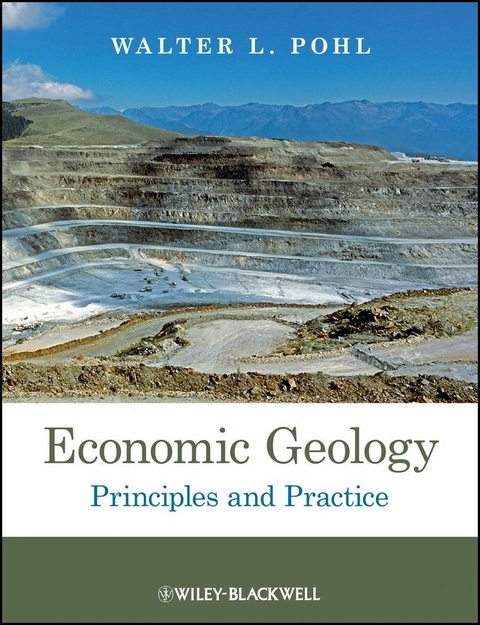
Economic Geology (eBook)
680 Seiten
John Wiley & Sons (Verlag)
978-1-4443-9486-3 (ISBN)
caused by a growing global population and ever increasing
standards of living, has resulted in economic geology
becoming a subject of urgent importance.
This book provides a broad panorama of mineral deposits,
covering their origin and geological characteristics, the
principles of the search for ores and minerals, and the
investigation of newly found deposits. Practical and environmental
issues that arise during the life cycle of a mine and after its
closure are addressed, with an emphasis on sustainable and "green"
mining.
The central scientific theme of the book is to place the
extraordinary variability of mineral deposits in the frame of
fundamental geological processes.
The book is written for earth science students and practicing
geologists worldwide. Professionals in administration, resource
development, mining, mine reclamation, metallurgy, and mineral
economics will also find the text valuable.
Economic Geology is a fully revised translation of the
the fifth edition of the German language text Mineralische und
Energie-Rohstoffe.
Additional resources for this book can be found
at: href="http://www.wiley.com/go/pohl/geology">www.wiley.com/go/pohl/geology.
The author's website can be found at: href="http://www.walter-pohl.com/">http://www.walter-pohl.com.
Walter L. Pohl is Emeritus Professor and former Dean of the Faculty of Geosciences at the Technical University of Braunschweig, Germany, and a consulting geologist in economic, engineering and environmental geology. For more information visit http://www.walter-pohl.com.
Preface.
Introduction.
What are ore deposits?
Mining in the stress field between society and environment.
The mineral resources conundrum.
Part I Metalliferous Ore Deposits.
1 Geological ore formation process systems(metallogenesis).
Synopsis.
1.1 Magmatic Ore Formation Systems.
1.2 Supergene Ore Formation Systems.
1.3 Sedimentary Ore Formation Systems.
1.4 Diagenetic Ore Formation Systems.
1.5 Metamorphic and Metamorphosed Ore Deposits.
1.6 Metamorphogenic Ore Formation Systems.
1.7 Metallogeny - Ore Deposit Formation in Space andTime.
1.8 Genetic Classification of Ore and Mineral Deposits.
1.9 Summary and Further Reading.
2 Economic geology of metals.
Synopsis.
2.1 The Iron and Steel Metals.
2.2 Base Metals.
2.3 Precious Metals.
2.4 Light Metals.
2.5 Minor and Speciality Metals.
2.6 Summary and Further Reading.
Part II Non-Metallic Minerals and Rocks.
3 Industrial minerals, earths and rocks.
Synopsis.
3.1 Andalusite, Kyanite and Sillimanite.
3.2 Asbestos.
3.3 Barite and Celestite.
3.4 Bentonite (Smectite Rocks).
3.5 Boron.
3.6 Carbonate Rocks: Limestone, Calcite Marble, Marlstone,Dolomite.
3.7 Clay and Clay Rocks.
3.8 Diamond.
3.9 Diatomite and Tripoli.
3.10 Feldspar.
3.11 Fluorite.
3.12 Graphite.
3.12.1 Graphite deposit types.
3.13 Gypsum and Anhydrite.
3.14 Kaolin.
3.15 Magnesite.
3.16 Mica (Muscovite, Phlogopite, Vermiculite).
3.17 Olivine.
3.18 Phosphates.
3.19 Quartz and Silicon.
3.20 Quartzite.
3.21 Quartz Sand and Gravel.
3.22 Sodium Carbonate, Sulfate and Alum.
3.23 Sulphur.
3.24 Talc and Pyrophyllite.
3.25 Volcaniclastic Rocks.
3.26 Wollastonite.
3.27 Zeolites.
3.28 Summary and Further Reading.
4 Salt deposits (evaporites).
Synopsis.
4.1 Salt Minerals and Salt Rocks.
4.2 The Formation of Salt Deposits.
4.3 Post-Depositional Fate of Salt Rocks.
4.4 From Exploration to Salt Mining.
4.5 Summary and Further Reading.
Part III The Practice of Economic Geology.
5 Geological concepts and methods in the mining cycle:exploration, exploitation and closure of mines.
Synopsis.
5.1 Economic Considerations.
5.2 The Search for Mineral Deposits (Exploration).
5.3 Development and Valuation of Mineral Deposits.
5.4 Mining and the Environment.
5.5 Deep Geological Disposal of Dangerous Waste.
5.6 Summary and Further Reading.
Part IV Fossil Energy Raw Materials -- Coal, Oil andGas.
6 Coal.
Synopsis.
6.1 The Substance of Coal.
6.2 Peat Formation and Coal Deposits.
6.3 The Coalification Process.
6.4 Post-Depositional Changes of Coal Seams.
6.5 Applications of Coal Geology.
6.6 Summary and Further Reading.
7 Petroleum and natural gas deposits.
Synopsis.
7.1 Species of Natural Bitumens, Gas and Kerogen, and theirProperties.
7.2 The Origin of Petroleum and Natural Gas.
7.3 Formation of Petroleum and Natural Gas Deposits.
7.4 Exploring for Petroleum and Natural Gas Deposits.
7.5 The Exploitation of Petroleum and Natural Gas Deposits.
7.6 Tar Sand, Asphalt, Pyrobitumen and Shungite.
7.7 Oil Shales.
7.8 Environmental Aspects of Oil and Gas Production.
7.9 Summary and Further Reading.
Epilogue.
References.
Index.
"The book provides an extensive overview of natural resources
and societal issues associated with extracting raw materials."
(Economic Geology, August 2013)
"It is difficult to specify the readership that would benefit most
from this book, but advanced students of economic geology, mining
engineering and environmental studies would certainly find much of
interest by perusal of selected sections. Practitioners would also
gain insights into fields well beyond their specialities, which was
certainly the case with this reviewer. Economic Geology: Principles
and Practice merits a place on the shelves of all university and
geological society libraries." (Miner Deposita,
2011)
Tony Waltham writes, "For an impressive overview of a huge subject,
this book must take some beating." (Geology Today, 1 March
2012)
"Overall, an excellent resource for earth science and geology
students enrolled in mineral exploration and/or general mining and
reclamation programs; also very useful to practicing economic
geologists/professionals involved in mining, mine reclamation, and
environmental studies. Summing Up: Highly recommend."
(Choice, 1 January 2012)
"I highly recommend the landmark text book Economic Geology:
Principles and Practice by Walter L. Pohl, to any students,
professional geologists and others in the related industries, and
anyone interested in mineral ores, and in the environmental aspects
of economic geology. This book is especially important is a time of
escalating demand for minerals and ores of all types, in a world
facing ever increasing population and environmental and
sustainability pressures." (Blog Business World, 10 October
2011)
| Erscheint lt. Verlag | 4.3.2011 |
|---|---|
| Sprache | englisch |
| Themenwelt | Naturwissenschaften ► Geowissenschaften ► Geologie |
| Technik | |
| Schlagworte | Angewandte u. ökonomische Geologie • Angewandte u. ökonomische Geologie • earth sciences • Economic & Applied Geology • Geologie • Geowissenschaften |
| ISBN-10 | 1-4443-9486-X / 144439486X |
| ISBN-13 | 978-1-4443-9486-3 / 9781444394863 |
| Informationen gemäß Produktsicherheitsverordnung (GPSR) | |
| Haben Sie eine Frage zum Produkt? |
 EPUB (Adobe DRM)
Kopierschutz: Adobe-DRM
Adobe-DRM ist ein Kopierschutz, der das eBook vor Mißbrauch schützen soll. Dabei wird das eBook bereits beim Download auf Ihre persönliche Adobe-ID autorisiert. Lesen können Sie das eBook dann nur auf den Geräten, welche ebenfalls auf Ihre Adobe-ID registriert sind.
Details zum Adobe-DRM
Dateiformat: EPUB (Electronic Publication)
EPUB ist ein offener Standard für eBooks und eignet sich besonders zur Darstellung von Belletristik und Sachbüchern. Der Fließtext wird dynamisch an die Display- und Schriftgröße angepasst. Auch für mobile Lesegeräte ist EPUB daher gut geeignet.
Systemvoraussetzungen:
PC/Mac: Mit einem PC oder Mac können Sie dieses eBook lesen. Sie benötigen eine
eReader: Dieses eBook kann mit (fast) allen eBook-Readern gelesen werden. Mit dem amazon-Kindle ist es aber nicht kompatibel.
Smartphone/Tablet: Egal ob Apple oder Android, dieses eBook können Sie lesen. Sie benötigen eine
Geräteliste und zusätzliche Hinweise
Buying eBooks from abroad
For tax law reasons we can sell eBooks just within Germany and Switzerland. Regrettably we cannot fulfill eBook-orders from other countries.
aus dem Bereich