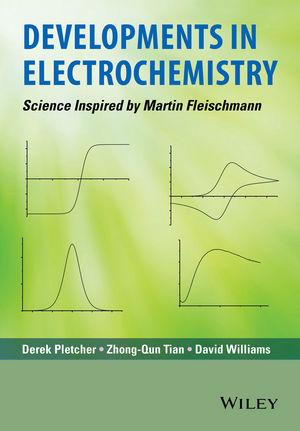
Developments in Electrochemistry (eBook)
John Wiley & Sons (Verlag)
978-1-118-69434-3 (ISBN)
Martin Fleischmann was truly one of the ‘fathers’ of modern electrochemistry having made major contributions to diverse topics within electrochemical science and technology. These include the theory and practice of voltammetry and in situ spectroscopic techniques, instrumentation, electrochemical phase formation, corrosion, electrochemical engineering, electrosynthesis and cold fusion.
While intended to honour the memory of Martin Fleischmann, Developments in Electrochemistry is neither a biography nor a history of his contributions. Rather, the book is a series of critical reviews of topics in electrochemical science associated with Martin Fleischmann but remaining important today. The authors are all scientists with outstanding international reputations who have made their own contribution to their topic; most have also worked with Martin Fleischmann and benefitted from his guidance.
Each of the 19 chapters within this volume begin with an outline of Martin Fleischmann’s contribution to the topic, followed by examples of research, established applications and prospects for future developments.
The book is of interest to both students and experienced workers in universities and industry who are active in developing electrochemical science.
Martin Fleischmann was truly one of the fathers of modern electrochemistry having made major contributions to diverse topics within electrochemical science and technology. These include the theory and practice of voltammetry and in situ spectroscopic techniques, instrumentation, electrochemical phase formation, corrosion, electrochemical engineering, electrosynthesis and cold fusion. While intended to honour the memory of Martin Fleischmann, Developments in Electrochemistry is neither a biography nor a history of his contributions. Rather, the book is a series of critical reviews of topics in electrochemical science associated with Martin Fleischmann but remaining important today. The authors are all scientists with outstanding international reputations who have made their own contribution to their topic; most have also worked with Martin Fleischmann and benefitted from his guidance. Each of the 19 chapters within this volume begin with an outline of Martin Fleischmann s contribution to the topic, followed by examples of research, established applications and prospects for future developments. The book is of interest to both students and experienced workers in universities and industry who are active in developing electrochemical science.
Derek Pletcher is Emeritus Professor at the University of Southampton. His research interests extend from fundamental electrochemistry, through electrochemical engineering to the industrial applications of electrolysis. He is the author of ~ 340 technical papers and ~ 30 reviews and has supervised the training of more than 90 postgraduate students. In 2010, he was awarded the prestigious Vittorio de Nora Medal by the US Electrochemical Society for his work related to the applications of electrochemistry. He is an elected Fellow of the Electrochemical Society (2005) and was awarded their Henry Linford Medal for Teaching Excellence in Electrochemistry (2006). He is a past Editor of the Journal of Applied Electrochemistry (1980 - 85) and presently serves on the Editorial Boards of Electrochimica Acta and Electrochemical Communications. Zhong-Qun Tian heads the Surface-enhanced Raman Spectroscopy and Nano-electrochemistry research group at Xiamen University. He graduated from the Department of Chemistry at Xiamen University in 1982 with a BSc and received his Ph.D in 1987 under advisor, Martin Fleischmann, FRS. He is a Fellow of International Society of Electrochemistry (ISE), 2010- ;Regional Representative (China) of International Society of Electrochemistry (ISE), 2007-2009; Fellow of Royal Society of Chemistry, UK, 2005- ; Council Member of Chinese Society of Micro/Nano Technology, 2005-; Guest Professor of Chemistry, Chinese University of Hong Kong, China, 2006-; Guest Professor of Chemistry, Univ. of Science and Technology of China, China, 2001-; Visiting Professor of Ecole Normal Superior, Paris, France, 2008/9. He has over 310 papers, five chapters in encyclopaedias and books and has edited two special journal issues. David Williams is Professor of Electrochemistry at the University of Auckland, NZ. His research covers electrochemistry and corrosion science. He is a graduate of the University of Auckland and developed his research career in electrochemistry and chemical sensors at the UK Atomic Energy Research Establishment, in the 1980s. He became Thomas Graham Professor of Chemistry at UCL in 1991. He joined the faculty of the Chemistry Dept at Auckland University in 2006. He is an Adjunct Professor at Dublin City University. He is a Visiting Professor at UCL, and University of Southampton, and Honorary Professor of the Royal Institution of Great Britain. He has published around 200 papers in international journals, and is the inventor of around 40 patents.
1. Martin Fleischmann
2. A Critical Review of the Methods Available for Quantitative Evaluation of Electrode Kinetics at Stationary Macrodisc Electrodes
3. Electrocrystallisation: Modelling and Its Applications
4. Nucleation and Growth of New Phases on Electrode Surfaces
5. Organic Electrochemistry
6. Electrochemical Engineering and Cell Design
7. Electrochemical Surface-Enhanced Raman Spectroscopy: Early History, Principles, Methods and Experiments
8. Applications of Electrochemical Surface Enhanced Raman Spectroscopy
9. In-situ Scanning Probe Microscopies - Imaging and Beyond
10. In-situ Infrared Spectroelectrochemical Studies of the Hydrogen Evolution Reaction
11. Electrochemical Noise - A Powerful General Tool
12. From Microelectrodes to Scanning Electrochemical Microscopy
13. Cold Fusion after a Quarter Century: The Pd/D System
14. In situ X-ray Diffraction of Electrode Surface Structure
15. Tribocorrosion
16. Hard Science at Soft Interfaces
17. Electrochemistry in Unusual Fluids
18. Aspects of Light-Driven Water Splitting
19. Electrochemical Impedance Spectroscopy
Appendix - The Publications of Martin Fleischmann
"The high quality chapters presented in this volume contribute greatly to achieving the editors' goal." (Chromatographia, 1 May 2015)
1
Martin Fleischmann1 – The Scientist and the Person
A group of electrochemists whose lives were enhanced by their contacts with Martin Fleischmann have joined together to produce this book; it is intended to celebrate the legacy that he has left to modern electrochemistry. Martin was an outstanding scientist with a great vision that allowed him to initiate a number of fields of activity. His detailed grasp of chemistry, physics and mathematics provided a background for a continuous flow of new approaches and experiments. Martin was essentially “an ideas man.” Indeed, often his ideas were ahead of the ability of equipment to carry out the experiments, and it was only a few years later that the ideas came to fruition and it became possible to obtain high-quality experimental data. As can be seen by the authorship of the following chapters, this ability to be ahead of “the state-of-the-art,” combined with inspirational leadership, made him a reliable stepping stone to successful careers for many of his coworkers. His enthusiasm for science, combined with a very warm personality and a lifetime's interest in the arts, skiing, food and wine, led him to have a large group of friends, ex-students and other coworkers, throughout the world. Stories about Martin abound, and a few of these are set out below. Indeed, the affection with which Martin is held can be seen in all the following chapters. All authors have, however, been asked to concentrate on the developments from the work of Fleischmann that are important now, and hence to produce a book that is relevant to “Electrochemistry in 2014.” This would surely have been the wish of Martin Fleischmann.
Martin Fleischmann FRS was born in Karlsbad, Czechoslovakia in March 1927 to a wealthy, German-speaking family. His father was a well-known lawyer and his mother the daughter of a senior Austrian civil servant whose family traced its roots back to the thirteenth century in Prague. In Martin's own words, he was born into a castle with a fantastic collection of paintings. All this was to change dramatically, however. His parents were vocal opponents of the Nazi regime and, inevitably, they were forced to flee their home and leave behind all their possessions. They arrived in England after a lengthy and dangerous journey by taxi and train through Germany and Holland with a total of £1.30 in their purse! Following a period living in a “chicken hut,” and the death of his father resulting from injuries received during a period of imprisonment by the Nazis, the family circumstances began to improve. Support from a refugee committee led to the lease of a cottage in Rustington (Sussex), where his mother was to start a business making dolls (that was to continue for more than 30 years, http://www.oldcottagedolls.co.uk) and Martin went back to education at Worthing High School for Boys. During the war he served in the Czech Air Force Training Unit. Martin was both an Undergraduate and Postgraduate in the Department of Chemistry at Imperial College London. During these student days he courted – and married – Sheila, who was to be his wife and support for 62 years. Together, they brought up three children, Nicholas, Vanessa and Charlotte, and Martin was always a devoted and stimulating father. He died on August 3rd, 2012 at the age of 85 after an extended illness.
His introduction to electrochemistry was as a PhD student with Professor Herrington at Imperial College. His own project concerned the diffusion of electrogenerated hydrogen through thin palladium foils! Importantly to his later career, he became part of a larger group that included John Bockris, Brian Conway and Roger Parsons, all to become leading figures in the world of electrochemistry. These contacts led to a stimulating environment for discussion and catalyzed broad interests in electrochemistry. After graduation in 1951, Martin went to the University of Newcastle where he was to interact with Lord Wynne-Jones, Reg Thirsk, Alan Bewick, Ron Armstrong and Frank Goodridge, amongst others. He was quickly promoted to a Readership before, in 1967, being appointed to the Faraday Chair of Chemistry at the University of Southampton where, with the support of Graham Hills, he was to establish a large Electrochemistry Group that soon had a worldwide reputation and still flourishes today. Key colleagues included Alan Bewick, Pat Hendra, Bob Jannson, Laurie Peter, Derek Pletcher, Jim Robinson and David Schiffrin. His work in Newcastle and Southampton led to numerous contributions in:
- Electrochemical nucleation and phase growth
- Surface-enhanced Raman spectroscopy
- In-situ X-ray techniques
- Potentiostat design
- Microelectrodes
- Theory and development of electroanalytical techniques
- Organic electrochemistry
- Electrolytic cell design and electrochemical engineering
- Corrosion
- Electrodes in biological science.
Martin was a consummate mathematician and liked nothing better than a model leading either to “back-of-the-envelope calculations” or many pages of equations; those who worked with him were regularly presented with 20 pages of mathematics, scribbled the evening before and often requiring one to learn about new mathematical transforms or functions! The idea was always to fit experimental data to the resulting equations, and hence to gain insight into the fundamentals of the electrode reaction mechanism. Martin already had the interpretation and conclusions fully worked out and ready for discussion!
During the late 1960s and throughout the 1970s, Southampton was an exciting place for electrochemists. Lectures and longer visits by the world's most distinguished electrochemists were frequent, while Martin was always full of ideas for new experiments and would discuss them energetically. The Electrochemistry Laboratory was bigger than many entire Chemistry Departments at the time, and it had many diverse projects. The atmosphere at Southampton at the time is captured in Jim McQuillan's recollection: “From June 1972, I was a postdoctoral fellow at Southampton with Martin Fleischmann and Pat Hendra. Both Martin and Pat were innovative scientists who enjoyed competing with each other in scientific brainstorming and both were excited by the prospect of audacious experiments. I well remember those sessions when ideas were flying.”
Pat Hendra's view was that Martin used him as an intellectual “punch bag.” Pat particularly remembers one morning (and there were many like it) when he was giving a tutorial to a small group of undergraduates. Suddenly, the door crashed open, unseating a secretary whose desk was behind the door, and in advanced the “Great Man,” as Pat always called him. With the oh so familiar words, “I've had an idea,” he started to outline it! He was, of course, bearing a coffee cup in his left hand and spilling some on the floor! Several minutes later, after repeated reassurances that Pat would find him after the end of teaching, Martin left to acquire another coffee while Pat returned to his students. No more tutorial – they were speechless. “Who was THAT?” Pat was left to explain that they had been privileged to see a genius at work!
Martin was involved in the early years of the International Society of Electrochemistry, and served as both its Secretary/Treasurer (1964–1967) and President (1973–1974). He was for a period Head of Chemistry in Southampton, and also served on Research Councils and National Committees, duties that he carried out in his own particular style. Again, his lasting contributions were ideas. He was not a detailed administrator; Derek Pletcher describes how Martin's office was always covered with stacks of reports/correspondence and so on, and if your particular interest dropped below a certain level in the piles you were wise to sneak in and return it to the top of the stack. Martin's then secretary, Kate, had a system where piles were regularly moved to boxes in a cupboard and then destroyed, if MF had not noticed, in two years! Derek also commented that he used to tease Martin: “The only admin that you do efficiently is to book your skiing holidays.” Despite these shortcomings, Martin was an effective leader with a great talent for inspiring novel research activity.
Martin's work led to a large number of publications in scientific journals (see the list below), many plenary lectures at conferences, and also invitations to visit laboratories throughout the world. Recognition peaked with the election to Fellowship of the Royal Society in 1985. He was also awarded several medals, perhaps the most prestigious being the Electrochemistry and Thermodynamics Medal (1979) of the Royal Society of Chemistry, and the Olin Palladium Medal (1986) of the US Electrochemical Society.
Martin Fleischmann took early retirement from Southampton in 1983 but, despite some serious health problems, he was to remain a very active scientist for a further 25 years. He continued to collaborate with colleagues in Southampton but spent extended periods at Harwell, the University of Utah, and the Laboratories of IMRA (part of Toyota) in the South of France. David Williams remembers first meeting Martin on a staircase during a scientific meeting and asking whether he would like to think about applying stochastic modeling to the problem of pitting corrosion; this topic piqued Martin's interest and led to a longstanding collaboration. The period with Stan Pons in...
| Erscheint lt. Verlag | 3.6.2014 |
|---|---|
| Sprache | englisch |
| Themenwelt | Naturwissenschaften ► Chemie ► Physikalische Chemie |
| Technik ► Maschinenbau | |
| Schlagworte | Analytical Chemistry • Analytische Chemie • Biography • Book • Chemie • Chemistry • Contributions • Electrochemical • Electrochemistry • Elektrochemie • Fathers • Fleischmann • History • Major • Martin • materials characterization • Materials Science • Materialwissenschaften • Memory • Modern • Nor • Practice • series • Situ • Spectroscopic • techniques • theory • topics within • Voltammetry • Werkstoffprüfung • Werkstoffprüfung |
| ISBN-10 | 1-118-69434-1 / 1118694341 |
| ISBN-13 | 978-1-118-69434-3 / 9781118694343 |
| Informationen gemäß Produktsicherheitsverordnung (GPSR) | |
| Haben Sie eine Frage zum Produkt? |
 EPUB (Adobe DRM)
Kopierschutz: Adobe-DRM
Adobe-DRM ist ein Kopierschutz, der das eBook vor Mißbrauch schützen soll. Dabei wird das eBook bereits beim Download auf Ihre persönliche Adobe-ID autorisiert. Lesen können Sie das eBook dann nur auf den Geräten, welche ebenfalls auf Ihre Adobe-ID registriert sind.
Details zum Adobe-DRM
Dateiformat: EPUB (Electronic Publication)
EPUB ist ein offener Standard für eBooks und eignet sich besonders zur Darstellung von Belletristik und Sachbüchern. Der Fließtext wird dynamisch an die Display- und Schriftgröße angepasst. Auch für mobile Lesegeräte ist EPUB daher gut geeignet.
Systemvoraussetzungen:
PC/Mac: Mit einem PC oder Mac können Sie dieses eBook lesen. Sie benötigen eine
eReader: Dieses eBook kann mit (fast) allen eBook-Readern gelesen werden. Mit dem amazon-Kindle ist es aber nicht kompatibel.
Smartphone/Tablet: Egal ob Apple oder Android, dieses eBook können Sie lesen. Sie benötigen eine
Geräteliste und zusätzliche Hinweise
Buying eBooks from abroad
For tax law reasons we can sell eBooks just within Germany and Switzerland. Regrettably we cannot fulfill eBook-orders from other countries.
aus dem Bereich