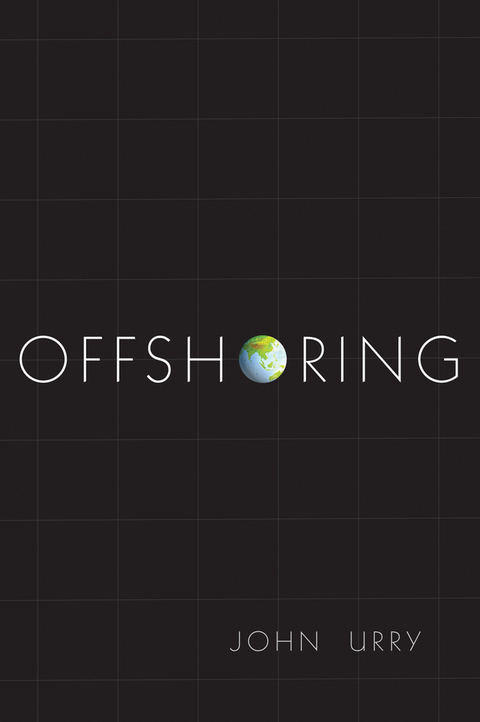
The concealment of income, wealth and profits in tax havens has brought the topic of offshoring into public debate, but as John Urry shows in this important new book offshoring is a much more pervasive feature of contemporary societies. These often secretive activities offshore also involve relations of work, finance, pleasure, waste, energy and security. Powerful and pervasive offshore worlds have been generated, posing huge challenges both for governments and for citizens.
This book documents the various patterns of offshoring Ð of the economy, sociability, politics and the environment. In each case, offshoring generates new patterns of power, reduces the responsibilities of the powerful 'offshore class', and limits the conditions for democratic governance. Offshore, out of sight, over the horizon are some of the troubling processes and metaphors by which much life has been rendered opaque and dependent upon secrets and lies. By analysing these patterns and processes, Urry sheds fresh light on the hidden worlds of offshoring and exposes the dark side of globalization.
The book concludes by considering whether offshoring can be reversed Ð whether it is possible to bring about the systematic ‘reshoring’ of relations that would be good for democracy and for developing low-carbon futures. Urry portrays the coming century as being poised between even more extreme offshoring and various endeavours to bring back 'home' that which has currently escaped 'over the horizon'.
The concealment of income, wealth and profits in tax havens has brought the topic of offshoring into public debate, but as John Urry shows in this important new book offshoring is a much more pervasive feature of contemporary societies. These often secretive activities offshore also involve relations of work, finance, pleasure, waste, energy and security. Powerful and pervasive offshore worlds have been generated, posing huge challenges both for governments and for citizens. This book documents the various patterns of offshoring of the economy, sociability, politics and the environment. In each case, offshoring generates new patterns of power, reduces the responsibilities of the powerful 'offshore class', and limits the conditions for democratic governance. Offshore, out of sight, over the horizon are some of the troubling processes and metaphors by which much life has been rendered opaque and dependent upon secrets and lies. By analysing these patterns and processes, Urry sheds fresh light on the hidden worlds of offshoring and exposes the dark side of globalization. The book concludes by considering whether offshoring can be reversed whether it is possible to bring about the systematic reshoring of relations that would be good for democracy and for developing low-carbon futures. Urry portrays the coming century as being poised between even more extreme offshoring and various endeavours to bring back 'home' that which has currently escaped 'over the horizon'.
John Urry (1946-2016) was Distinguished Professor of Sociology at Lancaster University
Preface
Chap 1: What is Offshoring?
Chap 2: Secrets
Chap 3: Work Offshored
Chap 4: Taxing Offshored
Chap 5: Leisure Offshored
Chap 6: Energy Offshored
Chap 7: Waste Offshored
Chap 8: Security Offshored
Chap 9: Out to Sea and Out of Sight
Chap 10: Bringing it all Back Home
Index
"An informative accounting of the consequences of an offshoring world and an impassioned critique of the offshored condition."
Theory, Culture & Society
"Offshoring shines a light on yet another of the shadowy realms upon which contemporary capitalist normalities rest."
Times Higher Education
"Urry writes with clarity and offers very useful examples to explain points.I would strongly recommend this book for teachers to purchase copies to be placed in their school/college/department libraries so that students can pursue the negative side of Globalisation in detail and be aware of lots of contemporary examples."
The Sociology Teacher
''Exposing capitalism's expanding economy of secrecy, John Urry reveals a terrifying picture of catastrophes waiting to happen, of global inequalities difficult to comprehend, and of human rights violations on an appalling scale. Sociology at its best, warning us of the worst. Offshoring should be required reading for all undergraduates.''
Michael Burawoy, University of California, Berkeley
''This is one point of John Urry's thought provoking book: the outside suggested by the concept of 'offshoring' no longer exists. Therefore politics of offshoring today are simultaneously domestic and global. And like Urry so excitingly does we have to ask: how can the 'outsourced' citizen of the world be included in decisions which affect their survival?''
Ulrich Beck, University of Munich
1
What Is Offshoring?
The problem
Warren Buffett, sometimes described as the twentieth century's most successful investor, recently maintained: ‘There is class warfare, all right, but it's my class, the rich class, that's making war, and we're winning.’1 This book describes in detail how this rich class did indeed wage class war and has so far won that war, partly through deploying the relatively new and striking strategy of offshoring. I document how this strategy came to be implemented as a key element in enabling the rise and rise of the rich class. The informal term ‘rich class’ refers to the putative global class made up of high net worth individuals and families, the owners/managers of major corporations and professional service companies, many thinktanks, and leading policy-makers.
To illustrate the significance of offshoring, consider ActionAid's major study published in May 2013. It reports that ninety-eight of the hundred largest publicly listed UK corporations (FTSE 100) own subsidiaries, associates, or joint ventures offshore in what that charity defines as ‘tax havens’.2 Moreover, corporations typically hold many such accounts. ActionAid reported that advertising giant WPP held 618 offshore accounts, HSBC 496, Royal Dutch Shell 473, Barclays 471, BP 457, RBS 393, Lloyds 259, British Land 187 and Prudential 179. The banking sector is the most prolific user of tax havens, with over half of the overseas subsidiaries of major banks being located in ‘treasure islands’ of low tax.3
Tax havens are also sometimes known as ‘secrecy jurisdictions’. Most corporations and wealthy people locate their income and wealth offshore in such secret locations. Often it seems that ‘only the little people pay tax’,4 with the rich class able to direct their wealth and much else ‘offshore’ and very often out of sight.
Moreover, these companies are built rather like Russian dolls, with multiple layers of secrecy and concealment.5 For example, there is a company called Goldman Sachs Structured Products (Asia) Limited based in the tax haven of Hong Kong. It is controlled by another company called Goldman Sachs (Asia) Finance, which is registered in another tax haven, namely Mauritius. That is administered by a further company in Hong Kong, which in turn is directed by a company located in New York. This is controlled by another company in Delaware, a major tax haven, and that company is administered by yet another company, also in Delaware, GS Holdings (Delaware) L.L.C. II. This in turn is a subsidiary of the only Goldman company that most people have actually heard of, namely the Goldman Sachs Group which occupies a glitzy tower completed in 2010 and located in Battery City Park in New York City. This company generated in 2012 a worldwide turnover of around US$34 billion and employed nearly 30,000 staff.
This chain of ownership is one of hundreds of such chains within the single company Goldman Sachs. Overall Goldman Sachs consists of more than 4,000 separate corporate entities scattered across the world, many offshore. Some of these entities lie ten layers of control below the New York headquarters. Around one-third are registered in tax havens; and in the world of Goldman Sachs the Cayman Islands are larger than South America, and Mauritius is bigger than Africa!
This book explores how this world of offshoring came into being and some of its major consequences. Offshoring affects countries losing taxation, especially in the developing world, and the seventy or so tax havens. Moreover, this is an issue not just of money and taxation but of many other processes that are offshored and wholly or partly rendered secret, including manufacturing industry, pleasure, energy, waste, carbon dioxide emissions and security. All of these are to some degree offshored and situated in ‘secret locations’. As they go offshore they are linked together in various chains of concealment. As Shaxson more generally argues: ‘offshore is how the world of power now works.’6 This world of offshored power is what this book seeks to reveal. In the next section the strategy of offshoring is placed within a brief historical context.
Beyond borders
All societies entail the movement of peoples and objects, but capitalist societies elevate its scale and impact. Much social thought has described capitalism's continuous and restless movement.7 In 1848 Karl Marx and Friedrich Engels described how, over the previous century, the bourgeoisie had created more extensive productive forces than all preceding generations.8 The need for a constant expanding market caused the bourgeoisie to chase over the surface of the globe, forcing fixed, fast-frozen relations to be swept away. All that is solid, Marx and Engels maintained, melted into air. The cheap prices of commodities produced by capitalist factories ‘battered down all Chinese walls’, undermined ‘national one-sidedness’ and created a world in its own bourgeois image. Marx and Engels pointed to the increasing ‘cosmopolitan character’ of production and consumption, describing how the exploitation of workers was regularly ‘shifted elsewhere’ as new cities and factories were developed, while older ones were destroyed.9
So capitalism is all about movement and especially the movement of capital and of workers. Capitalist societies involve a restless acceleration of economic, social and political life. This speeding up of movement is thought to have developed especially during the last quarter of the last century. Much academic and policy writing emphasised how the contemporary world was becoming ‘borderless’, with many frontiers increasingly irrelevant to how people's accelerating lives were lived and experienced.10
Writing in 1990, Ohmae famously described this borderless world: ‘the free flow of ideas, individuals, investments and industries … the emergence of the interlinked economy brings with it an erosion of national sovereignty as the power of information directly touches local communities; academic, professional, and social institutions; corporations; and individuals.’11 Ohmae optimistically argued that this borderless world would engender boundless economic and social growth. Borderlessness would generate new business opportunities, international friendship, family lives organised across distance, international understanding, greater openness of information and more wealth.
At least a hundred studies each year documented the nature and impact of many global processes. Overall it seemed that economies, finance, media, migration, tourism, politics, family life, friendship, the environment, the internet, and so on, were becoming less structured within nation-states and increasingly organised across the globe.12 Some analyses emphasised an increased density of interactions across the globe, with the liberalising of world trade, the internationalising of production, the globalising of commodity consumption, the declining costs of transport and communications, and the internationalising of investment. Global corporations seemed able to operate on a worldwide basis, with reduced long-term commitment to specific places, labour forces or societies.
Other studies detailed the global infrastructures that linked together people and places around the world. Further analysts argued that the ‘global’ is to be viewed more as a set of effects brought about by powerful actors undermining national limitations upon the free flow of information, images, people and money. The ‘global’ here is something performed through the actions and writings of free-market consultants, such as Ohmae, as they contest the powers of ‘old-fashioned’ national states to make and uphold national laws and regulations.13
Overall it was thought to be good to move, as well as to receive these various flows of people and objects arriving from other places. Many analysts believed that mobilities would reinvigorate societies through new ideas, information and people, thus making societies, places and people more ‘cosmopolitan’. Old-fashioned structures would dissolve.14 Social theorist Bauman conceptualised these processes as constituting a ‘liquid modernity’, contrasting it with a more fixed and stable older modernity.15
In developing such a mobile global order, a cluster of system changes occurred around 1990 as Ohmae was analysing and advocating the notion of borderlessness. First, Soviet communism disappeared almost overnight, partly because of its failure to develop and embed new informational technologies. Especially following the demolition of the Berlin Wall in 1989, many significant barriers to the flow of information, people and capital dissolved across Europe, with some Soviet bloc countries joining the European Union – which has as its goal reducing many barriers to movement.
Second, new systems of global news reporting developed. The First Gulf War in 1991 was the first major event in which there was 24-hour real-time reporting around the world. This generated a ‘global stage/screen’ for many major events: wars, terrorist atrocities, sports events, concerts, celebrity scandals, and so on. These became more mediatised, visible and apparently shared. New social media transformed the character and temporality of information and rumour circulating around the world and arriving from ‘elsewhere’.
Third, during the late 1980s,...
| Erscheint lt. Verlag | 5.6.2014 |
|---|---|
| Sprache | englisch |
| Themenwelt | Naturwissenschaften ► Geowissenschaften ► Geografie / Kartografie |
| Sozialwissenschaften ► Politik / Verwaltung | |
| Sozialwissenschaften ► Soziologie ► Spezielle Soziologien | |
| Wirtschaft ► Volkswirtschaftslehre ► Makroökonomie | |
| Schlagworte | Ãkonomische Soziologie • Economic Geography • Geographie • Geography • Offshoring, globalization, tax havens, energy, security, waste disposal • Ökonomische Soziologie • Sociology • Sociology of Economics • Soziologie • Wirtschaftsgeographie |
| ISBN-10 | 0-7456-8462-9 / 0745684629 |
| ISBN-13 | 978-0-7456-8462-8 / 9780745684628 |
| Informationen gemäß Produktsicherheitsverordnung (GPSR) | |
| Haben Sie eine Frage zum Produkt? |
 EPUB (Adobe DRM)
Kopierschutz: Adobe-DRM
Adobe-DRM ist ein Kopierschutz, der das eBook vor Mißbrauch schützen soll. Dabei wird das eBook bereits beim Download auf Ihre persönliche Adobe-ID autorisiert. Lesen können Sie das eBook dann nur auf den Geräten, welche ebenfalls auf Ihre Adobe-ID registriert sind.
Details zum Adobe-DRM
Dateiformat: EPUB (Electronic Publication)
EPUB ist ein offener Standard für eBooks und eignet sich besonders zur Darstellung von Belletristik und Sachbüchern. Der Fließtext wird dynamisch an die Display- und Schriftgröße angepasst. Auch für mobile Lesegeräte ist EPUB daher gut geeignet.
Systemvoraussetzungen:
PC/Mac: Mit einem PC oder Mac können Sie dieses eBook lesen. Sie benötigen eine
eReader: Dieses eBook kann mit (fast) allen eBook-Readern gelesen werden. Mit dem amazon-Kindle ist es aber nicht kompatibel.
Smartphone/Tablet: Egal ob Apple oder Android, dieses eBook können Sie lesen. Sie benötigen eine
Geräteliste und zusätzliche Hinweise
Buying eBooks from abroad
For tax law reasons we can sell eBooks just within Germany and Switzerland. Regrettably we cannot fulfill eBook-orders from other countries.
aus dem Bereich