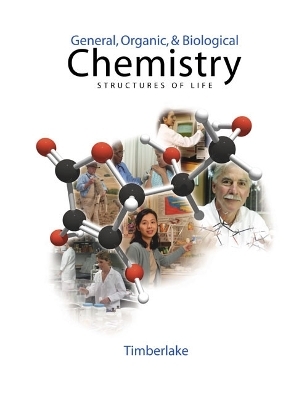
General, Organic, and Biological Chemistry
Pearson
978-0-321-04283-5 (ISBN)
- Titel ist leider vergriffen;
keine Neuauflage - Artikel merken
General, Organic, and Biological Chemistry provides a readable, uncomplicated and accessible introduction to students in allied health and other fields who have little or no background in chemistry. Timberlake uses the same style and integrated pedagogy that have made her one-semester text so successful in the classroom. She balances technical accuracy and everyday examples to help bring chemistry to life for students.
Karen C. Timberlake is a Professor of Chemistry at Los Angeles Valley College where she has taught chemistry for over 30 years. She has been writing textbooks for more than 20 years and was the regional winner of the 1985 Award for Excellence in Teaching from the Chemical Manufacturers Association. Her educational interests include the investigation, development, and utilization of teaching methods that successfully impact the learning of chemistry. She has provided numerous workshops on student-centered learning strategies for teaching chemistry over the last decade. For ten years, she has been a visiting professor at UCLA where she has taught a preparatory class using non-traditional teaching methods.
1. Measurements.
Units of Measurement.
Scientific Notation.
Measured and Exact Numbers.
Significant Figures.
Significant Figures in Calculations.
SI and Metric Prefixes.
Problem Solving Using Conversion Factors.
Density.
Temperature.
2. Atoms and Elements.
Elements and Symbols.
The Periodic Table.
The Atom.
Atomic Number and Mass Number.
Isotopes and Atomic Mass.
Electron Energy Levels.
Subshells and Orbitals.
Electron Configuration.
3. Nuclear Radiation.
Natural Radioactivity.
Nuclear Equations.
Producing Radioactive Isotopes.
Radiation Detection and Measurement.
Half-Life of Radioisotope.
Medical Applications Using Radioactivity.
Nuclear Fission and Fusion.
4. Compounds and Their Bonds.
Valence Electrons.
Octet Rule and Icons.
Iconic Compounds.
Naming and Writing Ionic Formulas.
Covalent Bonds.
Naming and Writing Formulas of Covalent Compounds.
Bond Polarity.
Polyatomic Ions.
Shapes of Molecules.
Polar and Nonpolar Molecules.
5. Energy and States Of Matter.
Energy.
Measuring Heat Energy.
Energy and Nutrition.
States of Matter.
Attractive Forces between Particles.
Melting and Freezing.
Boiling and Condensation.
Heating and Cooling Curves.
6. Chemical Reactions.
Chemical Changes.
Chemical Equations.
Balancing a Chemical Equation.
Types of Reactions.
Oxidation-Reduction Reactions.
Energy in Chemical Reactions.
Rate of Reaction.
Chemical Equilibrium.
7. Chemical Quantities.
The Mole.
Molar Mass.
Calculations Using Molar Mass.
Percent Composition and Empirical Formulas.
Mole Relationships in Chemical Equations.
Mass Calculations for Reactions.
Percent Yield.
Equilibrium Constants.
8. Gases.
Properties of Gases.
Gas Pressure.
Pressure and Volume (Boyle's Law).
Temperature and Volume (Charles' Law).
Temperature and Pressure (Gay-Lussac's Law).
The Combined Gas Law.
Volume and Moles (Avogadro's Law).
Ideal Gas Law.
Partial Pressures (Dalton's Law).
9. Solutions.
Properties of Water.
Solutions.
Electrolytes and Nonelectrolytes.
Equivalents.
Solubility.
Percent Concentration.
Molarity.
Colloids and Suspensions.
Osmosis and Dialysis.
10. Acids and Bases.
Acid and Bases.
Conjugate Acid and Base Pairs.
Strengths of Acids and Bases.
Dissociation Constants.
Ionization of Water.
The pH Scale.
Reactions of Acids and Bases.
Acidity of Salt Solutions.
Buffers.
Dilutions.
Acid-Base Titration.
11. Introduction to Organic Chemistry.
Organic Compounds.
The Tetrahedral Shape of Carbon.
Polarity of Organic Molecules.
Properties of Organic Compounds.
Functional Groups.
Constitutional Isomers.
12. Alkanes.
Alkanes.
IUPAC Naming System for Alkanes.
Drawing Structural Formulas.
Haloalkanes.
Cycloalkanes.
Physical Properties of Alkanes and Cycloalkanes.
Chemical Properties of Alkanes and Cycloalkanes.
13. Unsaturated Hydrocarbons.
Alkenes and Alkynes.
Naming Alkenes and Alkynes.
Cis-Trans Isomers.
Addition Reactions.
Polymerization.
Aromatic Compounds.
Properties of Aromatic Compounds.
14. Alcohols, Phenols, Ethers, and Thiols.
Structure and Classification of Alcohols.
Naming Alcohols, Phenols, and Thiols.
Some Important Alcohols and Phenols.
Ethers.
Physical Properties of Alcohols, Phenols, and Ethers.
Reactions of Alcohols.
15. Aldehydes, Ketones, and Chiral Molecules.
Structures and Bonding.
Naming Aldehydes and Ketone.
Some Important Aldehyde and Ketones.
Physical Properties.
Chiral Structures.
Oxidation and Reduction.
Addition Reactions.
16. Carbohydrates.
Types of Carbohydrates.
Classification of Monosaccharides.
D- and L- Notation from Fischer Projections.
Structures of Some Important Monosaccharides.
Cyclic Structures of Monosaccharides.
Chemical Properties of Monosaccharides.
Disaccharides.
Polysaccharides.
17. Carboxylic Acids, and Esters.
Carboxylic Acids.
Physical Properties of Carboxylic Acids.
Acidity of Carboxylic Acids.
Esters of Carboxylic Acids.
Naming Esters.
Properties of Esters.
18. Lipids.
Lipids.
Fatty Acids.
Waxes, Fats, and Oils.
Chemical Properties of Triacylglycerols.
Glycerophospholipids.
Spingolipids.
Steroids: Cholesterol, Bile Salts, and Steroid Hormones.
Cell Membranes.
19. Amines and Amides.
Amines.
Naming Amines.
Physical Properties of Amines.
Amines as Bases.
Heterocyclic Amines and Alkaloids.
Structure and Names of Amides.
Hydrolysis of Amides.
20. Amino Acids and Proteins.
Functions of Proteins.
Amino Acid Structure.
Amino Acids as Acids and Bases.
Formation of Peptides.
Protein Structure: Primary and Secondary Levels.
Protein Structure: Tertiary and Quaternary Structure.
Protein Hydrolysis and Denaturation.
21. Enzymes and Vitamins.
Biological Catalysts.
Enzyme Action.
Names and Classification of Enzymes.
Factors Affecting Enzyme Action.
Enzyme Inhibition.
Regulation of Enzyme Activity.
Enzyme Cofactors.
Vitamins.
22. Nucleic Acids and Protein Synthesis.
Components of Nucleic Acids.
Nucleosides and Nucleotides.
Structures of Nucleic Acids.
DNA Replication.
Types of RNA.
Transcription: Synthesis of RNA.
The Genetic Code.
Translation: Protein Synthesis.
Genetic Mutations.
Recombinant DNA.
Viruses and AIDS.
23. Metabolic Pathways for Carbohydrates.
Overview of Metabolism.
Biochemical Pathways.
Cell Structure.
ATP Energy.
Oxidation and Coenzymes.
Citric Acid Cycle.
Electron Transport System.
ATP and Chemiosmosis.
24. Metabolism and Energy Production.
Digestion of Carbohydrates.
Glycolysis: Oxidation of Glucose.
Pathways for Pyruvate.
Energy from Glycolysis.
Regulation of Glucose Metabolism.
Biosynthesis of Glucose.
Glycogen Metabolism.
Biosynthesis of Carbohydrates.
The Pentose Phosphate Pathway.
25. Metabolic Pathways for Lipids and Amino Acids.
Digestion of Lipids.
Utilization of Glycerol.
Oxidation of Fatty Acids.
ATP and Fatty Acid Oxidation.
Regulation of Lipid Metabolism.
Ketone Bodies.
Biosynthesis of Fatty Acids.
Biosynthesis of Triacylglycerols.
Biosynthesis of Complex Lipids.
| Erscheint lt. Verlag | 28.11.2001 |
|---|---|
| Sprache | englisch |
| Gewicht | 2208 g |
| Themenwelt | Naturwissenschaften ► Biologie ► Biochemie |
| Naturwissenschaften ► Chemie ► Organische Chemie | |
| ISBN-10 | 0-321-04283-2 / 0321042832 |
| ISBN-13 | 978-0-321-04283-5 / 9780321042835 |
| Zustand | Neuware |
| Informationen gemäß Produktsicherheitsverordnung (GPSR) | |
| Haben Sie eine Frage zum Produkt? |
aus dem Bereich