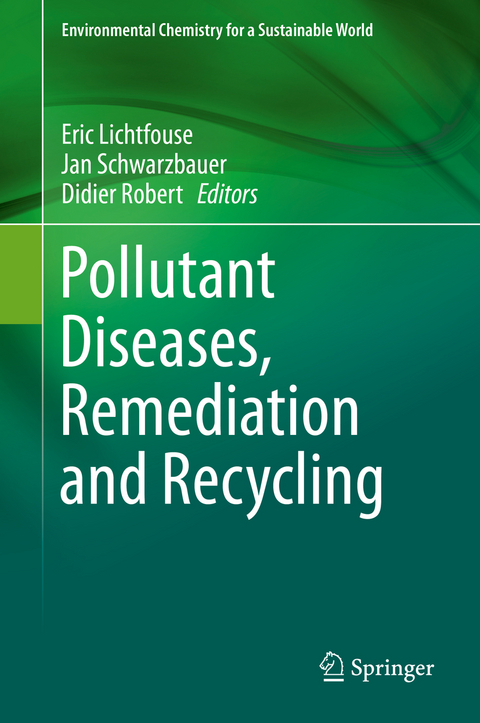
Pollutant Diseases, Remediation and Recycling (eBook)
545 Seiten
Springer International Publishing (Verlag)
9783319023878 (ISBN)

Dr. Eric Lichtfouse is Editor of scholarly journals and series in environmental chemistry and agriculture. He is heading publication assistance services and teaching scientific writing in Europe and the USA. He has done research in organic geochemistry, soil carbon dynamics and phytoremediation. Dr. Jan Schwarzbauer is Editor of the journal 'Environmental Earth Sciences' and Subject Editor of 'Journal of Soils and Sediments'. After studying chemistry at the University of Hamburg, he is working since 1998 at the RWTH Aachen University leading as full professor the group 'Environmental Organic Geochemistry'. Dr. Didier Robert is professor in organic chemistry and green chemistry at the University Paul Verlaine-Metz (France). He is associate editor of the Journal of Photocatalysis Sciences and its research activities are devoted to the decontamination of air and water by photochemical processes, especially by photocatalysis. He is also editor of the biannual magazine "UniversCity" published by UPV-Metz, dedicated to Cultures and Sciences.
Preface 6
Other Publications by the Editors 10
Contents 12
Chapter 1: School Air Quality: Pollutants, Monitoring and Toxicity 14
1.1 Introduction 15
1.2 Characteristics of the Indoor Environments, Chemical Pollutants and Their Sources Within School 17
1.2.1 Volatile Organic Compounds (VOCs) 20
Formaldehyde and Carbonyl Compounds 22
1.2.2 Particulate Matter (PM) 23
1.2.3 Carbon Dioxide CO 2 25
1.2.4 Ozone (O 3) 26
1.2.5 Other Inorganic Gases: Nitrogen Oxides (NO x), Carbon Oxide (CO), Sulphur Dioxide (SO 2) 27
1.3 Monitoring Strategies 28
1.3.1 Measurement Objective 28
1.3.2 Sampling Procedure 29
1.3.3 Sampling Duration and Frequency 30
1.3.4 Sampling Location 30
1.3.5 Parallel Outdoor Air Measurement 31
1.4 Sampling and Analysis Techniques 31
1.4.1 Volatile Organic Compounds (VOCs) 31
Formaldehyde and Carbonyl Compounds 33
1.4.2 Particulate Matter (PM) 34
Mass Concentration 34
Number and Size Distribution 35
Chemical Characterization 36
1.4.3 Inorganic Gases: Nitrogen Oxides (NO x), Carbon Oxide (CO), Sulphur Dioxide (SO 2) and Ozone (O 3) 37
1.5 An Overview of Findings from Scientific Literature 38
1.5.1 Volatile Organic Compounds (VOCs) 38
Formaldehyde and Carbonyl Compounds 40
1.5.2 Particulate Matter 41
1.5.3 Carbon Dioxide (CO 2) 44
1.5.4 Ozone (O 3) 44
1.5.5 Other Inorganic Gases: Nitrogen Oxides (NO x), Carbon Oxide (CO), Sulphur Dioxide (SO 2) 45
1.6 Conclusion 46
References 47
Chapter 2: Organic Contaminants from Industrial Wastewaters: Identification, Toxicity and Fate in the Environment 58
2.1 Introduction 61
2.2 Chemical Characterization of Industrial Wastewaters 64
2.2.1 Analytical Approaches for the Identification of Organic Contaminants in Industrial Wastewaters 64
2.2.2 Organic Contaminants Which Have Been Identified in Different Types of Industrial Wastewaters 65
2.3 Tracing Industrial Wastewaters in the Environment 79
2.4 Identification of Toxic Organic Contaminants in Industrial Wastewaters 88
2.4.1 Chemical Characterization of Industrial Wastewaters and Toxicity Evaluation 91
2.4.2 Effects-Directed Analysis 94
2.5 Chemical Evaluation of Industrial Contamination Linked to Surveys of Environmental Impacts 99
2.5.1 Industrial Contamination and Toxicity Evaluation in the Field 99
2.5.2 Industrial Contamination and Field Surveys of Ecological Changes 101
2.6 Conclusion 102
References 105
Chapter 3: Fly Ash Pollutants, Treatment and Recycling 115
3.1 Introduction 117
3.2 Fly Ash Typologies 119
3.2.1 Coal Fly Ash 119
3.2.2 Flue Gas Desulphurisation (FGD) Fly Ash 125
3.2.3 Municipal Solid Waste Incineration (MSWI) Fly Ash 126
3.2.4 Fly Ash from Biomass Matter Burning 130
3.3 Fly Ash Treatments 133
3.3.1 Heavy Metal Entrapment 135
Separation Processes 136
Washing 136
Leaching 136
Electrochemical Processes 138
Thermal Treatment 139
Solidification/Stabilisation Treatments 140
Chemical Stabilisation 141
The Ferrox ® Process 141
Phosphate Based Stabilisation Processes 142
Mechanochemistry 144
Acid Extraction 145
Chemical Fixation and Solidification with Binders 146
Cement Based Processes 146
Colloidal Silica 147
Carbonation 150
Bitumen Encapsulation 151
Geopolymer 152
Thermal Treatments 153
Vitrification 154
Conventional 154
Plasma 154
Melting (or Fusion) 156
Sintering 158
Microwave 159
3.3.2 Organic Pollutants Abatement 161
Thermal Treatment 162
Vitrification 163
Melting 163
Non-thermal Plasma Process 164
UV Irradiation (Photolytic) 165
Chemical Reaction 166
Hydrothermal Treatment 168
Supercritical Water Oxidation (SCWO) 169
S/S Mechanochemistry 170
Biological Removal 170
3.4 Fly Ash Recycling 171
3.4.1 Adsorbent 173
Nitrogen and Sulphur Oxides 174
Mercury 174
Organic Gas 175
PAH 175
Heavy Metals 176
Water Purification 176
Phosphor 179
Fluoride 179
Boron 179
Nitrogen 179
Phenols 180
Dyes 180
Closing Remarks 181
3.4.2 Agriculture 182
Metal Immobilisation and Soil Remediation 182
Impact on Soil Properties, Plant Nutrients, Plant Growth 183
Value of Preliminary Predictive Tests 184
Impact on Soil Fertility 184
Impact on Soil Biota 185
Impact of FA Amended with Organic Wastes 185
Use of FA as Container Substrate 186
Use of FA as Insecticide 186
Final Remarks 186
3.4.3 Building Materials 187
Use of FA as Replacement of Cement in Portland Cement Concrete 187
Use of FA as Pozzolanic Material in the Production of Pozzolanic Cements 188
Use of FA as Retardant Ingredient with Cement and Replacement of Gypsum 189
3.4.4 Synthesis of Zeolite 192
3.4.5 Geopolymers 195
3.4.6 Other Applications 196
Tiles 197
Glass Materials 197
Bricks 197
Other Products 197
Filling Material 198
Catalyst Constituent 198
Mesoporous Silica 199
Polymer Composite Material 199
Rubber Enforcement 200
3.4.7 Closing Remarks 200
3.5 Environmental Advantages in Fly Ash Reuse 200
3.5.1 Reduced Landfilling Disposal 202
3.5.2 Reduced Utilisation of Raw Materials 202
3.5.3 Reduction in Greenhouse Gases 202
3.5.4 Reduction in Water Consumption 203
3.5.5 Other Cost Saving Aspects 204
3.5.6 Closing Remarks 204
3.6 Conclusion 204
References 205
Chapter 4: Organotin Compounds from Snails to Humans 226
4.1 Introduction 229
4.2 Organotin Compounds: Chemical Profile, Production and Applications 230
4.2.1 Chemical Structure 230
4.2.2 Production and Industrial Applications 231
4.3 Antifouling Paints: The Organotin Family Flag Ship 234
4.3.1 The Need to Develop Antifouling Strategies 234
4.3.2 The Use of Tributyltin as Biocide in Antifouling Paints 234
4.4 Tributyltin – Or the Story of Boats, Ships and Superimposed Sex 239
4.4.1 Tributyltin Adverse Biological Effects 239
4.4.2 Imposex as a Biomarker of Tributyltin Pollution 241
Taking a Closer Look into Penis Bearing Females – N. Reticulatus Case Study 242
4.4.3 Mechanisms Underlying Imposex Induction 245
4.5 Regulating Organotin Compounds 246
4.5.1 Antifouling Paints International Regulations 246
4.5.2 European Legislation for Organotin Compounds 248
4.6 The Widespread Occurrence of Organotin Compounds 249
4.6.1 Sources and Pathways of Organotins in the Environment 249
4.6.2 Organotins Levels in the Environment 252
4.6.3 Regional and Global Biomonitoring Surveys 254
4.7 On the Way to Humans 256
4.7.1 What Goes Around, Comes Around: Unraveling Organotins in Humans 260
4.7.2 In Search for the “Ideal” Matrix to Estimate Organotin Body Burdens 266
Invasive Matrices 266
Hair and Nails 267
Urine 267
Breast Milk 268
Some Remarks Regarding Ideal Matrices 269
4.8 Conclusion 269
References 270
Chapter 5: Surfactants: Chemistry, Toxicity and Remediation 287
5.1 Introduction 288
5.2 Chemistry of Surfactants 290
5.3 Surfactant Pollution – Worldwide and the Indian Scenario 291
5.4 Safety Concerns on Surfactants 294
5.4.1 Toxicity on Microbial World 294
5.4.2 Toxicity on Soil and Plants 296
5.4.3 Toxicity to Aquatic System 298
5.4.4 Effect on Higher Vertebrates 300
5.4.5 Secondary Toxicity of Surfactants 301
5.5 Tackling Surfactant Pollution 302
5.5.1 Remediation Before Disposal 302
Physical and Chemical Methods 302
Oxidation Based Methodologies 303
Photocatalytic Degradation 303
Foam Fractionation 304
Sonochemical Degradation 304
Electrochemical Degradation 304
Biological Methods 304
5.5.2 Sewage Treatment Plants 308
5.5.3 Green Surfactants 309
Chemically Derived Green Surfactants 310
Biosurfactants as Alternate to Synthetic Surfactants 312
5.6 Conclusions 314
References 315
Chapter 6: Cadmium, Lead, Thallium: Occurrence, Neurotoxicity and Histopathological Changes of the Nervous System 331
6.1 Introduction 332
6.2 Cadmium 333
6.2.1 Sources and Exposure 333
6.2.2 General Toxicology 334
6.2.3 Mechanism of Neurotoxicity 336
6.2.4 Morphological Changes on Central Nervous System 337
6.3 Lead 340
6.3.1 Sources and Exposure 340
6.3.2 General Toxicology 341
6.3.3 Mechanism of Neurotoxicity 343
6.3.4 Morphologic Changes on Central Nervous System 345
6.4 Thallium 347
6.4.1 Sources and Exposure 347
6.4.2 General Toxicology 348
6.4.3 Mechanism of Neurotoxicity 349
6.4.4 Morphologic Changes on Central Nervous System 350
6.5 Conclusion 351
References 352
Chapter 7: Lead, Arsenic, Cadmium, Mercury: Occurrence, Toxicity and Diseases 360
7.1 Introduction 361
7.2 Toxic Elements in the Human Environment 363
7.3 Biomarkers of Toxic Elements 366
7.3.1 Biomarkers: The Link Between Exposure Assessment and Disease Outcome 366
7.3.2 Biomarkers of Arsenic Exposure 368
7.3.3 Biomarkers of Mercury Exposure 369
7.3.4 Biomarkers of Lead Exposure 369
7.3.5 Biomarkers of Cadmium Exposure 372
7.4 Human Health Effects of Toxic Metals 373
7.4.1 Male Reproductive Health Effects of Arsenic 373
7.4.2 Other Health Effects of Arsenic 374
7.4.3 Male Reproductive Health Effects of Mercury 376
7.4.4 Other Health Effects of Mercury 377
7.4.5 Male Reproductive Health Effects of Lead 379
7.4.6 Other Health Effects of Lead 380
7.4.7 Male Reproductive Health Effects of Cadmium 382
7.4.8 Other Health Effects of Cadmium 383
7.5 Chelation Therapy of Toxic Elements in Medicine 385
7.6 Conclusion 387
References 389
Chapter 8: Plants as Monitors of Lead Air Pollution 396
8.1 Introduction 399
8.2 Atmospheric Particulate Matter 402
8.3 Trace Element Air Pollution 406
8.3.1 Plants in Trace Elements Monitoring 408
8.4 Lead in the Environment 412
8.5 Isotopic Composition in Plant Biomonitoring of Lead Air Pollution 417
8.6 Conclusion 430
References 431
Chapter 9: Carcinogenic Nitrosamines: Remediation by Zeolites 441
9.1 Introduction 443
9.2 Adsorption of Nitrosamines on Zeolites 446
9.2.1 Gaseous Adsorption of Volatile Nitrosamines 446
9.2.2 Impact of Cation in Zeolite on the Gaseous Adsorption of Volatile Nitrosamines 450
9.2.3 Enhancing the Performance of Zeolite in Adsorption of Nitrosamines with Metal Oxide Modifiers 454
9.2.4 The Influence of Zeolite Morphology on the Gaseous Adsorption of Nitrosamines 457
9.2.5 Liquid Adsorption of Nitrosamines by Zeolites 459
9.2.6 Reducing Nitrosamine Level of Smoke by Zeolites 464
9.3 Researches of Nitrosamines Degradation on Zeolite 465
9.3.1 Catalytically Decomposition of Nitrosamines on Zeolite 465
9.3.2 Researches of Metal Oxide Modified Zeolite Catalysts Applied to the Removal of Nitrosamines 471
9.3.3 Degradation of Nitrosamines in Tobacco Smoke by Zeolites 475
9.4 Conclusion 478
References 481
Chapter 10: Dioxins and Furans: Sources, Impacts and Remediation 486
10.1 Introduction 487
10.1.1 Dioxin and Furans 487
10.1.2 Chemical Structure and Types 488
10.1.3 Chemical and Physical Properties 488
10.2 Sources of Dioxins and Furans 489
10.2.1 Incineration Processes 489
10.2.2 Industrial Sources 490
Pulp and Paper Mills 490
Metallurgy Industry 490
Chemical Industry 490
10.2.3 Other Sources 491
Vegetation Sources 492
Accidental Sources 492
Biological and Photochemical Processes 492
10.3 Health Effects and Environmental Impacts of Dioxins and Furans 492
10.3.1 Toxic Equivalency Factor (TEF) 492
10.3.2 Health Effects 493
10.3.3 Environmental Impacts 497
10.4 Removal of Dioxins and Furans 499
10.4.1 Conventional Removal Technologies 499
Landfill Cap System and Deep Well Injections 499
High Temperature Incineration 500
Cement Kilns 501
10.5 Emerging Technologies 502
10.5.1 Treatment of Flue Gas 502
Electron Beam Technology 502
Selective Catalytic Reduction 506
Carbon Adsorption Removal Technology 507
Fixed Bed Adsorption 511
Moving Bed Adsorption 511
Entrained Bed Adsorption 512
10.5.2 Treatment of Fly Ash 513
Plasma Technology 513
Thermal Plasma 514
Plasma Pyrolysis/Plasma Gasification 514
Plasma Vitrification 514
Non-thermal Plasma 515
Gliding Arc Plasma Technology 515
Supercritical Water Oxidation 516
Mechanochemical Destruction 516
Ultraviolet Irradiation 517
10.5.3 Remediation of Dioxins- and Furans-Contaminated Soil and Sediments 517
Bioslurry 518
Bioremediation 518
Solvated Electron Technology 520
Subcritical Water Treatment 521
Base-Catalysed De-chlorination 522
Mechano-chemical Dehalogenation Degradation 523
Soil Washing 524
Fenton’s Reagent Oxidation 525
In-situ Photolytic Destruction Technologies 526
Thermal Desorption 530
Catalytic Hydrogenation 531
Vitrification 533
APEG PLUS Technology 534
10.6 Conclusion 535
References 539
Index 549
| Erscheint lt. Verlag | 25.1.2014 |
|---|---|
| Reihe/Serie | Environmental Chemistry for a Sustainable World | Environmental Chemistry for a Sustainable World |
| Zusatzinfo | XII, 545 p. 122 illus., 69 illus. in color. |
| Verlagsort | Cham |
| Sprache | englisch |
| Themenwelt | Sachbuch/Ratgeber ► Natur / Technik ► Natur / Ökologie |
| Medizin / Pharmazie | |
| Naturwissenschaften ► Chemie | |
| Technik | |
| Schlagworte | air pollution and air quality • DDT wastewater • ecotoxicology • Food dioxin • Nervous system heavy metals • Plant pollution bioindicator • School air pollution • Water Quality and Water Pollution |
| ISBN-13 | 9783319023878 / 9783319023878 |
| Informationen gemäß Produktsicherheitsverordnung (GPSR) | |
| Haben Sie eine Frage zum Produkt? |
 PDF (Wasserzeichen)
DRM: Digitales Wasserzeichen
Dieses eBook enthält ein digitales Wasserzeichen und ist damit für Sie personalisiert. Bei einer missbräuchlichen Weitergabe des eBooks an Dritte ist eine Rückverfolgung an die Quelle möglich.
Dateiformat: PDF (Portable Document Format)
Mit einem festen Seitenlayout eignet sich die PDF besonders für Fachbücher mit Spalten, Tabellen und Abbildungen. Eine PDF kann auf fast allen Geräten angezeigt werden, ist aber für kleine Displays (Smartphone, eReader) nur eingeschränkt geeignet.
Systemvoraussetzungen:
PC/Mac: Mit einem PC oder Mac können Sie dieses eBook lesen. Sie benötigen dafür einen PDF-Viewer - z.B. den Adobe Reader oder Adobe Digital Editions.
eReader: Dieses eBook kann mit (fast) allen eBook-Readern gelesen werden. Mit dem amazon-Kindle ist es aber nicht kompatibel.
Smartphone/Tablet: Egal ob Apple oder Android, dieses eBook können Sie lesen. Sie benötigen dafür einen PDF-Viewer - z.B. die kostenlose Adobe Digital Editions-App.
Buying eBooks from abroad
For tax law reasons we can sell eBooks just within Germany and Switzerland. Regrettably we cannot fulfill eBook-orders from other countries.
aus dem Bereich