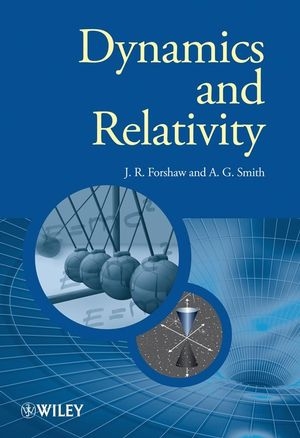
Dynamics and Relativity (eBook)
John Wiley & Sons (Verlag)
978-1-118-93329-9 (ISBN)
- Includes solutions for solving problems
- Numerous worked examples included throughout the book
- Mathematics is carefully explained and developed within a physics environment
- Sensitive to topics that can appear daunting or confusing
Dr Jeff Forshaw, Department of Physics & Astronomy, University of Manchester, Oxford Road, Manchester, UK.
Dr Gavin Smith, Department of Physics & Astronomy, University of Manchester, Oxford Road, Manchester, UK.
A new title in the Manchester Physics Series, this introductory text emphasises physical principles behind classical mechanics and relativity. It assumes little in the way of prior knowledge, introducing relevant mathematics and carefully developing it within a physics context. Designed to provide a logical development of the subject, the book is divided into four sections, introductory material on dynamics, and special relativity, which is then followed by more advanced coverage of dynamics and special relativity. Each chapter includes problems ranging in difficulty from simple to challenging with solutions for solving problems. Includes solutions for solving problems Numerous worked examples included throughout the book Mathematics is carefully explained and developed within a physics environment Sensitive to topics that can appear daunting or confusing
Dr Jeff Forshaw, Department of Physics & Astronomy, University of Manchester, Oxford Road, Manchester, UK. Dr Gavin Smith, Department of Physics & Astronomy, University of Manchester, Oxford Road, Manchester, UK.
Preface.
I. INTRODUCTORY DYNAMICS.
1. SPACE, TIME AND MOTION.
1.1 Defining Space and Time.
1.2 Vectors and Co-ordinate Systems.
1.3 Velocity and Acceleration.
1.4 Standards and Units.
2. FORCE, MOMENTUM AND NEWTON'S LAWS.
2.1 Force and Static Equilibrium.
2.2 Force and Motion.
2.3 Applications of Newton's Laws.
3. ENERGY.
3.1 Work, Power and Kinetic Energy.
3.2 Potential Energy.
3.3 Collisions.
3.4 Energy Conservation in Complex Systems.
4. ANGULAR MOMENTUM.
4.1 Angular Momentum of a Particle.
4.2 Conservation of Angular Momentum in Systems ofParticles.
4.3 Angular Momentum and Rotation About a Fixed Axis.
4.4 Sliding and Rolling.
4.5 Angular Impulse and the Centre of Percussion.
4.6 Kinetic Energy of Rotation.
II. INTRODUCTORY SPECIAL RELATIVITY.
5. THE NEED FOR A NEW THEORY OF SPACE AND TIME.
5.1 Space and Time Revisited.
5.2 Experimental Evidence.
5.3 Einstein's Postulates.
6. RELATIVISTIC KINEMATICS.
6.1 Time Dilation, Length Contraction and Simultaneity.
6.2 Lorentz Transformations.
6.3 Velocity Transformations.
7. RELATIVISTIC ENERGY AND MOMENTUM.
7.1 Momentum and Energy.
7.2 Applications in Particle Physics.
III ADVANCED DYNAMICS.
8. NON-INERTIAL FRAMES.
8.1 Linearly Accelerating Frames.
8.2 Rotating Frames.
9. GRAVITATION.
9.1 Newton's Law of Gravity.
9.2 The Gravitational Potential.
9.3 Reduced Mass.
9.4 Motion in a central force.
9.5 Orbits.
10. RIGID BODY MOTION.
10.1 The angular momentum of a rigid body.
10.2 The moment of inertia tensor.
10.3 Principal axes.
10.4 Fixed-axis rotation in the lab frame.
10.5 Euler's equations.
10.6 The free rotation of a symmetric top.
10.7 The stability of free rotation.
10.8 Gyroscopes.
IV. ADVANCED SPECIAL RELATIVITY.
11. THE SYMMETRIES OF SPACE AND TIME.
11.1 Symmetry in Physics.
11.2 Lorentz Symmetry.
12. FOUR-VECTORS AND LORENTZ INVARIANTS.
12.1 The Velocity Four-vector.
12.2 The Wave Four-vector.
12.3 The Energy-momentum Four-vector.
12.4 Electric and Magnetic Fields.
13. SPACE-TIME DIAGRAMS AND CAUSALITY.
13.1 Relativity Preserves Causality.
13.2 An Alternative Approach.
14. ACCELERATION AND GENERAL RELATIVITY.
14.1 Acceleration in Special Relativity.
14.2 A glimpse of General Relativity.
A DERIVING THE GEODESIC EQUATION.
B SOLUTIONS TO PROBLEMS.
'Dynamics and Relativity by Forshaw and Smith was the
ideal book for the upper level course Physics from Newton to
Einstein at Yale since it was thoroughly modern and
extremely lucid. Its most admirable features are the
countless solved examples that made it ideal for self-study and a
very detailed and lucid introduction to relativity.'
-- Ramamurti Shankar, John Randolph Huffman Professor
of Physics, Professor of Applied Physics, Yale University
2
Force, Momentum and Newton’s Laws
A force is something that pushes or pulls. The push or pull of a force may set an object in motion, as is the case when we throw a ball, push a book along the surface of a table or drop something from a height. Alternatively, forces may be used to stop objects already in motion; the friction between the brake-pads and the wheels of a car and between the tyres of the car and the road surface can quickly arrest the car’s motion. In these dynamical situations the direction of the applied force is crucial in achieving the desired effect: a stationary object starts to move in the direction of an applied force; to stop a moving object we apply a force in the opposite direction to the motion. This directional property suggests that forces may be represented mathematically by vectors. Forces are often found in static, rather than dynamic situations. Medieval cathedrals are impressive examples of how gravitational forces can be balanced by the electrostatic forces between atoms to create structures that are stable for many hundreds of years. To start this chapter we shall seek to place these intuitive ideas on a firmer footing and establish a useful definition of force. We shall do this first by looking at forces in static situations and only once we have a definition of force will we strive to link forces to the motion of things.
2.1 FORCE AND STATIC EQUILIBRIUM
How are we to define force? We wish to do so in a way that relies on as few other concepts as possible and to this end we remove the complication of motion and look at a case in which nothing is moving. Figure 2.1 shows a situation in which a mass is held stationary on a very smooth horizontal surface between three stretched springs. The springs each pull on the mass and we say that each spring exerts a force on the mass. Let us further say that the springs are carefully constructed to be as similar as possible; for the sake of this argument they can be considered to be identical. To further make sure that the springs behave identically we change the angles that the springs make with each other and look for a situation in which each spring is stretched by the same amount. When we perform this experiment in the lab we observe that the mass is stationary if and only if the angle between any pair of equally-stretched adjacent springs is 120°. Our definition of force must take the result of this type of experiment into account. Since we know from experience that pushing or pulling can produce motion we assert that our experiment with three springs, in which the mass doesn’t move, corresponds to a total force of zero. In this way we are led to the idea that force must be a vector quantity, which sums to give zero in our experiment. That the vector should also point along the axis of the spring can be deduced from a similar experiment constructed with two collinear springs: there is then no special direction other than the axis of the springs and any physical property of the system should not break this symmetry, so the force must point along the length of the spring. Force is thus to be regarded as a vector quantity representing a push or pull, which: (a) points along the axis of a stretched spring; (b) is additive when several springs are involved; (c) results in no motion when that sum is zero. We also know from experience that there are things other than springs which may push or pull, so we state as part of our definition that any thing that can potentially replace one of the springs in the above experiment also exerts a force on the mass.
Figure 2.1 Identical, equally-stretched springs with a mass in static equilibrium in the horizontal plane. The mass is supported vertically on a low-friction surface (such as an air-hockey table). Equally you could imagine the experiment as being performed in outer space.
This sounds pretty close to a good definition of force, albeit in a fairly specific scenario, but there is a weakness that you may have already noticed. We stated that the force is zero when the mass is stationary. That is quite reasonable for experiments performed at rest on the Earth but what happens if we do the experiment in outer space? How do we agree on what frame of reference to use for our force experiment and for our definition of force? An observer moving relative to us will claim that the mass in Figure 2.1 is in motion whilst we assert that it is stationary. We need, as a matter of some urgency, to encorporate the frame of reference into our definition of force. To help us choose a good frame of reference we shall consider a situation in which no forces are present.
For a force on a particle to exist there must be something else somewhere in the Universe that is responsible, i.e. a spring or something that can counter a spring. A particle, completely alone in the Universe would experience no forces. This hypothetical object, of point size and subject to no forces, is referred to as an isolated particle. What sort of motion do we expect for such an isolated particle? Similar problems troubled ancient thinkers who concluded that force was necessary to maintain the motion of a body1. This is a conclusion very close to our everyday experience. If you push a book along a table it may move, but when you decide to stop pushing, the book stops moving: the force is needed to maintain the motion. If however, one looks at a rolling ball, then the behaviour is noticeably different. A hard sphere set in motion on a flat, hard, horizontal surface travels a long way before stopping. So the rule that force is needed to maintain motion appears suspect. It was Galileo, studying the motion of rolling spheres on inclined planes who proposed that a moving body continues moving, i.e. we might say that the body has “inertia”. This means that the behaviour of the rolling ball is closer to that of the isolated particle than is that of the book on the table. Galileo’s genius was to realise that the motion of everyday objects is complicated by friction and that to see the raw, unhindered, motion of an isolated particle we need to devise careful experiments that are insensitive to friction.
Newton’s First Law, as written in Principia is is restatement of Galileo’s Principle of Inertia: “every body preserves its state of rest, or of uniform motion in a right line, unless compelled to change that state by forces acting upon it.” In other words, the isolated particle will have a constant velocity vector, and this velocity may be zero. Forces are responsible for changes in the velocity of a body. On the surface this sounds very clear; a watertight rule for the motion of bodies in the absence of forces. There is however, an important weakness in the First Law as stated above. Specifically, there is no statement as to what frame of reference should be used, and this is crucial for the complete description of the state of motion of the particle. Consider the situation illustrated by the cartoon in Figure 2.2. Two observers, called A and B are measuring the motion of an isolated particle. B observes that the particle is stationary and, according to the First Law, the particle will remain in that state. Observer A is moving, relative to a frame of reference in which B is at rest, with velocity v and acceleration a. A will therefore measure the particle to be moving with velocity –v and acceleration –a. So what does A conclude? The particle is accelerating, so there must be a force acting on it (according to the First Law). However, as the particle is isolated, by definition it cannot be subject to any forces. This contradiction is a direct result of observing the particle from an accelerating frame of reference. If a = 0 then A observes the particle with velocity –v, but with zero acceleration. Since this is uniform motion, the First Law still holds for the isolated particle. Thus there are two classes of frames of reference, those in which a = 0, called inertial frames of reference, and those for which a ≠ 0, called non-inertial frames of reference. The First Law thus becomes essentially a statement upon the existence of inertial frames of reference:
Figure 2.2 Two observers and the motion of an isolated particle.
There exist inertial frames of reference, with respect to which an isolated particle moves in a straight line of constant velocity (including zero).
This reformulation of the first law supposes that we can find an isolated particle. Clearly there is no real object so alone in the Universe that it is devoid of all forces; the very act of observing something involves an interaction at some level, even if it is only the force involved in reflecting light. So how do we ever find, in practice, a good inertial frame? From a practical point of view we must find ways of isolating a particle other than by removing it to a remote region of the Universe. This involves using our knowledge of forces to arrange things in such a way that there is no net force on a body. An air-hockey table is just such a construction: air is blown through tiny holes to create a force on the puck that cancels the effect of the Earth’s gravity. In addition, supporting the puck on a layer of air means that frictional forces are greatly reduced for most laboratory experiments. With the table adjusted properly, a puck will glide at nearly constant velocity across the table, with only a small change in speed. So does the air-hockey table define an inertial frame of reference? Approximately, yes, but at some level of precision the effects of the Earth’s rotation will become apparent. As was shown in Section 1.3.4, an object...
| Erscheint lt. Verlag | 20.5.2014 |
|---|---|
| Reihe/Serie | Manchester Physics Series |
| The Manchester Physics Series | The Manchester Physics Series |
| Sprache | englisch |
| Themenwelt | Naturwissenschaften ► Physik / Astronomie ► Atom- / Kern- / Molekularphysik |
| Naturwissenschaften ► Physik / Astronomie ► Mechanik | |
| Naturwissenschaften ► Physik / Astronomie ► Relativitätstheorie | |
| Technik | |
| Schlagworte | Angular • Applications • Axis • centre • Complex Systems • conservation • Energy • Festkörperphysik • Festkörperphysik • Fixed • introductory • Kern- u. Hochenergiephysik • kinetic • Laws • Mathematical & Computational Physics • Mathematische Physik • Momentum • newtons • Nuclear & High Energy Physics • particle • particles • Percussion • Physics • Physik • Potential • Rotation • Solid state physics • space • Systems • theory |
| ISBN-10 | 1-118-93329-X / 111893329X |
| ISBN-13 | 978-1-118-93329-9 / 9781118933299 |
| Informationen gemäß Produktsicherheitsverordnung (GPSR) | |
| Haben Sie eine Frage zum Produkt? |
 EPUB (Adobe DRM)
Kopierschutz: Adobe-DRM
Adobe-DRM ist ein Kopierschutz, der das eBook vor Mißbrauch schützen soll. Dabei wird das eBook bereits beim Download auf Ihre persönliche Adobe-ID autorisiert. Lesen können Sie das eBook dann nur auf den Geräten, welche ebenfalls auf Ihre Adobe-ID registriert sind.
Details zum Adobe-DRM
Dateiformat: EPUB (Electronic Publication)
EPUB ist ein offener Standard für eBooks und eignet sich besonders zur Darstellung von Belletristik und Sachbüchern. Der Fließtext wird dynamisch an die Display- und Schriftgröße angepasst. Auch für mobile Lesegeräte ist EPUB daher gut geeignet.
Systemvoraussetzungen:
PC/Mac: Mit einem PC oder Mac können Sie dieses eBook lesen. Sie benötigen eine
eReader: Dieses eBook kann mit (fast) allen eBook-Readern gelesen werden. Mit dem amazon-Kindle ist es aber nicht kompatibel.
Smartphone/Tablet: Egal ob Apple oder Android, dieses eBook können Sie lesen. Sie benötigen eine
Geräteliste und zusätzliche Hinweise
Buying eBooks from abroad
For tax law reasons we can sell eBooks just within Germany and Switzerland. Regrettably we cannot fulfill eBook-orders from other countries.
aus dem Bereich