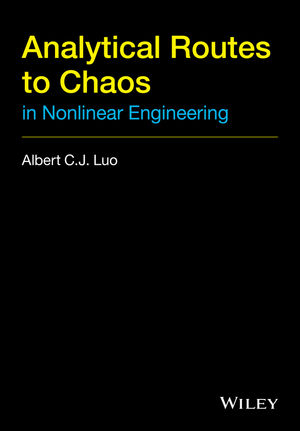
Analytical Routes to Chaos in Nonlinear Engineering (eBook)
John Wiley & Sons (Verlag)
978-1-118-88392-1 (ISBN)
Comprehensively covers analytical solutions of periodic motions to chaos in nonlinear dynamical systems, considering engineering applications, design and control
Analytical Routes to Chaos in Nonlinear Engineering discusses analytical solutions of periodic motions to chaos in nonlinear dynamical systems in engineering and considers engineering applications, design, and control. It systematically discusses complex nonlinear phenomena in engineering nonlinear systems, including the duffing oscillator, nonlinear self-excited systems, nonlinear parametric systems and nonlinear rotor systems. Nonlinear models used in engineering are also presented and a brief history of the topic is provided.
Analytical Routes to Chaos in Nonlinear Engineering is a comprehensive reference for researchers and practitioners across engineering, mathematics and physics disciplines, and is also useful background reading for graduate students
- Comprehensively covers analytical solutions of periodic motions to chaos in nonlinear dynamical systems, considering engineering applications, design and control
- Systematically discusses complex nonlinear phenomena in engineering nonlinear systems
- Presents nonlinear models used in engineering
- This applications oriented book uses clear and comprehensive illustrations to present concepts
Professor Luo is currently a Distinguished Research Professor at Southern Illinois University Edwardsville. He is an international renowned figure in the area of nonlinear dynamics and mechanics. For about 30 years, Dr. Luo’s contributions on nonlinear dynamical systems and mechanics lie in (i) the local singularity theory for discontinuous dynamical systems, (ii) Dynamical systems synchronization, (iii) Analytical solutions of periodic and chaotic motions in nonlinear dynamical systems, (iv) The theory for stochastic and resonant layer in nonlinear Hamiltonian systems, (v) The full nonlinear theory for a deformable body. Such contributions have been scattered into 13 monographs and over 200 peer-reviewed journal and conference papers. His new research results are changing the traditional thinking in nonlinear physics and mathematics. Dr. Luo has served as an editor for the Journal “Communications in Nonlinear Science and Numerical simulation”, book series on Nonlinear Physical Science (HEP) and Nonlinear Systems and Complexity (Springer). Dr. Luo is the editorial member for two journals (i.e., IMeCh E Part K Journal of Multibody Dynamics and Journal of Vibration and Control). He also organized over 30 international symposiums and conferences on Dynamics and Control.
Nonlinear problems are of interest to engineers, physicists and mathematicians and many other scientists because most systems are inherently nonlinear in nature. As nonlinear equations are difficult to solve, nonlinear systems are commonly approximated by linear equations. This works well up to some accuracy and some range for the input values, but some interesting phenomena such as chaos and singularities are hidden by linearization and perturbation analysis. It follows that some aspects of the behavior of a nonlinear system appear commonly to be chaotic, unpredictable or counterintuitive. Although such a chaotic behavior may resemble a random behavior, it is absolutely deterministic. Analytical Routes to Chaos in Nonlinear Engineering discusses analytical solutions of periodic motions to chaos or quasi-periodic motions in nonlinear dynamical systems in engineering and considers engineering applications, design, and control. It systematically discusses complex nonlinear phenomena in engineering nonlinear systems, including the periodically forced Duffing oscillator, nonlinear self-excited systems, nonlinear parametric systems and nonlinear rotor systems. Nonlinear models used in engineering are also presented and a brief history of the topic is provided. Key features: Considers engineering applications, design and control Presents analytical techniques to show how to find the periodic motions to chaos in nonlinear dynamical systems Systematically discusses complex nonlinear phenomena in engineering nonlinear systems Presents extensively used nonlinear models in engineering Analytical Routes to Chaos in Nonlinear Engineering is a practical reference for researchers and practitioners across engineering, mathematics and physics disciplines, and is also a useful source of information for graduate and senior undergraduate students in these areas.
Professor Luo is currently a Distinguished Research Professor at Southern Illinois University Edwardsville. He is an international renowned figure in the area of nonlinear dynamics and mechanics. For about 30 years, Dr. Luo's contributions on nonlinear dynamical systems and mechanics lie in (i) the local singularity theory for discontinuous dynamical systems, (ii) Dynamical systems synchronization, (iii) Analytical solutions of periodic and chaotic motions in nonlinear dynamical systems, (iv) The theory for stochastic and resonant layer in nonlinear Hamiltonian systems, (v) The full nonlinear theory for a deformable body. Such contributions have been scattered into 13 monographs and over 200 peer-reviewed journal and conference papers. His new research results are changing the traditional thinking in nonlinear physics and mathematics. Dr. Luo has served as an editor for the Journal "Communications in Nonlinear Science and Numerical simulation", book series on Nonlinear Physical Science (HEP) and Nonlinear Systems and Complexity (Springer). Dr. Luo is the editorial member for two journals (i.e., IMeCh E Part K Journal of Multibody Dynamics and Journal of Vibration and Control). He also organized over 30 international symposiums and conferences on Dynamics and Control.
Preface ix
1 Introduction 1
1.1 Analytical Methods 1
1.1.1 Lagrange Standard Form 1
1.1.2 Perturbation Methods 2
1.1.3 Method of Averaging 5
1.1.4 Generalized Harmonic Balance 8
1.2 Book Layout 24
2 Bifurcation Trees in Duffing Oscillators 25
2.1 Analytical Solutions 25
2.2 Period-1 Motions to Chaos 32
2.2.1 Period-1 Motions 33
2.2.2 Period-1 to Period-4 Motions 35
2.2.3 Numerical Simulations 52
2.3 Period-3 Motions to Chaos 57
2.3.1 Independent, Symmetric Period-3 Motions 57
2.3.2 Asymmetric Period-3 Motions 64
2.3.3 Period-3 to Period-6 Motions 71
2.3.4 Numerical Illustrations 82
3 Self-Excited Nonlinear Oscillators 87
3.1 van del Pol Oscillators 87
3.1.1 Analytical Solutions 87
3.1.2 Frequency-Amplitude Characteristics 97
3.1.3 Numerical Illustrations 110
3.2 van del Pol-Duffing Oscillators 114
3.2.1 Finite Fourier Series Solutions 114
3.2.2 Analytical Predictions 130
3.2.3 Numerical Illustrations 143
4 Parametric Nonlinear Oscillators 151
4.1 Parametric, Quadratic Nonlinear Oscillators 151
4.1.1 Analytical Solutions 151
4.1.2 Analytical Routes to Chaos 156
4.1.3 Numerical Simulations 169
4.2 Parametric Duffing Oscillators 186
4.2.1 Formulations 186
4.2.2 Parametric Hardening Duffing Oscillators 194
5 Nonlinear Jeffcott Rotor Systems 209
5.1 Analytical Periodic Motions 209
5.2 Frequency-Amplitude Characteristics 225
5.2.1 Period-1 Motions 226
5.2.2 Analytical Bifurcation Trees 231
5.2.3 Independent Period-5 Motion 239
5.3 Numerical Simulations 246
References 261
Index 265
Chapter 1
Introduction
In this chapter, analytical methods for approximate solutions of periodic motions to chaos in nonlinear dynamical systems will be presented briefly. The Lagrange stand form, perturbation method, method of averaging, harmonic balance, generalized harmonic balance will be discussed. A brief literature survey will be completed to present a main development skeleton of analytical methods for periodic motions in nonlinear dynamical systems. The weakness of current approximate, analytical methods will also be discussed in this chapter, and the significance of analytical methods in nonlinear engineering will be presented.
1.1 Analytical Methods
Since the appearance of Newton's mechanics, one has been interested in periodic motion. From the Fourier series theory, any periodic function can be expressed by a Fourier series expansion with different harmonics. The periodic motion in dynamical systems is a closed curve in state space in the prescribed period. In addition to simple oscillations in mechanical systems, one has been interested in motions of moon, earth, and sun in the three-body problem. The earliest approximation method is the method of averaging, and the idea of averaging originates from Lagrange (1788).
1.1.1 Lagrange Standard Form
Consider an initial value problem for and
where is an matrix and continuous with time is a —continuous vector function of and The unperturbed system is linear and such a linear system has independent basic solution to form a fundamental matrix . That is,
where is constant, determined by initial conditions. As in Luo (2012aa,b), a linear transformation is introduced as
Substitution of Equation (1.3) into Equation (1.1) gives
With , we obtain
The foregoing form is called the Lagrange standard form.
Consider a vibration problem as
From the basic solution of the unperturbed system, we have a transformation as
Using this transformation, Equation (1.6) becomes
where
If the function and is T-periodic with
where
1.1.2 Perturbation Methods
In the end of the nineteenth century, Poincare (1890) provided the qualitative analysis of dynamical systems to determine periodic solutions and stability, and developed the perturbation theory for periodic solution. In addition, Poincare (1899) discovered that the motion of a nonlinear coupled oscillator is sensitive to the initial condition, and qualitatively stated that the motion in the vicinity of unstable fixed points of nonlinear oscillation systems may be stochastic under regular applied forces. In the twentieth century, one followed Poincare's ideas to develop and apply the qualitative theory to investigate the complexity of motions in dynamical systems. With Poincare's influence, Birkhoff (1913) continued Poincare's work, and a proof of Poincare's geometric theorem was given. Birkhoff (1927) showed that both stable and unstable fixed points of nonlinear oscillation systems with two degrees of freedom must exist whenever their frequency ratio (also called resonance) is rational. The sub-resonances in periodic motions of such systems change the topological structures of phase trajectories, and the island chains are obtained when the dynamical systems are renormalized with fine scales. In such qualitative and quantitative analysis, the Taylor series expansion and the perturbation analysis play an important role. However, the Taylor series expansion analysis is valid in the small finite domain under certain convergent conditions, and the perturbation analysis based on the small parameters, as an approximate estimate, is only acceptable for a very small domain with a short time period. From Verhulst (1991), the perturbation solution of dynamical system can be stated as follows.
Theorem 1.1 Consider a dynamical system
with and is a —continuous vector function of and Assume can be expanded in a Taylor series with respect to as
with and is continuous in and with times continuously differentiable with , and is continuous in and and satisfies Lipschitz—continuous in Suppose there is a -series of as
Application of Equation (1.14) to Equation (1.12), using the Taylor series expansion of with respect to power of and equating coefficients with the initial condition
generates an approximate solution of with
on the time-scale 1.
Proof
The proof can be referred to Verhulst (1991).
Assume that in Equation (1.12) can be expanded in a convergent Taylor series with respect to and in a finite domain. Consider an unperturbed system in Equation (1.12) as
Using a transform
Equation (1.12) becomes
where and
Thus, the Poincare perturbation theory for nonlinear dynamical systems can also be stated as follows:
Theorem 1.2 (Poincare) Consider a dynamical system
with and . is a —continuous vector function of and If such a vector function can be expanded in a convergent power series with respect to and for and then can be expanded in a convergent power series with respect to and in the vicinity of and on time scale 1.
Proof
The proof can be referred to Verhulst (1991).
In the perturbation theory, the Poincare-Lindstedt method is discussed herein. Consider a vibration problem as
For with initial condition
For variation of a foregoing solution with the following transformation is introduced as
Application of Equation (1.24) to Equation (1.22) gives
with initial conditions
From the solution of by the variation of constant, Equation (1.25) gives
From the periodicity, in the foregoing equation yields
Thus,
from which we obtain
If the following equation exists
then
and the solution of Equation (1.25) is
In the foregoing procedure, the nonlinear solution is based on the variation of linear solution, which may not be adequate. This method is the foundation of multiple-scale method. Introduce
The following quantities are assumed as
Such a procedure makes the problem more complicated.
1.1.3 Method of Averaging
Based on the Lagrange standard form, one developed the method of averaging. van der Pol (1920) used the averaging method to determine the periodic motions of self-excited systems in circuits, and the presence of natural entrainment frequencies in such a system was observed in van der Pol and van der Mark (1927). Cartwright and Littlewood (1945) discussed the periodic motions of the van der Pol equation and proved the existence of periodic motions. Levinson (1948) used a piecewise linear model to describe the van der Pol equation and determined the existence of periodic motions. Levinson (1949) further developed the structures of periodic solutions in such a second order differential equation through the piecewise linear model, and discovered that infinite periodic solutions exist in such a piecewise linear model.
Since the nonlinear phenomena was observed in engineering, Duffing (1918) used the hardening spring model to investigate the vibration of electro-magnetized vibrating beam, and after that, the Duffing oscillator has been extensively used in structural dynamics. In addition to determining the existence of periodic motions in nonlinear different equations of the second order in mathematics, one has applied the Poincare perturbation methods for periodic motions in nonlinear dynamical systems. Fatou (1928) provided the first proof of asymptotic validity of the method of averaging through the existence of solutions of differential equations. Krylov and Bogolyubov (1935) developed systematically the method of averaging and the detailed discussion can be found in Bogoliubov and Mitropolsky (1961). The method of averaging is presented as follows:
Theorem 1.3 Consider a dynamical system
If the following conditions are satisfied, that is,
- the vector...
| Erscheint lt. Verlag | 23.5.2014 |
|---|---|
| Sprache | englisch |
| Themenwelt | Naturwissenschaften ► Physik / Astronomie ► Mechanik |
| Technik ► Maschinenbau | |
| Schlagworte | accuracy • appear • Aspects • Chaos • Chaos / Fractal / Dynamical Systems • Chaos, Fraktale u. dynamische Systeme • commonly • Control Process & Measurements • difficult • Equations • inherently • input values • Interest • interesting • Linear • Linearization • Maschinenbau • Mathematics • Mathematik • mechanical engineering • Mess- u. Regeltechnik • Nature • Nichtlineares System • Nichtlineare u. komplexe Systeme • Nonlinear • Nonlinear and Complex Systems • Nonlinear Equations • Nonlinear problems • Phenomena • Physics • Physik • Range • scientists • Systems |
| ISBN-10 | 1-118-88392-6 / 1118883926 |
| ISBN-13 | 978-1-118-88392-1 / 9781118883921 |
| Informationen gemäß Produktsicherheitsverordnung (GPSR) | |
| Haben Sie eine Frage zum Produkt? |
 EPUB (Adobe DRM)
Kopierschutz: Adobe-DRM
Adobe-DRM ist ein Kopierschutz, der das eBook vor Mißbrauch schützen soll. Dabei wird das eBook bereits beim Download auf Ihre persönliche Adobe-ID autorisiert. Lesen können Sie das eBook dann nur auf den Geräten, welche ebenfalls auf Ihre Adobe-ID registriert sind.
Details zum Adobe-DRM
Dateiformat: EPUB (Electronic Publication)
EPUB ist ein offener Standard für eBooks und eignet sich besonders zur Darstellung von Belletristik und Sachbüchern. Der Fließtext wird dynamisch an die Display- und Schriftgröße angepasst. Auch für mobile Lesegeräte ist EPUB daher gut geeignet.
Systemvoraussetzungen:
PC/Mac: Mit einem PC oder Mac können Sie dieses eBook lesen. Sie benötigen eine
eReader: Dieses eBook kann mit (fast) allen eBook-Readern gelesen werden. Mit dem amazon-Kindle ist es aber nicht kompatibel.
Smartphone/Tablet: Egal ob Apple oder Android, dieses eBook können Sie lesen. Sie benötigen eine
Geräteliste und zusätzliche Hinweise
Buying eBooks from abroad
For tax law reasons we can sell eBooks just within Germany and Switzerland. Regrettably we cannot fulfill eBook-orders from other countries.
aus dem Bereich