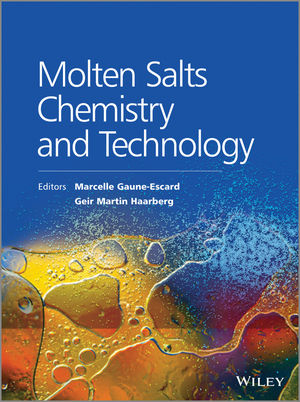
Both high temperature molten salts and room temperature ionic liquids (collectively termed liquid salts) have unique properties, including good heat capacity, good electrical conductivity and, in some cases, chemical catalytic properties. They are critical for the efficient production and processing of many different materials, for example the electrolytic extraction and refining of aluminium and silicon, particularly important in the post fossil fuel era. Other industrial applications range from solvents and fuel cells to alloy heat treatments and pyroprocessing in nuclear fuel.
With a focus on sustainable processes for the production and processing of materials, this book contains over 60 chapters and is organized into seven areas:
- Aluminium Electrolysis
- New Processes for Electrowinning
- Modeling and Thermodynamics
- High Temperature Experimental Techniques
- Electrochemistry in Ionic Liquids
- Nuclear Energy
- Energy Technology
Intended to provide a solid understanding of the properties, experimental methods, theoretical methods and applications of these materials, Molten Salts: Chemistry and Technology is an unrivalled reference for chemists, engineers and materials scientists in academia, research and industry.
Written to record and report on recent research progresses in the field of molten salts, Molten Salts Chemistry and Technology focuses on molten salts and ionic liquids for sustainable supply and application of materials. Including coverage of molten salt reactors, electrodeposition, aluminium electrolysis, electrochemistry, and electrowinning, the text provides researchers and postgraduate students with applications include energy conversion (solar cells and fuel cells), heat storage, green solvents, metallurgy, nuclear industry, pharmaceutics and biotechnology.
Marcelle Gaune-Escard is Research Director at Ecole Polytechnique, CNRS, Marseille, France. Most of her scientific activities focus on the multi-technique physicochemical, structural characterization and modeling of lanthanide halides melts. She has contributed over 250 journal papers, and over 300 conference presentations, and been involved in Chairing and organising numerous International Molten Salt Conferences. She is well-known for editing and publishing her own newsletter, Molten Salts & Ionic Liquids (since 1976, distribution 600, 24 countries, quarterly; Web edition since 1996). In 2004 Marcelle was awarded the Max Bredig Award in Molten Salt Chemistry, granted by the Electrochemical Society (USA) for the first time to a French female scientist. Geir Martin Haarberg is a Professor at the Materials Science and Engineering department at Norwegian University of Science and Technology, Trondheim, Norway since 2000. He has authored around 150 publications, including articles published in international journals, and conference proceedings (71).
List of Contributors
- A.V. Abramov, Department of Rare Metals and Nanomaterials, Ural Federal University, Russia
- H. Akatsuka, Research Laboratory for Nuclear Reactors, Tokyo Institute of Technology, Japan
- N. Akiyama, Central Research Institute of Electric Power Industry, Japan
- D. E. Aleksandrov, Department of Rare Metals and Nanomaterials, Ural Federal University, Russia
- I. M. Astrelin, Faculty of Chemistry and Technology, Kyiv Polytechnical Institute, National Technical University, Ukraine
- O.B. Babushkina, Centre of Electrochemical Surface Technology, Austria
- T. Bauer, Institute of Technical Thermodynamics, German Aerospace Center—DLR, Germany
- M. Berkani, Laboratoire de Physico-Chimie des Matériaux et Catalyse, Faculté des Sciences Exactes, Université de Béjaïa, Targa ouzemmour, Algérie
- C. Bessada, CNRS, CEMHTI UPR 3079, Univ. Orléans, F-45071 Orléans, France
- A.-L. Bieber, Laboratoire de Génie Chimique, CNRS UMR 5503, Université de Toulouse, France
- M. Boča, Institute of Inorganic Chemistry, Slovak Academy of Sciences, Slovakia; and Department of Chemistry, Faculty of Natural Sciences, Constantine The Philosopher University, Slovakia
- N. P. Brevnova, Department of Rare Metals and Nanomaterials, Ural Federal University, Russia
- A. Bund, Fachgebiet Elektrochemie und Galvanotechnik, Technische Universitaet Ilmenau, Germany
- M. F. Butman, Ivanovo State University of Chemistry and Technology, Russia
- L. Cassayre, Laboratoire de Génie Chimique, CNRS UMR 5503, Université de Toulouse, France
- P. Chamelot, Laboratoire de Génie Chimique, CNRS UMR 5503, Université de Toulouse, France
- M. V. Chernyshov, Department of Rare Metals and Nanomaterials, Ural Federal University, Russia
- A. V. Chukin, Department of Theoretical Physics and Applied Mathematics, Ural Federal University, Russia
- O. Conocar, CEA Marcoule, Nuclear Energy Division, Radiochemistry and Process Department, Laboratoires d'Elaboration des Procédés de Séparation, France
- B. Davis, Kingston Process Metallurgy, Inc., Canada
- S. Deki, Fuel Cell Nanomaterials Center, University of Yamanashi, Japan
- R. F. Descallar-Arriesgado, Faculty of Engineering, Hokkaido University, Japan
- V.S. Dolmatov, Kola Science Center RAS, Institute of Chemistry, Russia
- N. Douyère, CEA Marcoule, Nuclear Energy Division, Radiochemistry and Process Department, Laboratoires d'Elaboration des Procédés de Séparation, France
- P. Fellner, Slovak University of Technology in Bratislava, Slovakia
- D. Fray, Department of Materials Science and Metallurgy, University of Cambridge, UK
- T. Fujii, Research Reactor Institute, Kyoto University, Japan
- T. Fujimori, Graduate School of Energy Science, Kyoto University, Japan
- R. Fujita, Power Systems Company, Toshiba Corporation, Japan
- K. Fukasawa, Graduate School of Engineering, Kyoto University, Japan
- A. Fukunaga, Graduate School of Energy Science, Kyoto University, Japan; and Sumitomo Electric Industries, Ltd., Japan
- T. Fukunaga, Research Reactor Institute, Kyoto University, Japan
- M. Fukushima, Japan Atomic Energy Agency, Japan
- T. Furuta, Permerec Electrode Ltd., Japan
- A. Gab, Faculty of Chemistry and Technology, Kyiv Polytechnical Institute, National Technical University, Ukraine
- I. Galasiu, Romanian Academy—Institute of Physical Chemistry “Ilie Murgulescu”, Romania
- R. Galasiu, Romanian Academy—Institute of Physical Chemistry “Ilie Murgulescu”, Romania
- B. Gao, School of Materials and Metallurgy, Northeastern University, China
- M. Gaune-Escard, Aix-Marseille Université, CNRS IUSTI UMR 7343, Technopole de Château-Gombert, France
- M. Gembický, Department of Chemistry, State University of New York, USA
- M. Gibilaro, Laboratoire de Génie Chimique, CNRS UMR 5503, Université de Toulouse, France
- M. Gobet, CNRS, CEMHTI UPR 3079, Univ. Orléans, F-45071 Orléans, France
- A. Gray-Weale, School of Chemistry, University of Melbourne, Australia
- T. R. Griffiths, Redston Trevor Consulting Ltd., UK
- J. G. Gussone, German Aerospace Center (DLR), Institute of Materials Research, Germany
- G. M. Haarberg, Department of Materials Science and Engineering, Norwegian University of Science and Technology (NTNU), Norway
- R. Hagiwara, Graduate School of Energy Science, Kyoto University, Japan
- J. M. Hausmann, German Aerospace Center (DLR), Institute of Materials Research, Germany
- J. Híveš, Slovak University of Technology in Bratislava, Slovakia
- M. Hoshi, Department of Metallurgy, Graduate School of Engineering, Tohoku University, Japan
- J. Hryn, Argonne National Laboratory, USA
- X. Hu, School of Materials and Metallurgy, Northeastern University, China
- Y. Iida, Department of Applied Chemistry, Doshisha University, Japan
- K. Ikeda, Department of Applied Chemistry, Graduate School of Engineering, Doshisha University, Japan
- M. Inaba, Department of Applied Chemistry, Graduate School of Engineering, Doshisha University, Japan; and Department of Molecular Chemistry and Biochemistry, Faculty of Science and Engineering, Doshisha University, Japan
- S. Inazawa, Sumitomo Electric Industries, Ltd., Japan
- T. Ishibashi, Graduate School of Energy Science, Kyoto University, Japan
- Y. Ishigaki, Medical Research Institute, Kanazawa Medical University, Japan
- A. Ispas, Fachgebiet Elektrochemie und Galvanotechnik, Technische Universitaet Ilmenau, Germany
- Y. Ito, Energy Conversion Research Center, Doshisha University, Japan
- K. Itoh, Graduate School of Education, Okayama University, Japan
- A. B. Ivanov, Department of Rare Metals and Nanomaterials, Ural Federal University, Russia
- S. Ivanov, Fachgebiet Elektrochemie und Galvanotechnik, Technische Universitaet Ilmenau, Germany
- Y. Iwadate, Graduate School of Engineering, Chiba University, Japan
- A. Jacob, Centre for Innovation Competence Virtuhcon, Group “Multiphase Systems”, TU Bergakademie Freiberg, Germany; and Forschungszentrum Jülich, Germany
- K. Jomová, Department of Chemistry, Faculty of Natural Sciences, Constantine The Philosopher University, Slovakia
- A. Kajinami, Graduate School of Engineering, Kobe University, Japan
- R. V. Kamalov, Department of Rare Metals and Nanomaterials, Ural Federal University, Russia
- M. Keppert, Department of Materials Engineering and Chemistry, Faculty of Civil Engineering, Czech Technical University, Czech Republic
- T. Kikuchi, Faculty of Engineering, Hokkaido University, Japan
- K. Kinoshita, Central Research Institute of Electric Power Industry, Japan
- S. Kishida, Department of Applied Chemistry, Graduate School of Engineering, Osaka University, Japan
- S. Kitawaki, Japan Atomic Energy Agency, Japan
- H. Kofuji, Japan Atomic Energy Agency, Japan
- T. Koketsu, Graduate School of Energy Science, Kyoto University, Japan
- T. Koyama, Central Research Institute of Electric Power Industry, Japan
- O. V. Kremenetskaya, Max Planck Institute for Chemical Physics of Solids, Germany
- V. G. Kremenetsky, Kola Science Center RAS, Institute of Chemistry, Russia
- B. Kubíková, Institute of Inorganic Chemistry, Slovak Academy of Sciences, Slovakia
- L. S. Kudin, Ivanovo State University of Chemistry and Technology, Russia
- M. Kurata, Central Research Institute of Electric Power Industry, Japan
- S. Kuwabata, Department of Applied Chemistry, Graduate School of Engineering, Osaka University, Japan; and CREST, Japan Science and Technology Agency, Japan
- S. A. Kuznetsov, Kola Science Center RAS, Institute of Chemistry, Russia
- J. Lacquement, CEA Marcoule, Nuclear Energy Division, Radiochemistry and Process Department, Laboratoires d'Elaboration des Procédés de Séparation, France
- V. Laging, Department of Materials Science and Engineering, Delft University of Technology, Den Haag, The Netherlands
- D. Laing, Institute of Technical Thermodynamics, German Aerospace Center—DLR, Germany
- A. Laplace, CEA Marcoule, Nuclear Energy Division, Radiochemistry and Process Department, Laboratoires d'Elaboration des Procédés de Séparation, France
- M. Li, Department of Metallurgy, Graduate School of Engineering, Tohoku University, Japan
- F. Lisý, Department of Fluorine Chemistry, Nuclear Research Institute Řež, plc, Czech Republic
- E.O. Lomako, Centre of Electrochemical Surface Technology,...
| Erscheint lt. Verlag | 12.5.2014 |
|---|---|
| Sprache | englisch |
| Themenwelt | Naturwissenschaften ► Chemie ► Technische Chemie |
| Technik | |
| Schlagworte | Aluminium Electrolysis • Chemie • Chemistry • Electrochemistry • Electrochemistry in Ionic Liquids • Electrodeposition • Electrowinning • energy technology • High Temperature Experimental Techniques • Industrial Chemistry • Marcelle Gaune-Escard • materials processing • Materials Science • Materialverarbeitung • Materialwissenschaften • Modeling and Thermodynamics • molten salt reactors • Molten Salts Chemistry and Technology • Nachhaltige u. Grüne Chemie • Nachhaltige u. Grüne Chemie • New Processes for Electrowinning • nuclear energy • Salzschmelze • Sustainable Chemistry & Green Chemistry • Technische Chemie • Technische u. Industrielle Chemie |
| ISBN-13 | 9781118448823 / 9781118448823 |
| Informationen gemäß Produktsicherheitsverordnung (GPSR) | |
| Haben Sie eine Frage zum Produkt? |
 EPUB (Adobe DRM)
Kopierschutz: Adobe-DRM
Adobe-DRM ist ein Kopierschutz, der das eBook vor Mißbrauch schützen soll. Dabei wird das eBook bereits beim Download auf Ihre persönliche Adobe-ID autorisiert. Lesen können Sie das eBook dann nur auf den Geräten, welche ebenfalls auf Ihre Adobe-ID registriert sind.
Details zum Adobe-DRM
Dateiformat: EPUB (Electronic Publication)
EPUB ist ein offener Standard für eBooks und eignet sich besonders zur Darstellung von Belletristik und Sachbüchern. Der Fließtext wird dynamisch an die Display- und Schriftgröße angepasst. Auch für mobile Lesegeräte ist EPUB daher gut geeignet.
Systemvoraussetzungen:
PC/Mac: Mit einem PC oder Mac können Sie dieses eBook lesen. Sie benötigen eine
eReader: Dieses eBook kann mit (fast) allen eBook-Readern gelesen werden. Mit dem amazon-Kindle ist es aber nicht kompatibel.
Smartphone/Tablet: Egal ob Apple oder Android, dieses eBook können Sie lesen. Sie benötigen eine
Geräteliste und zusätzliche Hinweise
Buying eBooks from abroad
For tax law reasons we can sell eBooks just within Germany and Switzerland. Regrettably we cannot fulfill eBook-orders from other countries.
aus dem Bereich