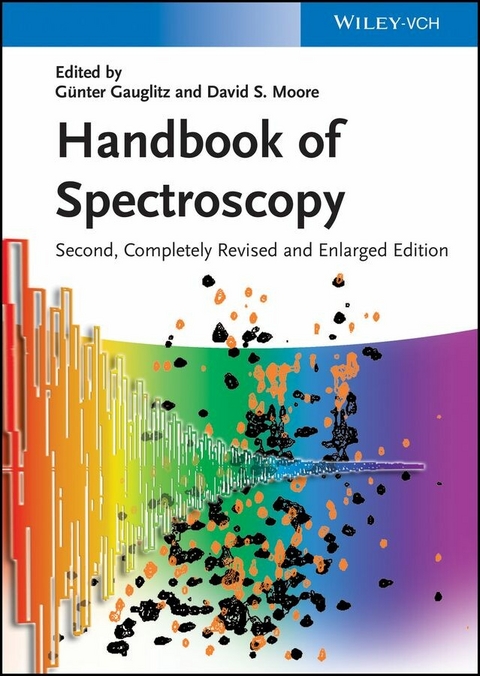
Handbook of Spectroscopy (eBook)
Wiley-VCH (Verlag)
978-3-527-65472-7 (ISBN)
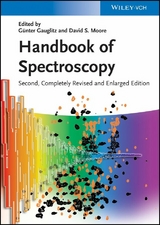
Clearly structured into sixteen sections, it covers everything from spectroscopy in nanodimensions to medicinal applications, spanning a wide range of the electromagnetic spectrum and the physical processes involved, from nuclear phenomena to molecular rotation processes.
In addition, data tables provide a comparison of different methods in a standardized form, allowing readers to save valuable time in the decision process by avoiding wrong turns, and also help in selecting the instrumentation and performing the experiments.
These four volumes are a must-have companion for daily use in every lab.
Professor Gauglitz published over 225 publications on photokinetics, UV-VIS spectroscopy, chromatographic detection, optical sensors, modification and characterization of boundary layers, and many more topics. He is author of several books on practical spectroscopy, and basics and applications in photokinetics, among others.
Professor Moore published more than 110 publications and five book chapters, as well as holder of four patents. He is presently a technical staff member at Los Alamos National Laboratory, USA. David Moore received a B.S. in Chemistry (University of Utah, 1974) and a Ph.D. in Physical Chemistry (University of Wisconsin, 1980). He was a Los Alamos National Laboratory Director-Funded Postdoctoral Fellow (1980-1981) and an Alexander von Humboldt Fellow (Essen 1993-94). in 2004 he was named Fellow of the American Physical Society.
Professor Günter Gauglitz has published over 260 publications on photokinetics, UV-VIS spectroscopy, chromatographic detection, optical sensors, modification and characterization of boundary layers, and many more topics. He is the author of several books on practical spectroscopy, and basics and applications in photokinetics, among chapters on sensors and surface modifications. He is holder of more than 10 patents. He received the Wallac Award of the Society of Biomolecular Screening in 1997, the Pregl Medal of the Austrian Chemical Society in 2006 and the Carl-Duisberg-Medal of the German Chemical Society in 2012. Dr. David S. Moore received the 2009 Los Alamos Fellows Prize for Leadership and is a Fellow of the International Union of Pure and Applied Chemistry (2011) and the American Physical Society (2004). He was also an Alexander von Humboldt Fellow (Essen 1993-94). Moore's research involves the use of nonlinear optical and ultrafast spectroscopies to understand the behavior of molecules under shock compression, the use of Raman, coherent Raman, and surface enhanced Raman methods for trace explosives detection and identification, the application of coherent control methods for condensed phase chemistry (explosive initiation) and explosives detection, and the development of remote stimulation methods to detect explosives via alternative signatures. He is presently a Research Scientist and Group Leader at Los Alamos, is author of more than 180 publications and seven book chapters, and is the holder of five patents
Volume 1
SECTION I: SAMPLE PREPARATION AND SAMPLE PRETREATMENT
Preparation of Liquid and Solid Samples
Liquid and Solid Sample Collection
SECTION II: METHODS 1: OPTICAL SPECTROSCOPY
Basics of Optical Spectroscopy
Instrumentation
Measurement Techniques
Applications
SECTION III: METHODS 2: NMR
An Introduction to Solution, Solid-State, and Imaging NMR Spectroscopy
Solution NMR Spectroscopy
Suspended-State NMR Spectroscopy (High-Resolution Magic Angle Spinning (HR-MAS) NMR Spectroscopy)
Solid-State NMR
SECTION IV: METHODS 3: MASS SPECTROMETRY
Mass Spectrometry
Multiparametric Analysis of Mass Spectrometry-Based Proteome Profiling in Gestation-Related Diseases
Laser-Assisted Mass Spectrometry
Volume 2
SECTION V: METHODS 4: ELEMENTAL ANALYSIS
X-Ray Fluorescence Analysis
Atomic Absorption Spectrometry (AAS) and Atomic Emission Spectrometry (AES)
Inductively Coupled Plasma Spectrometry
Laser Ablation Inductively Coupled Plasma Mass Spectrometry (LA-ICPMS)
SECTION VI: METHODS 5: SURFACE ANALYSIS
Electron Probe Techniques
Ion/Neutral Probe Techniques
Photon Probe Techniques
SECTION VII: METHODS 6: SPECTROSCOPY IN NANO DIMENSIONS
Single Molecule Spectroscopy
Single-Molecule Interfacial Electron Transfer Dynamics
Scanning Near-Field Gap-Mode Microscopy
Volume 3
SECTION VIII: APPLICATIONS 1: BIOANALYSIS
Trends in Bioanalytical Spectroscopy
Quality Assessment of Spectroscopic Methods in Clinical Laboratories
UV-Vis and NIR Fluorescence Spectroscopy
Principles of Vibrational Spectroscopic Methods and their Application to Bioanalysis
Bioanalytical NMR Spectroscopy
Direct Optical Spectroscopy
SECTION IX: APPLICATIONS 2: POLYMER ANALYSIS
Surface Plasmon Spectroscopy Methods and Electrochemical Analysis
Applications of Fourier Transform Infrared (FTIR) Imaging
Photon Correlation Spectroscopy Coupled with Field-Flow Fractionation for Polymer Analysis
Surface Plasmon Resonance Spectroscopy and Molecularly Imprinted Polymer (MIP) Sensors
SECTION X: APPLICATIONS 3: ENVIRONMENTAL ANALYSIS
LC-MS in Environmental Analysis
Ion Attachment Mass Spectrometry for Environmental Analysis
Immunoassays
SECTION XI: APPLICATIONS 4: PROCESS CONTROL
Process Control in Chemical Manufacturing
Process Control Using Spectroscopic Tools in Pharmaceutical Industry and Biotechnology
Applications of Optical Spectroscopy to Process Environments
Spectral Imaging in Quality and Process Control
Trends in Spectroscopic Techniques for Process Control
Volume 4
SECTION XII: APPLICATIONS 5: SPECTROSCOPY AT SURFACES
Optical Spectroscopy at Surfaces
NEXAFS Studies at Surfaces
The X-Ray Standing Wave Technique
Photonelectron Spectroscopy Applications to Materials Science
SECTION XIII: Applications 6: Nano-Optics
Miniaturized Optical Sensors for Medical Diagnostics
Tip-Enhanced Near-Field Optical Microscopy
Optical Waveguide Spectroscopy
SECTION XIV: HYPHENATED TECHNIQUES
Mass Spectral Detection
Optical Detection
Atomic Spectral Detection
NMR as a Chromatography Detector
SECTION XV: GENERAL DATA TREATMENT: DATA BASES/SPECTRAL LIBRARIES
Optical Spectroscopy
Nuclear Magnetic Resonance Spectroscopy
Mass Spectrometry
Raman Spectroscopy Fundamentals
Index
"...the value of the work as a real encyclopedia on analytical spectroscopy, which will find appreciation both by practitioners as well as by researchers in the field."
ChemPhysChem
"...very comprehensive treatment of spectroscopy...highly recommended..."
Choice
"In general, I think this book will serve as an essential spectroscopy "encyclopedia" for experimentalists active in the field of spectroscopy or those who are planning to enter this area in an industrial as well as a university setting."
Angewandte Chemie IE
"...collections that seek comprehensiveness in spectroscopy, will find this a collection of practical and generally well-written articles on analytical techniques of spectroscopy."
E-Streams
"To sum up, this two-volume handbook provides comprehensive coverage on a variety of modern spectroscopic techniques... This is a suitable reference book for any practitioner in spectroscopic analysis, and we would recommend it for any scientific library."
Journal of the American Chemical Society
"...I am pleased to recommend the "Handbook of Spectroscopy "as an up-to-date, authoritative, comprehensive reference source providing rapid access to essential information for a wide audience involved in the research, teaching, learning, and practice of spectroscopic technologies both to newcomers as well as to advanced practitioners of the field and to academic, industrial, and technical libraries."
The Chemical Educator
"Research scientists, analytical scientists, environmental investigators, and industrial engineers, who are often confronted with the ever-increasing complexity of real-life sample analysis, will find a readily accessible source of information and authoritative guidance on how to best apply currently available spectroscopic techniques to their particular fields of interest and to their specific applications."
International Journal of Environmental and Analytical Chemistry
"Die Anschaffung lohnt sich."
Dr. Norbert Höfert, Gefahrstoffe - Reinhaltung der Luft 1/2-2004
"... This is a suitable reference book for any practitioner in spectroscopic analysis and we would recommend it for any scientific library."
Gang Ma and Heather C. Allen, Ohio State University
List of Contributors
- Rigoberto Advincula
- Case Western Reserve University
- Department of Macromolecular Science and Engineering
- Adelbert Road
- Cleveland, OH 44106
- USA
- Willem M. Albers
- VTT Technical Research Centre of Finland
- Bio and Process Technology
- Functional Plastics
- Sinitaival 6
- FI-33720 Tampere
- Finland
- Klaus Albert
- University of Tuebingen
- Department of Chemistry
- Institute of Organic Chemistry
- Auf der Morgenstelle 18
- D-72076 Tübingen
- Germany
- Akira Baba
- Niigata University
- Center for Transdisciplinary Research
- Department of Electronics and Electrical Engineering
- Ikarashi 2-nocho
- Nishi-ku
- Niigata 950-2181
- Japan
- Garfield Beckford
- Georgia State University
- Department of Chemistry
- Peachtree Ctr Ave
- Suite 540
- Atlanta, GA 30303
- USA
- Christian Blum
- University of Twente
- Nanobiophysics, MESA + Institute for Nanotechnology
- PO Box 217
- 7500AE
- Enschede
- The Netherlands
- Sophie Bourcier
- Ecole Polytechnique
- Laboratoire des Mécanismes Réactionnels
- CNRS
- route de Saclay
- 91128
- Palaiseau cedex
- France
- Marc Brecht
- University of Tuebingen
- Institute of Physical and Theoretical Chemistry
- Auf der Morgenstelle 8
- 72076 Tuebingen
- Germany
- José Alfons Clement Broekaert
- University of Hamburg
- Department of Chemistry
- Institute for Inorganic and Applied Chemistry
- Martin-Luther-King-Platz 6
- D 20146 Hamburg
- Germany
- Steven P. Brown
- Laboratoire de Stereochimie et des Interactions Moleculaires
- Ecole Normale Superieure de Lyon
- 46 Allee d'Italie
- 69364 Lyon
- Cedex 07
- France
- Michael Brudel
- InProcess Instruments GmbH
- Sophie-Germain-Str 1
- 28201 Bremen
- Germany
- Leslie G. Butler
- Lousiana State University
- Department of Chemistry
- Baton Rouge, LA 70803-1804
- USA
- Pengfei Cao
- Case Western Reserve University
- Department of Macromolecular Science and Engineering
- 2100 Adelbert Road
- Cleveland, OH 44106
- USA
- Maria Benedetta Casu
- University of Tuebingen
- Institute of Physical and Theoretical Chemistry
- Auf der Morgenstelle 18
- 72026 Tuebingen
- Germany
- Thomas Chassé
- University of Tuebingen
- Institute of Physical and Theoretical Chemistry
- Auf der Morgenstelle 18
- 72026 Tuebingen
- Germany
- Brian M. Cullum
- University of Maryland Baltimore County
- Department of Chemistry and Biochemistry
- 1000 Hilltop Circle
- Baltimore, MD 21250
- USA
- Allan Cyago
- Case Western Reserve University
- Department of Macromolecular Science and Engineering
- 2100 Adelbert Road
- Cleveland, OH 44106
- USA
- Tuan Vo-Dinh
- Duke University
- Department of Biomedical Engineering
- Fitzpatrick Institute for Photonics
- Durham, NC 27708
- USA
- Markus Ehni
- University of Tuebingen
- Institute of Physical and Theoretical Chemistry
- Auf der Morgenstelle 18
- 72026 Tuebingen
- Germany
- Lyndon Emsley
- Laboratoire de Stereochimie et des Interactions Moleculaires
- Ecole Normale Superieure de Lyon
- 46 Allee d'Italie
- 69364 Lyon
- Cedex 07
- France
- John C. Fetzer
- Fetzpahs Consulting
- PO Box 942
- Pinole, CA 94564
- USA
- Dieter Fischer
- Leibniz Institute of Polymer Research Dresden, Analytics
- Hohe Str. 6
- 01069 Dresden
- Germany
- Toshihiro Fujii
- Meisei University
- Department of Chemistry
- Faculty of Sciences and Engineering
- Hodokubo 2-1-1
- Hino
- Tokyo 191-8506
- Japan
- Detlef Günther
- ETH Zurich
- Department of Chemistry and Applied Biosciences
- Laboratory for Inorganic Chemistry
- HCI G105, Wolfgang Pauli Str. 10
- CH-8093
- Zurich
- Switzerland
- Günter Gauglitz
- University of Tuebingen
- Institute of Physical and Theoretical Chemistry
- Auf der Morgenstelle 8
- 72026 Tuebingen
- Germany
- Alexander Gerlach
- Universität Tübingen, Institut für Angewandte Physik
- Auf der Morgenstelle 10
- 72026 Tübingen
- Germany
- Michael O. Glocker
- University of Rostock
- Proteome Center Rostock
- Schillingallee 69
- 18057 Rostock
- Germany
- Nicholas J. Goddard
- University of Manchester
- School of Chemical Engineering and Analytical Science (SCEAS)
- PO Box 88
- Manchester
- M60 1QD
- UK
- Igor Gornushkin
- BAM Federal Institute for Materials Research and Testing
- Department 1 Analytical Chemistry
- Reference Materials
- Division 1.4 Process Analytical Technology
- Richard-Willstaetter-Str 11
- D-12489 Berlin
- Germany
- Pekka Hänninen
- University of Turku
- Department of Biophysics
- Cell Biology and Anatomy
- Tykistökatu 6
- 20520 Turku
- Finland
- Chad E. Hadden
- Rapid Structure Characterization Group
- Pharmaceutical Development
- Pharmacia Corporation
- Kalamazoo
- MI 49001-0199
- USA
- Achim Hartschuh
- LMU Muenchen
- Department Chemie & CeNS
- 81377 Muenchen
- Germany
- Bodo Hattendorf
- ETH Zurich
- Department of Chemistry and Applied Biosciences
- Laboratory for Inorganic Chemistry
- HCI G105, Wolfgang Pauli Str. 10
- CH-8093
- Zurich
- Switzerland
- Martin Hof
- J. Heyrovský Institute of Physical Chemistry of ASCR
- v.v.i., Dolejškova 2155/3
- Prague
- CZ-182 23
- Czech Republic
- Koen Janssens
- University of Antwerp, Campus Groenenborger
- G.V.144, Groenenborgerlaan 171
- 2020 Antwerpen
- Belgium
- Peter Uhd Jepsen
- Technical University of Denmark
- Department of Photonics Engineering
- DK-2800
- Kongens Lyngby
- Denmark
- Rudolf W. Kessler
- Reutlingen University
- Prozessanalytik
- Fakultät Angewandte Chemie
- Reutlingen Research Institute
- Alteburgstr 150
- 72762 Reutlingen
- Germany
- Waltraud Kessler
- Steinbeis-Transferzentrum Prozesskontrolle und Datenanalyse
- Herderstr 47
- 72762 Reutlingen
- Germany
- Seong-Soo Kim
- University of Ulm
- Institute for Analytical and Bioanalytical Chemistry
- Albert-Einstein-Allee 11
- 89081 Ulm
- Germany
- Yuki Kitahara
- Meisei University
- Department of Chemistry
- Faculty of Sciences and Engineering
- Hodokubo 2-1-1
- Hino
- Tokyo 191-8506
- Japan
- Cornelia Koy
- University of Rostock
- Proteome Center Rostock
- Schillingallee 69
- 18057 Rostock
- Germany
- Markus Kramer
- Rapid Structure Characterization Group
- Pharmaceutical Development
- Pharmacia Corporation
- Kalamazoo
- MI 49001-0199
- USA
- Georg Kurz
- Roche Diagnostics Deutschland GmbH
- Nonnenwald 2
- 82377 Penzberg
- Germany
- Stephan Küppers
- Forschungszentrum Jülich GmbH ZEA-3: Analytics
- Leo-Brandt-Str.
- 52425 Jülich
- Germany
- Al de Leon
- Case Western Reserve University
- Department of Macromolecular Science and Engineering
- 2100 Adelbert Road
- Cleveland, OH 44106
- USA
- Hong Peter Lu
- Bowling Green State University
- Center for Photochemical Sciences
- Department of Chemistry
- Bowling Green, OH 43403
- USA
- Peter B....
| Erscheint lt. Verlag | 5.5.2014 |
|---|---|
| Sprache | englisch |
| Themenwelt | Naturwissenschaften ► Chemie ► Analytische Chemie |
| Technik | |
| Schlagworte | AAS/AES/X-ray fluorescence • Analytical Chemistry • Analytische Chemie • bioanalysis • Chemical Analysis / Sample Preparation • Chemie • Chemische Analyse • Chemische Analyse / Probenvorbereitung • Chemistry • David S. Moore • Elemental Analysis • Handbook of Spectroscopy • Massenspektrometrie • Mass Spectrometry • NMR Spectroscopy / MRI / Imaging • NMR-Spektroskopie / MRT / Bildgebende Verfahren • Nuclear Magnetic Resonance • Optical (UV/VIS/NIR/IR/Raman/Luminescence) • Sample preparation and sample pretreatment • spectroscopy • Spectroscopy in nano dimensions • Spektroskopie • Surface analysis techniques • Tuan Vo-Dinh |
| ISBN-10 | 3-527-65472-0 / 3527654720 |
| ISBN-13 | 978-3-527-65472-7 / 9783527654727 |
| Informationen gemäß Produktsicherheitsverordnung (GPSR) | |
| Haben Sie eine Frage zum Produkt? |
 PDF (Adobe DRM)
Größe: 27,0 MB
Kopierschutz: Adobe-DRM
Adobe-DRM ist ein Kopierschutz, der das eBook vor Mißbrauch schützen soll. Dabei wird das eBook bereits beim Download auf Ihre persönliche Adobe-ID autorisiert. Lesen können Sie das eBook dann nur auf den Geräten, welche ebenfalls auf Ihre Adobe-ID registriert sind.
Details zum Adobe-DRM
Dateiformat: PDF (Portable Document Format)
Mit einem festen Seitenlayout eignet sich die PDF besonders für Fachbücher mit Spalten, Tabellen und Abbildungen. Eine PDF kann auf fast allen Geräten angezeigt werden, ist aber für kleine Displays (Smartphone, eReader) nur eingeschränkt geeignet.
Systemvoraussetzungen:
PC/Mac: Mit einem PC oder Mac können Sie dieses eBook lesen. Sie benötigen eine
eReader: Dieses eBook kann mit (fast) allen eBook-Readern gelesen werden. Mit dem amazon-Kindle ist es aber nicht kompatibel.
Smartphone/Tablet: Egal ob Apple oder Android, dieses eBook können Sie lesen. Sie benötigen eine
Geräteliste und zusätzliche Hinweise
Buying eBooks from abroad
For tax law reasons we can sell eBooks just within Germany and Switzerland. Regrettably we cannot fulfill eBook-orders from other countries.
 EPUB (Adobe DRM)
Kopierschutz: Adobe-DRM
Adobe-DRM ist ein Kopierschutz, der das eBook vor Mißbrauch schützen soll. Dabei wird das eBook bereits beim Download auf Ihre persönliche Adobe-ID autorisiert. Lesen können Sie das eBook dann nur auf den Geräten, welche ebenfalls auf Ihre Adobe-ID registriert sind.
Details zum Adobe-DRM
Dateiformat: EPUB (Electronic Publication)
EPUB ist ein offener Standard für eBooks und eignet sich besonders zur Darstellung von Belletristik und Sachbüchern. Der Fließtext wird dynamisch an die Display- und Schriftgröße angepasst. Auch für mobile Lesegeräte ist EPUB daher gut geeignet.
Systemvoraussetzungen:
PC/Mac: Mit einem PC oder Mac können Sie dieses eBook lesen. Sie benötigen eine
eReader: Dieses eBook kann mit (fast) allen eBook-Readern gelesen werden. Mit dem amazon-Kindle ist es aber nicht kompatibel.
Smartphone/Tablet: Egal ob Apple oder Android, dieses eBook können Sie lesen. Sie benötigen eine
Geräteliste und zusätzliche Hinweise
Buying eBooks from abroad
For tax law reasons we can sell eBooks just within Germany and Switzerland. Regrettably we cannot fulfill eBook-orders from other countries.
aus dem Bereich