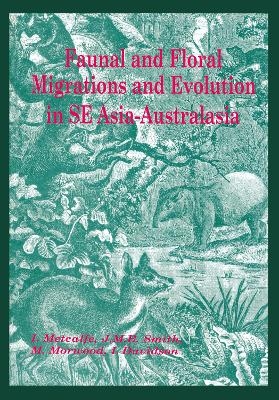
Faunal and Floral Migration and Evolution in SE Asia-Australasia
A A Balkema Publishers (Verlag)
978-90-5809-349-3 (ISBN)
Ian Metcalfe, Jeremy M.B. Smith, Mike Norwood, Iain Davidson
Preface; Introduction; Section 1. Palaeogeographic Background. Palaeozoic and Mesozoic tectonic evolution and biogeography of SE Asia-Australasia; Cenozoic reconstructions of SE Asia and the SW Pacific: changing patterns of land and sea; Section 2. Palaeozoic and Mesozoic geology and biogeography. Cambrian to Permian conodont biogeography in East Asia-Australasia; Wallace Lines in eastern Gondwana: Palaeobiogeography of Australasian Permian Brachiopoda; A review of the Early Permian flora from Papua (West New Guinea); A biogeographic comparison of the dinosaurs and associated vertebrate faunas from the Mesozoic of Australia and Southeast Asia; Early Middle Jurassie (Aalenian) radiolarian fauna from the Xialu chert in the Yarlung Zangbo Suture Zone, southern Tibet; Section 3. Wallace's Line. Why Wallace drew the line: Are-analysis of Wallace's bird collections in the Malay Archipelago and the origins of biogeography; The linear approach to biogeography: Should we erase Wallace's Line? Fauna) exchange between Asia and Australia in the Tertiary as evidenced by recent butterflies; Why does the distribution of the Honeyeaters (Meliphagidae) conform so weil to Wallace's Line? Human influences on vertebrate zoogeography: animal translocation and biological invasions across and to the east of Wallace's Line, Wallace's line and marine organisms: the distribution of staghorn corals (Acropora) in lndonesia; Section 4. Plant biogeography and evolution. Why are there so many Primitive Angiosperms in the Rain Forests of Asia-Australasia? Australian Paleogene vegetation and environments: evidence for palaeo-Gondwanan elements in the fossil records of Lauraceae and Proteaceae; Vegetation and climate in lowland Southeast Asia at the Last Glacial Maximum; The restiads invade the north: the diaspora of the Restionaceae; Evolutionary history of Alectryon in Australia; Section 5. Non Primates. Australasian distributions in Trichoptera (lnsecta)- a frequent pattern or a rare case? Butterflies and Wallace's Line: faunistic patterns and explanatory hypotheses within the south-east Asian butterflies; The vertebrate fauna of the Wallacean Island Interchange Zone: the basis of inbalance and impoverishment; Dispersal versus vicariance, artifice rather than contest; The Australian rodent fauna, flotilla's, flotsam or just fleet footed? Corroboration of the Garden of Eden Hypothesis; Mammals in Sulawesi: where did they come from and when, and what happened to them when they got there? Section 6. Primates. Radiation and Evolution of Three Macaque Species, Macaca fascicularis, M. radiata and M. sinica, as Related to the Geographie Changes in the Pleistocene of Southeast Asia; Borneo as a biogeographic barrier to Asian-Australasian migration; Modelling Divergence, Inter-breeding and Migration: Species Evolution in a Changing World; Early hominid occupation of Flores, East lndonesia, and its wider Significance; The requirements for human colonisation of Australia; Did early hominids cross sea gaps on natural rafts?
| Erscheint lt. Verlag | 1.6.2001 |
|---|---|
| Verlagsort | Rotterdam |
| Sprache | englisch |
| Maße | 178 x 254 mm |
| Gewicht | 852 g |
| Themenwelt | Naturwissenschaften ► Biologie ► Botanik |
| Naturwissenschaften ► Biologie ► Evolution | |
| Naturwissenschaften ► Geowissenschaften ► Geografie / Kartografie | |
| Naturwissenschaften ► Geowissenschaften ► Mineralogie / Paläontologie | |
| ISBN-10 | 90-5809-349-2 / 9058093492 |
| ISBN-13 | 978-90-5809-349-3 / 9789058093493 |
| Zustand | Neuware |
| Informationen gemäß Produktsicherheitsverordnung (GPSR) | |
| Haben Sie eine Frage zum Produkt? |
aus dem Bereich