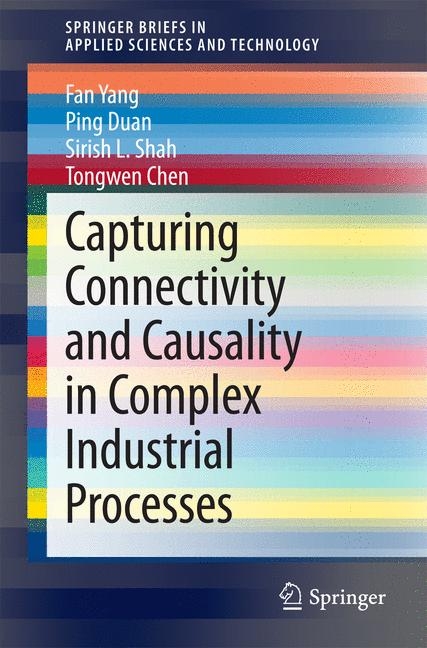
Capturing Connectivity and Causality in Complex Industrial Processes (eBook)
XIII, 91 Seiten
Springer International Publishing (Verlag)
978-3-319-05380-6 (ISBN)
This brief reviews concepts of inter-relationship in modern industrial processes, biological and social systems. Specifically ideas of connectivity and causality within and between elements of a complex system are treated; these ideas are of great importance in analysing and influencing mechanisms, structural properties and their dynamic behaviour, especially for fault diagnosis and hazard analysis. Fault detection and isolation for industrial processes being concerned with root causes and fault propagation, the brief shows that, process connectivity and causality information can be captured in two ways:
· from process knowledge: structural modeling based on first-principles structural models can be merged with adjacency/reachability matrices or topology models obtained from process flow-sheets described in standard formats; and
· from process data: cross-correlation analysis, Granger causality and its extensions, frequency domain methods, information-theoretical methods, and Bayesian networks can be used to identify pair-wise relationships and network topology.
These methods rely on the notion of information fusion whereby process operating data is combined with qualitative process knowledge, to give a holistic picture of the system.
The authors jointly have extensive research experience in modeling, control, and monitoring of complex industrial processes. In particular, they have worked on industrial projects in oil and petrochemical sectors to address safety, alarm, and fault diagnosis issues from operating plants. Moreover, they have conducted research in the related areas on capturing connectivity and causality using process data and various forms of process knowledge; their research results have been published in international journals, benefiting the automation community. Realizing the importance of capturing connectivity and causality in real-world problems, and summarizing their knowledge and understanding on various approaches currently available, the authors have made a great effort in presenting this brief as an introduction, a survey, and also a tutorial on this seasoned topic.
The authors jointly have extensive research experience in modeling, control, and monitoring of complex industrial processes. In particular, they have worked on industrial projects in oil and petrochemical sectors to address safety, alarm, and fault diagnosis issues from operating plants. Moreover, they have conducted research in the related areas on capturing connectivity and causality using process data and various forms of process knowledge; their research results have been published in international journals, benefiting the automation community. Realizing the importance of capturing connectivity and causality in real-world problems, and summarizing their knowledge and understanding on various approaches currently available, the authors have made a great effort in presenting this brief as an introduction, a survey, and also a tutorial on this seasoned topic.
Introduction.- Examples of Applications for Connectivity and Causality Analysis.- Description of Connectivity and Causality.- Capturing Connectivity and Causality from Process Knowledge.- Capturing Causality from Process Data.- Case Studies.
| Erscheint lt. Verlag | 1.4.2014 |
|---|---|
| Reihe/Serie | SpringerBriefs in Applied Sciences and Technology | SpringerBriefs in Applied Sciences and Technology |
| Zusatzinfo | XIII, 91 p. 54 illus., 24 illus. in color. |
| Verlagsort | Cham |
| Sprache | englisch |
| Themenwelt | Mathematik / Informatik ► Mathematik ► Statistik |
| Naturwissenschaften ► Chemie | |
| Technik | |
| Schlagworte | Causal Relationship • Complexity • Complex Systems • Data Mining • Fault Diagnosis • Process Connectivity • Process Knowledge • System Topology |
| ISBN-10 | 3-319-05380-9 / 3319053809 |
| ISBN-13 | 978-3-319-05380-6 / 9783319053806 |
| Informationen gemäß Produktsicherheitsverordnung (GPSR) | |
| Haben Sie eine Frage zum Produkt? |
 PDF (Wasserzeichen)
DRM: Digitales Wasserzeichen
Dieses eBook enthält ein digitales Wasserzeichen und ist damit für Sie personalisiert. Bei einer missbräuchlichen Weitergabe des eBooks an Dritte ist eine Rückverfolgung an die Quelle möglich.
Dateiformat: PDF (Portable Document Format)
Mit einem festen Seitenlayout eignet sich die PDF besonders für Fachbücher mit Spalten, Tabellen und Abbildungen. Eine PDF kann auf fast allen Geräten angezeigt werden, ist aber für kleine Displays (Smartphone, eReader) nur eingeschränkt geeignet.
Systemvoraussetzungen:
PC/Mac: Mit einem PC oder Mac können Sie dieses eBook lesen. Sie benötigen dafür einen PDF-Viewer - z.B. den Adobe Reader oder Adobe Digital Editions.
eReader: Dieses eBook kann mit (fast) allen eBook-Readern gelesen werden. Mit dem amazon-Kindle ist es aber nicht kompatibel.
Smartphone/Tablet: Egal ob Apple oder Android, dieses eBook können Sie lesen. Sie benötigen dafür einen PDF-Viewer - z.B. die kostenlose Adobe Digital Editions-App.
Buying eBooks from abroad
For tax law reasons we can sell eBooks just within Germany and Switzerland. Regrettably we cannot fulfill eBook-orders from other countries.
aus dem Bereich