Yorikiyo Nagashima is Professor Emeritus at the Department of Physics of Osaka University, Japan. An organizer of international conferences, he is also a member of the most important collaboration groups in his field of expertise, including those related to neutrino research. Professor Nagashima was the spokesman of the VENUS group, one of the major detectors of the Japanese first collider accelerator TORISTAN, where he served the first and second term at the start of the project. Professor Nagashima has authored or co-authored almost 300 papers, some of them cited up to 250 times.
Yorikiyo Nagashima is Professor Emeritus at the Department of Physics of Osaka University, Japan. An organizer of international conferences, he is also a member of the most important collaboration groups in his field of expertise, including those related to neutrino research. Professor Nagashima was the spokesman of the VENUS group, one of the major detectors of the Japanese first collider accelerator TORISTAN, where he served the first and second term at the start of the project. Professor Nagashima has authored or co-authored almost 300 papers, some of them cited up to 250 times.
1. Higgs
2. Neutrino
3. Grand Unified Theories
4. Supersymmetry I: Basics
5. Supersymmetry II: Phenomenology
6. Extra Dimension
7. Axion
8. Cosmology I: Big Bang Universe
9. Cosmology II: Structure Formation
10. Dark Matter
11. Dark Energy
Preface
Modern particle physics started in 1935 when Fermi and Yukawa proposed theories of weak and strong interactions, respectively. The 40-year saga in the quest for the ultimate form of matter and the interactions that govern them culminated in the Standard Model (SM) of particle physics in the early 1970s.
Nearly 50 years have passed since the SM was established. It is a miracle that it still holds the status as the ultimate theory of matter at the most fundamental level. No experimental observations that contradict the SM have been discovered, with perhaps one exception. Even the neutrino oscillation, the exception, may be considered as a small extension of the SM that does not need modifications. As the theory of relativity and quantum mechanics were born as a result of searches beyond Newtonian mechanics and electromagnetism, we expect that a new physics exists beyond the SM.
The SM established a prescription to unify forces by way of the gauge symmetry and spontaneous symmetry breaking. The grand unified theories (GUTs), the super-gravity (SUGRA), and the string theories were developed as extensions of the SM. Problems were pointed out and hints and new ideas have been suggested in developing the unified theories. The hierarchy is an outstanding problem among them. Many theoretical ideas including the super-symmetry (SUSY) and the extra dimension (ED) have been proposed to solve the problem. Most of them suggest a new physics at the teraelectronvolt (TeV) energy scale.
It has also been pointed out from the very beginning that the SM will lose its predictive power on phenomena beyond the TeV energy range (or ∼ 10−19 m in size). This is because the dynamics of the Higgs that causes electroweak phase transition below ∼ 1 TeV is unknown. The SM also established a notion that discovery of a new particle is synonymous with the discovery of a new physics. Therefore, experimental searches for new particles in the hitherto unexplored energy region, especially in the TeV range, are the most orthodox way to explore the physics beyond the SM.
On the other hand, experiments at energy scale in the range ∼ 1010−19 GeV are required to probe the physics of the unified theories. They are beyond the reach of present-day technology. Fortunately, the advent of the unified theories found a way to elucidate the history of early universe. Cosmology and particle physics have become one and the same scientific field. Conversely, the advent of cosmology opened a new window to view and probe the high-energy phenomena that are inaccessible by today's technology. We can probe properties of particles by looking at cosmic relic particles, fossils of the Big Bang, so to speak. Nowadays, researches in particle physics that do not rely on accelerators occupy an important branch. They are generically referred to as non-accelerator physics. It is an unappealing name, nonetheless used for the reason that no other has been invented.
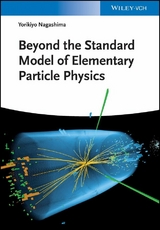
This book is the third of a series of textbooks on “Elementary Particle Physics” [1] and [2]. Part 1 of Volume I [1] introduced the quantum field theory at the level that is necessary to understand phenomenology and to derive at least tree-level formulas for various reactions. Part 2 of Volume I described a way, logically as well as historically, to reach the SM of particle physics. Content of Volume II [2] is the SM itself, an essential part of the electroweak interactions, and quantum chromodynamics (QCD). This book, entitled “Beyond the Standard Model of Elementary Particle Physics” should be considered as Volume III. The title speaks of its content by itself but the discussions are limited to topics that will become experimentally accessible in the near future. Each of the three volumes is organized to stand on their own depending on the readers’ interest and level, except occasional references to equations that were derived previously. This book is organized as follows:
Chapter 1 describes the properties of the Higgs particle, which is within the SM but whose dynamics is unknown. The Higgs mechanism constitutes the basis of the SM. Clarification of its dynamics may consolidate or modify the foundation of the SM. Therefore, it is the most urgent topic. The large hadron collider (LHC) was built primarily to discover the Higgs and clarify the underlying mechanism. It is now producing data.
Chapter 2 discusses the neutrino. Vanishing of the neutrino mass has always been the most outstanding topic from the beginning of its prediction by Pauli. The neutrino oscillation is a firm evidence that the neutrino is not massless, which is a topic on its own, and at the same time has provided the first and so far the only experimental data that goes beyond the SM. Clarifying relations among the three types of the neutrinos is the most direct approach to the flavor mystery, which is one of the unsolved problems of the SM. Furthermore, the neutrino provides important links to connect the SM with the GUTs and also with cosmology.
Chapter 3 discusses a basic structure of the GUTs. It does not aim to go deep in its structure but is meant to introduce problems that one encounters in trying to unify the forces. Above all, it has placed the so-called gauge hierarchy in limelight. The GUT is a topic by itself, but this chapter also serves as a prelude to the SUSY and the extra-dimensional theories.
Chapter 4 introduces basic algebra of SUSY that is necessary to derive formulas for the SUSY phenomenology. If the reader is interested only in the SUSY phenomenology, he or she may skip this chapter except the first introductory remarks and go directly to Chapter 5.
Chapter 5 discusses the phenomenology of the low-scale SUSY and how they are being examined by LHC data. The SUSY was offered as a remedy to solve the technical difficulties associated with the hierarchy problem. It also has a virtue that the gauged SUSY, referred to as SUGRA, can handle gravity and hence is a candidate for the unification of all forces. The super-string theory, the prime candidate for the ultimate unified theory, considers strings as fundamental building blocks of matter. It also respects the SUSY and works in 10- or 11-dimensional spacetime, which inspired the theory of the ED. However, the low-scale SUSY is treated as an independent phenomenological theory to solve the difficulties associated with the SM or its extension. It also offers a prime candidate for the dark matter (DM) in the universe.
The ED discussed in Chapter 6 provides an alternative to the SUSY to solve the hierarchy problem. Unlike the SUSY, which only solves the technical aspect of the hierarchy problem, ED offers a possible solution to deny the existence of the hierarchy itself, that is, that the energy scale of gravity may not be GeV but in the TeV region. Another interesting possibility is the gauge–Higgs unification, which might provide a symmetry to circumvent the hierarchy problem.
Chapter 7 discusses the axion and explains instantons, chiral anomaly, and the strong charge parity (CP) problem, which are in the realm of the SM but offer completely different aspects not provided by the perturbation theories. Existence of the axion seems an unavoidable outcome of these theoretical issues. It also provides an alternative candidate for the DM and a link between particle physics and cosmology. The first half of the chapter is devoted to these theoretical problems. Readers who are interested only in the phenomenology of the axion may skip this part.
Chapters 8 and 9 are devoted to cosmology. Chapter 8 describes a thermal history of the Hot Big Bang universe as a uniform and isotropic perfect fluid. Connections between particle physics and cosmology/astro-particle physics, including the inflation, are discussed. Chapter 9 deals with the deviation of matter distribution from uniformity, namely the large-scale structure of the universe, CMB (cosmic microwave background), and roles of the DM in forming them. Although these topics deserve treatments of their own, they are, in the author's mind, necessary introductions to tackle the problem of the DM and the dark energy (DE).
Chapter 10 discusses evidences and searches for the DM and possible candidates from the particle physics point of view. Finally, Chapter 11 discusses the DE. The field of DE is in its infancy. However, the author believes that both the DM and the DE will be the two main themes of particle physics in the twenty-first century.
Target readers of this book are experimental physicists, graduate students aiming at theories or experiments, and hopefully laymen in the field who are serious enough to follow the mathematical logics described in the book. They are expected to have a basic knowledge of particle physics at the level described in [1]. But they may be ignorant of each topic adopted in this book. Each chapter is basically independent and stands on its own, except Chapter 9 (Cosmology II) which quotes many results from the previous chapter. Some readers may also find it easier to read some parts of Chapter 8 (Cosmology I) first for understanding the invisible axions described in Chapter 7.
LHC made a historic discovery of the Higgs particle with mass 125 GeV in 2012. No indications of new physics have been found so far (as of summer 2013). The SM turned out to be much better than expected by many theorists. The validity of the SM is now extended at least by a factor 10 in the energy scale to ∼O(10 TeV). People began to cast doubt about the naturalness, which has been the guiding principle in proposing new models. This book faces the danger of becoming obsolete soon if LHC makes another revolutionary discovery during the rest of its operations. The most...
| Erscheint lt. Verlag | 14.4.2014 |
|---|---|
| Sprache | englisch |
| Themenwelt | Naturwissenschaften ► Physik / Astronomie ► Atom- / Kern- / Molekularphysik |
| Technik | |
| Schlagworte | Astronomie u. Astrophysik • Astronomy & Astrophysics • Astrophysik • background knowledge • BASIC • Beyond • BIG • Dark • Elementarteilchen • Elementarteilchenphysik • Evidence • Experimental • Formulas • Higgsboson • Hochenergiephysik • Ideas • Implications • Kern- u. Hochenergiephysik • matter • Modern • Neutrino Physics • Nuclear & High Energy Physics • Open • outcomes • particle • Phenomenological • Physics • Physik • presentation • Quantenfeldtheorie • questions • techniques • Teilchenphysik |
| ISBN-10 | 3-527-66504-8 / 3527665048 |
| ISBN-13 | 978-3-527-66504-4 / 9783527665044 |
| Informationen gemäß Produktsicherheitsverordnung (GPSR) | |
| Haben Sie eine Frage zum Produkt? |
 EPUB (Adobe DRM)
Kopierschutz: Adobe-DRM
Adobe-DRM ist ein Kopierschutz, der das eBook vor Mißbrauch schützen soll. Dabei wird das eBook bereits beim Download auf Ihre persönliche Adobe-ID autorisiert. Lesen können Sie das eBook dann nur auf den Geräten, welche ebenfalls auf Ihre Adobe-ID registriert sind.
Details zum Adobe-DRM
Dateiformat: EPUB (Electronic Publication)
EPUB ist ein offener Standard für eBooks und eignet sich besonders zur Darstellung von Belletristik und Sachbüchern. Der Fließtext wird dynamisch an die Display- und Schriftgröße angepasst. Auch für mobile Lesegeräte ist EPUB daher gut geeignet.
Systemvoraussetzungen:
PC/Mac: Mit einem PC oder Mac können Sie dieses eBook lesen. Sie benötigen eine
eReader: Dieses eBook kann mit (fast) allen eBook-Readern gelesen werden. Mit dem amazon-Kindle ist es aber nicht kompatibel.
Smartphone/Tablet: Egal ob Apple oder Android, dieses eBook können Sie lesen. Sie benötigen eine
Geräteliste und zusätzliche Hinweise
Buying eBooks from abroad
For tax law reasons we can sell eBooks just within Germany and Switzerland. Regrettably we cannot fulfill eBook-orders from other countries.
aus dem Bereich