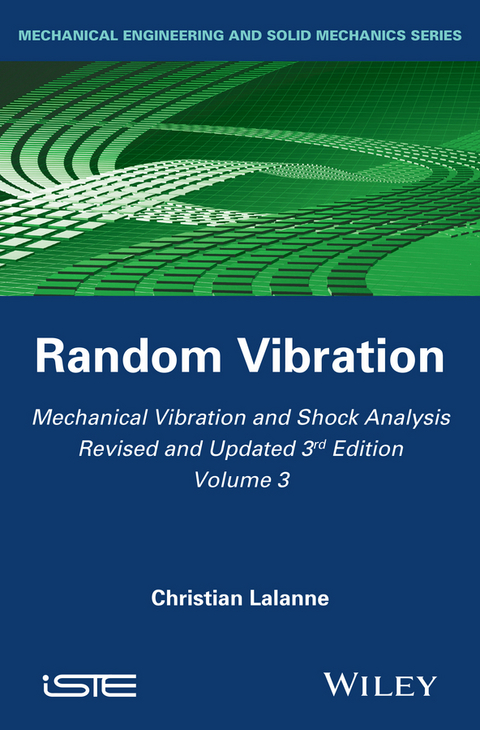
Mechanical Vibration and Shock Analysis, Random Vibration (eBook)
649 Seiten
Wiley (Verlag)
978-1-118-93117-2 (ISBN)
The power spectrum density is also defined, together with the requisite precautions to be taken in its calculations as well as the processes (windowing, overlapping) necessary to obtain improved results.
An additional complementary method – the analysis of statistical properties of the time signal – is also described. This enables the distribution law of the maxima of a random Gaussian signal to be determined and simplifies the calculation of fatigue damage by avoiding direct peak counting.
The vast majority of vibrations encountered in the real environment are random in nature. Such vibrations are intrinsically complicated and this volume describes the process that enables us to simplify the required analysis, along with the analysis of the signal in the frequency domain. The power spectrum density is also defined, together with the requisite precautions to be taken in its calculations as well as the processes (windowing, overlapping) necessary to obtain improved results. An additional complementary method the analysis of statistical properties of the time signal is also described. This enables the distribution law of the maxima of a random Gaussian signal to be determined and simplifies the calculation of fatigue damage by avoiding direct peak counting.
Christian Lalanne is a Consultant Engineer who previously worked as an expert at the French Atomic Energy Authority and who has specialized in the study of vibration and shock for more than 40 years. He has been associated with the new methods of drafting testing specifications and associated informatic tools.
Chapter 1. Statistical Properties of a Random Process
Chapter 2. Random Vibration Properties in the Frequency Domain
Chapter 3. Rms Value of Random Vibration
Chapter 4. Practical Calculation of the Power Spectral Density
Chapter 5. Statistical Properties of Random Vibration in the Time Domain
Chapter 6. Probability Distribution of Maxima of Random Vibration
Chapter 7. Statistics of Extreme Values
Chapter 8. Response of a One-Degree-of-Freedom Linear System to Random Vibration
Chapter 9. Characteristics of the Response of a One-Degree-of-Freedom Linear System to Random Vibration
Chapter 10. First Passage at a Given Level of Response of a One-Degree-of-Freedom Linear System to a Random Vibration
List of Symbols
The list below gives the most frequent definition of the main symbols used in this book. Some of the symbols can have another meaning which will be defined in the text to avoid any confusion.
| a | Threshold value of ℓ(t) or maximum of ℓ(t) |
| A | Maximum of A (t) |
| A(t) | Envelope of a signal |
| b | Exponent |
| c | Viscous damping constant |
| e(t) | Narrow band white noise |
| E() | Expectation of… |
| E1( ) | First definition of error function |
| E2( ) | Second definition of error function |
| Erf | Error function |
| E( ) | Expected function of … |
| f | Frequency of excitation |
| fsamp. | Sampling frequency |
| fmax | Maximum frequency |
| f0 | Natural frequency |
| g | Acceleration due to gravity |
| G | Particular value of power spectral density |
| G( ) | Power spectral density for 0 ≤ f ≤ ∞ |
| Measured value of G( ) |
| Gℓu( ) | Cross-power spectral density |
| h | Interval (f/f0) or f2/f1 |
| h(t) | Impulse response |
| H( ) | Transfer function |
| i |
| k | Stiffness |
| K | Number of subsamples |
| ℓ | Value of ℓ(t) |
| Mean value of ℓ(t) |
| Average maximum of Np peaks |
| ℓrms | Rms value of ℓ(t) |
| Rms value of |
| ℓ(t) | Generalized excitation (displacement) |
| First derivative of ℓ(t) |
| Second derivative of ℓ(t) |
| L | Given value of ℓ(t) |
| Lrms | Rms value of filtered signal |
| L(Ω) | Fourier transform of ℓ(t) |
| Fourier transform of |
| m | Mean |
| M | Number of points of PSD |
| Ma | Average number of maxima which exceeds threshold per unit time |
| Mn | Moment of order n |
| n | Order of moment or number of degrees of freedom |
| na | Average number of crossings of threshold a per unit time |
| Average number of crossings of threshold a with positive slope per unit time |
| n0 | Average number of zero-crossings per unit time |
| Average number of zero-crossings with positive slope per second (average frequency) |
| Average number of maxima per unit time |
| N | Number of curves or Number of points of signal or Numbers of dB |
| Np | Number of peaks |
| Average number of crossings of threshold a with positive slope for given length of time |
| Average number of zero-crossings with positive slope for given length of time |
| Average number of positive maxima for given length of time |
| p( ) | Probability density |
| pN ( ) | Probability density of largest maximum over given duration |
| P | Probability |
| PSD | Power spectral density |
| q |
| qE |
| Probability that a maximum is positive |
| Probability that a maximum is negative |
| q( ) | Probability density of maxima of ℓ(t) |
| q(θ) | Reduced response |
| First derivative of q(θ) |
| Second derivative of q(θ) |
| Q | Q factor (quality factor) |
| Q( ) | Distribution function of maxima of ℓ(t) |
| Q(u) | Probability that a maximum is higher than a given threshold |
| r | Irregularity factor |
| rms | Root mean square (value) |
| r(t) | Temporal window |
| R | Slope in dB/octave or Ratio of the number of minima to the number of maxima |
| RE( ) | Auto-correlation function of envelope |
| Rℓu | Cross-correlation function between ℓ(t) and u(t) |
| R(f) | Fourier transform of r(t) |
| R(t) | Envelope of maxima of u(t) |
| First derivative of R(t) |
| R(τ) | Auto-correlation function |
| s | Standard deviation |
| S0 | Value of constant PSD |
| S( ) | Power spectral density for –∞ ≤ f ≤ +∞ |
| t | Time |
| T | Duration of sample of signal or duration of vibration |
| Ta | Average time between two successive maxima |
| u | Ratio of threshold a to rms value ℓrms of ℓ(t) |
| u0 | Initial value of u(t) |
| Initial value of |
| Average of highest peaks |
| urms | Rms value of u(t) |
| Rms value of |
| Rms value of |
| u(t) | Generalized response |
| First derivative of u(t) |
| Second derivative of u(t) |
| v | Ratio a/urms |
| vrms | Rms value of |
| xrms | Rms value of x(t) |
| Absolute acceleration of base of one-degree-of-freedom system |
| Rms value of |
| Maximum value of |
| yrms | Rms value of y(t) |
| Rms value of |
| Rms value of |
| zrms | Rms value of z(t) |
| Rms value of |
| Rms value of |
| α | Time-constant of the probability density of the first passage of a threshold or Risk of up-crossing or |
| β | 2 (1 – 2 ξ2) |
| Variable of chi-square with n degrees of freedom |
| δt | Time step |
| δ( ) | Dirac delta function |
| Δτ | Effective time interval |
| Δf | Frequency interval between half-power points or frequency step of the PSD |
| ΔF | Bandwidth of analysis filter |
| Δℓ | Interval of amplitude of ℓ(t) |
| Δt | Time interval |
| ε | Statistical error or Euler’s constant (0.57721566490…) |
| γ ℓu | Coherence function between ℓ(t) and... |
| Erscheint lt. Verlag | 16.4.2014 |
|---|---|
| Sprache | englisch |
| Themenwelt | Naturwissenschaften ► Physik / Astronomie ► Mechanik |
| Technik ► Maschinenbau | |
| Schlagworte | Festkörpermechanik • Festkörpermechanik • Maschinenbau • mechanical engineering • solid mechanics |
| ISBN-10 | 1-118-93117-3 / 1118931173 |
| ISBN-13 | 978-1-118-93117-2 / 9781118931172 |
| Informationen gemäß Produktsicherheitsverordnung (GPSR) | |
| Haben Sie eine Frage zum Produkt? |
 PDF (Adobe DRM)
Größe: 13,9 MB
Kopierschutz: Adobe-DRM
Adobe-DRM ist ein Kopierschutz, der das eBook vor Mißbrauch schützen soll. Dabei wird das eBook bereits beim Download auf Ihre persönliche Adobe-ID autorisiert. Lesen können Sie das eBook dann nur auf den Geräten, welche ebenfalls auf Ihre Adobe-ID registriert sind.
Details zum Adobe-DRM
Dateiformat: PDF (Portable Document Format)
Mit einem festen Seitenlayout eignet sich die PDF besonders für Fachbücher mit Spalten, Tabellen und Abbildungen. Eine PDF kann auf fast allen Geräten angezeigt werden, ist aber für kleine Displays (Smartphone, eReader) nur eingeschränkt geeignet.
Systemvoraussetzungen:
PC/Mac: Mit einem PC oder Mac können Sie dieses eBook lesen. Sie benötigen eine
eReader: Dieses eBook kann mit (fast) allen eBook-Readern gelesen werden. Mit dem amazon-Kindle ist es aber nicht kompatibel.
Smartphone/Tablet: Egal ob Apple oder Android, dieses eBook können Sie lesen. Sie benötigen eine
Geräteliste und zusätzliche Hinweise
Zusätzliches Feature: Online Lesen
Dieses eBook können Sie zusätzlich zum Download auch online im Webbrowser lesen.
Buying eBooks from abroad
For tax law reasons we can sell eBooks just within Germany and Switzerland. Regrettably we cannot fulfill eBook-orders from other countries.
 EPUB (Adobe DRM)
Kopierschutz: Adobe-DRM
Adobe-DRM ist ein Kopierschutz, der das eBook vor Mißbrauch schützen soll. Dabei wird das eBook bereits beim Download auf Ihre persönliche Adobe-ID autorisiert. Lesen können Sie das eBook dann nur auf den Geräten, welche ebenfalls auf Ihre Adobe-ID registriert sind.
Details zum Adobe-DRM
Dateiformat: EPUB (Electronic Publication)
EPUB ist ein offener Standard für eBooks und eignet sich besonders zur Darstellung von Belletristik und Sachbüchern. Der Fließtext wird dynamisch an die Display- und Schriftgröße angepasst. Auch für mobile Lesegeräte ist EPUB daher gut geeignet.
Systemvoraussetzungen:
PC/Mac: Mit einem PC oder Mac können Sie dieses eBook lesen. Sie benötigen eine
eReader: Dieses eBook kann mit (fast) allen eBook-Readern gelesen werden. Mit dem amazon-Kindle ist es aber nicht kompatibel.
Smartphone/Tablet: Egal ob Apple oder Android, dieses eBook können Sie lesen. Sie benötigen eine
Geräteliste und zusätzliche Hinweise
Buying eBooks from abroad
For tax law reasons we can sell eBooks just within Germany and Switzerland. Regrettably we cannot fulfill eBook-orders from other countries.
aus dem Bereich