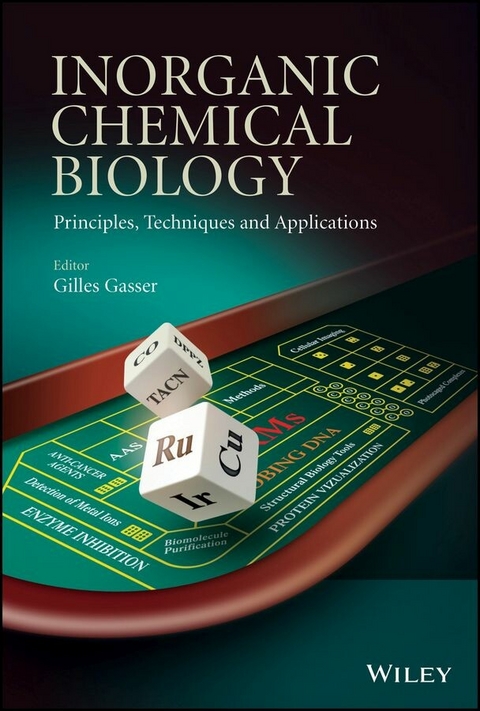
Inorganic Chemical Biology (eBook)
John Wiley & Sons (Verlag)
978-1-118-68425-2 (ISBN)
Understanding, identifying and influencing the biological systems are the primary objectives of
chemical biology. From this perspective, metal complexes have always been of great assistance
to chemical biologists, for example, in structural identification and purification of essential
biomolecules, for visualizing cellular organelles or to inhibit specific enzymes. This inorganic side
of chemical biology, which continues to receive considerable attention, is referred to as inorganic
chemical biology.
Inorganic Chemical Biology: Principles, Techniques and Applications provides a comprehensive
overview of the current and emerging role of metal complexes in chemical biology. Throughout all
of the chapters there is a strong emphasis on fundamental theoretical chemistry and experiments
that have been carried out in living cells or organisms. Outlooks for the future applications of
metal complexes in chemical biology are also discussed.
Topics covered include:
• Metal complexes as tools for structural biology
• IMAC, AAS, XRF and MS as detection techniques for metals in chemical biology
• Cell and organism imaging and probing DNA using metal and metal carbonyl complexes
• Detection of metal ions, anions and small molecules using metal complexes
• Photo-release of metal ions in living cells
• Metal complexes as enzyme inhibitors and catalysts in living cells
Written by a team of international experts, Inorganic Chemical Biology: Principles, Techniques and
Applications is a must-have for bioinorganic, bioorganometallic and medicinal chemists as well as
chemical biologists working in both academia and industry.
Editor
Gilles Gasser, Department of Chemistry, University of Zurich, Switzerland
Understanding, identifying and influencing the biological systems are the primary objectives of chemical biology. From this perspective, metal complexes have always been of great assistance to chemical biologists, for example, in structural identification and purification of essential biomolecules, for visualizing cellular organelles or to inhibit specific enzymes. This inorganic side of chemical biology, which continues to receive considerable attention, is referred to as inorganic chemical biology. Inorganic Chemical Biology: Principles, Techniques and Applications provides a comprehensive overview of the current and emerging role of metal complexes in chemical biology. Throughout all of the chapters there is a strong emphasis on fundamental theoretical chemistry and experiments that have been carried out in living cells or organisms. Outlooks for the future applications of metal complexes in chemical biology are also discussed. Topics covered include: Metal complexes as tools for structural biology IMAC, AAS, XRF and MS as detection techniques for metals in chemical biology Cell and organism imaging and probing DNA using metal and metal carbonyl complexes Detection of metal ions, anions and small molecules using metal complexes Photo-release of metal ions in living cells Metal complexes as enzyme inhibitors and catalysts in living cells Written by a team of international experts, Inorganic Chemical Biology: Principles, Techniques and Applications is a must-have for bioinorganic, bioorganometallic and medicinal chemists as well as chemical biologists working in both academia and industry.
Editor Gilles Gasser, Department of Chemistry, University of Zurich, Switzerland
Chapter 1
New Applications of Immobilized Metal Ion Affinity Chromatography in Chemical Biology
Rachel Codd, Jiesi Gu, Najwa Ejje and Tulip Lifa
School of Medical Sciences (Pharmacology) and Bosch Institute, The University of Sydney, Australia
1.1 Introduction
Immobilized metal ion affinity chromatography (IMAC) was first introduced as a method for resolving native proteins with surface exposed histidine residues from a complex mixture of human serum [1]. IMAC has since become a routine method used in molecular biology for purifying recombinant proteins with histidine tags engineered at the N- or C-terminus. The success of IMAC for protein purification may have obscured its potential utility in other applications in biomolecular chemistry and chemical biology. Since there exists in nature a multitude of non-protein based low molecular weight compounds that have an inherent affinity towards metal ions, or that have a fundamental requirement for metal ion binding for activity, IMAC could be used to capture these targets from complex mixtures. This highly selective affinity-based separation method could facilitate the discovery of new anti-infective and anticancer compounds from bacteria, fungi, plants, and sponges. A recent body of work highlights new applications of IMAC for the isolation of known drugs and for drug discovery, metabolome profiling, and for preparing metal-specific molecular probes for chemical proteomics-based drug discovery. At its core, IMAC is a method underpinned by the fundamental tenets of coordination chemistry. This chapter will briefly focus on these aspects, before moving on to describe a number of recent innovations in IMAC. The ultimate intent of this chapter is to seed interest in other research groups for expanding the use of IMAC across chemical biology.
1.2 Principles and Traditional Use
An IMAC system comprises three variable elements (Fig. 1.1): the insoluble matrix (green), the immobilized chelate (depicted as iminodiacetic acid, IDA, red), and the metal ion (commonly Ni(II), blue). Critical to the veracity of IMAC as a separation technique is that the coordination sphere of the immobilized metal–chelate complex is unsaturated, which allows target compounds to reversibly bind to the resin via the formation and dissociation of coordinate bonds. Each element of the IMAC system can be varied independently or in combination, which, together with basic experimental conditions (buffer selection, pH value), will influence the outcome of a separation experiment. This modular type of experimental system allows a high level of control for optimization.
Figure 1.1 The elements of an immobilized metal ion affinity chromatography (IMAC) experiment. The system (left-hand side) comprises an insoluble matrix (green) with a covalently bound chelate (iminodiacetic acid, IDA, red) which coordinates in a 1:1 fashion a metal ion (Ni(II), blue) to give a complex with vacant coordination sites available for the reversible binding of targets with metal binding groups. Traditional IMAC targets (right-hand side) include native proteins with surface exposed histidine residues, histidine-tagged proteins, and phosphorylated proteins
In accord with its original intended use, the majority of IMAC targets are proteins, which even as native molecules can bind to the immobilized metal–chelate complex with variable affinities, as determined by the presence of surface exposed histidine residues and, in some cases, more weakly binding cysteine residues (Fig. 1.1, protein shown at left). Compared with native proteins, recombinant proteins, which feature a hexameric histidine repeat unit (His-tag) engineered at the C- or N-terminus, are higher affinity IMAC targets (Fig. 1.1, protein shown at middle). In this case, the C-terminal histidine residues of the recombinant protein displace the three water ligands in the immobilized Ni(II)–IDA coordination sphere, with the majority of the components in the protein expression mixture not retained on the resin (Fig. 1.2). After washing the resin to remove these unbound components, the coordinate bonds between the Ni(II)–IDA complex and the C-terminal histidine residues are dissociated by competition upon washing the resin with a buffer containing a high concentration of imidazole.
Figure 1.2 The traditional use of IMAC for the purification of His-tagged recombinant proteins. The recombinant protein binds to the immobilized coordination complex upon the displacement of water ligands by the histidine residues engineered at the N- or C- (as shown) terminus. The resin is washed to remove unbound components from the expression mixture, and the purified protein is eluted from the resin by competition upon washing with a high concentration of imidazole buffer
Phosphorylated proteins (Fig. 1.1, protein at right) as studied in phosphoproteomics [2–4], are also isolable using an IMAC format, based upon the affinity between Fe(III) and phosphorylated proteins (Fe(III)–phosphoserine, log K ∼ 13 [5]). The IMAC-compatible metal ions most suited for phosphoproteomics include Fe(III), Ga(III), or Zr(IV), with these hard acids having preferential binding affinities towards the hard base phosphate groups. This highlights that the IMAC technique is governed by key principles of coordination chemistry, including the hard and soft acids and bases (HSAB) theory [6], coordination number and geometry preferences, and thermodynamic and kinetic factors.
Because there is a significant market demand for IMAC-based separations, considerable research in the biotechnology sector has focused upon finding new and improved matrices and immobilized chelates. Common matrices include cross-linked agarose, cellulose, and sepharose. These polymers can be prepared with different degrees of cross-linking, branching, and different levels of activation, which affect the concentration of the immobilized chelate in the final matrix. There are several different types of immobilized chelates in use in IMAC applications (Fig. 1.3), with the most common being tridentate iminodiacetic acid (IDA, A) and tetradentate nitrilotriacetic acid (NTA, B). Immobilized tetradentate N-(carboxymethyl)aspartic acid (CM-Asp, C) and pentadentate N,N,N′-tris(carboxymethyl)ethylenediamine (TED, D) are used less frequently. These different N- and O-atom containing ligand types cover a range of degrees of coordinative unsaturation, which for a metal ion with an octahedral coordination preference would span: three available sites (M(N1O2(OH2)3) (IDA)), two available sites (M(N1O3(OH2)2) (NTA), M(N1O3(OH2)2) (CM-Asp)), and one available site (M(N2O3(OH2)) (TED)). A significant number of resins with non-traditional immobilized chelates, such as 1,4,7-triazocyclononane [7], 8-hydroxyquinoline [8] or N-(2-pyridylmethyl)aminoacetate [9] have been prepared, which have different performance characteristics with respect to protein purification, compared with the traditional IMAC resins.
Figure 1.3 Immobilized chelates used in IMAC applications. Chelates: iminodiacetic acid (IDA, a), nitrilotriacetic acid (NTA, b), N-(carboxymethyl)aspartic acid (CM-Asp, c) or N,N,N′-tris(carboxymethyl)ethylenediamine (TED, d). A range of metal ions, including Ni(II), Cu(II), Co(II) or Zn(II), are compatible with each type of immobilized chelate. The type of chelate and the coordination preferences of the metal ion will direct the degree of coordinative unsaturation of the immobilized complex
The nature of the immobilized coordination complex, in terms of both chelate and metal ion, has a major influence on the outcome of an IMAC procedure. An example of the influence of the chelate is found in early studies, which focused on the development of IMAC for phosphoproteomics. Fractions of phosphoserine-containing ovalbumin were retained on an immobilized Fe(III)–IDA resin, but were not retained on an immobilized Fe(III)–TED resin [2]. While an explanation for this observation was not provided in the original work, we posit that this is most likely due to the difference between the number of available coordination sites in the Fe(III)–IDA complex (three sites) and the Fe(III)–TED complex (one site) (Fig. 1.3). This would suggest that retention of ovalbumin fractions via phosphoserine residues involves at least a bidentate binding mode, and that the single coordination site at the Fe(III)–TED complex was insufficient for retaining the target.
1.3 A Brief History
As an enabling technology, IMAC has played a significant role in accelerating knowledge of molecular, cell, and human biology, through expediting access to significant quantities of pure proteins. For a technique that is conducted every day in many laboratories around the world, it is interesting to reflect briefly upon the history and acceptance of IMAC in its early phases of development. The many review articles available on the history of IMAC [10–14] warrants only a brief coverage of this topic here. The first description of IMAC for protein fractionation used Zn(II)- or Cu(II)-loaded IDA resins prepared in house, with the columns configured in series [1]. Processing of an aliquot of human serum showed that the Zn(II) column was enriched with transferrin, acid glycoprotein, and ceruloplasmin, while the Cu(II) column was...
| Erscheint lt. Verlag | 14.4.2014 |
|---|---|
| Sprache | englisch |
| Themenwelt | Naturwissenschaften ► Biologie ► Biochemie |
| Naturwissenschaften ► Chemie ► Anorganische Chemie | |
| Naturwissenschaften ► Chemie ► Organische Chemie | |
| Technik | |
| Schlagworte | Assistance • Bioanorganische Chemie • Biochemie u. Chemische Biologie • Biochemistry (Chemical Biology) • bioinorganic chemistry • biological • biologists • biomolecules • Biowissenschaften • Cell Biology • cellular • Chemical • Chemie • Chemische Biologie • Chemistry • Complexes • enzymes • Essential • Example • Great • Life Sciences • Metal • objectives • Organelles • Perspective • Primary • Purification • Side • structural identification • Systems • Visualizing • Zellbiologie |
| ISBN-10 | 1-118-68425-7 / 1118684257 |
| ISBN-13 | 978-1-118-68425-2 / 9781118684252 |
| Informationen gemäß Produktsicherheitsverordnung (GPSR) | |
| Haben Sie eine Frage zum Produkt? |
 EPUB (Adobe DRM)
Größe: 22,8 MB
Kopierschutz: Adobe-DRM
Adobe-DRM ist ein Kopierschutz, der das eBook vor Mißbrauch schützen soll. Dabei wird das eBook bereits beim Download auf Ihre persönliche Adobe-ID autorisiert. Lesen können Sie das eBook dann nur auf den Geräten, welche ebenfalls auf Ihre Adobe-ID registriert sind.
Details zum Adobe-DRM
Dateiformat: EPUB (Electronic Publication)
EPUB ist ein offener Standard für eBooks und eignet sich besonders zur Darstellung von Belletristik und Sachbüchern. Der Fließtext wird dynamisch an die Display- und Schriftgröße angepasst. Auch für mobile Lesegeräte ist EPUB daher gut geeignet.
Systemvoraussetzungen:
PC/Mac: Mit einem PC oder Mac können Sie dieses eBook lesen. Sie benötigen eine
eReader: Dieses eBook kann mit (fast) allen eBook-Readern gelesen werden. Mit dem amazon-Kindle ist es aber nicht kompatibel.
Smartphone/Tablet: Egal ob Apple oder Android, dieses eBook können Sie lesen. Sie benötigen eine
Geräteliste und zusätzliche Hinweise
Zusätzliches Feature: Online Lesen
Dieses eBook können Sie zusätzlich zum Download auch online im Webbrowser lesen.
Buying eBooks from abroad
For tax law reasons we can sell eBooks just within Germany and Switzerland. Regrettably we cannot fulfill eBook-orders from other countries.
 PDF (Adobe DRM)
Kopierschutz: Adobe-DRM
Adobe-DRM ist ein Kopierschutz, der das eBook vor Mißbrauch schützen soll. Dabei wird das eBook bereits beim Download auf Ihre persönliche Adobe-ID autorisiert. Lesen können Sie das eBook dann nur auf den Geräten, welche ebenfalls auf Ihre Adobe-ID registriert sind.
Details zum Adobe-DRM
Dateiformat: PDF (Portable Document Format)
Mit einem festen Seitenlayout eignet sich die PDF besonders für Fachbücher mit Spalten, Tabellen und Abbildungen. Eine PDF kann auf fast allen Geräten angezeigt werden, ist aber für kleine Displays (Smartphone, eReader) nur eingeschränkt geeignet.
Systemvoraussetzungen:
PC/Mac: Mit einem PC oder Mac können Sie dieses eBook lesen. Sie benötigen eine
eReader: Dieses eBook kann mit (fast) allen eBook-Readern gelesen werden. Mit dem amazon-Kindle ist es aber nicht kompatibel.
Smartphone/Tablet: Egal ob Apple oder Android, dieses eBook können Sie lesen. Sie benötigen eine
Geräteliste und zusätzliche Hinweise
Buying eBooks from abroad
For tax law reasons we can sell eBooks just within Germany and Switzerland. Regrettably we cannot fulfill eBook-orders from other countries.
aus dem Bereich