Comparative Virology (eBook)
600 Seiten
Elsevier Science (Verlag)
978-1-4832-6969-6 (ISBN)
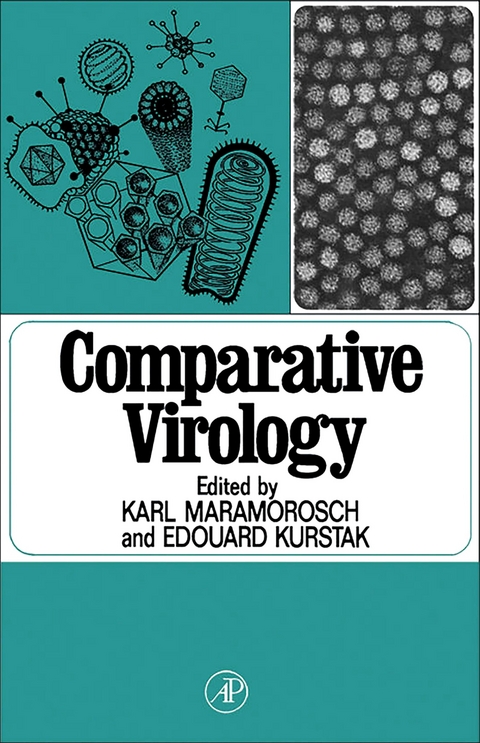
Comparative Virology provides an integrated comparison of viruses, based on their chemical and morphological characteristics. These descriptions will not only give the reader a background but also a detailed analysis of the various groups. In some instances the groups are still host related, as in the case of bacteriophages and polyhedral insect viruses. In others, for instance in pox viruses, the group comprises viruses of vertebrates and invertebrates. The hosts of the bacilliform Rhabdovirales range from man and other warm-blooded vertebrates through invertebrate animals to plants. A special chapter is devoted to viruses devoid of protein-a group that is of great interest and that has only recently been recognized. Since there is historical and practical interest in ecologie groupings, such as arboviruses and oncogenic viruses, chapters on such groups have also been included. The book opens with a discussion on the classification of viruses. Chapters dealing with DNA viruses and RNA viruses follow, and the ecologically and disease-oriented groups complete the volume. It is hoped that "e;"e;Comparative Virology"e;"e; will help bring unity to the science of virology through the comparative approach that is not dependent on virus-host interactions. The combined efforts of eminent contributors to discuss and evaluate new information will hopefully benefit all who are interested in virology
Front Cover 1
Comparative Virology 4
Copyright Page 5
Table of Contents 6
List of Contributors 12
Preface 14
Chapter 1. Remarks on the Classification of Viruses 18
I. Introduction 19
II. The LHT System 21
III. Pros and Cons of the LHT System 32
IV. Phanerogram, Cryptogram, and Gymnogram 35
V. Evaluation of Characteristics 39
VI. Categories and Taxons, Nomenclature 42
VII. Lanni's System 46
VIII. Bellett's System 47
IX. Miscellaneous Remarks 52
X. Gibbs' Classification 55
XI. Classification of the Classifications 55
XII. Conclusions 58
References 58
Chapter 2. Small DNA Viruses 60
I. Introduction 60
II. Classification and Nomenclature: General Considerations 61
III. Specific Properties of Various Parvoviruses and Parvovirus Candidates 62
IV. Discussion and Conclusions 91
References 93
Chapter 3. The Papovavirus Group 98
I. Introduction 98
II. Biology of Papovaviruses 99
III. Chemical Composition of SV40 and Polyoma Virus 102
IV. The Structure of the Papovaviruses 110
References 119
Chapter 4. Adenoviruses 122
I. Introduction 122
II. Definition of an Adenovirus 123
III. Summary of Identified Adenoviruses 124
IV. Structural Characteristics of Virions and Virion Components of Adenoviruses 126
V. Hemagglutinating Activity of Adenoviruses Association with Virus Products
VI. Comparison of Immunological Characteristics of Adenovirus-Specific Proteins 132
VII. Some Aspects on Adenovirus-Cell Interactions Cytopathology, Lytic, and Nonlytic Multiplication
VIII. Concluding Remarks 144
References 147
Chapter 5. Herpesviruses: Current Information on the Composition and Structure 152
I. Introduction 152
II. Chemical Composition of the Herpesvirion 154
III. The Architecture of the Herpesvirion 173
IV. Conclusions 180
References 181
Chapter 6. Comparative Observations on Poxviruses of Invertebrates and Vertebrates 186
I. Introduction 188
II. Comparative Observations on the Structure and Composition of Poxviruses 188
III. The Replicative Cycle 194
IV. Detailed Comparisons of Insect Poxviruses 202
References 220
Chapter 7. A Comparative Study of the Structure and Biological Properties of Bacteriophages 224
I. Introduction 225
II. Morphology of Bacteriophages 229
III. Bacteriophage Nucleic Acids 246
IV. The Infective Cycle of Bacteriophages 250
V. Host Ranges of Bacteriophages 258
VI. Bacteriophages as Antigens 258
VII. The Taxonomy of Bacteriophages 261
VIII. The Comparison of Bacteriophages with Bacteriocins and Related Entities 262
IX. Extrachromosomal Elements 265
X. The Origin and Evolution of Bacteriophages 265
References 267
Chapter 8. Picornaviral Architecture 272
I. Classification 273
II. Morphology 277
III. Physicochemical Properties 279
IV. Antigens and Viral Derivatives 294
V. Structure of the Virion 302
VI. Biosynthesis and Assembly 312
VII. Conclusion 315
References 317
Chapter 9. Arboviruses: Incorporation in a General System of Virus Classification 324
I. Introduction 324
II. Arboviruses 325
III. Properties of the Virions 333
IV. Arboviruses in a General System of Classification 340
V. Conclusions 346
References 348
Chapter 10. Comparative Properties of Rod-Shaped Viruses 352
I. Introduction 352
II. Rigidoviridales 353
III. Flexiviridales 366
IV. Alfalfa Mosaic Virus 367
V. Conclusion 375
References 376
Chapter 11. Bullet-Shaped Viruses 378
I. Introduction 378
II. Structure 382
III. Biochemical and Biophysical Properties 387
IV. Antigenic Properties 389
V. Morphogenesis 393
VI. Summary 401
References 402
Chapter 12. Structure and Transcription of the Genomes of Double-Stranded RNA Viruses 404
I. Structure of the Reovirus Genome 406
II. Transcription of the Reovirus Genome 414
III. Biological Significance of a Segmented Genome 421
References 422
Chapter 13. The Structure and Assembly of Influenza and Parainfluenza Viruses 424
I. Introduction 424
II. Structure of Influenza Viruses 426
III. Structure of Parainfluenza Viruses 433
IV. The Assembly Process 439
V. Other Enveloped Viruses with Helical Nucleocapsids 444
VI. Summary and Conclusions 445
References 447
Chapter 14. A Plant Virus with Properties of a Free Ribonucleic Acid: Potato Spindle Tuber Virus 450
I. Introduction 451
II. Previous Studies on Potato Spindle Tuber Disease 452
III. Properties of Crude Extracts from PSTV-Infected Tissue 454
IV. Nature and Subcellular Location of PSTV in Situ 460
V. Properties of PSTV Nucleic Acid 466
VI. Attempted Purification of PSTV RNA 486
VII. Discussion and Conclusions 489
VIII. Summary 494
References 495
Chapter 15. The Viruses Causing the Polyhedroses and Granuloses of Insects 496
I. Introduction 496
II. The Virus Particles (Virions) 498
III. The Inclusion Bodies 512
IV. Serological Relationships 521
References 522
Chapter 16. Oncogenic Viruses: A Survey of their Properties 526
I. Introduction 527
II. Distribution of Oncogenic Viruses 528
III. Virus-Host Cell Interaction 535
IV. Polyoma Virus, Simian Virus 40 (SV40), and Adenovirus 537
V. RNA Oncogenic Viruses 542
VI. Possible Human Tumor Viruses 548
VII. Concluding Remarks 551
VIII. Summary 552
References 553
Author Index 556
Subject Index 578
Small DNA Viruses
M. DAVID HOGGAN
Publisher Summary
This chapter discusses the specific properties of various parvoviruses and parvovirus candidates. It discusses the classification and nomenclature of viruses. The detailed classification of the small deoxyribonucleic acid (DNA) viruses has as yet not been finalized; however, the generic name, that is, parvovirus has been approved by the Executive Committee of the International Committee on Nomenclature of Viruses, while the name, picodnavirus has not. One property that seems to hold true for most parvovirus candidates, which may relate to the osteolytic activity of some of its members, is that they all seem to require actively multiplying cells for replication. Either non-confluent actively dividing primary cultures or, in some cases, malignant cells that are not susceptible to contact inhibition have been shown to satisfy this requirement for a number of the parvovirus candidates. One characteristic of the adeno-associated viruses (AAV) subgroup, which on the surface sets it apart from other members of the group, is its dependence on adenovirus for the production of infectious virus.
II Classification and Nomenclature: General Considerations
III Specific Properties of Various Parvoviruses and Parvovirus Candidates
C Hemagglutination of Various Parvovirus Candidates
D Relative Specific Density of Various Parvovirus Candidates in CsCl
E Pilot Comparative Study of Nine Parvovirus Candidates
F Biochemical and Biophysical Characterization of the Nucleic Acid of Various Parvovirus Candidates
G Immunological Characterization and Relatedness between Various Parvovirus Candidates
I Introduction
The first of a rapidly growing list of small (18–25 nm) deoxyribonucleic acid (DNA)-containing viruses known as parvoviruses (Andrews, 1970) was first isolated about 10 years ago by Kilham and Olivier (1959) and was, at that time, thought to be a member of another group of slightly larger (35–45 nm) DNA viruses known to be tumorigenic, called papova–viruses. It was called rat virus or RV since it had been isolated in rat cell culture from a number of rat tumors. This was soon followed by the isolation of a similar but serologically distinct virus (H-1) from fractions of transplantable human tumors passed into rats and injected into newborn hamsters (Toolan et al., 1960).
Since that time, similar viruses have been isolated from many diverse hosts. These include the hemadsorbing enteric virus (Haden) from cattle (Abinanti and Warfield, 1961; Storz and Warren, 1970); feline panleukopenia virus of cats (Johnson, 1965; Johnson et al., 1967); mink enteritis virus (Burger et al., 1963; Johnson et al., 1967; Gorham et al., 1966); minute virus of mice (MVM) (Crawford, 1966); adeno-associated viruses (AAV) from humans and simians (Blacklow et al., 1967b); porcine parvovirus (Mayr and Mahnel, 1966; Mayr et al., 1967, 1968; and Horzinek et al., 1967); minute virus of canines (MVC) (Binn et al., 1968); and the densonucleosis virus (DNV) of the insect Galleria mellonella L. (Meynadier et al., 1964).
Although the bacteriophage ϕX174 (Sinsheimer, 1959) will not be considered in detail in this report, it should be pointed out that it shares a number of properties with the other small DNA viruses under consideration (Payne et al., 1964; Mayor and Melnick, 1966).
Since a number of the small DNA viruses have been the subject of recent reviews (Toolan, 1968; Rapp, 1969; and Hoggan, 1970) no attempt will be made to give an exhaustive survey of the literature, but I do hope to consider some of the early, as well as more recent findings, on these agents and show how these agents, even though quite distinct, have many common properties even though they come from widely divergent phylogenetic hosts.
II Classification and Nomenclature: General Considerations
The detailed classification of the small DNA viruses has as yet not been finalized, but the generic name, parvovirus (Anonymous, 1965), has been approved by the Executive Committee of the International Committee on Nomenclature of Viruses (Andrewes, 1970), while the name, picodnavirus (Mayor and Melnick, 1966), has not.
Although no final classification system has been approved, many features of these agents are obvious to workers in the field. These include the following general characteristics: They contain DNA; they show icosahedral symmetry with a mean diameter between 15 and 30 nm; they are resistant to high temperature (e.g., 56°C for 30 minutes); they contain no essential lipid since they are resistant to ether and chloroform; and all show a high relative specific density in CsCl (1.38–1.46 gm/cm3). Many of the basic ideas relating to the classification emanated from the report of the Provisional Committee for the Nomenclature of Viruses with Sir Christopher Andrewes as President (1965) and from a working subcommittee of the nomenclature of these small DNA viruses which is currently studying the problems and is assigned to make recommendations. I wish to emphasize that the thoughts and ideas presented here have in fact been influenced by the deliberations of this committee, but this report should not be construed as an official report by this committee, but is only an attempt by the author to better understand some of the interesting facts about these viruses and present a comparative study of these viruses in the light of current knowledge.
Some of the viruses considered have as yet not been sufficiently studied to be unequivocably placed into the parvovirus group. I wish to thank those who provided me with preprints and unpublished data, including Drs. Robert W. Atchison, L. Crawford, and J. Storz.
I should also point out that the excellent attempt to classify all vertebrate viruses by Wilner (1969) also influenced my thinking in approaching this present communication. It should be emphasized that the presentation will be somewhat biased and limited with most of the comparisons being made between the AAV and other potential members of the group. The author’s personal laboratory experience has been limited to the four known types of AAV (Atchison et al., 1965; Hoggan et al., 1966a,b; Parks et al., 1967b), the prototype member of the parvovirus group, RV (Kilham and Olivier, 1959), H-1 (Toolan et al., 1960), Haden virus (Abinanti and Warfield, 1961; Storz and Warren, 1970), DNV (Meynadier et al., 1964), and MVM (Crawford, 1966).
III Specific Properties of Various Parvoviruses and Parvovirus Candidates
A BIOLOGICAL PROPERTIES
The biological properties of the various candidate members of the parvovirus group of viruses are not the primary consideration of this report and the interested reader is referred to the recent reviews by Toolan (1968), Rapp (1969), and Hoggan (1970). There are, however, a number of biological properties that should be considered in comparing these viruses. Perhaps the best known property of the RV and the H viruses which first brought these viruses to the attention of laboratory workers, is the osteolytic activity of some of these agents when injected into newborn hamsters (Toolan, 1960a,b; Kilham, 1961a,b). Attempts in our laboratory to induce such osteolytic activity with the various AAV have not been successful but whether such activity may be found with other new candidate members is not known. One property which seems to hold true for most parvovirus candidates, which may relate to the osteolytic activity of some of its members is that they all seem to require actively multiplying cells for replication (Toolan, 1968; Mayr et al., 1968; Storz and Warren, 1970; Kilham, 1961a,b; Tennant et al., 1969). Either nonconfluent actively dividing primary cultures or, in some cases, malignant cells which are not susceptible to contact inhibition have been shown to satisfy this requirement for a number of the parvovirus candidates.
One characteristic of the AAV subgroup, which on the surface sets it apart from other members of the group, is its dependence on adenovirus for the production of infectious virus (Atchison et al., 1965; Hoggan et al., 1966b; Smith et al., 1966; Parks et al., 1967a).
On the other hand, some of the nondefective parvovirus candidates are helped by adenoviruses when grown under restrictive conditions as described for the H-1...
| Erscheint lt. Verlag | 28.6.2014 |
|---|---|
| Sprache | englisch |
| Themenwelt | Medizin / Pharmazie ► Medizinische Fachgebiete |
| Studium ► Querschnittsbereiche ► Infektiologie / Immunologie | |
| Naturwissenschaften ► Biologie ► Evolution | |
| Technik | |
| ISBN-10 | 1-4832-6969-8 / 1483269698 |
| ISBN-13 | 978-1-4832-6969-6 / 9781483269696 |
| Informationen gemäß Produktsicherheitsverordnung (GPSR) | |
| Haben Sie eine Frage zum Produkt? |
 EPUB (Adobe DRM)
Kopierschutz: Adobe-DRM
Adobe-DRM ist ein Kopierschutz, der das eBook vor Mißbrauch schützen soll. Dabei wird das eBook bereits beim Download auf Ihre persönliche Adobe-ID autorisiert. Lesen können Sie das eBook dann nur auf den Geräten, welche ebenfalls auf Ihre Adobe-ID registriert sind.
Details zum Adobe-DRM
Dateiformat: EPUB (Electronic Publication)
EPUB ist ein offener Standard für eBooks und eignet sich besonders zur Darstellung von Belletristik und Sachbüchern. Der Fließtext wird dynamisch an die Display- und Schriftgröße angepasst. Auch für mobile Lesegeräte ist EPUB daher gut geeignet.
Systemvoraussetzungen:
PC/Mac: Mit einem PC oder Mac können Sie dieses eBook lesen. Sie benötigen eine
eReader: Dieses eBook kann mit (fast) allen eBook-Readern gelesen werden. Mit dem amazon-Kindle ist es aber nicht kompatibel.
Smartphone/Tablet: Egal ob Apple oder Android, dieses eBook können Sie lesen. Sie benötigen eine
Geräteliste und zusätzliche Hinweise
Buying eBooks from abroad
For tax law reasons we can sell eBooks just within Germany and Switzerland. Regrettably we cannot fulfill eBook-orders from other countries.
aus dem Bereich