


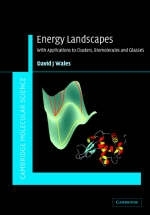
Energy Landscapes
Applications to Clusters, Biomolecules and Glasses
Seiten
2004
Cambridge University Press (Verlag)
978-0-521-81415-7 (ISBN)
Cambridge University Press (Verlag)
978-0-521-81415-7 (ISBN)
This book aims to provide a self-contained account of energy landscape theory and how it is used in studies of clusters, biomolecules and glasses. It is the first book to cover this active field. Illustrated in full colour, the book is aimed at graduate students and researchers in the field.
The study of energy landscapes holds the key to resolving some of the most important contemporary problems in chemical physics. Many groups are now attempting to understand the properties of clusters, glasses and proteins in terms of the underlying potential energy surface. The aim of this book is to define and unify the field of energy landscapes in a reasonably self-contained exposition. This is the first book to cover this active field. The book begins with an overview of each area in an attempt to make the subject matter accessible to workers in different disciplines. The basic theoretical groundwork for describing and exploring energy landscapes is then introduced followed by applications to clusters, biomolecules and glasses in the final chapters. Beautifully illustrated in full colour throughout, this book is aimed at graduate students and workers in the field.
The study of energy landscapes holds the key to resolving some of the most important contemporary problems in chemical physics. Many groups are now attempting to understand the properties of clusters, glasses and proteins in terms of the underlying potential energy surface. The aim of this book is to define and unify the field of energy landscapes in a reasonably self-contained exposition. This is the first book to cover this active field. The book begins with an overview of each area in an attempt to make the subject matter accessible to workers in different disciplines. The basic theoretical groundwork for describing and exploring energy landscapes is then introduced followed by applications to clusters, biomolecules and glasses in the final chapters. Beautifully illustrated in full colour throughout, this book is aimed at graduate students and workers in the field.
David Wales is a lecturer in the Department of Chemistry at Cambridge University.
1. Introduction; 2. The Born–Oppenheimer approximation and normal modes; 3. Symmetry considerations; 4. Features of the landscape; 5. Describing the landscape; 6. Exploring the landscape; 7. Properties of the landscape; 8. Clusters; 9. Biomolecules; 10. Glasses and supercooled liquids.
| Erscheint lt. Verlag | 22.1.2004 |
|---|---|
| Reihe/Serie | Cambridge Molecular Science |
| Zusatzinfo | 110 Plates, color; 150 Line drawings, unspecified |
| Verlagsort | Cambridge |
| Sprache | englisch |
| Maße | 182 x 255 mm |
| Gewicht | 1527 g |
| Themenwelt | Naturwissenschaften ► Chemie ► Physikalische Chemie |
| Naturwissenschaften ► Physik / Astronomie ► Festkörperphysik | |
| ISBN-10 | 0-521-81415-4 / 0521814154 |
| ISBN-13 | 978-0-521-81415-7 / 9780521814157 |
| Zustand | Neuware |
| Informationen gemäß Produktsicherheitsverordnung (GPSR) | |
| Haben Sie eine Frage zum Produkt? |
Mehr entdecken
aus dem Bereich


aus dem Bereich
Quantenmechanik | Spektroskopie | Statistische Thermodynamik
Buch | Softcover (2024)
De Gruyter (Verlag)
CHF 83,90
200 Aufgaben zum sicheren Umgang mit Quellen ionisierender Strahlung
Buch | Hardcover (2023)
Hanser, Carl (Verlag)
CHF 48,95


