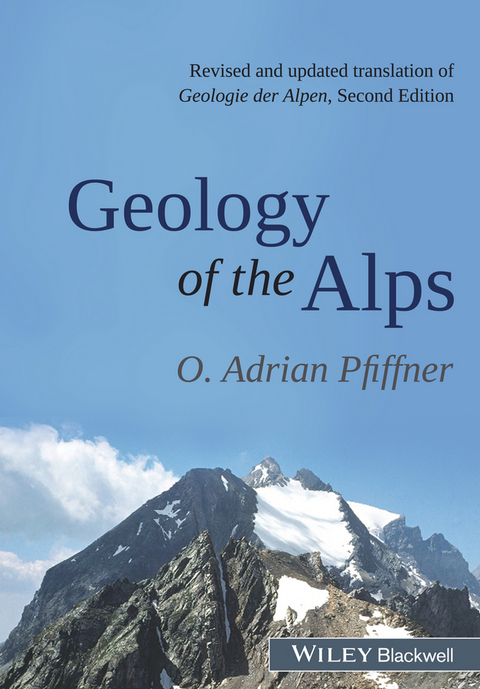
The Alps, with their outstanding outcrop conditions, represent a superb natural laboratory for many geological processes, and have played a crucial role in the history of geology. This book gives an up-to-date and holistic overview of the key aspects of Alpine geology.
After a brief presentation of the plate tectonic framework, the rock suites are discussed, starting with the pre-Triassic crystalline basement, followed by Paleozoic, Mesozoic and Cenozoic sedimentary sequences. The lithological description of the rock types is supplemented by a discussion of their paleogeographic and plate tectonic contexts.
The book goes on to describe the structure of the Alps (including the Jura Mountains and the Alpine foreland to the north and south) illustrated by numerous cross-sections. The evolution of the Alps as a mountain chain incorporates a discussion of the Alpine metamorphic history and a compilation of orogenic timetables. The final sections cover the evolution of Alpine drainage patterns and the region's glacial history.
Readership: The book is essential reading for students and lecturers on Alpine courses and excursions, and all earth-scientists interested in the geology of the region.
Adrian Pfiffner received his first degree and his PhD from the ETH Zurich. Between 1979 and 1986 he was a researcher at the University of Neuchâtel, and was appointed Professor of Geology at the University of Bern in 1986. His research concentrated on deformation mechanisms in rocks, nappe tectonics, the structure of the Alps incorporating deep seismic profiling, and the structure of the Central Andes of Peru.
The Alps, with their outstanding outcrop conditions, represent a superb natural laboratory for many geological processes, and have played a crucial role in the history of geology. This book gives an up-to-date and holistic overview of the key aspects of Alpine geology. After a brief presentation of the plate tectonic framework, the rock suites are discussed, starting with the pre-Triassic crystalline basement, followed by Paleozoic, Mesozoic and Cenozoic sedimentary sequences. The lithological description of the rock types is supplemented by a discussion of their paleogeographic and plate tectonic contexts. The book goes on to describe the structure of the Alps (including the Jura Mountains and the Alpine foreland to the north and south) illustrated by numerous cross-sections. The evolution of the Alps as a mountain chain incorporates a discussion of the Alpine metamorphic history and a compilation of orogenic timetables. The final sections cover the evolution of Alpine drainage patterns and the region s glacial history. Readership: The book is essential reading for students and lecturers on Alpine courses and excursions, and all earth-scientists interested in the geology of the region.
Adrian Pfiffner received his first degree and his PhD from the ETH Zurich. Between 1979 and 1986 he was a researcher at the University of Neuchâtel, and was appointed Professor of Geology at the University of Bern in 1986. His research concentrated on deformation mechanisms in rocks, nappe tectonics, the structure of the Alps incorporating deep seismic profiling, and the structure of the Central Andes of Peru.
Geology of the Alps 5
Contents 7
Preface 10
1The Alps in their plate tectonic framework 13
1.1 Older mountain chains in Europe 14
1.2 Break-up of Pangaea and opening of the Alpine Tethys 20
1.3 The Alpine system in Europe 24
1.4 Structure of the Alps 26
References 32
2 The pre-Triassic Basement of the Alps 35
2.1 The pre-Triassic Basement in the Black Forest and Vosges 37
2.2 The pre-Triassic Basement of the External Massifs 41
External Massifs in the Western Alps 42
External Massifs in the Central Alps 44
External Massifs in the Eastern Alps 49
2.3 The pre-Triassic Basement of the Penninic Nappes 51
2.4 The pre-Triassic Basement of the Austroalpine Nappes 52
2.5 The pre-Triassic Basement of the Southern Alps 55
2.6 Palaeozoic Sediments in the Eastern and Southern Alps 61
The Palaeozoic in the Carnic Alps 61
The Palaeozoic of the Greywacke Zone 63
The Palaeozoic of the Innsbruck Quartz Phyllite 63
2.7 The Variscan Orogen at the Close of the Palaeozoic 66
2.8 Post-Variscan Sediments and Volcanics of the Permian 70
The North Swiss Permo-Carboniferous Trough 70
The Permo-Carboniferous in the Helvetic Nappe Complex 71
The Permo-Carboniferous in the Penninic Nappe Complex 74
The Permo-Carboniferous in the Austroalpine Nappe Complex 76
The Permo-Carboniferous in the Southalpine Nappe System 78
References 80
3 The Alpine Domain in the Mesozoic 83
3.1 The Mesozoic Rock Suites 84
The European Continental Margin 84
Oceanic Arms between the Baltic and Africa 93
The Adriatic Continental Margin 102
3.2 Plate Tectonic Evolution 107
Triassic: Epicontinental Platforms 107
Jurassic: Opening up of Oceanic Arms 109
Cretaceous: Opening and Closing of Oceanic Arms 128
References 137
4 The Alpine Domain in the Cenozoic 141
4.1 The Cenozoic Sedimentary Sequences 143
4.2 Late Cretaceous and Paleogene Flyschs 148
4.3 Eocene–Oligocene Flyschs 152
4.4 Oligocene–Miocene Molasse in the Northalpine Foreland Basin 155
4.5 Oligocene–Pliocene Sediments in The Po Basin 159
4.6 The Jura Mountains 160
4.7 Intramontane Basins 161
4.8 Plutonic and Volcanic Rocks 161
4.9 Tectonic and Palaeogeographical Evolution 166
References 177
5 Tectonic Structure of the Alps 181
5.1 The Western Alps 185
The Jura Mountains 190
The Subalpine Chains of the Dauphinois 191
The Penninic Nappes and their Contact with the Adriatic Continental Margin 198
5.2 The Central Alps 204
The Jura Mountains 212
The Molasse Basin 216
The Helvetic Nappe System 221
The Penninic Nappe System 243
The Austroalpine Nappe System 252
The Southalpine Nappe System 254
5.3 The Eastern Alps 257
The Molasse Basin 263
The Helvetic Nappe System 267
The Penninic Nappe System 269
The Austroalpine Nappe System 270
The Southalpine Nappe System and Dolomites 276
5.4 The Deep Structure of the Alps 277
References 287
6 Tectonic Evolution of the Alps 293
6.1 Alpine Metamorphism 295
Regional Distribution of Alpine Metamorphism 295
High-Pressure Metamorphism 298
Temperature-Dominated Regional Metamorphism 302
Contact Metamorphism 303
6.2 The Cretaceous Orogeny 306
6.3 The Cenozoic Orogeny 308
6.4 Uplift and Erosion 334
References 342
7 The latest Steps in the Evolution of the Alps 347
7.1 Miocene and Pliocene Drainage Patterns 349
7.2 Pleistocene Glaciations 354
7.3 Recent Movements and Seismicity 360
7.4 Rockslides, Creeping Slopes, Erosion by Modern Rivers 367
References 376
Index 379
"The paperback price seems remarkable for a volume with so much in it." (The Open University Geological Society Journal, 1 October 2014)
| Erscheint lt. Verlag | 11.4.2014 |
|---|---|
| Sprache | englisch |
| Themenwelt | Naturwissenschaften ► Geowissenschaften ► Geologie |
| Technik | |
| Schlagworte | Alpine Geology • Aspects • Book • brief presentation • Conditions • crucial • earth sciences • Framework • geological • Geologie u. Geophysik • Geology • Geology & Geophysics • Geomorphologie • geomorphology • Geowissenschaften • History • holistic • Key • Laboratory • many • outcrop • outstanding • Overview • Plate • processes • Role • Structural Geology & Tectonics • Strukturgeologie, Tektonik • suites • superb natural • Tectonic • uptodate |
| ISBN-13 | 9781118708101 / 9781118708101 |
| Informationen gemäß Produktsicherheitsverordnung (GPSR) | |
| Haben Sie eine Frage zum Produkt? |
 PDF (Adobe DRM)
Kopierschutz: Adobe-DRM
Adobe-DRM ist ein Kopierschutz, der das eBook vor Mißbrauch schützen soll. Dabei wird das eBook bereits beim Download auf Ihre persönliche Adobe-ID autorisiert. Lesen können Sie das eBook dann nur auf den Geräten, welche ebenfalls auf Ihre Adobe-ID registriert sind.
Details zum Adobe-DRM
Dateiformat: PDF (Portable Document Format)
Mit einem festen Seitenlayout eignet sich die PDF besonders für Fachbücher mit Spalten, Tabellen und Abbildungen. Eine PDF kann auf fast allen Geräten angezeigt werden, ist aber für kleine Displays (Smartphone, eReader) nur eingeschränkt geeignet.
Systemvoraussetzungen:
PC/Mac: Mit einem PC oder Mac können Sie dieses eBook lesen. Sie benötigen eine
eReader: Dieses eBook kann mit (fast) allen eBook-Readern gelesen werden. Mit dem amazon-Kindle ist es aber nicht kompatibel.
Smartphone/Tablet: Egal ob Apple oder Android, dieses eBook können Sie lesen. Sie benötigen eine
Geräteliste und zusätzliche Hinweise
Buying eBooks from abroad
For tax law reasons we can sell eBooks just within Germany and Switzerland. Regrettably we cannot fulfill eBook-orders from other countries.
aus dem Bereich