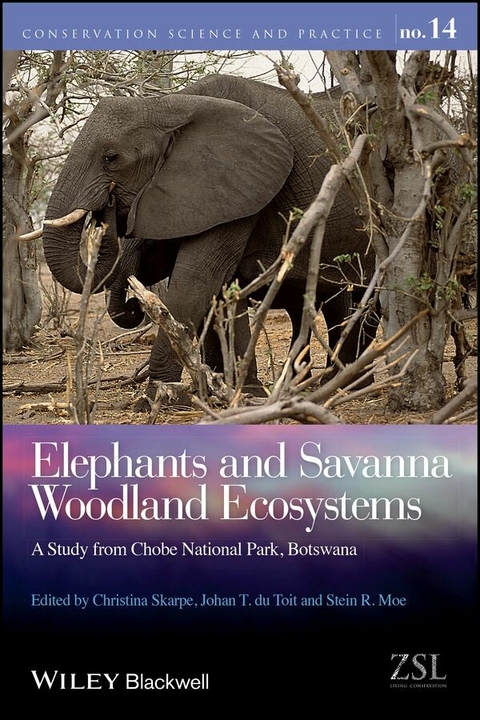
Elephants and Savanna Woodland Ecosystems (eBook)
John Wiley & Sons (Verlag)
978-1-118-85858-5 (ISBN)
The proposed book will be composed of 16 chapters, each written by one lead author and 2-7 additional authors/contributors. The book draws on the results of five years research on the dynamics of an ecosystem where elephant and antelope populations were severely decimated more than a century ago, and then recovered. We show that both the decline and return of elephants caused profound ecosystem perturbations. A heterogeneity framework (Pickett et al. 2003) provides the conceptual structure of the book. Following Pickett et al. (2003) we consider the effects of elephants (agents) feeding on vegetation (substrate) and thereby being responsible for the vegetation changing between states. Controllers affect the action by the agent on the substrate or on the resultant transition between states of the substrate. Responders include other herbivores, predators, decomposers, and abiotic variables. In the first section of the book the sub-humid, dystrophic, broad-leafed savannas of the Chobe area in northern Botswana are presented and the importance of the elephants for the resource heterogeneity of the system and, hence, for the structure of biotic communities is discussed. We then describe the dynamics of the Chobe elephant population, which was hunted virtually to extinction in the late 1800’s and subsequently recovered. By foraging on nutrient poor woody vegetation elephants are essential for nutrient cycling in these systems, and by regularly moving between the woodlands and the Chobe riverfront (to drink), they are major (re)distributors of nutrients. We claim that the elephants are the prime agents of change in this ecosystem. The substrate affected by the elephants is the vegetation, and we discuss the historical changes in the riverfront vegetation, described as open flats in the 1870’s, as tall woodland in the mid 1900’s and currently consisting of shrublands. We show that the woodlands on the alluvial soils were established when artificially low populations of elephants and mesobrowsers provided a “window of opportunity” for tree establishment, and that the trees subsequently disappeared when herbivore populations recovered. The present vegetation in a landscape scale is characterized by the differences in plant strategies and functionality between the relatively nutrient rich alluvial soil close to the river and on the nutrient-poor Kalahari sand dominating most of the system. The difference in resource availability between soil types is a main controller of the effect of elephants on plants and on the vegetation. Other important controllers are smaller herbivores, which modify the effect of elephants on woody vegetation for example by preventing tree regeneration through seedling predation. Mesograzers may also control elephant foraging by scramble competition. Thus, we show that elephants in interaction with other herbivores and with soil resources are important determinants of vegetation composition and physiognomy.
Responders to the elephant induced states of vegetation include nutrient cycling and dynamics. Also interactions between plants and mesoherbivores are largely a function of ecosystem heterogeneity induced by elephant activities. We further show that elephants may interact differently with the grazing and the browsing guild of mesoherbivores. Also a large carnivore, the lion, seems to respond to elephant induced changes in physiognomy of the habitat offering a favorable combination of open land and dense shrub. In the 6th section o f the book we briefly discuss the interactions between humans and elephants, which have co-existed in the African savanna ecosystem throughout the existence of the species. Compared to many other protected areas in southern Africa with high elephant densities the Chobe National Park is large, unfenced and situated in a relatively sparsely populated area. Still, the increasing elephant population leads to increased contact between elephants and local societies creating problems and, perhaps, opportunities. We discuss the “Chobe elephant problem” versus the “Chobe elephant opportunity”. Finally, in a synthesis chapter, we contrast the broad-lefed, dystrophic savannas of Chobe, characterized by an elephant-dominated browser community, with the savannas and grasslands of Serengeti and other fine-leafed eutrophic savannas with mesoherbivore dominated grazer communities. We use evidence from the Chobe research project to explore general mechanisms by which very large herbivores interact with ecosystem heterogeneity and functioning, and how this differs from the impact by mesoherbivores. We discuss the functional composition of wildlife communities with and without megaherbivores across gradients in moisture and in soil resources, and we compare these extant communities with records of fossil ones on other continents. This discussion briefly includes the debate in North America on introducing surrogate megaherbivores to restore lost ecosystem processes, and explores the contribution of science to the emotive issue of elephant control through culling.
During the nineteenth century, ivory hunting caused a substantial decrease of elephant numbers in southern Africa. Soon after that, populations of many other large and medium-sized herbivores went into steep decline due to the rinderpest pandemic in the 1890s. These two events provided an opportunity for woodland establishment in areas previously intensively utilized by elephants and other herbivores. The return of elephants to currently protected areas of their former range has greatly influenced vegetation locally and the resulting potential negative effects on biodiversity are causing concern among stakeholders, managers, and scientists. This book focuses on the ecological effects of the increasing elephant population in northern Botswana, presenting the importance of the elephants for the heterogeneity of the system, and showing that elephant ecology involves much wider spatiotemporal scales than was previously thought. Drawing on the results of their research, the authors discuss elephant-caused effects on vegetation in nutrient-rich and nutrient-poor savannas, and the potential competition between elephants on the one hand and browsers and mixed feeders on the other. Ultimately this text provides a comprehensive review of ecological processes in African savannas, covering long-term ecosystem changes and human-wildlife conflicts. It summarises new knowledge on the ecology of the sub-humid African savanna ecosystems to advance the general functional understanding of savanna ecosystems across moisture and nutrient gradients.
Christina Skarpe is a Professor in Applied Ecology at the Faculty of Applied Ecology and Agricultural Sciences at Hedmark University College, Norway. Her main research interest is large herbivores and African savanna ecology. From Uppsala University, Sweden, Botswana Ministry of Agriculture and later from Norwegian Institute of Nature Research and Hedmark University College she concentrated on herbivores- and worked on diverse projects in Africa, Scandinavia, China and Central America. Johan du Toit is Professor of Ecology and Conservation of Large Mammals in the Wildland Resources Department at Utah State University, USA. He has almost 30 years' experience conducting ecological research in African savanna ecosystems. At the University of Zimbabwe he coordinated the Tropical Resource Ecology Programme, after which he was the Austin Roberts Professor of Mammalogy and Director of the Mammal Research Institute at the University of Pretoria. His research focus is the ecology and conservation of large mammals in terrestrial ecosystems. Stein R. Moe is a Professor of Ecology at the Norwegian University of Life Sciences, Norway. Although his scientific works span over four continents, his main focus has been on African savanna ecology. He is currently coordinating a Master's program in tropical ecology and natural resource management in the Department of Ecology and Natural Resource Management. Following several years as a departmental board member, he is now a member of the faculty board at the University.
Cover 1
Title Page 7
Copyright 8
Contents 9
List of Contributors 13
Foreword 15
Preface 19
Part I The Chobe Ecosystems 23
Chapter 1 Introduction 25
References 27
Chapter 2 The Chobe Environment 29
Geomorphology 29
Soils 32
Climate 33
Flora and vegetation in the Chobe savanna 35
The mammal community 36
Human impact 42
Closing remarks 48
References 48
Chapter 3 Elephant-Mediated Ecosystem Processes in Kalahari-Sand Woodlands 52
Large herbivore biomass density and the contribution of elephants 53
How can a dystrophic ecosystem support so many elephants? 54
An elephant ecosystem 55
Interactions between keystone and foundation species maintain regional biodiversity 58
References 59
Part II The Substrate 63
Chapter 4 Historical Changes of Vegetation in the Chobe Area 65
Vegetation in the Chobe area before the decline in elephants 67
Elephants, germs, livestock and logging 67
Vegetation changes on the alluvium and on the sand 70
Elephants and the Chobe woodlands 77
References 79
Chapter 5 Vegetation: Between Soils and Herbivores 83
Habitat types 84
Plant communities, species diversity and structure of vegetation 85
Abiotic and biotic variables related to the present vegetation 96
Life-form and species distribution 101
Seed-bank of woody species 104
Concluding remarks 105
References 106
Part III The Agent 111
Chapter 6 Guns, Ivory and Disease: Past Influences on the Present Status of Botswana's Elephants and their Habitats 113
Introduction 113
Pre- and post-colonial hunting of elephants in southern Africa 113
Disease and ecological transformation: the rinderpest panzootic arrives in 1896 116
Recovery of Botswana’s elephant population in the 20th century 117
Overview 122
References 123
Chapter 7 The Chobe Elephants: One Species, Two Niches 126
Sexual size-dimorphism and social organization 127
Sex differences in the use of plant parts 128
Browsing height stratification 131
Sex differences in the use of food patches 132
Sexual segregation at the habitat scale 134
Implications for management and further research 136
References 137
Chapter 8 Surface Water and Elephant Ecology: Lessons from a Waterhole-Driven Ecosystem, Hwange National Park, Zimbabwe 140
A brief description of Hwange National Park 141
Movement patterns reveal the dry-season trade-off between foraging and drinking 141
Evidence that water defines key-resource areas: population-level processes 142
Beyond water, habitats and social interactions 147
Surface-water driven management of elephants and savanna ecosystems 147
Acknowledgements 149
References 150
Part IV Controllers 155
Chapter 9 Soil as Controller of and Responder to Elephant Activity 157
The soils 158
Soil as a controller of elephant activities and impact 162
Soil controls the vegetation 164
Mammal communities and soil 164
Soil as a responder to elephant activities 165
Large herbivores and fire 170
References 172
Chapter 10 Impala as Controllers of Elephant-Driven Change within a Savanna Ecosystem 176
Introduction 176
Impala and seedlings 178
Seedling predation across eastern and southern African 183
Impala prevent woodland regeneration 185
A guild-based approach to predicting the effects of ungulates on tree establishment 187
Cascading effects of an ecosystem controller 189
References 189
Chapter 11 Buffalo and Elephants: Competition and Facilitation in the Dry Season on the Chobe Floodplain 194
Introduction 194
Spatial and temporal overlap between elephant and buffalo in Chobe 196
Interference competition 199
Exploitation competition 200
References 204
Part V Responders 209
Chapter 12 Plant-Herbivore Interactions 211
A partially migratory system 213
Plant characteristics vary with resource availabilityand herbivory 213
Large herbivores feed selectively in response to plant traits 217
Plant responses to large herbivores 220
Herbivore responses to plant responses 221
Interactions between elephants, plants and ungulates 223
References 224
Chapter 13 Elephants and the Grazing and Browsing Guilds 229
How this chapter was compiled 232
Grazing and browsing ungulates in the Chobe environment 234
Historical changes in abundance and foraging of some grazing and browsing ungulates 235
The grazing, the mixed feeding and the browsing guilds 235
Elephants and the grazing and the browsing guild 242
References 245
Chapter 14 Cascading Effects on Smaller Mammals and Gallinaceous Birds of Elephant Impacts on Vegetation Structure 251
Medium-sized mammals and gallinaceous birds: large-scale habitat selection and diversity 253
Gallinaceous birds: selection of cover within high-density habitats 256
Small mammals 265
Discussion 267
Conclusion 270
References 270
Chapter 15 The Chobe Riverfront Lion Population: A Large Predator as Responder to Elephant-Induced Habitat Heterogeneity 273
Introduction 273
Habitat heterogeneity and population regulation in carnivores 274
The lion riverfront population 277
Elephant impact and the lion riverfront population 284
Conclusion 285
References 286
Part VI Elephants in Social-Ecological Systems 291
Chapter 16 Human Dimensions of Elephant Ecology 293
History of human-elephant conflict (HEC) and coexistence 294
Elephants as threats to humans and their crops 296
Management and mitigation of HEC 297
Humans as threats to elephants 300
Elephant macroeconomics – ivory and tourism 300
Elephant microeconomics – community-based conservation initiatives 301
Attitudes and conflicts 302
Conclusions and recommendations 303
References 304
Chapter 17 Elephants and Heterogeneity in Savanna Landscapes 311
Elephant drinking sites, transition zones, and population regulation 312
Available area, distance between waterpoints, and elephant overpopulation 315
Are elephants agents of landscape heterogeneity or homogeneity? 316
Conclusion 318
References 318
Index 321
Supplemental Images 327
"The volume points to the value of careful analysis of ecosystems whenever management policies are being developed: the authors present convincing evidence of elephants' beneficial impacts to the Chobe ecosystem." (The Quarterly Review of Biology, 1 December 2015)
Chapter 2
The Chobe Environment
Christina Skarpe1 and Susan Ringrose2
1 Faculty of Applied Ecology and Agricultural Sciences, Hedmark University College, Norway
2 PO Box HA 65 HAK, Maun, Botswana
Environmental factors set the conditions for living organisms and ecological processes in all spatial and temporal scales. At the largest scales continental drift has determined what genetic material is available for evolution, and is a reason for the largely different floras and faunas of different continents. Variation in geology and climate, topographic relief and hydrology creates environmental heterogeneity which promotes diversity of plant and animal communities and of ecosystems. If these environmental factors are seen as having bottom-up effects on species and communities, others such as fire, herbivory and human activities, for example, forestry, agriculture and livestock grazing, might be seen as having top-down effects. Which factors form the environment for ecological processes and which are interactive components of the ecosystem depends on the scale of observation, and for example fire and herbivory are important factors in savanna ecology, but constitute interactive parts of ecosystems in all but the smallest scales (Skarpe, 1992).
Geomorphology
The Chobe ecosystem is part of the dissected Southern African plateau, formed over time by intermittent uplift of the region following the fragmentation of Gondwana, some 180 million years ago. The Kalahari upland basin, which is inset into the plateau, is one of the largest inland sedimentary basins of Africa. During the Jurassic-Cretaceous periods it received considerable deposition (Karoo deposition) which now form the host sediment for the Kalahari sands. The sands which are generally up to 250 m thick, underlie most of Botswana including the Chobe area. The Kalahari sands however thin out over the Chobe area where basalts are exposed in the uplands south of the river. Early drainage dissected the original Southern African plateau and included the proto-Zambezi, Kwando and Okavango Rivers (Moore and Larkin, 2001).
The Chobe area has developed as a result of palaeoenvironmental shifts which have influenced the courses of the original Okavango, Kwando and Zambezi rivers. The three initial proto-rivers were truncated by epeirogenic flexuring (minor uplift) along the Ovambo-Kalahari-Zimbabwe axis, which includes the area to the south of the Makgadikgadi Pans (Moore et al., 2009). This caused the rivers to drain into an early extensive Makgadikgadi-Okavango-Zambezi depression, producing a large palaeolake which may have covered most of northern Botswana and the adjacent Caprivi about 60 million years ago (McCarthy and Rubidge, 2005). This palaeolake became smaller over time as the East African Rift system began to extend south-westward, leading to a fault controlled drainage diversions which formed the Zambezi and Kwando river courses (Modisi et al., 2000). For instance, the original N-S draining Kwando river was diverted north-eastwards and now drains into and beyond a mini-delta on Kalahari sediments abutting the still active NE–SW trending Linyanti fault. Although some water continues to drain through the Linyanti River and on eastwards as the Itenge River, in most years there is barely enough flow to reach the Chobe area. The Chobe River is flooded mainly by back-flow from the Zambezi River during the annual floods. Nevertheless, the steepness of the river banks in the Chobe National Park and the abundance of calcrete in the river cliffs all testify to earlier, more vigorous stream development and the effect of continuous uplift of the entire Southern African plateau.
During the last 400,000 years, embracing the later Pleistocene and Holocene periods, the climate of the southern hemisphere has shifted as documented by the Vostok ice core in Antarctica (Petit et al., 1999) with extensive cold and dry glacial periods being interspersed by warm, wet interglacials. These alternations of cold-dry and warm-wet intervals have strongly influenced palaeo-climatic change hence landform development, throughout northern Botswana (e.g. Partridge et al., 1999; Thomas and Shaw, 2002; Ringrose et al., 2005; Huntsman-Mapila et al., 2006). Within Chobe National Park, evidence depicting cooler-dry intervals includes extensive systems of fossil sand dunes which are still visible over much of the centre and east of the Park. Evidence of warm-wet periods with higher water levels includes the remnants of several strandlines which stand at least 20 m above the present Mababe depression (Figure 2.1). The Mababe depression is still linked with overflow systems from the Kwando and Okavango, to this day. The higher strandlines indicate former (Late Pleistocene) increased water inflow attributable in part to the past expanded flow down the Zambezi, Okavango and Kwando rivers (Burrough and Thomas, 2008; Cruse et al., 2009). This later diminished due to palaeoclimatic change and due to continued tectonic shifts due through the later south-west propagation of the East African Rift system. This fault controlled tectonic activity is prevalent to this day leading to generally low magnitude earthquakes mostly south of the Kwando-Linyanti area.
Figure 2.1 Map of northern Botswana with some features mentioned in text. Drawing by Marit Hjeljord.
Apart from the low undulating topography of fossil dunes and sand ridges, much of the Chobe National Park area is flat with elevations from 1120 m above mean sea level in the north-east and dropping to 920 m in west towards the Mababe depression and the Chobe river (Figure 2.1). Evidence of Holocene or earlier drainage likely lies with the numerous short south-bank tributaries of the Chobe River, which now form dry valleys (e.g. Kalwizikalkanga; Figure 2.2). The Mababe depression, also received relatively recent palaeodrainage from the NE. These drainage lines are now characterised by small pans and dry valleys, for example, the Ngwezumba and Gautumbi valleys and the Nogadsaa and Zweizwe pan areas in Chobe National Park (Figure 2.1; Thomas and Shaw, 1991). Within more recent times, as in the past, cyclic change and the inherent variability of the river related systems are the norm. Recent (2011–2012) high flood levels have been experienced in all the northern rivers (Zambezi, Kwando, Okavango). This has influenced recent inflow events in the Mababe depression, including the Savuti Marsh and its channel, which had been dry for about 30 years. The Savuti channel was infilled via the Linyanti swamps and the Okavango system through the Selinda spillway. Southern Okavango drainage also overflowed into the southern part of the Mababe depression. While to a much lesser extent than the flooding which took place in the Pleistocene-Holocene, these recent flood events are a reflection of the former expansive drainage networks throughout the Chobe area.
Figure 2.2 Map of the core investigated area in northern Chobe National Park. Drawing by Marit Hjeljord.
The water level fluctuations in the Chobe River depend on contributions from different sources, primarily Zambezi and Kwando Rivers, and is out of phase with the local rainy season (October–April). Consequently, there are four distinct seasons in the floodplains along the river: (i) a low water rainy season from October to March; (ii) a high water (floodplains inundated) rainy season from March to April; (iii) a high water dry season from April to June and (iv) low water dry season from June to October. The Chobe River is the only (natural) permanent water in the region, except during periods when the Savuti Marsh, about 130 km to the southeast, contains water. This makes it a vital resource for water-dependant fauna in the ecosystem. The Chobe River gives its name to the northernmost district in Botswana and to the Chobe National Park, which forms much of its southern bank.
Soils
The soils in Chobe National Park are mostly deep to very deep, well to excessively drained arenosols, developed from the Kalahari sands (Figure 2.3; de Wit and Nachtergaele, 1990). The sand consists of quartz with minor feldspars and mica. In the dunes the grains are coated with iron oxide, colouring the sand brown to deep red, while in seasonally wet, reductive environments the soil is grey to almost white (Leistner, 1967; de Wit and Nachtergaele, 1990). The bottoms of the former lake basins, the Mababe depression and the surroundings of Nogadsaa and Zweizwe pans are characterised by calcareous, fine-textured and compact alluvial luvisols and gleysols of lacustrine and riverine origin (Blair Rains and McKay, 1968; de Wit and Nachtergaele, 1990; Chapter 9). These areas have many pans, shallow, poorly drained depressions that hold water for varying periods after rain. Riverine alluvial soils also make up the recent and uplifted fossil floodplains along the Chobe River. Unlike Kalahari sand, which is poor in minerals and plant nutrients, these alluvial soils are calcareous and moderately fertile. The sands have a cation exchange capacity (CEC) of around 2 cmol kg, compared with about 6 cmol kg in fossil alluvial soils (luvisols) along the Chobe River and more than 30 cmol kg in the sodic recent alluvium (gleysols) on the floodplains (Aarrestad et al., 2011; Chapter 9).
Figure 2.3 Distribution of soils in the Chobe area (UNDP-FAO classification system). Drawing by Dr Lin Cassidy.
The material in the eroding vegetated sand dunes and ridges is...
| Erscheint lt. Verlag | 2.4.2014 |
|---|---|
| Reihe/Serie | Conservation Science and Practice |
| Conservation Science and Practice | Conservation Science and Practice |
| Sprache | englisch |
| Themenwelt | Naturwissenschaften ► Biologie ► Ökologie / Naturschutz |
| Naturwissenschaften ► Biologie ► Zoologie | |
| Naturwissenschaften ► Geowissenschaften ► Geologie | |
| Technik | |
| Schlagworte | Africa • Ãkologie / Tiere • Animal ecology • Animal Science & Zoology • areas previously intensively • Biowissenschaften • Conservation Science • decline • Due • Elephant • Elephants • Establishment • Herbivores • Hunting • ivory • Life Sciences • many • Naturschutzbiologie • Nineteenth century • Numbers • Ökologie / Tiere • Opportunity • Pandemic • Populations • Rinderpest • steep • substantial decrease • two events • Zoologie |
| ISBN-10 | 1-118-85858-1 / 1118858581 |
| ISBN-13 | 978-1-118-85858-5 / 9781118858585 |
| Informationen gemäß Produktsicherheitsverordnung (GPSR) | |
| Haben Sie eine Frage zum Produkt? |
 PDF (Adobe DRM)
Größe: 14,5 MB
Kopierschutz: Adobe-DRM
Adobe-DRM ist ein Kopierschutz, der das eBook vor Mißbrauch schützen soll. Dabei wird das eBook bereits beim Download auf Ihre persönliche Adobe-ID autorisiert. Lesen können Sie das eBook dann nur auf den Geräten, welche ebenfalls auf Ihre Adobe-ID registriert sind.
Details zum Adobe-DRM
Dateiformat: PDF (Portable Document Format)
Mit einem festen Seitenlayout eignet sich die PDF besonders für Fachbücher mit Spalten, Tabellen und Abbildungen. Eine PDF kann auf fast allen Geräten angezeigt werden, ist aber für kleine Displays (Smartphone, eReader) nur eingeschränkt geeignet.
Systemvoraussetzungen:
PC/Mac: Mit einem PC oder Mac können Sie dieses eBook lesen. Sie benötigen eine
eReader: Dieses eBook kann mit (fast) allen eBook-Readern gelesen werden. Mit dem amazon-Kindle ist es aber nicht kompatibel.
Smartphone/Tablet: Egal ob Apple oder Android, dieses eBook können Sie lesen. Sie benötigen eine
Geräteliste und zusätzliche Hinweise
Zusätzliches Feature: Online Lesen
Dieses eBook können Sie zusätzlich zum Download auch online im Webbrowser lesen.
Buying eBooks from abroad
For tax law reasons we can sell eBooks just within Germany and Switzerland. Regrettably we cannot fulfill eBook-orders from other countries.
 EPUB (Adobe DRM)
Kopierschutz: Adobe-DRM
Adobe-DRM ist ein Kopierschutz, der das eBook vor Mißbrauch schützen soll. Dabei wird das eBook bereits beim Download auf Ihre persönliche Adobe-ID autorisiert. Lesen können Sie das eBook dann nur auf den Geräten, welche ebenfalls auf Ihre Adobe-ID registriert sind.
Details zum Adobe-DRM
Dateiformat: EPUB (Electronic Publication)
EPUB ist ein offener Standard für eBooks und eignet sich besonders zur Darstellung von Belletristik und Sachbüchern. Der Fließtext wird dynamisch an die Display- und Schriftgröße angepasst. Auch für mobile Lesegeräte ist EPUB daher gut geeignet.
Systemvoraussetzungen:
PC/Mac: Mit einem PC oder Mac können Sie dieses eBook lesen. Sie benötigen eine
eReader: Dieses eBook kann mit (fast) allen eBook-Readern gelesen werden. Mit dem amazon-Kindle ist es aber nicht kompatibel.
Smartphone/Tablet: Egal ob Apple oder Android, dieses eBook können Sie lesen. Sie benötigen eine
Geräteliste und zusätzliche Hinweise
Buying eBooks from abroad
For tax law reasons we can sell eBooks just within Germany and Switzerland. Regrettably we cannot fulfill eBook-orders from other countries.
aus dem Bereich