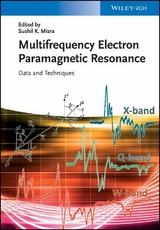
Sushil Misra has done extensive experimental and theoretical research in the area of electron spin resonance (ESR) for the last 28 years. Currently, he is a collaborating faculty member at the Advanced Center for Electron Spin Research technology at Cornell University. He has written many review articles and book chapters on the subject and published over 225 papers in refereed journals in the field of ESR. As a specialist frequently invited to international conferences and his involvement with the International EPR Society he not only contributed a significant portion to the Handbook on Electron Spin Resonance, volume 2, but also published another book with Wiley-VCH entitled 'Multifrequency Electron Paramagnetic resonance: Theory and Applications', covering a large number of recently developed main topics in ESR.
With a background in physics, chemsitry, and bio-chemistry the author team combines a strong expertise in developing EPR instrumentation and applying it to condensed matter, proteins, and even for in-vivo studies.
Sushil Misra has done extensive experimental and theoretical research in the area of electron spin resonance (ESR) for the last 28 years. Currently, he is a collaborating faculty member at the Advanced Center for Electron Spin Research technology at Cornell University. He has written many review articles and book chapters on the subject and published over 225 papers in refereed journals in the field of ESR. As a specialist frequently invited to international conferences and his involvement with the International EPR Society he not only contributed a significant portion to the Handbook on Electron Spin Resonance, volume 2, but also published another book with Wiley-VCH entitled "Multifrequency Electron Paramagnetic resonance: Theory and Applications", covering a large number of recently developed main topics in ESR. With a background in physics, chemsitry, and bio-chemistry the author team combines a strong expertise in developing EPR instrumentation and applying it to condensed matter, proteins, and even for in-vivo studies.
Chapter I. Introduction
Sushil K. Misra
Chapter II. Rapid Scan Electron Paramagnetic Resonance
Sandra S. Eaton, Richard W. Quine, Mark Tseitlin, Deborah G. Mitchell, George A. Rinard, and Gareth R. Eaton
Introduction
Post-acquisition treatment of rapid-scan signals
Simulation of rapid-scan spectra
Scan coils
Design of scan drivers
Use of ENDOR type coils and RF amplifiers for very fast scans
Resonator design
Background signals
Bridge design
Selection of acquisition parameters
Multifrequency rapid scan
Example of applications
Extension of the rapid-scan technology to scans that are not fast relative to relaxation times
Summary
Chapter III. Computational modeling and least-squares fitting of EPR spectra
Stefan Stoll
Introduction
Software
General principles
Static cw EPR spectra
Dynamic cw EPR spectra
Pulse EPR spectra
Pulse and cw ENDOR spectra
Pulse DEER spectra
Least-squares fitting
Various topics
Outlook
Chapter IV. MULTIFREQUENCY TRANSITION-ION DATA TABULATION
Sushil K. Misra, Sean Moncrieff, and Stefan Diehl
Introduction
Listing of spin-Hamiltonian Parameters
References
Chapter V. COMPILATION OF HYPERFINE SPLITTINGS AND g-FACTORS FOR AMINOXYL (NITROXIDE) RADICALS
Lawrence J. Berliner
Introduction
Tabulations
References
Chapter 3
Computational Modeling and Least-Squares Fittingof EPR Spectra
Stefan Stoll
3.1 Introduction
In EPR (electron paramagnetic resonance) spectroscopy, computer simulation and least-squares fitting are essential in extracting quantitative structural and dynamic parameters from experimental spectra. Without numerical methods, this extraction would be restricted to simple systems. This chapter summarizes simulation and fitting methods that have been proposed in the literature and implemented in software. It includes an extensive, though not complete, list of references.
Emphasis is placed on methods currently implemented in the software package EasySpin [1], which covers EPR simulations in the following regimes: (i) rigid-limit continuous-wave (cw) EPR spectra for arbitrary spin systems, for both powders and single crystals, at various levels of theory including eigenfields, matrix diagonalization, and perturbation theory; (ii) dynamic EPR spectra of tumbling spin centers with one electron spin and several nuclei, implementing stochastic Liouville equation (SLE) solvers and perturbative approaches; (iii) EPR spectra in the fast-motion limit, using either a Breit–Rabi solver or perturbation theory; (iv) dynamic EPR spectra due to chemical exchange in solution, implementing a direct Liouville-space method; (v) solid-state ENDOR (electron nuclear double resonance) spectra based on either matrix diagonalization or perturbation theory; and (vi) pulse EPR spectra for general pulse sequences using the Hilbert-space density matrix formalism in the high-field limit. All these simulation regimes are reviewed in the following.
Similarly to many other programs, EasySpin also provides a range of least-squares fitting algorithms, among them Levenberg–Marquardt (LM), Nelder–Mead simplex, genetic algorithms, particle-swarm optimization, as well as simple Monte Carlo and grid searches. These algorithms, as well as the objective function choice, multicomponent fitting, and error analysis, are discussed below.
This chapter is not intended to be a complete review of all theory underlying EPR simulation methods, which would be utterly impossible. Instead, it summarizes theoretical and algorithmic aspects that are implemented in or are relevant to EasySpin. Applicability and limitations of methods are discussed as well. The chapter is not concerned with the specifics of usage of software packages. Tutorials and documentation for EasySpin can be found online at easyspin.org.
Many reviews have appeared over time that summarize progress in the methodology for EPR spectral simulation and fitting and that describe available simulation programs, starting with very early ones [2–4] up to more recent times [5–8]. A previous Handbook of ESR included a review on computer techniques [9]. A very detailed review of simulation methods and programs as of 1992 is contained in the book by Mabbs and Collison [10]. A list of software available in 1993 is published [11].
In the following, after summarizing key aspects of available simulation software packages, we discuss the basic aspects of EPR simulations and then progress to describe methods for static and dynamic cw EPR spectra, pulse EPR, ENDOR, and DEER (double electron–electron resonance) spectra. Subsequently, a section is dedicated to least-squares fitting. After a short section covering topics such as spin quantitation and data formats, we summarize in the conclusion some of the challenges that still lie ahead.
3.2 Software
In this section, we describe a few details about EasySpin and other EPR simulation programs. Some of them are available online, and many others can be obtained from their authors. A few have ceased to be developed and are no longer maintained.
3.2.1 EasySpin
EasySpin, developed by the author, was originally conceived as an in-house simulation program for solid-state cw EPR spectra in the laboratory of Arthur Schweiger at ETH Zurich, with a first public release in 2000. The initial work is documented in a 2003 PhD thesis [12] and, including subsequent extensions, in a 2006 article in Journal of Magnetic Resonance [1]. A summary of EasySpin functionality relevant to nitroxides was subsequently published [13].
Since its first publication, EasySpin has advanced on many levels. Thanks to feedback from the worldwide user community, bugs were corrected, algorithms became more robust, implementations became faster, and more regimes and experiments were added. Notably, support for pulse EPR simulations was added in 2009 [14], least-squares fitting was introduced in 2010, and chemical exchange was implemented in 2012.
The program continues to be developed, with the ultimate goal of removing the data analysis and simulation bottleneck from the EPR discovery process. Its core strengths are solid-state cw EPR spectra as well as ENDOR and ESEEM (electron spin echo envelope modulation) spectra, with growing support for slow-motion simulations and other more specialized situations.
3.2.2 Other Software
EasySpin draws substantially from methods implemented in other, mostly older, EPR simulation programs. In the following, we give a partial list. The National Institute of Environmental Health Sciences (NIEHS) maintains a database of EPR simulation programs (electron spin resonance software database, ESDB) [15], including programs of limited availability and dedicated to specific problems.
Bruker ships certain spectrometers with SimFonia, a simulation program developed by Weber at Bruker in the 1990s [16]. Hanson and coworkers have developed Sophe, a widely used simulation program for solid-state EPR spectra [17–23] that has been equipped with a graphical user interface (UI) by Bruker and marketed as XSophe. A more modern UI to Sophe called Molecular Sophe (MoSophe) has recently been developed [24].
WinSIM is dedicated to solution spectra of spin traps and was developed at the NIEHS [25]. Hendrich [26] has developed SpinCount, a program that emphasizes spin quantitation. Slow-motion spectra of nitroxide radicals can be simulated and fitted using the suite of highly optimized SLE solvers developed by the Freed group at the ACERT center at Cornell [27–30]. Altenbach has developed a code dedicated to nitroxide labels [31]. Dipolar broadening of cw EPR spectra of nitroxides can be analyzed using DIPFIT [32]. E-SpiReS is a program for slow-motion simulation that also interfaces to quantum chemistry programs [33, 34]. At Manchester, an in-house code has been used to simulate hundreds of spectra in a book about transition metal ion EPR [10]. Weil's program EPRNMR [35] is designed for solid-state EPR and has extensive support for single-crystal spectra. DDPOW supports binuclear complexes [36]. QPOW [37] and SIMPOW6 [38] were developed at the University of Illinois. Sim is a program by Weihe that accepts arbitrary Hamiltonian matrices as input [39, 40]. SPIN, developed at the National High Magnetic Field Laboratory, is tailored toward high-spin systems. Xemr is a general-purpose EPR simulation program [41]. EPRsim32 [42] is a powder cw EPR simulation program that includes genetic fitting algorithms. Rockenbauer and Korecz [43] have developed a general simulation program that includes chemical exchange. Another still popular program for chemical exchange was created by Heinzer in the early 1970s [44, 45]. WinMOMD is a program for simulation of slow-motional nitroxide spectra using the MOMD (microscopic order, macroscopic disorder) model [46]. EWVoigt is geared toward nitroxide spectra in the fast-motion regime and utilizes convolution methods [47]. EPRSIM-C implements a variety of models for nitroxide spectra and includes evolutionary fitting algorithms [48].
Several programs were developed specifically for ENDOR and ESEEM simulations. MAGRES from Nijmegen [49, 50] was an early one. GENDOR is an ENDOR simulation program developed by Hoffman at Northwestern [51–53]. HYSCORE (hyperfine sublevel correlation) simulation programs were pioneered by Goldfarb [54] and Schweiger [55]. Astashkin's program SimBud is equipped with a UI [56]. OPTESIM [57] provides ESEEM simulations and least-squares fitting.
Many simulation programs for NMR spectra have been developed over the years and have been reviewed [58–61]. Among the many programs, SIMPSON [62], SPINEVOLUTION [63], and Spinach [64] are particularly widely used. Spinach is a very general and efficient spin dynamics code that is geared toward large NMR spin systems, but supports EPR experiments as well.
In addition to the programs mentioned, there are many excellent in-house codes developed by various research groups, but are not separately described in literature, and are either not distributed or have not seen widespread use.
3.3 General Principles
3.3.1 Spin Physics
The simulation of EPR spectra is based on a spin Hamiltonian that describes the interactions amongst the spins in the spin system and between the spins and the externally applied magnetic field. The following summarizes the most common terms in the spin Hamiltonian used to model EPR spectra [65]. We do not intend to outline the complete theoretical basis. Instead, the discussion is limited to some aspects that are often overlooked by users and that are important for obtaining correct simulation results. We also summarize the basic quantum dynamic equations needed to compute EPR spectra.
3.3.1.1 Interactions
EPR spectra are generally simulated on the basis of a spin Hamiltonian (sH), an effective Hamiltonian that represents the subset...
| Erscheint lt. Verlag | 19.3.2014 |
|---|---|
| Sprache | englisch |
| Themenwelt | Naturwissenschaften ► Chemie |
| Technik | |
| Schlagworte | Bildgebendes Verfahren • Chemie • Chemistry • Compilation of Hyperfine Splittings and G-Factors for Aminoxyl (Nitroxide) Radicals • Computational Modeling and Least-Squares Fitting of EPR Spectra • Condensed Matter • ENDOR • Handbook of Multifrequency Electron Paramagnetic Resonance: Data and Techniques • Kondensierte Materie • Multifrequency Transition Ion Data Tabulation • NMR Spectroscopy / MRI / Imaging • NMR-Spektroskopie / MRT / Bildgebende Verfahren • Physics • Physik • Pulse EPR • Rapid Scan EPR • spectroscopy • Spektroskopie • Sushil K. Misra |
| ISBN-10 | 3-527-67245-1 / 3527672451 |
| ISBN-13 | 978-3-527-67245-5 / 9783527672455 |
| Informationen gemäß Produktsicherheitsverordnung (GPSR) | |
| Haben Sie eine Frage zum Produkt? |
 EPUB (Adobe DRM)
Kopierschutz: Adobe-DRM
Adobe-DRM ist ein Kopierschutz, der das eBook vor Mißbrauch schützen soll. Dabei wird das eBook bereits beim Download auf Ihre persönliche Adobe-ID autorisiert. Lesen können Sie das eBook dann nur auf den Geräten, welche ebenfalls auf Ihre Adobe-ID registriert sind.
Details zum Adobe-DRM
Dateiformat: EPUB (Electronic Publication)
EPUB ist ein offener Standard für eBooks und eignet sich besonders zur Darstellung von Belletristik und Sachbüchern. Der Fließtext wird dynamisch an die Display- und Schriftgröße angepasst. Auch für mobile Lesegeräte ist EPUB daher gut geeignet.
Systemvoraussetzungen:
PC/Mac: Mit einem PC oder Mac können Sie dieses eBook lesen. Sie benötigen eine
eReader: Dieses eBook kann mit (fast) allen eBook-Readern gelesen werden. Mit dem amazon-Kindle ist es aber nicht kompatibel.
Smartphone/Tablet: Egal ob Apple oder Android, dieses eBook können Sie lesen. Sie benötigen eine
Geräteliste und zusätzliche Hinweise
Buying eBooks from abroad
For tax law reasons we can sell eBooks just within Germany and Switzerland. Regrettably we cannot fulfill eBook-orders from other countries.
aus dem Bereich