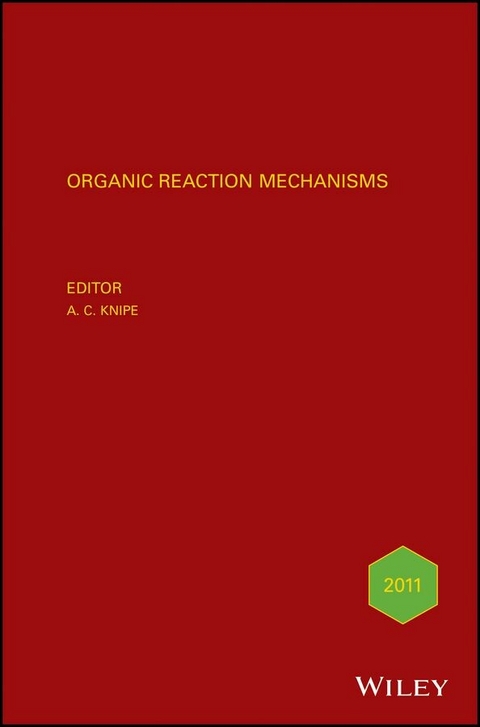
Organic Reaction Mechanisms 2011 (eBook)
John Wiley & Sons (Verlag)
978-1-118-56028-0 (ISBN)
The only book series to summarize the latest progress on organic reaction mechanisms, Organic Reaction Mechanisms, 2011 surveys the development in understanding of the main classes of organic reaction mechanisms reported in the primary scientific literature in 2011. The 47th annual volume in this highly successful series highlights mechanisms of stereo-specific reactions. Reviews are compiled by a team of experienced editors and authors, allowing advanced undergraduates, graduate students, postdocs, and chemists to rely on the volume's continuing quality of selection and presentation.
Professor A.C. Knipe, School of BMS, The University of Ulster, Northern Ireland.
1 Reactions of Aldehydes and Ketones and their Derivatives by B.
A. Murray 1
2 Reactions of Carboxylic, Phosphoric, and Sulfonic Acids and
their Derivatives by C. T. Bedford 67
3 Oxidation and Reduction by R. N. Mehrotra 97
4 Carbenes and Nitrenes by E. Gras and S. Chassaing
199
5 Nucleophilic Aromatic Substitution by M. R. Crampton 233
6 Electrophilic Aromatic Substitution by M. R. Crampton 257
7 Carbocations by R. A. McClelland 285
8 Nucleophilic Aliphatic Substitution by K. C. Westaway 303
9 Carbanions and Electrophilic Aliphatic Substitution by M. L.
Birsa 339
10 Elimination Reactions by M. L. Birsa 361
11 Addition Reactions: Polar Addition by P. Kocovsky
371
12 Addition Reactions: Cycloaddition by N. Dennis 449
13 Molecular Rearrangements by J. M. Coxon 477
Author Index 539
Subject Index 581
Chapter 1
Reactions of Aldehydes and Ketones and their Derivatives
B. A. Murray
Department of Science, Institute of Technology Tallaght (ITT Dublin), Dublin, Ireland
- Formation and Reactions of Acetals and Related Species
- Reactions of Glucosides
- Reactions of Ketenes
- Formation and Reactions of Nitrogen Derivatives
- Imines: Synthesis, and General and Iminium Chemistry
- Stereoselective ‘Name’ Reactions of Imines
- Synthesis of Aziridines from Imines
- Addition of Organometallics
- Enantioselective Alkylations and Additions of Other C-nucleophiles to Imines
- Arylations, Alkenylations, and Allylations of Imines
- Reduction of Imines
- Other Reactions of Imines
- Oximes, Hydrazones, and Related Species
- C–C Bond Formation and Fission: Aldol and Related Reactions
- Reviews of Aldols and General Reviews of Asymmetric Catalysis
- Asymmetric Aldols Catalysed by Proline and its Derivatives
- Asymmetric Aldols Catalysed by Other Amino Acids and their Derivatives
- Asymmetric Aldols Catalysed by Other Organocatalysts
- Other Asymmetric Aldols
- Mukaiyama and Vinylogous Aldols
- The Henry (Nitroaldol) Reaction
- The Baylis–Hillman Reaction and its Morita Variant
- Other Aldol and Aldol-type Reactions
- Allylation and Related Reactions
- The Horner–Wadsworth–Emmons Reaction
- Alkynylations
- The Stetter Reaction, Benzoin Condensation, and Pinacol Coupling
- Michael Additions
- Miscellaneous Condensations
- Other Addition Reactions
- Enolization, Reactions of Enolates, and Related Reactions
- Oxidation and Reduction of Carbonyl Compounds
- Atmospheric Reactions
- Other Reactions
- References
Formation and Reactions of Acetals and Related Species
Carbohydrate-based benzylidene acetals (e.g. 1) undergo reductive ring opening.1 In a deuterium-isotope study of this process, stereoselectivity is retained using AlD3, via the rare SNi mechanism (internal nucleophilic substitution). The reagents BD3·THF and Et3SiD involve SN1-like routes.
Complementary protocols can convert the ethyl hemiacetal of trifluoroacetaldehyde (2, R = Et) to either anti- or syn-4,4,4-trifluoro-1-aryl-3-hydroxy-2-methyl-1-butanones (3). Using an enamine, trans-Me-CH=C(Ar)NR1R2, anti-selectivity is achieved, whereas an imine, Et-C(Ar)=NR3 gives the syn-product. Conditions are mild (typically −15 or −72 °C), with the product being freed with 10% HCl in both cases. Examples with hydrate as reactant (i.e. 2 with R = H) and with CHF2 instead of CF3 are also reported.2 A chiral tetrazolyl pyrrolidine renders the reaction enantioselective.3
A review examines neighbouring group participation involving the oxygen atom of O,O- or O,N-acetals.4
2-(4-Substituted-phenyl)-1,3-dithiane anions (4, R = H, OMe, Cl, CN) have been reacted with alkyl iodides in dimethyl sulfoxide (DMSO). Evidence for an SRN1 process has been presented, via radicals and radical ions, the latter being susceptible to C–S bond fragmentation.5
The formal alkyne Prins reaction of mixed N,S-acetals generated from homopropargylamines has been studied and compared to that of N,O-analogues. The cycloisomerization is catalysed by gold(I), with significant thioether participation in the mechanism, consistent with the thiophilicity of such gold species.6
A BINOL-phosphoric acid catalyses addition of thiols to N-acylaldimines, giving N-acylated N,S-acetals (5) with yields and ee of up to 99%.7
Reactions of Glucosides
An efficient, stereocontrolled synthesis of α- or β-1-C-alkyl-imino-l-arabinols (6) depends on the nucleophilic addition of pentose-derived imines generated from enantiopure t-butanesulfinamide.8 The stereoselectivity of this key step can be controlled either by the sugar moiety or by the stereogenic sulfur centre.
Both anomers of the methyl glycoside (7) of 6-O-benzyl-N-dimethylmaleoyl-d-allosamine are glycosylated exclusively on O(3) when reacted with the trichloroacetimidate of peracetylated α-d-galactopyranoside (8).9 A density functional theory (DFT) study has investigated the regioselectivity of both anomers, identifying strong hydrogen bonds in both reactions. The explanation of the regioselectivities achieved in this analysis proved transferable to related cases in the literature.
Product-based evidence for remote participation of a 4-O-acyl group in a gold(I)-catalysed glycosylation has been further probed by deuterium labelling studies.10
2-C-Branched carbohydrates undergo mild glycosidations and selective anomerizations using gold(III) bromide catalysis.11 Acid–base-catalysed activation of a glycosyl donor, and activation of a glycosyl acceptor by PhBF2 (or Ph2BF), has been used to set up hydrogen-bond-mediated intramolecular SN2-type glycosidation, typically with high anomeric selectivity.12 The use of stereoelectronic effects to determine oxocarbenium- versus β-sulfonium-ion-mediated glycosylations has been described.13
The influence on reactivity and selectivity of having glycosyl donors in ‘unusual’ conformations has been reviewed (118 references), covering both glycosylation and glycoside hydrolysis. Examples involving conformations enforced by special protecting groups, tethering, anhydro-bridging, steric hindrance, and so on are described.14 The mechanism of chemical glycosylations has been reviewed (135 references), emphasizing evidence for and against oxocarbenium ions.15
Evidence for a very short-lived oxocarbenium species in an enzymatic glycosyl transfer that proceeds with retention of configuration has been obtained via QM/MM metadynamics simulations.16 Computational studies probing such intermediacy have examined the stability of the methoxymethyl cation in water: a simulation estimates its lifetime at 1 ps.17
Mechanisms of glycosyltransferases have been reviewed.18
1-β-O-Acyl glucoside conjugates of phenylacetic acids have been synthesized, and their acyl migration and hydrolysis kinetics have been compared with the corresponding acyl glucoronides.19
The isomerization of glyceraldehyde [HOCH2CH(OH)CHO] to dihydroxyacetone at the surface of Lewis acidic zeolites has been studied theoretically, focusing on the rate-determining 1,2-hydride shift involved.20
The mechanism of the entry of fructose into the Maillard reaction (a series of sugar/amino acid processes in vivo) has been studied by DFT: the order of reactivity for the isomers is predicted as α- > β- > open-chain. Heyns rearrangement products are most favourable under basic conditions, possible under neutral conditions, but unfeasible at or below glycine's isoelectric point.21 Kinetic and activation parameters have been reported for the corresponding glucose/proline reaction.22
A kinetic study of the reductive opening of the diphenylmethylene acetal in methyl 2,3-O-diphenylmethylene-α-l-rhamnopyranoside has been compared to earlier quantum calculations.23
The 1,2-dicarbonyl sugar, 3-deoxy-d-erythro-hexos-2-ulose (9, 3-deoxy-d-glucosone) degrades to (salts of) the isomeric 3-deoxy-d-ribo- and -arabino-hexonic acids (10; 1 : 6 ratio) at pH 7.5/37 °C, as shown by selective 13C- and 2H-labelling and 13C-NMR. Evidence for a 1,2-hydrogen shift mechanism is presented: DFT calculations suggest that the hydrogen moving from C(1) to C(2) is almost neutral (rather than hydridic). Mechanisms involving acyclic and cyclic routes are considered, with the experimental data fitting the latter better.24
Kinetic studies of four monosaccharides locked in a 2,5B-conformation as xyloside mimics (e.g. 11) indicate that they hydrolyse 102 to 104 times faster in acid than unlocked xylosides, and the α-anomers are much more reactive than the β-anomers. It is suggested that much of the energy penalty going from chair to TS has already been paid in such substrates.25
Effects of neighbouring-group participation in the acid-catalysed hydrolysis of 2-O-substituted methyl glucopyranosides have been studied kinetically: ‘arming’ non-participating groups and ‘disarming’...
| Erscheint lt. Verlag | 27.3.2014 |
|---|---|
| Reihe/Serie | Organic Reaction Mechanisms |
| Organic Reaction Mechanisms | Organic Reaction Mechanisms |
| Sprache | englisch |
| Themenwelt | Naturwissenschaften ► Chemie ► Organische Chemie |
| Technik | |
| Schlagworte | A. C. Knipe • Carbanions and Electrophilic Aliphatic Substitution • Carbenes and Nitrenes • Carbocations • Chemie • Chemistry • Cycloaddition Reactions • electrophilic aromatic substitution • elimination reactions • Molecular Rearrangements • nucleophilic aliphatic substitution • nucleophilic aromatic substitution • Organic Chemistry • Organic Reaction Mechanisms, 2011 • Organische Chemie • oxidation and reduction • Phosphoric and Sulfonic Acids and their Derivatives • Physical Chemistry • Physical Organic Chemistry • Physikalische Chemie • Physikalische Organische Chemie • Polar Addition Reactions • Reaction of Aldehydes and Ketones and their Derivatives • Reactions of Carboxylic |
| ISBN-10 | 1-118-56028-0 / 1118560280 |
| ISBN-13 | 978-1-118-56028-0 / 9781118560280 |
| Informationen gemäß Produktsicherheitsverordnung (GPSR) | |
| Haben Sie eine Frage zum Produkt? |
 EPUB (Adobe DRM)
Kopierschutz: Adobe-DRM
Adobe-DRM ist ein Kopierschutz, der das eBook vor Mißbrauch schützen soll. Dabei wird das eBook bereits beim Download auf Ihre persönliche Adobe-ID autorisiert. Lesen können Sie das eBook dann nur auf den Geräten, welche ebenfalls auf Ihre Adobe-ID registriert sind.
Details zum Adobe-DRM
Dateiformat: EPUB (Electronic Publication)
EPUB ist ein offener Standard für eBooks und eignet sich besonders zur Darstellung von Belletristik und Sachbüchern. Der Fließtext wird dynamisch an die Display- und Schriftgröße angepasst. Auch für mobile Lesegeräte ist EPUB daher gut geeignet.
Systemvoraussetzungen:
PC/Mac: Mit einem PC oder Mac können Sie dieses eBook lesen. Sie benötigen eine
eReader: Dieses eBook kann mit (fast) allen eBook-Readern gelesen werden. Mit dem amazon-Kindle ist es aber nicht kompatibel.
Smartphone/Tablet: Egal ob Apple oder Android, dieses eBook können Sie lesen. Sie benötigen eine
Geräteliste und zusätzliche Hinweise
Buying eBooks from abroad
For tax law reasons we can sell eBooks just within Germany and Switzerland. Regrettably we cannot fulfill eBook-orders from other countries.
aus dem Bereich