


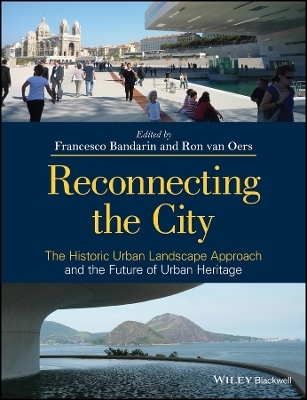
Reconnecting the City – The Historic Urban Landscape Approach and the Future of Urban Heritage
John Wiley & Sons Inc (Hersteller)
978-1-118-38394-0 (ISBN)
- Keine Verlagsinformationen verfügbar
- Artikel merken
Historic Urban Landscape is a new approach to urban heritage management, promoted by UNESCO, and currently one of the most debated issues in the international preservation community. However, few conservation practitioners have a clear understanding of what it entails, and more importantly, what it can achieve. Following the publication of The Historic Urban Landscape: Managing Heritage in an Urban Century, the approach is now further elaborated with a more practical slant and translates the notion into an operational set of management practices. In this follow-up book, the editors pull together specially commissioned chapters on best practice in urban heritage management from established professionals in the field. Drawn from a variety of disciplines related to urban management and conservation these authors present and discuss methodologies and practices to consider in the implementation of the Historic Urban Landscape approach as advocated by UNESCO. The contributors are selected from professionals who have written, argued or debated about the role of historic cities in contemporary society.
As well as their chapters, there are interviews with six high-profile people from different regions of the world giving their critical reflections on the UNESCO approach in relation to their own ideas on urban heritage conservation and city management. Reconnecting the City: the Historic Urban Landscape Approach and the Future of Urban Heritage provides a thorough discussion, structured by themes on issues related to key topics in the field of urban management, from changing demographics and increasing urbanisation to the pressures of economic development and decentralisation; social interaction; and economic feasibility and financing of heritage conservation. By presenting a range of methodologies and tools to support urban conservation in a way that is sensitive to cultural differences, the editors encourage a departure from the compartmentalized approaches of today's urban heritagemanagement. The book includes contributions from HH The Aga Khan, Rem Koolhaas, Stefano Bianca and Julian Smith - and many other internationally respected figures.
The book's companion website offers invaluable resources from UNESCO relating to the Historic Urban Landscape Approach, as well as additional illustrations and web-links.
Francesco Bandarin is UNESCO's Assistant Director-General for Culture and Professor of Urban Planning at the University Institute of Architecture of Venice. He was formerly Director of the UNESCO World Heritage Centre and the Secretary of the World Heritage Committee. He is trained as an Architect (Venice 1975) and Urban Planner (UC Berkeley 1977) and has pursued an academic career as Professor of Urban Planning at the University of Venice (IUAV) and a professional career as consultant for international organizations in the field of urban conservation and development. He has been actively involved in the Venice Safeguarding Project and in the preparation of Rome for the year 2000 Jubilee. As Director of the World Heritage Centre he has promoted the revision of the UNESCO recommendations on historic cities and has contributed to development of the debate on the role of contemporary architecture in historic cities, on the management of their social and physical changes and on the role of communities in the conservation of historic values. Ron van Oers is Vice Director, World Heritage Institute of Training and Research for Asia and the Pacific (WHITRAP). He was formerly Programme Specialist for Culture at the UNESCO World Heritage Centre, coordinating the World Heritage Cities Programme and the international effort to develop new guidelines for urban conservation, which were adopted as the 2011 Recommendation on the Historic Urban Landscape. He is trained as an Urban Planner (Delft 1993) and received his doctorate (PhD, Delft 2000) on a research into the principles of Dutch colonial town planning (published as book). He is the Founding Editor (together with Dr. Ana Pereira-Roders) of the Journal of Cultural Heritage Management and Sustainable Development (JCHMSD), published by Emerald Group Publishing (UK) and a Member of the Editorial Advisory Board of Change Over Time : International Journal of Conservation and the Built Environment , published by Penn Press, University of Pennsylvania's School of Design (USA).
Acknowledgements Preface Francesco Bandarin and Ron van Oers Introduction. Urban Conservation and the End of Planning Francesco Bandarin SECTION 1. The Layered Dimensions of Urban Conservation Chapter 1. Archaeology: Reading the City through Time Tim Williams Chapter 2. How Geology Shapes the Urban Environment Claudio Margottini and Daniele Spizzichino Chapter 3. Morphology as the Study of City Form and Layering Stefano Bianca Interview. Searching for a Chinese Approach to Urban Conservation Wang Shu Case study. Bologna: From Urban Restoration to Urban Rehabilitation Patrizia Gabellini Chapter 4. Historic Cities and Climate Change Anthony Gad Bigio Interview. Looking at the Challenges of the Urban Century Filipe Duarte Santos Chapter 5. The Intangible Dimension of Urban Heritage Rohit Jigyasu Interview. Interpreting Cultural Landscapes as Expressions of Local Identity Lisa Prosper Case study. The Traditional Chinese View of Nature and Challenges of Urban Development Feng Han Chapter 6. Planning and Managing Historic Urban Landscapes Francesco Siravo Interview. The Challenge of Urban Transformation Mohsen Mostafavi Chapter 7. Cities as Cultural Landscapes Ken Taylor SECTION 2. Building the Toolkit Chapter 8. Evolution of the Normative Framework Jukka Jokilehto Chapter 9. Civic Engagement Tools for Urban Conservation Julian Smith Interview. Listening to the People, Promoting Quality of Life His Highness the Aga Khan Case study. Valuing Cultural Diversity Richard Engelhardt Chapter 10. Knowledge and Planning Tools Jyoti Hosagrahar Case study. Reading the City of Tokyo Hidenobu Jinnai Chapter 11. The Role of Regulatory Systems Patricia O'Donnell Interview. Constructing Cultural Significance Rahul Mehrotra Chapter 12. Devising Financial Tools for Urban Conservation Donovan Rypkema Case study. A User's Guide for Heritage Economics Christian Ost Case study. The World Bank's Tools for Urban Conservation MV Serra Chapter 13. Researching and Mapping the Historic Urban Landscape Michael Turner and Rachel Singer Interview. Heritage and the Metropolis Rem Koolhaas Conclusion. The Way Forward: An Agenda for Reconnecting the City Ron van Oers Contributors
| Verlagsort | New York |
|---|---|
| Sprache | englisch |
| Maße | 150 x 250 mm |
| Gewicht | 666 g |
| Themenwelt | Naturwissenschaften ► Geowissenschaften ► Geografie / Kartografie |
| Sozialwissenschaften ► Soziologie | |
| Technik ► Architektur | |
| Technik ► Bauwesen | |
| ISBN-10 | 1-118-38394-X / 111838394X |
| ISBN-13 | 978-1-118-38394-0 / 9781118383940 |
| Zustand | Neuware |
| Informationen gemäß Produktsicherheitsverordnung (GPSR) | |
| Haben Sie eine Frage zum Produkt? |


