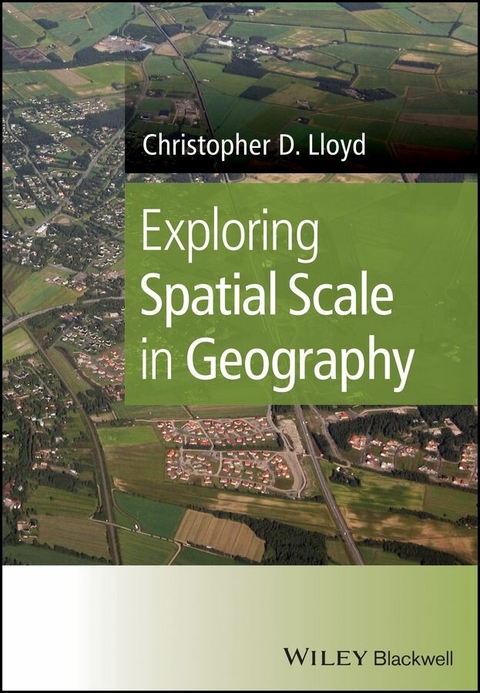
Exploring Spatial Scale in Geography takes a practical approach with a core focus on real world problems and potential solutions. Links are made to appropriate software environments with an associated website providing access to guidance material which outlines how particular problems can be approached using popular GIS and spatial data analysis software.
This book offers alternative definitions of spatial scale, presents approaches for exploring spatial scale and makes use of a wide variety of case studies in the physical and social sciences to demonstrate key concepts, making it a key resource for anyone who makes use of geographical information.
Exploring Spatial Scale in Geography provides a conceptual and practical guide to issues of spatial scale in all areas of the physical and social sciences. Scale is at the heart of geography and other spatial sciences. Whether dealing with geomorphological processes, population movements or meteorology, a consideration of spatial scale is vital. Exploring Spatial Scale in Geography takes a practical approach with a core focus on real world problems and potential solutions. Links are made to appropriate software environments with an associated website providing access to guidance material which outlines how particular problems can be approached using popular GIS and spatial data analysis software. This book offers alternative definitions of spatial scale, presents approaches for exploring spatial scale and makes use of a wide variety of case studies in the physical and social sciences to demonstrate key concepts, making it a key resource for anyone who makes use of geographical information.
Christopher D. Lloyd Department of Geography and Planning, School of Environmental Sciences, University of Liverpool, UK.
"The type of reader who would likely gain from the book is from the last group, the researcher seeking an annotated bibliography. Each chapter ends with suggestions for further reading. Extensive references are cited at the back of eachchapter rather than at the end of the book. The index is quite valuable and was accurate for all the terms I checked."
--Mathematical Geosciences, 2015
"This book provides a systematic and comprehensive account of the many spatial analytic methods useful for understanding the implications of spatial scale for geographical data. The author effectively and concisely covers a wide range of methods, using a variety of different data sets and examples."
--International Journal of Geographical Information Science, 2015
1
Introduction
1.1 The purpose of the book
Scale is at the heart of geography and other spatial sciences such as hydrography and cartography. Whether the concern is with geomorphological processes, population movements or meteorology, a consideration of spatial scale is vital. Mike Goodchild has suggested that ‘scale is perhaps the most important topic of geographical information science’ (Goodchild, 2001, p. 10). However, the concept of scale has multiple meanings, both between and within academic disciplines, and popular ideas about what it means are perhaps no less diverse. Section 2.1 provides definitions of scale which link to cartography (e.g. we talk of ‘map scale’) and to the characteristics of spatial data. As well as considering some definitions of spatial scale, the book describes some approaches for its characterisation. In addition, the book addresses topics like the effect of different levels of aggregation on statistical analyses and approaches to transferring data values for one set of zones to another set of zones or to a surface. Section 2.1 provides some definitions of scale, but, in the present book, the key focus is on scale as the size or extent of a process.
At the heart of this book is the idea that we must work with abstractions (models) of geographical phenomena which we seek to summarise or generalise in some way so as to make them intelligible or interpretable. The characteristics of these phenomena are likely to vary geographically, and their characteristics at one spatial scale may be quite different to those at another. If we are dealing with multiple phenomena in combination then potential problems are magnified, as each phenomenon may have very different spatial characteristics and may operate at different spatial scales. Accounting for the nature of a model and the inherent spatial variation in some property or properties is not straightforward, and it is on this problem that the book is focused.
Geographical information systems (GISystems) constitute a powerful means to manage and analyse multi-scale data. In this context, the term multi-scale refers to data with different levels of spatial aggregation (e.g. different pixel sizes) or different levels of generalisation (e.g. the level of spatial detail in representing linear features). In addition, GISystems provide tools which can be used to rescale the data – to change from a representation at one spatial scale to a representation at another (Atkinson and Tate 2000). This book seeks to consider how scale can be defined and explored in geographical information (GI) science contexts.
To capture or use geographical data it is essential to have information about the spatial scales of the processes which are of interest. Characterising spatial scale is important in its own right, but it is also necessary to quantify the relationship between the sampling framework and the spatial scale of a process. In short, is the data framework sufficient or excessive for a given application? Geomorphologists characterising landforms are directly concerned with the spatial scale of variation of those landforms. In addition, the spatial scales of processes operating on those landforms are of interest. Social geographers seek to understand the ways in which human populations are distributed. In some societies, subgroups of the population tend to cluster, either by choice or by force – for example, those with a similar social class are more likely to live in close proximity to one another than those in markedly different social classes. Such clustering may be evident over small areas (at a fine spatial scale) or over quite large areas (a coarse spatial scale). Any analysis of spatial data is dependent on the measurement scale (the support; see Section 2.1) and coverage of the data; thus, characterising the spatial scale of variation and how this relates to the measurement scale should be a fundamental part of any application of such data. Here, the spatial scale of variation can be taken to refer to distances over which similar values tend to occur on average.
This book offers alternative definitions of spatial scale, presents some approaches for exploring spatial scale and makes use of a wide variety of case studies in the physical and the social sciences to demonstrate key concepts. Spatial scale with respect to a physical process is often expressed in terms of distances (and perhaps directions) between observations. Alternative representations are possible. One example concerns the concept of neighbourhood whereby the size of the neighbourhood as conceived of by an individual may differ between urban and rural areas, and it thus may be possible to consider spatial scale as a function of population density rather than simply distance. The book explores such alternative representations through detailed case studies.
The book has a practical focus – the core concern is with real-world problems and potential solutions to these problems. Therefore, links are made to appropriate software environments, with an associated website providing access to guidance material which outlines how particular problems can be approached using popular GISystems and spatial data analysis software. The book consists of three strands. The first is conceptual – some definitions of spatial scale are outlined and debates about the meaning and value of concepts of spatial scale are considered. The second strand outlines methods for the exploration of spatial scale including standard measures of spatial autocorrelation, fractals, wavelets, multilevel models, methods for areal interpolation and geostatistical measures, and the methods are illustrated with examples. The third and final strand demonstrates the application of these concepts and methods to real-world case studies. Chapters 3–9 follow this structure and thus each presents concepts, methods and example applications. Use is made of multiple examples drawn from physical and social geography, and these diverse cases help to illustrate why scale should not be ignored in any analysis of spatial data.
1.1.1 What this book adds
There are many introductions to methods for the analysis of spatial scale or for taking spatial scale into account in the analysis of geographical data (many such sources are cited in this book, with further reading sections at the end of each Chapter). The added value of this book is that it brings together a wide range of ideas and methods which relate to the exploration of scale in geography. The book takes a systematic approach to the explanation of key concepts followed by introductions to key methods which are then illustrated through case studies. Many of the case studies are based on research which has appeared in journal articles, and although each case study is intended to be self-contained, interested readers can follow up the relevant references if they require more details about the data or specific aspects of the methods or interpretations. No equivalent stand-alone introduction to the analysis of spatial scale currently exists, and it is hoped that the book will fill a gap in the spatial analysis literature and act as a first port of call for those with an interest in spatial scale and spatial data analysis.
1.1.2 Scales of analysis and alternative definitions
As noted by Goodchild (2011), the surface of the Earth is infinitely complex and it would be possible in principle to map the surface of the Earth to a sub-millimetre (and possibly molecular) level. But, in practice, we are obliged to sample the spatial properties we are interested in to make the handling and analysis of data representing them manageable. Spatial data sources are extensive in terms of both the features and properties they represent and the geographical areas they cover. The level of detail represented by these data sets is highly variable. As an example, images acquired through satellite remote sensing are available for multiple spatial (and spectral) resolutions. As such, users of these data may encounter multi-scale representations, and for one region, there may be available several remotely sensed images that have different spatial resolutions (Lloyd 2011). In most cases, users of such data have little choice about the scale of measurement, and it is therefore necessary to develop ways to work with data at a range of spatial scales (Goodchild and Quattrochi 1997). Characterisation of spatial scale is also important where a new sample is being collected – by quantifying the dominant scales of spatial variation in a property it is possible to ascertain an appropriate sampling strategy.
Scale is a complex topic with numerous definitions encompassed within diverse conceptual frameworks. This complexity has been tackled by researchers in many disciplines. Spatial scale has been the subject of several previous books. Herod (2010) provides a wide ranging introduction to the concept and meaning of scale, within social theory. Several edited books focus on the topic from a GIScience perspective – these include Quattrochi and Goodchild (1997), Tate and Atkinson (2001) and Sheppard and McMaster (2004). A short introduction to scale in geography is given by Montello (2001). While the focus in this book is on geography, and on GIScience in particular, there is much related work in other disciplines including ecology (see, for example, the books edited by Peterson and Parker 1998and Gardner et al. 2001and the classic text by Legendre and Legendre 2012) and spatial epidemiology (the book by Lawson 2006has a lot of material on statistical analysis and spatial scale in...
| Erscheint lt. Verlag | 4.3.2014 |
|---|---|
| Sprache | englisch |
| Themenwelt | Naturwissenschaften ► Geowissenschaften ► Geografie / Kartografie |
| Naturwissenschaften ► Geowissenschaften ► Geologie | |
| Technik | |
| Schlagworte | Alternative • APPROACHES • Areas • Book • CASE • Definitions • earth sciences • Geographie • Geography • geomorphological processes • Geowissenschaften • GIS & Remote Sensing • GIS, Fernerkundung u. Kartographie • GIS, Remote Sensing & Cartography • GIS u. Fernerkundung • Guide • heart • Issues • Offers • Population • Practical • presents • scale • Spatial |
| ISBN-13 | 9781118526811 / 9781118526811 |
| Informationen gemäß Produktsicherheitsverordnung (GPSR) | |
| Haben Sie eine Frage zum Produkt? |
 EPUB (Adobe DRM)
Kopierschutz: Adobe-DRM
Adobe-DRM ist ein Kopierschutz, der das eBook vor Mißbrauch schützen soll. Dabei wird das eBook bereits beim Download auf Ihre persönliche Adobe-ID autorisiert. Lesen können Sie das eBook dann nur auf den Geräten, welche ebenfalls auf Ihre Adobe-ID registriert sind.
Details zum Adobe-DRM
Dateiformat: EPUB (Electronic Publication)
EPUB ist ein offener Standard für eBooks und eignet sich besonders zur Darstellung von Belletristik und Sachbüchern. Der Fließtext wird dynamisch an die Display- und Schriftgröße angepasst. Auch für mobile Lesegeräte ist EPUB daher gut geeignet.
Systemvoraussetzungen:
PC/Mac: Mit einem PC oder Mac können Sie dieses eBook lesen. Sie benötigen eine
eReader: Dieses eBook kann mit (fast) allen eBook-Readern gelesen werden. Mit dem amazon-Kindle ist es aber nicht kompatibel.
Smartphone/Tablet: Egal ob Apple oder Android, dieses eBook können Sie lesen. Sie benötigen eine
Geräteliste und zusätzliche Hinweise
Buying eBooks from abroad
For tax law reasons we can sell eBooks just within Germany and Switzerland. Regrettably we cannot fulfill eBook-orders from other countries.
aus dem Bereich