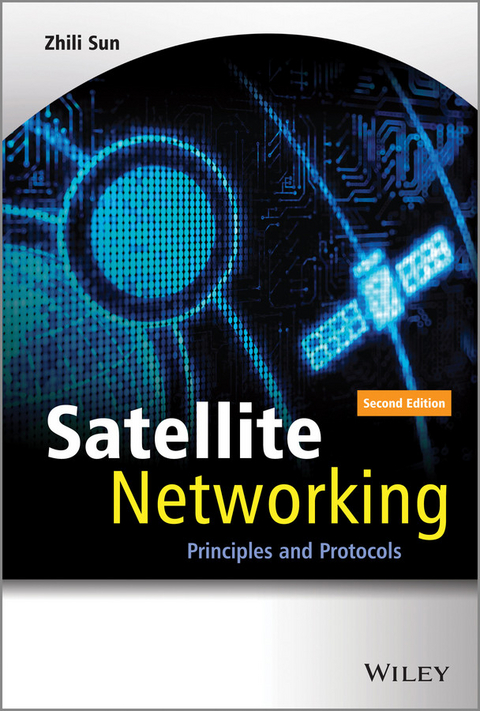
Satellite Networking (eBook)
John Wiley & Sons (Verlag)
978-1-118-85676-5 (ISBN)
This book provides up to date coverage of the basics of ATM and internet protocols, and characteristics of satellite networks and internetworking between satellite and terrestrial networks
Satellite Networking: Principles and Protocols, Second Edition provides up to date information of the original topics in satellite networking and protocols focusing on Internet Protocols (IP) over satellites, broadband over satellites, next generation IP (IPv6) over satellites, new generation of DVB-S/S2 and DVB-RCS next generations and new services and applications. It also includes some analytical techniques for evaluation of end to end IP performance and QoS over satellite, reflecting the recent convergence of telecommunication, Internet, broadcasting and mobile networks.
Topics new to this edition: Internetworking with MANET, DVB-S/S2 and DVB-RCS/RCS2 (including TCP/IP over DVB-S/RCS), recent developments in broadband satellite systems, convergence of services and network technologies (including Internet, telecom, mobile, TV, etc.), radio resource management, PEP, I-PEP, SCPS, traffic modelling and engineering with analysis and examples, and future developments of satellite networking.
- Provides up to date coverage of the basics of ATM and internet protocols, and characteristics of satellite networks and internetworking between satellite and terrestrial networks (e.g. mobile ad hoc networks), including coverage of new services and applications (e.g. Internet, telecom, mobile and TV)
- Discusses the real-time protocols including RTP, RTCP and SIP for real-time applications such as VoIP and MMC, and explains TCP/IP over satellite and evolution of IPv6 over satellite and beyond
Professor Zhili Sun, University of Surrey, UK
Dr Zhili Sun is a Reader in Communications at the Centre for Communication Systems Research (CCSR) at the University of Surrey, UK.
He has more than 12 years experience of working in the field since completing his Ph.D. and teaches MSc students modules on satellite communications and data and internet networking as well as industrial short courses e.g. at INT, France.
This book provides up to date coverage of the basics of ATM and internet protocols, and characteristics of satellite networks and internetworking between satellite and terrestrial networks Satellite Networking: Principles and Protocols, Second Edition provides up to date information of the original topics in satellite networking and protocols focusing on Internet Protocols (IP) over satellites, broadband over satellites, next generation IP (IPv6) over satellites, new generation of DVB-S/S2 and DVB-RCS next generations and new services and applications. It also includes some analytical techniques for evaluation of end to end IP performance and QoS over satellite, reflecting the recent convergence of telecommunication, Internet, broadcasting and mobile networks. Topics new to this edition: Internetworking with MANET, DVB-S/S2 and DVB-RCS/RCS2 (including TCP/IP over DVB-S/RCS), recent developments in broadband satellite systems, convergence of services and network technologies (including Internet, telecom, mobile, TV, etc.), radio resource management, PEP, I-PEP, SCPS, traffic modelling and engineering with analysis and examples, and future developments of satellite networking. Provides up to date coverage of the basics of ATM and internet protocols, and characteristics of satellite networks and internetworking between satellite and terrestrial networks (e.g. mobile ad hoc networks), including coverage of new services and applications (e.g. Internet, telecom, mobile and TV) Discusses the real-time protocols including RTP, RTCP and SIP for real-time applications such as VoIP and MMC, and explains TCP/IP over satellite and evolution of IPv6 over satellite and beyond
Professor Zhili Sun, University of Surrey, UK Dr Zhili Sun is a Reader in Communications at the Centre for Communication Systems Research (CCSR) at the University of Surrey, UK. He has more than 12 years experience of working in the field since completing his Ph.D. and teaches MSc students modules on satellite communications and data and internet networking as well as industrial short courses e.g. at INT, France.
List of Figures
- 1.1 Typical applications and services of satellite networking
- 1.2 Functional relationships of user terminal, terrestrial network and satellite network
- 1.3 Typical topologies of networks: star, hierarchy and mesh
- 1.4 Circuit switching networks
- 1.5 Concept of multiplexing in the frequency domain
- 1.6 Analogue transmission multiplexing hierarchy
- 1.7 Concept of multiplexing in the time domain
- 1.8 Digital transmission hierarchies
- 1.9 Space switching concept
- 1.10 Time switching concept
- 1.11 Virtual channel switching concept
- 1.12 Datagram routing concept
- 1.13 Packet error probabilities for given bit error probabilities and packet sizes
- 1.14 OSI/ISO seven-layer reference model
- 1.15 B-ISDN ATM reference model
- 1.16 The Internet reference model
- 1.17 Illustration of the space segment and ground segment
- 1.18 Satellite orbits
- 1.19 Attenuations of different frequency bands due to rain (A), fog (B) and gas (C)
- 1.20 Capacity boundary of communication channel
- 1.21 Shannon bandwidth efficiency for large
- 1.22 Using routers to internetwork with heterogeneous terrestrial networks
- 1.23 Mapping of user-centric QoS requirements into network performance
- 1.24 Model for user-centric QoS categories
- 1.25 The four viewpoints of QoS
- 1.26 User- and network-centric views of QoS and NP concepts
- 1.27 Functional blocks of the transmission system
- 1.28 Randomizer/de-randomizer schematic diagram
- 1.29 Framing structure
- 1.30 Conceptual diagram of the convolutional interleaver and de-interleaver
- 1.31 QPSK constellation
- 1.32 Functional block diagram of the DVB-S2 system
- 1.33 Functional block diagram of the DVB-SH transmitter (Either TDM or OFDM configurations)
- 1.34 Slot pilot insertion
- 1.35 Physical layer (PL) scrambling
- 1.36 Mapping of the SH frame on OFDM
- 1.37 Satellite in the global information infrastructure
- 2.1 Vector from earth to satellite
- 2.2 Orbit with major axis of orbit (AB) and semi-major axis of orbit (AO)
- 2.3 Inclination of orbit i
- 2.4 Equatorial, incline and polar orbits
- 2.5 Right ascension of the node and argument of perigee
- 2.6 Footprints of geosynchronous satellites
- 2.7 Typical high elliptical orbit
- 2.8 Footprint of a LEO satellite
- 2.9 Relationship between altitude and coverage
- 2.10 Antenna radiation pattern
- 2.11 Relation between elevation angle and altitude
- 2.12 Distance between earth station and satellite
- 2.13 Carrier waves, modulating signals and modulated signals
- 2.14 Signal-space diagram for coherent BPSK
- 2.15 Signal-space diagram for coherent QPSK
- 2.16 Noise performance of modulation schemes
- 2.17 Block diagram of physical layer functions of satellite networks
- 2.18 Forward error correction (FEC) coding
- 2.19 Block diagram of turbo encoder
- 2.20 Block diagram of turbo decoder
- 2.21 Comparison of FEC codes
- 2.22 Multiple access techniques: FDMA, TDMA and CDMA
- 2.23 Comparison between the concepts of multiplexing and multiple access
- 2.24 A typical example of satellite TDMA scheme
- 2.25 Single hop topology with satellite at the centre
- 2.26 Multiple hops topology with hub at the centre
- 2.27 Satellite networks with inter-satellite links
- 2.28 Concepts of inter-satellite beam and intra-satellite beam handovers
- 2.29 Satellite constellations of earth fixed coverage and satellite fixed coverage
- 2.30 Satellite network availability model
- 3.1 ATM cell
- 3.2 Functions of the ATM protocol stack
- 3.3 Trade-off between delay and cell payload efficiency
- 3.4 Delay due to packetisation and queuing
- 3.5 The ATM cell header format at the UNI and NNI
- 3.6 Connection/routing table in ATM switch
- 3.7 Concept of VP and VC in the physical layer
- 3.8 Example of VP switching
- 3.9 Example of VC and VP switching
- 3.10 Service classes and their attributes
- 3.11 AAL 1 packet format for Class A
- 3.12 Illustration of the adaptive clock method
- 3.13 AAL 2 packet format for Class B
- 3.14 AAL 3/4 packet format for Classes C and D
- 3.15 AAL 5 format for Internet protocol
- 3.16 The ITU-T target solution for ATM cell transmission
- 3.17 SDH STM-1 frame
- 3.18 B-ISDN reference configuration
- 3.19 ATM interfaces network node interconnections
- 3.20 ATM address format
- 3.21 Generic cell rate (GCRA) algorithm
- 3.22 Leaky bucket algorithm (LBA)
- 3.23 An illustration of smooth traffic coming to the leaky bucket – GCRA(1.5, 0.5)
- 3.24 Illustration of burst traffic coming to the leaky bucket— GCRA(4.5, 7)
- 3.25 Virtual scheduling algorithm (VSA)
- 3.26 Internet packets over routers and sub-networks
- 3.27 IP packet header format
- 3.28 IP address formats
- 3.29 Special IP addresses
- 3.30 The TCP segment header
- 3.31 Congestion control and avoidance
- 3.32 The UDP datagram header format
- 3.33 Protocol stacks for LAN emulation and classical IP over ATM
- 4.1 Basic configuration of access and transit networks
- 4.2 Relationships between user, signalling and management functions
- 4.3 Example of network connections and interfaces
- 4.4 Analogue network in-band signalling and out-of-band signalling
- 4.5 Digital network in-band signalling and out-of-band signalling
- 4.6 Associated and separate signalling
- 4.7 Layers of management functions in network operation systems (NOS)
- 4.8 Illustration of on-board circuit switching
- 4.9 Example of traffic multiplexing and capacity requirement for satellite links
- 4.10 Illustration of the concept of plesiochronous digital hierarchy (PDH)
- 4.11 Multiplexing and de-multiplexing to insert a network node in PDH network
- 4.12 Add and drop function to insert a network node in SDH network
- 4.13 STM-1 frame of the SDH network
- 4.14 Mapping from PDH to SDH
- 4.15 Section overhead (SOH) of the STM-1 frame
- 4.16 Hypothetical reference digital path (HRDP)
- 4.17 HRDP in ITU-T HRX at 64 kbit/s
- 4.18 Hybrid MANET– satellite network concept
- 4.19 Hybrid MANET– satellite network challenge: selecting satellite access points
- 4.20 Hybrid MANET– satellite challenge: satellite as relay between two MANETs
- 4.21 Satellite and MANET network: resource management— automatic access point activation to increase throughput
- 5.1 Example of user access mode via satellite ATM network
- 5.2 Example of network transit mode via a satellite ATM network
- 5.3 Ground segment modules
- 5.4 TDMA frame format (earth station to satellite)
- 5.5 Satellite resource management
- 5.6 Satellite with ATM on-board switch
- 5.7 Multibeam satellite
- 5.8 Layered model of performance for B-ISDN
- 5.9 Cell delay variation parameter definitions
- 6.1 Relationship between IP and different network technologies
- 6.2 Satellite-centric viewpoint of global networks
- 6.3 Mapping from earth-centric view to GEO-centric view
- 6.4 Network-centric view of satellite networks
- 6.5 Basic concept of encapsulation of an IP packet
- 6.6 HDLC frame structure
- 6.7 Frame structure of the point-to-point protocol (PPP)
- 6.8 Format of a MAC frame
- 6.9 Satellite-centric view of last mile connections to the Internet
- 6.10 Satellite-centric view of first mile connections to the Internet
- 6.11 Satellite-centric view of transit connections to the Internet
- 6.12 Satellite-centric view of fixed satellites with earth moving
- 6.13 The GEOCAST system as an example of star and mesh topologies
- 6.14 RPF terrestrial example
- 6.15 IGMP over satellite: (a) static and (b) dynamic multicast
- 6.16 Multicast routing flooding: two approaches
- 6.17 Secret key system
- 6.18 Public key system for privacy (a) and authentication (b)
- 6.19 Transport mode in IPv4
- 6.20 Tunnelling mode (the same for both IPv4 and IPv6)
- 6.21 Firewall consisting of two routers and one gateway
- 6.22 Illustration of logical key...
| Erscheint lt. Verlag | 6.3.2014 |
|---|---|
| Sprache | englisch |
| Themenwelt | Naturwissenschaften ► Physik / Astronomie ► Mechanik |
| Technik ► Elektrotechnik / Energietechnik | |
| Technik ► Nachrichtentechnik | |
| Schlagworte | Book • broadcast • Communication Technology - Networks • Concepts • Coverage • Drahtlose Kommunikation • Electrical & Electronics Engineering • Elektrotechnik u. Elektronik • First • fundamental • Future • Internetworking • Kommunikationsnetze • Mobile & Wireless Communications • Networks • Orbits • performance enhancement protocol • Principles • protocols • Satellite • Satellite communications • Satellitenkommunikation • Satellites • significantly • telecommunications • Terrestrial |
| ISBN-10 | 1-118-85676-7 / 1118856767 |
| ISBN-13 | 978-1-118-85676-5 / 9781118856765 |
| Informationen gemäß Produktsicherheitsverordnung (GPSR) | |
| Haben Sie eine Frage zum Produkt? |
 EPUB (Adobe DRM)
Größe: 17,7 MB
Kopierschutz: Adobe-DRM
Adobe-DRM ist ein Kopierschutz, der das eBook vor Mißbrauch schützen soll. Dabei wird das eBook bereits beim Download auf Ihre persönliche Adobe-ID autorisiert. Lesen können Sie das eBook dann nur auf den Geräten, welche ebenfalls auf Ihre Adobe-ID registriert sind.
Details zum Adobe-DRM
Dateiformat: EPUB (Electronic Publication)
EPUB ist ein offener Standard für eBooks und eignet sich besonders zur Darstellung von Belletristik und Sachbüchern. Der Fließtext wird dynamisch an die Display- und Schriftgröße angepasst. Auch für mobile Lesegeräte ist EPUB daher gut geeignet.
Systemvoraussetzungen:
PC/Mac: Mit einem PC oder Mac können Sie dieses eBook lesen. Sie benötigen eine
eReader: Dieses eBook kann mit (fast) allen eBook-Readern gelesen werden. Mit dem amazon-Kindle ist es aber nicht kompatibel.
Smartphone/Tablet: Egal ob Apple oder Android, dieses eBook können Sie lesen. Sie benötigen eine
Geräteliste und zusätzliche Hinweise
Zusätzliches Feature: Online Lesen
Dieses eBook können Sie zusätzlich zum Download auch online im Webbrowser lesen.
Buying eBooks from abroad
For tax law reasons we can sell eBooks just within Germany and Switzerland. Regrettably we cannot fulfill eBook-orders from other countries.
 PDF (Adobe DRM)
Kopierschutz: Adobe-DRM
Adobe-DRM ist ein Kopierschutz, der das eBook vor Mißbrauch schützen soll. Dabei wird das eBook bereits beim Download auf Ihre persönliche Adobe-ID autorisiert. Lesen können Sie das eBook dann nur auf den Geräten, welche ebenfalls auf Ihre Adobe-ID registriert sind.
Details zum Adobe-DRM
Dateiformat: PDF (Portable Document Format)
Mit einem festen Seitenlayout eignet sich die PDF besonders für Fachbücher mit Spalten, Tabellen und Abbildungen. Eine PDF kann auf fast allen Geräten angezeigt werden, ist aber für kleine Displays (Smartphone, eReader) nur eingeschränkt geeignet.
Systemvoraussetzungen:
PC/Mac: Mit einem PC oder Mac können Sie dieses eBook lesen. Sie benötigen eine
eReader: Dieses eBook kann mit (fast) allen eBook-Readern gelesen werden. Mit dem amazon-Kindle ist es aber nicht kompatibel.
Smartphone/Tablet: Egal ob Apple oder Android, dieses eBook können Sie lesen. Sie benötigen eine
Geräteliste und zusätzliche Hinweise
Buying eBooks from abroad
For tax law reasons we can sell eBooks just within Germany and Switzerland. Regrettably we cannot fulfill eBook-orders from other countries.
aus dem Bereich