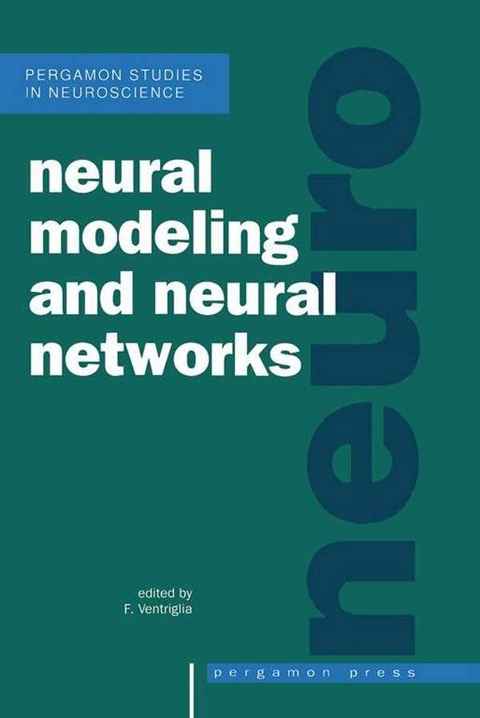
Neural Modeling and Neural Networks (eBook)
363 Seiten
Elsevier Science (Verlag)
9781483287904 (ISBN)
Research in neural modeling and neural networks has escalated dramatically in the last decade, acquiring along the way terms and concepts, such as learning, memory, perception, recognition, which are the basis of neuropsychology. Nevertheless, for many, neural modeling remains controversial in its purported ability to describe brain activity. The difficulties in "e;modeling"e; are various, but arise principally in identifying those elements that are fundamental for the expression (and description) of superior neural activity. This is complicated by our incomplete knowledge of neural structures and functions, at the cellular and population levels. The first step towards enhanced appreciation of the value of neural modeling and neural networks is to be aware of what has been achieved in this multidisciplinary field of research. This book sets out to create such awareness. Leading experts develop in twelve chapters the key topics of neural structures and functions, dynamics of single neurons, oscillations in groups of neurons, randomness and chaos in neural activity, (statistical) dynamics of neural networks, learning, memory and pattern recognition.
Anatomical Bases of Neural Network Modeling
JANOS SZENTÁGOTHAI, First Department of Anatomy, Semmelweis University Medical School, Tuzolto u. 58, Budapest IX, H-1450, Hungary
Publisher Summary
Neuronal connectivity in most neural centers is sufficiently specific to permit the disassembly of the whole network into distinct pieces (or units) of characteristic internal connectivity that are arranged into larger structures by repetition of similar architectural units. These units have been termed neuronal modules and the architectural principle is referred to by the modular architectonic principle of neural centers. This chapter discusses the modular architectonic principle as it can be recognized in various parts of the central nervous system (CNS) of the vertebrates, starting with the spinal cord. The upper diencephalic and telencephalic (striatum and putamen) part of the brainstem does not retain anything resembling the quasi-segmental arrangement of the lower neuraxis. There is, however, a small part of the diencephalon—the so called hypothalamus, that is, the ventralmost part of the diencephalon—in which the elements of the basic architectural principle of the neuraxis are preserved longitudinally oriented fiber tracts and transversally oriented (coronal) quasi-discs of neuropil.
General introduction
Modern neuroanatomical methods have made it possible to define practically any neuron (1) Anatomically (shape and location of the cell body, dendritic arborizations, a considerable part of axonal arborizations, synapses received from and given to other neurons [or other tissue elements]); (2) Physiologically (especially spiking activity under suitable experimental conditions, biophysical conditions, prevailing on the outside or the inside of the neuronal membrane, number and location as well as distribution of several ionic channels, etc; the situation is somewhat more difficult in neurons that lack spiking activity and have to be assumed to convey changes of their state electrotonically; the sign of synaptic action, whether excitatory or inhibitory can be defined usually); (3) Biochemically (by identification of the mediator, [mediators] through which one neuron can influence other neurons with which they are connected synaptically [in addition to mediators other substances called modulators can also be defined in many cases]). Beyond these classical properties investigation into the nature of many neurons is well on its way to uncover the molecular and genetic mechanisms that are at the bases of the anatomical, physiological and biochemical properties of the neurons.
Considering the extreme complexity of structure and functioning of any piece of neural tissue we have to start with a clear objective, in order not to loose our way already at the very beginning. The classical approach of the neuroanatomist was and will probably always remain, to give reasonable descriptions of neuron networks. Highly abstract black box type models of neural centers have their –rather limited — fields of application, however, this is certainly not the territory of the neuroanatomist. If we were able to build realistic — albeit even radically simplified — models of neuron networks, we might enable students of neural models to try their hand at giving life to such models either by mathematical, general purpose or special hard-wired simulation experiments.
Neuronal connectivity in most neural centers is sufficiently specific to permit disassembly of the whole network into distinct pieces (or units) of characteristic internal connectivity that are arranged into larger structures by repetition of similar architectural units. These units have been termed neuronal modules and this architectural principle is referred to by speaking of the modular architectonic principle of neural centers. In the following chapters an attempt will be made to illustrate this modular architectonic principle as it can be recognized in various parts of the central nervous system (CNS) of the vertebrates, starting with the spinal cord; and the changes that occur in the lower brainstem; subsequently we shall move to the example of the cerebellum, then to the neocortex and eventually — as a special case of the cortex — to its archaic part, the limbic lobe and its highly specialized structure, the hippocampus.
Spinal cord and brainstem
The spinal cord of the vertebrates has two major functions; (a) to integrate neural (reflex and other) functions in one or few neighbouring segments of the body, (b) to serve as a conducting medium along the entire body axis. These two basic functions cannot be separated completely, because functions bridging only minor or even major parts of the body axis have to be separated from the true connections between the higher parts of the CNS and the spinal segmental level as intersegmental mechanismus. The brainstem listed in caudo-cranial direction: the medulla oblongata pons and mesencephalon while preserving the essential architectural principle of the cord, are gradually widened literally by being blown up — by new neuron systems, that besides acting as centers for higher coordination of body posture and movement, are serving the increased demand for central structures by the concentration of specific sense organs (equilibrium, audition, vision) on the head and act also as structures connecting with the CNS axis highly specialized centers, like the cerebellum in all vertebrates and lateral lobes subserving specific electric senses and lateral line organs that were developed in the fishes, but gradually disappeared in the upper vertebral classes.
The architectonic principle of the segmental apparatus
It has to be born in mind that the segmental arrangement in the vertebrates differs fundamentally from the segmentation in invertebrate phyla where segmentation belongs to the essence of the building plan, whereas in the vertebrates segmentation is superimposed upon an originally continuous neuraxis by the mesodermal segmentation of the body. In spite of this, the secondarily imposed segmentation serves as an important system of landmarks for the description of spinal cord architecture.
Although it may seem difficult to reduce the strange form of the spinal gray matter: two dorsal and two ventral gray columns, connected before and behind the central canal by two gray commissures — into some simplified geometry for a more schematic representation of the spaces occupied by the cell and neuropil material, such a subdivision of the spinal gray matter is indeed possible. The central core of the gray matter can be easily reduced into a double barrel structure — resembling the shape of a hunting rifle — and to consider the remaining parts of the dorsal and ventral (in some parts of the cord also into a lateral) appendages attached to the dorsal, lateral and ventrolateral perimeters of the barrels. This architecture was not apparent for the early students of the CNS, because the classical Golgi procedures could be applied with success mainly to very young animals. In these early stages of life the double barrel structure of the central gray core does not become apparent. It is only during postnatal development that the neuropil is expanded by ingrowing arborizations of preterminal and terminal arborizations. This became visible only when the application of Golgi type methods by perfusion made the study of adult material possible (Réthelyi, 1976).
The spatial orientation of dendrites and terminal axonal arborizations have been understood already by the authors of the early classical period of neuroanatomy in the years 1888 until shortly after 1900 — notably by Ramón y Cajal (see Fig. 1) — as the most important cue for understanding the synaptic relations in any part of the neuropil. Based upon these criteria the two barrels of the spinal central core can be reduced to a relatively simple geometry of two columns of stacked coins as illustrated in Fig. 2. Both dendrites of the interneurons and axonal arborizations appear to be compressed into flat cylinders from which it is easy to deduce that synapses are established with the largest probability between terminal axons that enter any given flat cylinder and the interneurons whose bodies are lying in and whose dendritic arborizations are confined to the same cylinder. The neuropil of the ventral horn is also restricted — although with much less rigour — to halfmoon-shape extensions in ventrolateral direction of these discs. The motoneurons are not only much larger than the interneurons, but are oriented with the longer axes of their bodies and their dendrites parallel to the spinal cord axis, so that they transgress — and hence may receive synapses from the preterminal axon arborizations within 4–5 neighbouring discs. The neuropil architecture of the dorsal gray column differs very considerably from that of the ventral gray column in being very clearly layered into cell sheets lying parallel to the dorsal surface of the dorsal horn. On this basis the entire spinal gray matter was subdivided by Rexed (1954) into ten layers, generally labeled in dorso-ventral direction by Roman numerals I–X. For practical purposes, especially in physiological experiments, this subdivision is quite useful,...
| Erscheint lt. Verlag | 22.10.2013 |
|---|---|
| Sprache | englisch |
| Themenwelt | Mathematik / Informatik ► Informatik ► Netzwerke |
| Studium ► 1. Studienabschnitt (Vorklinik) ► Physiologie | |
| Naturwissenschaften ► Biologie ► Humanbiologie | |
| ISBN-13 | 9781483287904 / 9781483287904 |
| Informationen gemäß Produktsicherheitsverordnung (GPSR) | |
| Haben Sie eine Frage zum Produkt? |
 EPUB (Adobe DRM)
Kopierschutz: Adobe-DRM
Adobe-DRM ist ein Kopierschutz, der das eBook vor Mißbrauch schützen soll. Dabei wird das eBook bereits beim Download auf Ihre persönliche Adobe-ID autorisiert. Lesen können Sie das eBook dann nur auf den Geräten, welche ebenfalls auf Ihre Adobe-ID registriert sind.
Details zum Adobe-DRM
Dateiformat: EPUB (Electronic Publication)
EPUB ist ein offener Standard für eBooks und eignet sich besonders zur Darstellung von Belletristik und Sachbüchern. Der Fließtext wird dynamisch an die Display- und Schriftgröße angepasst. Auch für mobile Lesegeräte ist EPUB daher gut geeignet.
Systemvoraussetzungen:
PC/Mac: Mit einem PC oder Mac können Sie dieses eBook lesen. Sie benötigen eine
eReader: Dieses eBook kann mit (fast) allen eBook-Readern gelesen werden. Mit dem amazon-Kindle ist es aber nicht kompatibel.
Smartphone/Tablet: Egal ob Apple oder Android, dieses eBook können Sie lesen. Sie benötigen eine
Geräteliste und zusätzliche Hinweise
Buying eBooks from abroad
For tax law reasons we can sell eBooks just within Germany and Switzerland. Regrettably we cannot fulfill eBook-orders from other countries.
aus dem Bereich