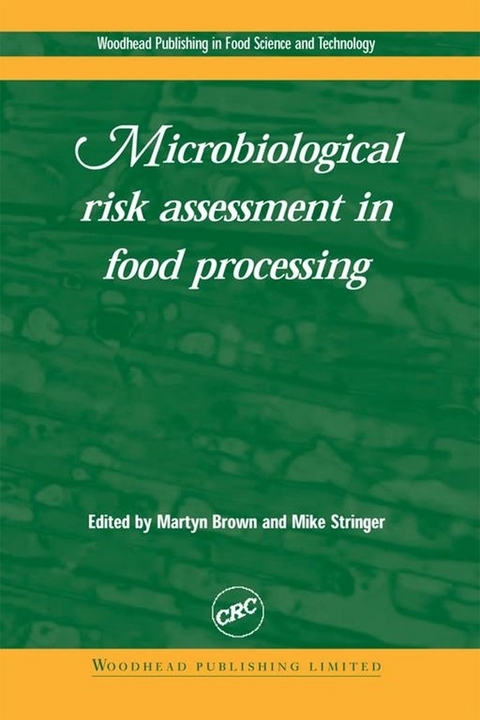
Microbiological Risk Assessment in Food Processing (eBook)
320 Seiten
Elsevier Science (Verlag)
978-1-85573-668-9 (ISBN)
Microbiological risk assessment (MRA) is one of the most important recent developments in food safety management. Adopted by Codex Alimentarius and many other international bodies, it provides a structured way of identifying and assessing microbiological risks in food. Edited by two leading authorities, and with contributions by international experts in the field, Microbiological risk assessment provides a detailed coverage of the key steps in MRA and how it can be used to improve food safety.The book begins by placing MRA within the broader context of the evolution of international food safety standards.Part one introduces the key steps in MRA methodology. A series of chapters discusses each step, starting with hazard identification and characterisation before going on to consider exposure assessment and risk characterisation. Given its importance, risk communication is also covered. Part two then considers how MRA can be implemented in practice. There are chapters on implementing the results of a microbiological risk assessment and on the qualitative and quantitative tools available in carrying out a MRA. It also discusses the relationship of MRA to the use of microbiological criteria and another key tool in food safety management, Hazard Analysis and Critical Control Point (HACCP) systems.With its authoritative coverage of both principles and key issues in implementation, Microbiological risk assessment in food processing is a standard work on one of the most important aspects of food safety management. - Provides a detailed coverage of the key steps in microbiological risk assessment (MRA) and how it can be used to improve food safety- Places MRA within the broader context of the evolution of international food safety standards- Introduces the key steps in MRA methodology, considers exposure assessment and risk characterisation, and covers risk communication
Front Cover
1
Microbiological Risk Assessment in Food Processing 4
Copyright Page
5
Table of Contents 6
Contributors 12
Preface 16
Chapter 1. Introduction 20
1.1 References 23
Chapter 2. The evolution of microbiological risk assessment 24
2.1 Introduction 24
2.2 Historical aspects of safe food production 25
2.3 The evolution of food safety systems 26
2.4 International food safety standards 42
2.5 Present and future uses of microbiological risk assessment 48
2.6 List of abbreviations 57
2.7 References 58
Part I: The methodology of microbiological risk assessment 64
Chapter 3. Microbiological risk assessment (MRA): an introduction 66
3.1 Introduction 66
3.2 Key steps in MRA 68
3.3 Hazard identification 72
3.4 Hazard characterisation/dose–response assessment 73
3.5 Exposure assessment 76
3.6 Risk characterisation 79
3.7 References 82
Chapter 4. Hazard identification 83
4.1 Introduction: the importance of correct hazard identification 83
4.2 What is hazard identification? 83
4.3 What hazard identification should cover and produce asan output 84
4.4 What to do in hazard identification 85
4.5 Key information in hazard identification 86
4.6 Tools in hazard identification 88
4.7 Microbial hazards 89
4.8 Identifying the origin and distribution of microbial hazards 91
4.9 Changes in microbial hazards 92
4.10 Other biological hazards 94
4.11 References 94
Chapter 5. Hazard characterization/dose–response assessment 96
5.1 Introduction: key issues in hazard characterization 96
5.2 Types of dose–response data 102
5.3 Modeling dose–response relationships 105
5.4 Problems in hazard characterization 109
5.5 Future trends 113
5.6 Sources of further information and advice 115
5.7 References 116
Chapter 6. Exposure assessment 119
6.1 Introduction 119
6.2 The role of exposure assessments in microbiological risk assessment 120
6.3 What’s in an exposure assessment? 124
6.4 Who should do an exposure assessment and when? 128
6.5 Building up supply chain data for an exposure assessment 128
6.6 Sources of information 130
6.7 Types of data used in an exposure assessment 133
6.8 The output of an exposure assessment 136
6.9 References 142
Chapter 7. Risk characterisation 146
7.1 Introduction: key issues in risk characterisation 146
7.2 Risk characterisation requirements 148
7.3 Risk characterisation methods 154
7.4 Quantitative and qualitative outputs 161
7.5 Risk characterisation in practice: some examples 166
7.6 Current problems and future trends 170
7.7 References 172
Chapter 8. Risk communication 174
8.1 Introduction 174
8.2 The concept of risk 175
8.3 Risk perception 177
8.4 The concept of communication 182
8.5 Risk communication 185
8.6 The future of risk communication 188
8.7 References 189
Part II: Implementing microbiological risk assessments 192
Chapter 9. Implementing the results of a microbiological risk assessment: pathogen risk management 194
9.1 Introduction 194
9.2 Establishing food safety objectives 196
9.3 Developing food safety management strategies 200
9.4 Establishing microbiological criteria 204
9.5 Problems in implementation 209
9.6 Future trends 210
9.7 References 210
9.8 Acknowledgement 211
Chapter 10. Tools for microbiological risk assessment 212
10.1 Introduction 212
10.2 Qualitative tools for risk assessment 214
10.3 Predictive modelling 215
10.4 Tools for modelling, prediction and validation 222
10.5 Future trends 228
10.6 Sources of further information and advice 229
10.7 References and further reading 230
Chapter 11. Microbiological criteria and microbiological risk assessment 233
11.1 Introduction 233
11.2 Types of criteria 234
11.3 Key issues in the use of microbiological criteria 236
11.4 Dealing with variability, uncertainty and hazard severity: sampling plans 240
11.5 Microbiological criteria and food safety assurance: food safety objectives 245
11.6 Using microbiological risk assessments to set microbiological criteria 247
11.7 Using microbiological risk assessments to develop performance and process criteria 250
11.8 Using microbiological risk assessments to prioritise risk management actions 255
11.9 Using criteria in risk assessments 256
11.10 Future trends 258
11.11 Further reading 259
11.12 References 260
Appendix: details of the simulation model used in Section 11.7 265
Chapter 12. HACCP systems and microbiological risk assessment 267
12.1 Introduction 267
12.2 Legal requirements for HACCP systems 268
12.3 International guidance on HACCP implementation 269
12.4 Problems in HACCP implementation 275
12.5 The interaction between HACCP systems and microbiological risk assessment (MRA) 277
12.6 The future relationship of HACCP systems and MRA 280
12.7 References 282
Chapter 13. The future of microbiological risk assessment 285
13.1 Introduction 285
13.2 Information needs for risk assessment 288
13.3 How should risk assessment processes develop? 297
13.4 Key steps in risk assessment 299
13.5 Risk acceptance 303
13.6 The outputs of risk assessment: risk management and communication 308
13.7 Conclusion 311
13.8 References 311
Index 312
Introduction
M. Brown Unilever Research, Sharnbrook
M. Stringer Campden Chorleywood Food Research Association, Chipping Campden
Attempts to assess the nature of the risks posed by foodborne pathogens to consumers have long been undertaken by the food industry as a means of ensuring safe food. However, the 1990s in particular have seen growing government and industry commitment towards developing an internationally- accepted methodology for assessing the importance of microbiological risks. A number of factors have driven this process. Serious and well-publicised outbreaks of foodborne disease in the US and Europe have highlighted the need to improve the identification of new hazards, the assessment and management of existing microbiological food safety risks, and the need for dialogue with consumers about microbiological safety (Pennington, 1997; Tuttle et al., 1999). At the same time, developments in risk assessment methodology, better microbiological data and greater computing power have made it possible to develop more sophisticated and meaningful risk assessments (Tennant, 1997; Benford, 2001; Morgan, 1993).
Further impetus has been provided by the continued globalisation of the food supply, and renewed attempts to harmonise food safety principles and practice in international trade. In 1993 the Uruguay Round of the General Agreement on Tariffs and Trade (GATT) resolved that barriers to international trade in food, including those designed to protect public health, could only be science-based. In response, member countries of the World Trade Organisation (WTO) concluded the sanitary and phytosanitary (SPS) agreement (Anon, 1995a and b). The SPS agreement proposed the key requirements necessary to demonstrate equivalent levels of safety in foods originating in different nations, produced by different manufacturing systems and complying with differing regulatory requirements. The agreement requires that food safety measures taken by individual countries are:
• applied only to the extent required to protect human health
• based on scientific principles
• not maintained without scientific evidence
• based on an assessment of the risk to health that is appropriate to the circumstance
The WTO turned for guidance on defining suitable criteria to the Codex Committee on Food Hygiene of the Codex Alimentarius Commission (CAC), the body set up by the WTO and the Food and Agriculture Organisation (FAO) of the United Nations to develop benchmark standards and procedures for international food safety management. The CAC subsequently developed principles and guidelines to define the nature of, and provide a methodology for, assessing the risks to human health from pathogens in foods (Anon., 1996; Anon., 1999). These guidelines provide the foundation for a common methodology for microbiological risk assessment and management by WTO countries.
The CAC defines microbiological risk assessment as a scientifically-based process involving four key steps which are designed to produce a risk estimate:
1. hazard identification
2. hazard characterisation
3. exposure assessment
4. risk characterisation
Hazard identification identifies the causal relationship between a pathogenic agent, an illness and a food as one vector of a specified illness. Hazard characterisation, or dose-response characterisation as this stage is also known, attempts to relate the probability and severity of illness to the dose of the pathogen (or toxin) ingested by the consumer. Exposure assessment seeks to estimate the scale of exposure by assessing how much and how often consumers are exposed to a hazardous agent in food as a result of contamination levels and the effects of processing, distribution and consumer use. Finally, risk characterisation synthesises the output of the previous stages to provide an estimate (qualitative or quantitative) of the level of risk for a defined group of consumers from the identified pathogen in a particular food product.
This introduction shows that microbiological risk assessment is still a relatively new and emerging discipline. Relatively few formal microbiological risk assessments have been completed, in part because of the resources required and the relative paucity of information in some areas. In particular, few formal assessments have been undertaken by the food industry to form the basis for risk management decisions. As a result, much remains to be discovered in the light of practical experience (some of these completed assessments are discussed in Chapter 7). A number of immediate challenges have been identified by individual formal assessments. These challenges include (Anon., 2000a and b: Ross and McMeekin, 2002):
• problems in the quantity and quality of suitable and relevant data
• issues in the handling of variability and uncertainty
• the limited availability of trained personnel
• debates over methodology, for example how best to model the inputs of the hazard to the supply chain and the resulting outputs with the product, and how to model dose-response data
• how to express the output of a risk assessment in a way that is both accurate and meaningful to food safety managers and consumers
This book is the first comprehensive review not only of the methodology of microbiological risk assessment in the light of experience, but also of the range of problems encountered in practice and how these might be addressed. Two initial chapters set the scene. The first (Chapter 2) puts microbiological risk assessment in the context of the broader development of international food safety standards, whilst Chapter 3 introduces basic microbiological risk assessment methodology. These chapters are followed by authoritative coverage of the four key stages in microbiological risk assessment (Chapters 4 to 7), explaining and reviewing the individual steps which underpin each stage, the problems involved in a practical study and how they might be overcome or, their effects at least, minimised. A subsequent chapter (Chapter 10) reviews the range of qualitative, quantitative and computational tools (such as predictive modelling) available to support each of these stages in an assessment.
The CAC has placed risk assessment as the first step within a broader framework of risk analysis consisting of:
• risk assessment
• risk communication
• risk management
As its name suggests, risk assessment provides a formal, validated and transparent estimate of the level of risk which can be communicated to key groups, such as policy and decision makers, QA professionals and consumers. Such assessments provide a basis for making decisions, setting priorities and adopting appropriate procedures for food safety management. The book therefore includes a chapter on the challenge of risk communication (Chapter 8). There is also a detailed introduction to the issues involved in using risk assessment as a basis for the effective management of pathogen risks related to food production (Chapter 9). Chapter 11 discusses how such assessments can be used to establish microbiological criteria (for specifications) and food safety objectives (FSOs). The chapter shows how these can be used as inputs into food safety management tools such as hazard analysis and critical control point (HACCP) systems, or as benchmarks for establishing equivalence between food safety management or regulatory regimes. Chapter 12 considers in detail the critical relationship between microbiological risk assessment and food safety management systems such as HACCP systems. The concluding chapter looks at the future of microbiological risk assessment, including developments in methodology, risk communication and management, and the acceptance of risk by consumers.
1.1 References
ANON. Results of the Uruguay round of the multilateral trade negotiations 1993: agreement on application of sanitary and phytosanitary measures. Geneva: World Trade Organisation; 1995a.
ANON. Results of the Uruguay round of the multilateral trade negotiations 1993: agreement on technical barriers to trade. Geneva: World Trade Organisation; 1995b.
ANON. Principles and guidelines for the application of microbiological risk assessment. Rome: Codex Alimentarius Commission; 1996.
ANON. Principles and guidelines for the conduct of microbiological risk assessment. Rome: Alinorm 99/13A Codex Alimentarius Commission; 1999.
ANON. Guidelines on hazard characterisation for pathogens in food and water (preliminary document). Rome: World Health Organisation/Food and Agriculture Organisation of the United Nations; 2000a.
ANON. Report of the joint FAO/WHO expert consultation on risk assessment of microbiological hazards in foods: 17-21st July, 2000. Rome: World Health...
| Erscheint lt. Verlag | 26.9.2002 |
|---|---|
| Sprache | englisch |
| Themenwelt | Naturwissenschaften ► Biologie ► Biochemie |
| Technik ► Lebensmitteltechnologie | |
| ISBN-10 | 1-85573-668-3 / 1855736683 |
| ISBN-13 | 978-1-85573-668-9 / 9781855736689 |
| Informationen gemäß Produktsicherheitsverordnung (GPSR) | |
| Haben Sie eine Frage zum Produkt? |
 PDF (Adobe DRM)
Kopierschutz: Adobe-DRM
Adobe-DRM ist ein Kopierschutz, der das eBook vor Mißbrauch schützen soll. Dabei wird das eBook bereits beim Download auf Ihre persönliche Adobe-ID autorisiert. Lesen können Sie das eBook dann nur auf den Geräten, welche ebenfalls auf Ihre Adobe-ID registriert sind.
Details zum Adobe-DRM
Dateiformat: PDF (Portable Document Format)
Mit einem festen Seitenlayout eignet sich die PDF besonders für Fachbücher mit Spalten, Tabellen und Abbildungen. Eine PDF kann auf fast allen Geräten angezeigt werden, ist aber für kleine Displays (Smartphone, eReader) nur eingeschränkt geeignet.
Systemvoraussetzungen:
PC/Mac: Mit einem PC oder Mac können Sie dieses eBook lesen. Sie benötigen eine
eReader: Dieses eBook kann mit (fast) allen eBook-Readern gelesen werden. Mit dem amazon-Kindle ist es aber nicht kompatibel.
Smartphone/Tablet: Egal ob Apple oder Android, dieses eBook können Sie lesen. Sie benötigen eine
Geräteliste und zusätzliche Hinweise
Buying eBooks from abroad
For tax law reasons we can sell eBooks just within Germany and Switzerland. Regrettably we cannot fulfill eBook-orders from other countries.
aus dem Bereich