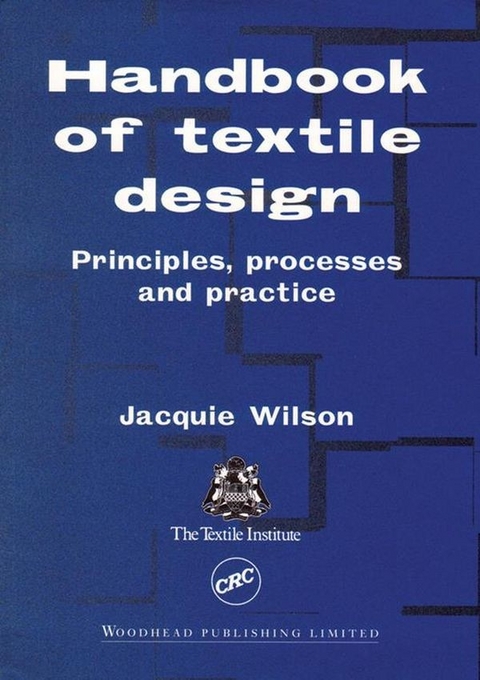
Handbook of Textile Design (eBook)
160 Seiten
Elsevier Science (Verlag)
978-1-85573-753-2 (ISBN)
Jacquie Wilson graduated from the Scottish College of Textiles (now Herriot Watt Borders Campus) in 1974 with an Honours Associateship in Textile Design. She spent ten years in industry working for a variety of companies including John Smedley and William Hollins (Viyella) as a Knitwear Designer, woven Fabric Designer and Design Director. Jacquie has been a lecturer at UMIST since 1984 teaching textile design and design management. Her research interests include textile design education and the process of design.
Designers in the textile industry have a wide range of roles and responsibilities and are frequently required to make design decisions throughout the manufacturing process. This very practical handbook provides a comprehensive overview of the role of the textile designer within the textile industry. It deals with the all aspects of the design process from the beginning - from how to go about attracting clients through range planning and development to presentation. It firmly locates the work of the textile designer within the wider context of the global textile and clothing industries and considers the process of design for both freelance and in-house designers. Commercial considerations are also covered, together with trend forecasting and the factors influencing purchasing decisions.Based on the author's experience as a textile designer in industry and as a lecturer at UMIST, Manchester, UK, this book covers the entire textile design process from briefing through initial ideas, research and design development, to finished fabrics being sold to garment manufacturers and to retail. The Handbook of textile design is an invaluable reference for students of textile design as well as buyers and merchandisers of textile products, and anyone requiring an understanding of the textile design process. - The range and diversity of textile design techniques available to the designer- The professional practice of running a textile design studio- How design work is carried out from the initial brief all the way through to invoicing the client
Front Cover 1
Handbook of Textile Design: Principles, Processes and Practice 2
Copyright Page 3
Table of Contents 4
Dedication 7
Preface 8
Acknowledgements 9
Chapter 1. An overview of textiles and textile design from fibre to product purchase 10
1.1 The global textile and clothing industries 10
1.2 Textile materials, processes, and products 10
1.3 Textile organisations 15
1.4 Categorising textiles 16
1.5 Summary 18
Bibliography 18
Chapter 2. Textile designers 19
2.1 The diversity of textile design and textile designers 19
2.2 Timing in the textile and clothing industries 21
2.3 Printed and constructed textiles 22
2.4 Summary 27
Bibliography 27
Chapter 3. The textile design function 28
3.1 The activities of a textile designer 28
3.2 How design work is done 28
3.3 Range planning 33
3.4 Range development 35
3.5 Range presentation 37
3.6 Summary 40
References 40
Bibliography 40
Chapter 4. The principles and elements of textile design 41
4.1 Design principles and elements 41
4.2 Inspiration for textile designs 47
4.3 Pattern 47
4.4 Summary 50
References 51
Bibliography 52
Chapter 5. Commercial aspects of design 53
5.1 The organisation and functions of a retail business 53
5.2 Different types of retail structures 54
5.3 Merchandise 54
5.4 Information generation 58
5.5 Summary 62
Bibliography 63
Chapter 6. The professional practice of design – 1 64
6.1 Getting design jobs 64
6.2 A model for design administration 66
6.3 The initial meeting and briefing 67
6.4 Sizing up the job 68
6.5 Agreeing terms of reference 68
6.6 Fees—how much to charge 69
6.7 Different types of fees 69
6.8 Keeping records 70
6.9 Invoicing 70
6.10 Summary 71
References 72
Bibliography 72
Chapter 7. The professional practice of design – 2 73
7.1 Professional bodies 73
7.2 Trade organisations and associations 74
7.3 Business organisations 75
7.4 Legal protection 77
7.5 Summary 80
Bibliography 80
Chapter 8. Designing for the future 81
8.1 Purchase decisions 81
8.2 Fashion 85
8.3 Summary 89
References 90
Bibliography 90
Chapter 9. Weave and woven textile design 91
9.1 Weaving 91
9.2 Weave structure 93
9.3 Plain weave 95
9.4 Some simple basic weaves 97
9.5 More complex weaves and weave combinations 100
9.6 Sample warps 100
9.7 Finishing 100
9.8 Fabric specifications/making particulars 101
9.9 Summary 101
Bibliography 101
Chapter 10. Weft knitting, weft-knitted fabric and knitwear design 102
10.1 Knitting 102
10.2 Weft-knit manufacture 103
10.3 Machine gauge 104
10.4 Weft-knitting machines and fabric types 104
10.5 Characteristics of weft-knitted fabrics 108
10.6 Weft-knitted fabric structures 108
10.7 The graphic representation of fabrics 109
10.8 Knitwear production 111
10.9 Summary 113
Bibliography 114
Chapter 11. Printing and printed textile design 115
11.1 Printed textiles 115
11.2 Initial considerations 115
11.3 Different classes of printing 116
11.4 Printing processes and print types 117
11.5 Developing design ideas 121
11.6 Classifying printed textile designs 121
11.7 Design size 123
11.8 Repeats and colourways 124
11.9 Base fabrics 124
11.10 Dyes and pigments 124
11.11 Print sampling 124
11.12 Making particulars 125
11.13 Summary 126
Bibliography 126
Appendix A: Sample Gantt chart for a textile design project 127
Appendix B: Some tips for presenting work 128
Measuring 128
Cutting 128
Mounting 128
Gluing 129
Finishing 129
Appendix C: Example of a simple structure for letters 130
Appendix D: Example fabric specification sheet for a woven fabric 132
Appendix E: Example fabric specification sheet for a knitted fabric 133
Appendix F: Calculating percentage compositions 134
Appendix G: Getting press coverage 136
Appendix H: A structure for fee letters 137
Structure 137
Subject heading 137
Introduction 137
Summary of the brief 138
Services provided 138
Special clauses 138
Additional fees 139
Fee instalments 139
Expenses chargeable 139
Request for written acceptance 140
Conclusion 140
Appendix I: Sample fee letter 141
Appendix J: Calculating an hourly rate 143
Summary 144
Glossary 145
Index 156
An overview of textiles and textile design from fibre to product purchase
1.1 The global textile and clothing industries
Textile making is a very ancient craft, with a history almost as old as mankind itself. Remembered and recorded in poetry and ancient stories and myths, textiles have always been important to man. As well as providing protection from the elements, the first textiles were used as decoration, providing status for the owner. They were also used as tools; bags for transporting belongings and for holding food as it was gathered.
Textiles are produced in almost every country of the world, sometimes for consumption exclusively in the country of manufacture, sometimes mainly for export. From cottage industry to multi-national corporation, textiles and clothing are truly global industries.
In 1782, the invention of the steam engine gave the world a new power source and started the Industrial Revolution. Previous to this the production of textiles had been a domestic system, a cottage industry with textiles spun, knitted and woven in the home. By the middle of the nineteenth century, however, there was a whole range of new machines and inventions that were to take textiles into an era of mass production in factories. The development of man-made fibres and new dyestuffs in the early part of the twentieth century, and continuing technological developments, have led and continue to lead to new products and applications. The actual processes of textile manufacture, however, are still very much as they have always been, with the vast majority of cloth being woven or knitted from yarn spun from fibre. And, while much production may be very technologically advanced, hand-produced textiles are still made in many countries exactly as they were many, many years ago.
Nowadays, many different types of companies are involved in the production of textiles and clothing world-wide; some companies own many huge manufacturing plants in many different countries while others will have only a few employees and some may not actually manufacture at all.
1.2 Textile materials, processes, and products
Fibres are manufactured or processed into yarns, and yarns are made into fabrics. Fabrics may be manufactured by a variety of processes including knitting, weaving, lace-making, felt-making, knotting (as in some rug and carpet manufacture), and stitch bonding. These fabrics may be industrial textiles with detailed technical and performance specifications, or they may be sold either to retail or contract as apparel, furnishings or household textiles, where aesthetics may be as, or sometimes even more important than performance. The fabrics may be coloured by dyeing or printing, or be finished to enhance their appearance (such as by brushing) or performance (such as by application of a flame-retardant). A wide diversity of products are made from textile products or have some textile components; textiles go into car tyres, and geotextiles are used for lining reservoirs, while medical applications include artificial ligaments and replacement arteries. Figure 1.1 summarises textile materials, processes and products in chart form.
1.2.1 Design in textiles and clothing
Every textile product is designed: that is, it is made specifically to some kind of plan. Design decisions are made at every stage in the manufacturing process – what fibres should be used in a yarn, what yarns in a fabric, what weight of fabric should be produced, what colours should the yarn or fabric be produced in, what fabric structures should be used and what finishes applied. These decisions may be made by engineers and technologists in the case of industrial or medical textiles where performance requirements are paramount, or, more often in the case of apparel, furnishings and household textiles, by designers trained in aesthetics, technology and marketing. The designers found in the textile and clothing industries are frequently involved throughout the design process, from initial identification of a need/requirement, through research, generation of initial design ideas, design development and testing to ultimate product specification.
1.2.2 Designers found in the textiles and clothing industries
The designers found in textiles and clothing include:
• colourists predicting and forecasting future colour ranges
• yarn designers
• knitted fabric designers
• woven fabric designers
• carpet designers
• print designers
• embroidery designers
• knitwear designers
• garment designers
• accessory designers
• print producers
• stylists
• colourists developing colourways
• repeat artists
1.2.3 Fibres
Fabric is made from yarn, and yarn is made from fibres. These fibres can be either natural or man-made.
Natural fibres include animal fibres (e.g. wool and silk), vegetable fibres (e.g. jute and cotton) and mineral fibres (e.g. asbestos). Man-made fibres are either regenerated or synthetic; viscose rayon, based on regenerated cellulose, is man-made but not synthetic while polyester, polypropylene and nylon are all synthetic fibres.
Synthetic fibres are produced by the large chemical companies including Dupont, Bayer, Hoechst and Astra Zeneca. Many of these companies produce no fabric but specialise in the production of certain types of fibre which they sell on as fibres or manufacture into yarns.
1.2.4 Yarns
Yarn producers or spinners buy in natural and/or man-made fibres to make these into yarns of different sizes and characters; regular and fancy yarns. For many years the main spinning systems could be given as woollen, worsted and cotton, and these systems gave rise to the woollen, worsted and cotton industries. Developments in spinning, however, have led to new spinning systems including ‘open-end’, ‘self-twist’ and ‘jet’ spinning.
At its simplest, yarn production is essentially about taking fibres, organising them so that they lie in a lengthways direction and twisting them to create a yarn. By combining fibre types, and using different spinning systems and machinery, yarns can be developed with individual profiles suitable for a vast range of end uses. Regular yarns are those which have a regular straight profile and these can be twisted together, making ‘two-fold’ or ‘three-fold’ yarns for example. Fancy yarns can be created by deliberately introducing irregularities or intermittent effects along their length. Yarns can be combined together as components of new yarns with different effects and properties from their component parts. As well as changing the appearance of a fabric, the introduction of a fancy yarn will affect the handle and performance of that fabric.
1.2.5 Woven fabrics
Strictly speaking, the definition of a textile is ‘a woven fabric’ but the term textile is now considered to cover any product that uses textile materials or is made by textile processes.
Essentially, woven fabrics are structures produced by interlacing two sets of threads; the warp which runs in a lengthways direction and the weft which runs in a widthways direction. Weaving methods include tapestry and jacquard.
1.2.6 Knitted fabrics
Knitted fabrics are produced by interlacing loops of yarn. In weft knitting, loops are formed one at a time in a weft-ways direction as the fabric is formed. Hand-knitting with a pair of knitting needles is weft knitting. In warp knitting there is a set of warp yarns which are simultaneously formed into loops. To connect these chains of loops the warp threads are moved sideways in such a way as to cause the loops to interlink.
1.2.7 Lace and non-woven fabrics
Fabrics may also be produced by methods other than weaving and knitting. Lace is an open-work fabric made by looping, plaiting or twisting threads by means of a needle or a set of bobbins. Fabrics produced by crochet and macramé are often called lace, although strictly speaking they are not. Knotting is another way of making fabrics. Knotting was a popular pastime for women in eighteenth-century Europe and colonial North America, and one method still seen today is macramé. A knotting process is also used for fishing nets, and some rugs and carpets are knotted — made by tying yarns onto a foundation weave.
There is also a group of fabrics called non-wovens which include true felt (where animal fibres are matted together) and fabrics produced by bonding webs of fibres together by stitching or by sticking with adhesive. However, in terms of volume produced, knitted and woven fabrics are by far the most common methods of fabric production.
1.2.8 Fabric terms
A length of woven or knitted fabric is usually referred to as a ‘piece’. Often, fabric woven by a mill will not be coloured and this undyed fabric is called ‘grey cloth’. Colour can be added by dyeing the piece, and such fabric is referred...
| Erscheint lt. Verlag | 21.9.2001 |
|---|---|
| Sprache | englisch |
| Themenwelt | Kunst / Musik / Theater ► Design / Innenarchitektur / Mode |
| Naturwissenschaften ► Chemie ► Technische Chemie | |
| Technik | |
| Wirtschaft | |
| ISBN-10 | 1-85573-753-1 / 1855737531 |
| ISBN-13 | 978-1-85573-753-2 / 9781855737532 |
| Informationen gemäß Produktsicherheitsverordnung (GPSR) | |
| Haben Sie eine Frage zum Produkt? |
 PDF (Adobe DRM)
Kopierschutz: Adobe-DRM
Adobe-DRM ist ein Kopierschutz, der das eBook vor Mißbrauch schützen soll. Dabei wird das eBook bereits beim Download auf Ihre persönliche Adobe-ID autorisiert. Lesen können Sie das eBook dann nur auf den Geräten, welche ebenfalls auf Ihre Adobe-ID registriert sind.
Details zum Adobe-DRM
Dateiformat: PDF (Portable Document Format)
Mit einem festen Seitenlayout eignet sich die PDF besonders für Fachbücher mit Spalten, Tabellen und Abbildungen. Eine PDF kann auf fast allen Geräten angezeigt werden, ist aber für kleine Displays (Smartphone, eReader) nur eingeschränkt geeignet.
Systemvoraussetzungen:
PC/Mac: Mit einem PC oder Mac können Sie dieses eBook lesen. Sie benötigen eine
eReader: Dieses eBook kann mit (fast) allen eBook-Readern gelesen werden. Mit dem amazon-Kindle ist es aber nicht kompatibel.
Smartphone/Tablet: Egal ob Apple oder Android, dieses eBook können Sie lesen. Sie benötigen eine
Geräteliste und zusätzliche Hinweise
Buying eBooks from abroad
For tax law reasons we can sell eBooks just within Germany and Switzerland. Regrettably we cannot fulfill eBook-orders from other countries.
aus dem Bereich