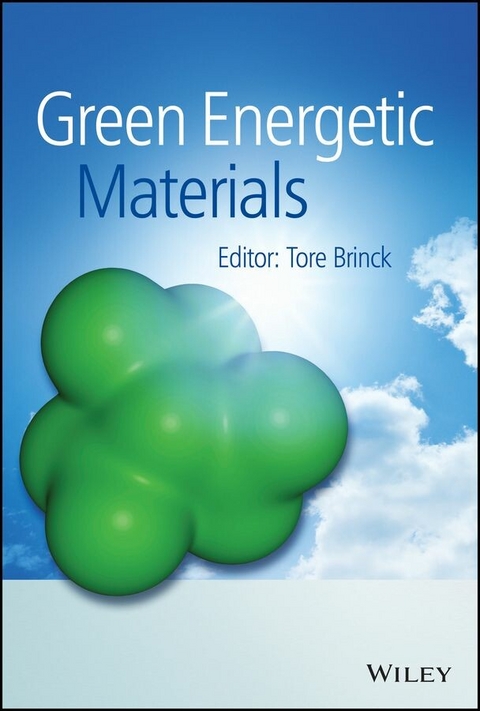
Green Energetic Materials (eBook)
304 Seiten
Wiley (Verlag)
978-1-118-67645-5 (ISBN)

Since the end of the 20th century it has been increasingly realised that the use, or production, of many energetic materials leads to the release of substances which are harmful to both humans and the environment. To address this, the principles of green chemistry can be applied to the design of new products and their manufacturing processes, to create green energetic materials that are virtually free of environmental hazards and toxicity issues during manufacturing, storage, use and disposal. Active research is underway to develop new ingredients and formulations, green synthetic methods and non-polluting manufacturing processes.
Green Energetic Materials provides a detailed account of the most recent research and developments in the field, including green pyrotechnics, explosives and propellants. From theoretical modelling and design of new materials, to the development of sustainable manufacturing processes, this book addresses materials already on the production line, as well as considering future developments in this evolving field.
Topics covered include:
- Theoretical design of green energetic materials
- Development of green pyrotechnics
- Green primary and secondary explosives
- Oxidisers and binder materials for green propellants
- Environmentally sustainable manufacturing technologies for energetic materials
- Electrochemical methods for synthesis of energetic materials and waste remediation
Green Energetic Materials is a valuable resource for academic, industrial and governmental researchers working on the development of energetic materials, for both military and civilian applications.
Professor Tore Brinck, KTH - Royal Institute of Technology, School of Chemical Science and Engineering, Sweden Tore Brinck received his Ph.D. in Chemistry in 1993 from the University of New Orleans. He was appointed full Professor of Physical Chemistry at the Royal Institute of Technology (KTH) in 2006. His research has focused on theoretical and experimental characterization of novel high energy materials. He is the author of more than 80 scientific articles.
2
Theoretical Design of Green Energetic Materials: Predicting Stability, Detection, Synthesis and Performance
Tore Brinck1 and Martin Rahm2
1Applied Physical Chemistry, School of Chemical Science and Engineering, KTH Royal Institute of Technology Sweden
2Loker Hydrocarbon Research Institute and Department of Chemistry, University of Southern California USA
2.1 Introduction
This book is a testament to the need for development of greener energetic materials. However, to be considered truly green, the material properties must be refined at many levels. For example, a potential replacement for today's solid propellant compositions should not only produce substantially less toxic waste during combustion, but also be perform better or on par with today's solutions. Reduced performance would lower payloads and increase propellant consumption, and thereby have a negative impact on the environment. There are also numerous other issues to consider. The complexity of the design problem, together with the inherit safety issues associated with the synthesis and handling of energetic materials, makes the road to progress much slower to travel without invoking rational design based on modeling and theoretical considerations. The energetic materials community has also been ground breaking in the employment of computational chemistry methods in general, and quantum chemical techniques in particular, for the design of new materials with optimized properties. However, it must be emphasized that chemical knowledge and intuition are necessary inputs to the design process, and without the contribution of chemists experienced in synthesis new compounds will never materialize.
In this chapter our main focus is on the use of computational techniques for the development of new propellant components. However, not only the techniques, but also the basic considerations, are to a great extent similar to those employed when designing other energetic materials, such as explosives and pyrotechnics.
Most propellant compositions combine an oxidizer with one or more fuel components. For example, the typical solid propellant consists of ammonium perchlorate and solid aluminum in a hydroxyl-terminated polybutadiene binder. Most common oxidizers have a rather low energy content by themselves. It is instead through the combustion of fuels, and particularly metal fuels, that a rocket motor can release energy. The combustion temperature rapidly becomes a concern with increased metal loadings, as state of the art materials used in throat and nozzles of rocket engines fail at approximately 2500 K [1]. Some modern highly aluminized propellants exhibit combustion temperatures up towards 3600 K and can only be employed together with engine designs that employ techniques such as, regenerative cooling, film cooling, or ablative protection [1,2]. Further performance increases cannot rely much further on improved engine designs and larger metal loadings, as combustion temperatures above 5000 K are considered unrealistic for practical applications. Maintaining high performance, while reducing combustion temperatures through reduced metal loadings, will require new oxidizers with higher internal energy, for example compounds with highly energetic bonds. Compounds that are able to combust themselves entirely, without the addition of a fuel, are for many purposes desirable, as they can be used with lighter and less expensive engines. We will refer to such compounds as having a neutral oxygen balance.
Good candidate compounds for green high performance propulsion are generally high in nitrogen, have a positive or neutral oxygen balance, and are free of halogens. Nitrogen-rich compounds are desirable as they release large amounts of energy upon decomposition when forming the exceedingly stable N=N triple bond of molecular nitrogen from the much weaker single and double N=N bonds of the parent molecules. Average bond energies for the triple, double, and single bonds of nitrogen are 226, 98, and 39 kcal/mol, respectively. The extraordinary relative stability of the N2 triple bond is easily realized when comparing it to the same energies for C=C bonds, which have the values 230, 146, and 83 kcal/mol.
Whereas compounds featuring a large number of N=N single bonds are desirable for their high internal energy, they generally have problems with low kinetic stability. Fundamental theory, such as the Bell–Evans–Polanyi principle [3], clearly shows that there is a general correlation between thermodynamic and kinetic stability. From a more simplistic perspective, it can be realized that the activation barrier towards dissociation is not likely to exceed the energy of the weakest bond of the molecule. A common design objective is therefore to strengthen weak N=N and N=O single bonds by invoking resonance delocalization to attain a partial double bond character. Common strategies include resonance stabilization between sp 2 hybridized nitrogen and oxygen, and aromatic stabilization in ring systems with 4n +2 π-electrons [4]. Resonance stabilization is generally a prerequisite of planar molecules. This is also of interest from a stability perspective, as planar molecules and ions are more likely to crystalize in sheet-like structures, a structure type that is believed to reduce the impact sensitivity.
Another alternative design strategy for combining high energy content (low thermodynamic stability) with sufficient kinetic stability is to utilize caged structures. Besides invoking single bonds that are high in energy, for example N=N bonds, such structures often benefit thermodynamically from strain energy. Despite the fact that a caged structure often is made up of seemingly weak bonds, the kinetic stability can be relatively high. The reason for the high decomposition barrier is usually that it is not possible to form a thermodynamically favored intermediate by breaking only one bond. Instead, the main dissociation pathway either involves several bonds breaking in one step, or passes via a high lying intermediate; both types of transformations are often associated with a high barrier. This should be taken as a general consideration for identifying energetic compounds with high kinetic stability, that is, molecules that cannot decompose to a stable intermediate via a single simple chemical transformation are likely to have a larger kinetic stability than can be anticipated from the strengths of their individual chemical bonds. In the following discussion we will provide several examples where this is the case.
It is obvious that predicting performance and stability is key to the design of green energetic materials. Traditionally, it is also in these areas that computational chemistry has played its most important role. Enthalpies of formation for gaseous molecules are readily obtained by quantum chemical methods. However, as most energetic materials are used in solid or liquid phases, methods have been developed to also calculate phase transition energetics and condensed phase densities. The kinetic stability is first approximated by evaluating the potential decomposition pathways and their barriers in the gas phase by quantum chemistry. Invoking the effects of interactions with neighboring molecules in condensed phases increases the complexity considerably, but significant progress has been made in this area too. However, the true bottleneck in obtaining new functional energetic materials has been devising synthetic routes. Here, we believe that computational chemistry has the potential to play a more important role. Potential synthetic routes can be evaluated by a similar analysis to that used for evaluating stability and decomposition pathways. Finally, we note that detection and characterization often are key issues in the discovery of highly energetic molecules of high symmetry and low molecular weight. Theoretically predicted spectra for different spectroscopies can be great aids to the process.
2.2 Computational Methods
Kohn–Sham density functional theory (KS-DFT) is today the standard quantum chemical method for the optimization of molecular geometries and calculation of vibrational frequencies. It is generally used to probe potential energy surfaces and characterize transition states. The widely used B3LYP exchange-correlation functional has also been quite successful for energetic molecules and their reactions. In general, B3LYP geometries are more accurate than energies. However, there are examples of nitro-group rich systems where B3LYP produces both erroneous geometries and energies, and for some of these the more recent M06-2X functional [5] of Truhlar and coworkers performs considerably better. A general observation is that when the two functionals give geometries in consensus, these can be trusted for energy calculations at higher level. Double zeta basis sets augmented by diffuse and polarization functions, for example 6–31+G(d,p), are recommended for geometry optimizations of energetic molecules.
In order to obtain energies that are close to chemical accuracy, post-Hartree Fock methods are generally needed. In particular, methods such as CBS-QB3 [6,7] and G3MP2 [8], that combine coupled cluster [CCSD(T)] calculations with smaller basis sets and basis set extrapolation at the MP2 level, are recommended for small and medium sized energetic molecules. Heats of formation () of new systems should not be computed via atomization energies, but rather from hypothetical reactions involving molecules with well-defined experimental gas phase heats of formations. For larger molecules, it may be necessary to resort to DFT-methods. We note that the B3LYP-based atom-equivalent parameterizations of Rice and coworkers often...
| Erscheint lt. Verlag | 15.1.2014 |
|---|---|
| Sprache | englisch |
| Themenwelt | Naturwissenschaften ► Chemie ► Technische Chemie |
| Technik ► Elektrotechnik / Energietechnik | |
| Schlagworte | Chemie • Chemistry • Design • End • Energetic • Environment • environmental • Explosives and Propellants • Explosiv- und Treibstoffe • Free • Grüne Chemie • Green • Grüne Chemie • harmful • humans • Leads • Manufacturing • many • Materials • materials processing • Materials Science • Materialverarbeitung • Materialwissenschaften • Nachhaltige u. Grüne Chemie • Nachhaltige u. Grüne Chemie • New • Principles • processes • Products • Release • substances • Sustainable Chemistry & Green Chemistry • use |
| ISBN-10 | 1-118-67645-9 / 1118676459 |
| ISBN-13 | 978-1-118-67645-5 / 9781118676455 |
| Informationen gemäß Produktsicherheitsverordnung (GPSR) | |
| Haben Sie eine Frage zum Produkt? |
 EPUB (Adobe DRM)
Größe: 4,9 MB
Kopierschutz: Adobe-DRM
Adobe-DRM ist ein Kopierschutz, der das eBook vor Mißbrauch schützen soll. Dabei wird das eBook bereits beim Download auf Ihre persönliche Adobe-ID autorisiert. Lesen können Sie das eBook dann nur auf den Geräten, welche ebenfalls auf Ihre Adobe-ID registriert sind.
Details zum Adobe-DRM
Dateiformat: EPUB (Electronic Publication)
EPUB ist ein offener Standard für eBooks und eignet sich besonders zur Darstellung von Belletristik und Sachbüchern. Der Fließtext wird dynamisch an die Display- und Schriftgröße angepasst. Auch für mobile Lesegeräte ist EPUB daher gut geeignet.
Systemvoraussetzungen:
PC/Mac: Mit einem PC oder Mac können Sie dieses eBook lesen. Sie benötigen eine
eReader: Dieses eBook kann mit (fast) allen eBook-Readern gelesen werden. Mit dem amazon-Kindle ist es aber nicht kompatibel.
Smartphone/Tablet: Egal ob Apple oder Android, dieses eBook können Sie lesen. Sie benötigen eine
Geräteliste und zusätzliche Hinweise
Zusätzliches Feature: Online Lesen
Dieses eBook können Sie zusätzlich zum Download auch online im Webbrowser lesen.
Buying eBooks from abroad
For tax law reasons we can sell eBooks just within Germany and Switzerland. Regrettably we cannot fulfill eBook-orders from other countries.
 PDF (Adobe DRM)
Kopierschutz: Adobe-DRM
Adobe-DRM ist ein Kopierschutz, der das eBook vor Mißbrauch schützen soll. Dabei wird das eBook bereits beim Download auf Ihre persönliche Adobe-ID autorisiert. Lesen können Sie das eBook dann nur auf den Geräten, welche ebenfalls auf Ihre Adobe-ID registriert sind.
Details zum Adobe-DRM
Dateiformat: PDF (Portable Document Format)
Mit einem festen Seitenlayout eignet sich die PDF besonders für Fachbücher mit Spalten, Tabellen und Abbildungen. Eine PDF kann auf fast allen Geräten angezeigt werden, ist aber für kleine Displays (Smartphone, eReader) nur eingeschränkt geeignet.
Systemvoraussetzungen:
PC/Mac: Mit einem PC oder Mac können Sie dieses eBook lesen. Sie benötigen eine
eReader: Dieses eBook kann mit (fast) allen eBook-Readern gelesen werden. Mit dem amazon-Kindle ist es aber nicht kompatibel.
Smartphone/Tablet: Egal ob Apple oder Android, dieses eBook können Sie lesen. Sie benötigen eine
Geräteliste und zusätzliche Hinweise
Buying eBooks from abroad
For tax law reasons we can sell eBooks just within Germany and Switzerland. Regrettably we cannot fulfill eBook-orders from other countries.
aus dem Bereich