Solar Cell Materials (eBook)
John Wiley & Sons (Verlag)
978-1-118-69581-4 (ISBN)
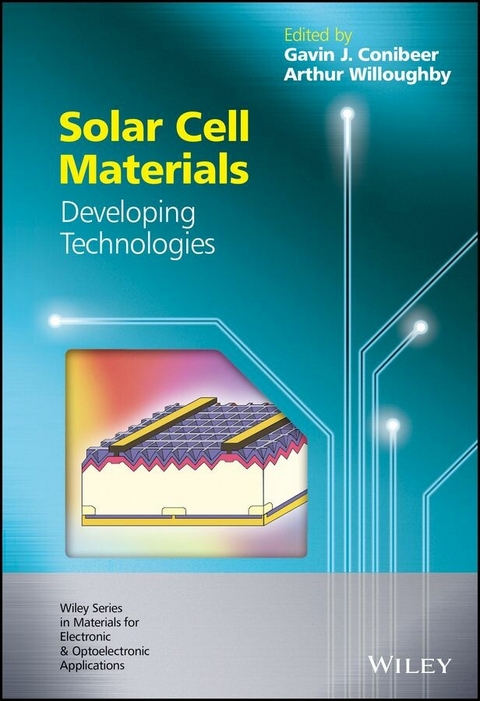
It surveys the materials and materials trends in the field including third generation solar cells (multiple energy level cells, thermal approaches and the modification of the solar spectrum) with an eye firmly on low costs, energy efficiency and the use of abundant non-toxic materials.
Dr. Gavin Conibeer is Deputy Director of the Centre of Excellence for Advanced Silicon Photovoltaics and Photonics at the University of New South Wales (UNSW, Australia). He has a BSc (Eng) and MSc (London) and received his PhD at Southampton University (UK). His research interests include third generation photovoltaics, hot carrier cooling in semiconductors, phonon dispersion modulation in nanostructures, high efficiency thermoelectric devices and photoelectrochemical generation of hydrogen. As well as numerous publications, Dr. Conibeer has also given a short course on Third Generation Photovoltaics at UNSW and a unit on Photovoltaics for the Open University (UK). Professor Arthur Willoughby is currently Professor Emeritus at the University of Southampton having retired from Southampton after many years teaching. He holds a BSc and PhD in Engineering, both from Imperial College, and was head of Engineering Materials at Southampton for more than 10 years. With research interests focussed around semiconductor materials, Arthur Willoughby is founding editor of Journal of Materials Science: Materials in Electronics for Springer as well as principal editor for Materials Letters for Elsevier. He has written multiple journal articles as well as book chapters for Springer and MRS, and is a series editor for the Wiley Series in Materials for Electronic and Optoelectronic Applications.
"All in all it is a magnificent book that I take pride in
having on my bookshelf." (Energy
Technology, 13 October 2014)
2
Fundamental Physical Limits to Photovoltaic Conversion
J.F. Guillemoles
Institut de Recherche et Développement sur l'Energie Photovoltaïque (IRDEP), France
2.1 INTRODUCTION
Where to stop the quest for better devices? What does better mean? The conversion efficiency arises prominently in this respect.
More efficient devices, everything kept equal, would first translate into cheaper solar electricity. Are there limits to reducing the cost of PV electricity? In 2012, modules were sold 0.5–0.7 €/W and the cost of solar electricity is around 20 cts/kWh. In the longer term, development of photovoltaics (PV) has to be based on a major technological breakthrough regarding the use of processes and materials at very low cost, or/and on the engineering of devices offering far higher performance, harvesting most of the available solar energy. Two approaches are targeted at this issue today: the first aims at low-cost materials and low-cost processes to reduce the surface cost of PV devices, possibly sacrificing some of the device efficiency, and the second, aiming at the maximal possible efficiency, at the same cost as today's modules (see Figure 2.1). There is a major difference between these two approaches: the conversion concepts, the materials and the processes.
Figure 2.1 Relation of the cost per watt of solar energy to the surface cost of manufacturing solar devices (modules) and the device efficiency. The light gray, dark gray, and white oval regions represent the ranges found for crystalline silicon (first-), thin-film (second-), and third-generation solar technologies, respectively. The white zone marks the anticipated range for very high efficiency devices. For comparison, limiting efficiencies derived from thermodynamic constraints are also indicated as horizontal bands (low range: no concentration, high range: maximal concentration). Stars indicate industrial production costs as they could be estimated in 2010 from available data: filled stars for c-Si modules and hollow stars for thin-film technologies. (Adapted with permission from Green, 2003. Copyright © 2003, Springer.)
If we think in terms of the manufacturing costs of PV modules, the target aimed at requires that the system needs to produce 1 MWh (comprising about 0.2 m2 of high-end c-Si modules lasting 25 yr) cost less than €30 for parity with the base load or €120 for grid parity. For a very low-cost device, for instance based on polymers or organic–inorganic hybrids, with an expectation for conversion efficiencies on a par with those achieved by the amorphous Si line (on the grounds of similar structural disorder and a low carrier mobility) and shorter life durations, the budget is €7.5/m2 (5-year life duration with 5% efficiency, including power electronics and installation), closer to the cost of structural materials than of functional electronic materials. Finally, for profitable electricity production, we need to pay attention to the system costs. Thus, one sees that it might be extremely difficult to attempt to reduce production costs far beyond what is currently being obtained with inorganic thin-film systems.
This chapter will deal with the scientific issues behind the photovoltaic conversion process, keeping in mind what would make a difference to having this technology more widely used.
The first of these questions is of course the efficiency of the processes. Since the appearance of the first PV devices, the question of the conversion efficiency limits arose, and for a good reason: not only does it have high scientific and technological visibility, it is also one of the major factors in lowering the cost of generating solar electricity. Interestingly, this question of efficiency limit took quite a bit of time before being settled [Landsberg and Badescu, 1998].
The paper of Schockley and Queisser, devising an approach based on a detailed balance approach of photovoltaic conversion is still one of the most quoted papers on PV, yielding the limit of single-junction, standard PV devices.
This question has also been approached on a more general basis, using thermodynamics (Landsberg and Tonge, 1980, Parrott 1992, De Vos 1992) to give device-independent or even process-independent limits (Section 2.1). These limits are essentially related to the source (the sun) characteristics and to the conditions of use (e.g. ambient temperature). Perhaps more useful, and practical, limits have been proposed for defined processes.
In very general terms, photovoltaic conversion in its simpler form supposes several steps:
These steps are illustrated in Figure 2.2 and describe PV process as it is working in all working devices, with nonessential modifications for organic PV (in which electron and holes are coupled as excitons) and multijunction cells (where the incident spectrum on a cell is a part of the total solar spectrum).
Figure 2.2 Photovoltaic action proceeds in 3 steps. (a) photons have to be collected and coupled to the converting system; (b) the converting systems contains occupied (VB) and empty states (CB) separated by a gap between which light induces transitions are allowed; (c) upon photon absorption, two populations of charge carriers are created; (d).
In this process, the work per absorbed photon is equal to the electromotive force between the electrodes (i.e. the voltage) times the elementary charge, that is the difference in the quasi-Fermi levels in the two contacts. In the absence of current extraction and when the mobility is high enough this quasi Fermi level (QFL) separation is that of electrons and holes in the absorber (see Section 2.4 for a more complete discussion).
Because the QFL is generated by the incoming flux, it increases with the light flux. This can also be understood as a larger generation rate per unit volume will create a larger density of electron–holes pairs, and therefore a higher conduction-band electron QFL and a lower valence-band electron QFL (that is a larger chemical potential of holes in the VB). This large QFL separation can be obtained in different ways, everything else being equal:
A large chemical potential can be seen as a large partial pressure: this helps the extraction of generated carriers and therefore a larger free energy per carrier can be collected, whereas, whatever the concentration of electron–hole pairs, their potential energy is always the same, near Eg. The collection of carriers depends on the chemical potential of the carriers in the contacts, that is, in fine, of the external conditions, and for instance the load into which the solar cell will deliver power.
The maximum power is delivered when the load impedance matches the differential impedance of the generator (as is true by the way for any generator).
Indeed, if the device has a current–voltage characteristic I(V), the power is maximum for
this yields:
(2.2)
which is the relation announced.
The current at V=0 (short-circuit) is noted Isc, while the voltage at I=0 (open circuit) is noted Voc.
One can write a relation such that:
(2.3)
where η is the efficiency, Pinc, the solar incident power and FF, the fill factor, is a number close to 0.85 and slowly dependent on the working point for an ideal cell.
Importantly, each carrier has to be collected at a specific contact, that is, ideally, the contact should be selective for one of the carriers, and prevent collection from the other. Selective contacts usually take the form of barriers for one of the contacts, as for instance in a p/n junction.
There are general relationships based on thermodynamics that fundamentally limit the efficiency of conversion of light into work. They have been discussed extensively in the literature and are presented in Section 2.2.
Photovoltaic conversion, as sketched in Figure 2.2, starts with a good coupling between the conversion device and the sun. We therefore start to explore limits to photon management. This limit is essentially given by the 2nd thermodynamic principle: a PV device does not become hotter than the sun (Section 2.2). It is then important to know how good the absorption of the material can be as this determines the dimensions and geometry of the device as its thickness has to be the best compromise between being
| Erscheint lt. Verlag | 13.1.2014 |
|---|---|
| Reihe/Serie | Wiley Series in Materials for Electronic & Optoelectronic Applications |
| Wiley Series in Materials for Electronic & Optoelectronic Applications | Wiley Series in Materials for Electronic & Optoelectronic Applications |
| Sprache | englisch |
| Themenwelt | Naturwissenschaften ► Chemie |
| Technik ► Elektrotechnik / Energietechnik | |
| Technik ► Maschinenbau | |
| Schlagworte | Analysis • Book • Classical • Classical thermodynamics • contributors • Conversion • devices • Electrical & Electronics Engineering • electricity • Electronic materials • Elektrizitätslehre • Elektrizitätslehre • Elektronische Materialien • Elektrotechnik u. Elektronik • Energie • Energy • fundamental • Introduction • Limit • Limitations • Limits • List • Materials Science • Materialwissenschaften • Physical • Physics • Physik • preface • References • series • Solar • Solarenergie u. Photovoltaik • Solar Energy & Photovoltaics • Solarzelle • Sun • xix abbreviations |
| ISBN-10 | 1-118-69581-X / 111869581X |
| ISBN-13 | 978-1-118-69581-4 / 9781118695814 |
| Informationen gemäß Produktsicherheitsverordnung (GPSR) | |
| Haben Sie eine Frage zum Produkt? |
 PDF (Adobe DRM)
Größe: 13,7 MB
Kopierschutz: Adobe-DRM
Adobe-DRM ist ein Kopierschutz, der das eBook vor Mißbrauch schützen soll. Dabei wird das eBook bereits beim Download auf Ihre persönliche Adobe-ID autorisiert. Lesen können Sie das eBook dann nur auf den Geräten, welche ebenfalls auf Ihre Adobe-ID registriert sind.
Details zum Adobe-DRM
Dateiformat: PDF (Portable Document Format)
Mit einem festen Seitenlayout eignet sich die PDF besonders für Fachbücher mit Spalten, Tabellen und Abbildungen. Eine PDF kann auf fast allen Geräten angezeigt werden, ist aber für kleine Displays (Smartphone, eReader) nur eingeschränkt geeignet.
Systemvoraussetzungen:
PC/Mac: Mit einem PC oder Mac können Sie dieses eBook lesen. Sie benötigen eine
eReader: Dieses eBook kann mit (fast) allen eBook-Readern gelesen werden. Mit dem amazon-Kindle ist es aber nicht kompatibel.
Smartphone/Tablet: Egal ob Apple oder Android, dieses eBook können Sie lesen. Sie benötigen eine
Geräteliste und zusätzliche Hinweise
Zusätzliches Feature: Online Lesen
Dieses eBook können Sie zusätzlich zum Download auch online im Webbrowser lesen.
Buying eBooks from abroad
For tax law reasons we can sell eBooks just within Germany and Switzerland. Regrettably we cannot fulfill eBook-orders from other countries.
 EPUB (Adobe DRM)
Kopierschutz: Adobe-DRM
Adobe-DRM ist ein Kopierschutz, der das eBook vor Mißbrauch schützen soll. Dabei wird das eBook bereits beim Download auf Ihre persönliche Adobe-ID autorisiert. Lesen können Sie das eBook dann nur auf den Geräten, welche ebenfalls auf Ihre Adobe-ID registriert sind.
Details zum Adobe-DRM
Dateiformat: EPUB (Electronic Publication)
EPUB ist ein offener Standard für eBooks und eignet sich besonders zur Darstellung von Belletristik und Sachbüchern. Der Fließtext wird dynamisch an die Display- und Schriftgröße angepasst. Auch für mobile Lesegeräte ist EPUB daher gut geeignet.
Systemvoraussetzungen:
PC/Mac: Mit einem PC oder Mac können Sie dieses eBook lesen. Sie benötigen eine
eReader: Dieses eBook kann mit (fast) allen eBook-Readern gelesen werden. Mit dem amazon-Kindle ist es aber nicht kompatibel.
Smartphone/Tablet: Egal ob Apple oder Android, dieses eBook können Sie lesen. Sie benötigen eine
Geräteliste und zusätzliche Hinweise
Buying eBooks from abroad
For tax law reasons we can sell eBooks just within Germany and Switzerland. Regrettably we cannot fulfill eBook-orders from other countries.
aus dem Bereich