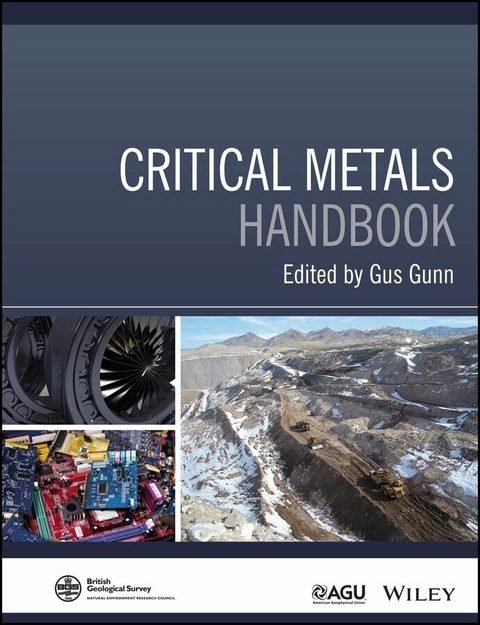
Mankind is using a greater variety of metals in greater quantities than ever before. As a result there is increasing global concern over the long-term availability of secure and adequate supplies of the metals needed by society. Critical metals, which are those of growing economic importance that might be susceptible to future scarcity, are a particular worry. For many of these we have little information on how they are concentrated in the Earth's crust, how to extract them from their ores, and how to use, recycle and dispose of them effectively and safely.
Published with the British Geological Survey, the Critical Metals Handbook brings together a wealth of knowledge on critical metals and provides a foundation for improving the future security and sustainability of critical metal supplies. Written by international experts, it provides a unique source of authoritative information on diverse aspects of the critical metals, including geology, deposits, processing, applications, recycling, environmental issues and markets. It is aimed at a broad non-specialist audience, including professionals and academics working in the exploration and mining sectors, in mining finance and investment, and in mineral processing and manufacturing. It will also be a valuable reference for policy makers concerned with resource management, land-use planning, eco-efficiency, recycling and related fields.
Gus Gunn is a principal research scientist at the British Geological Survey in Nottingham, UK. He has spent his entire career, starting in 1975, working in mineral exploration and mineral deposits research. Since 2009 his main focus has been on critical metals and on the development of strategies to ensure their long-term security of supply.
Gus Gunn is a principal research scientist at the British Geological Survey in Nottingham, UK. He has spent his entire career, starting in 1975, working in mineral exploration and mineral deposits research. Since 2009 his main focus has been on critical metals and on the development of strategies to ensure their long-term security of supply.
List of Contributors, xi
Acknowledgements, xiii
1 Metal resources, use and criticality, 1
T.E. Graedel, Gus Gunn and Luis Tercero Espinoza
2 The mining industry and the supply of critical minerals,20
David Humphreys
3 Recycling of (critical) metals, 41
Christian Hagelüken
4 Antimony, 70
Ulrich Schwarz-Schampera
5 Beryllium, 99
David L. Trueman and Phillip Sabey
6 Cobalt, 122
Stephen Roberts and Gus Gunn
7 Gallium, 150
Thomas Butcher and Teresa Brown
8 Germanium, 177
Frank Melcher and Peter Buchholz
9 Indium, 204
Ulrich Schwarz-Schampera
10 Lithium, 230
Keith Evans
11 Magnesium, 261
Neale R. Neelameggham and Bob Brown
12 Platinum-group metals, 284
Gus Gunn
13 Rare earth elements, 312
Frances Wall
14 Rhenium, 340
Tom A. Millensifer, Dave Sinclair, Ian Jonasson and AnthonyLipmann
15 Tantalum and niobium, 361
Robert Linnen, David L. Trueman and Richard Burt
16 Tungsten, 385
Teresa Brown and Peter Pitfield
Appendices, 414
Glossary of technical terms, 419
Index, 431
"In general, this is an excellent edition, with high quality figures, readable tables, clearly written texts, well-organized structure, and precisely aimed at a broad range of non-specialists in policy, environment pollution, remediation, and economy domains; but professionals and researchers working in exploration and mining sectors, including mining finance and investment, as well as in mineral processing and manufacturing, will be greatly satisfied to have this Handbook on their bookshelves." (Pure Appl. Geophys, 1 January 2015)
"This is a highly recommended volume for anyone with an interest in the economics of the critical metals and their basic geology and mineralogy; it also belongs in any major earth sciences library. As these commodities have grown in importance during the past decade, bits and pieces of relevant material have been made available in various articles and government reports, but this is the first volume out the door to comprehensively bring all this material together, and it is a welcomed, well-produced, and data-rich book." Economic Geology, July 2014
2. The mining industry and the supply of critical minerals
DAVID HUMPHREYS
Independent Consultant, London, UK
Mineral products are bought for their utility, this utility being reflected in the price which consumers are prepared to pay for them. Properly functioning markets should ensure that an appropriate supply of such products is available to meet consumer demand. A shortage of the sought-after mineral serves to push prices up and stimulate companies to invest in new production capacity. A surfeit of supply leads to a fall in price and a curtailment of output.
The issue of a mineral’s ‘criticality’ enters into the equation because the global economy is composed not just of companies and consumers but also of nations, and nations have strategic interests. Within the broader, strategic, context, mineral products are viewed not only as having utility to consumers but also in terms of the contribution they make to national projects, such as raising the living standards of the nation’s citizens, maintaining a capability to produce certain important industrial goods, or ensuring that the nation has the ability to defend itself militarily. In making the transition from being simply ‘useful’ to being ‘critical’, minerals and their supply become not just matters for the market but also matters of national security. The process of transition is thus often referred to as ‘securitisation’.
The role played by the mining industry in meeting the demand for minerals is subject to a similar duality. The economic function of mining companies is to respond to the requirements of the market, as expressed through mineral prices. For the most part, the industry does this quite effectively. The industry has always had a strong enterprise culture and rising mineral prices can usually be relied upon to prompt mining and exploration companies to develop mines and search for new mineral deposits.
As with mineral consumers, producers operate in a national setting. National authorities are responsible for establishing the legal, fiscal and environmental parameters within which mining companies work. However, like consuming nations, producing nations have strategic objectives. In this context, mining may be perceived as a vehicle for the promotion of broader objectives such as economic development, the reduction of poverty or the assertion of national self-determination. In a direct parallel with the process of securitisation in consuming countries, the assertion of these strategic priorities results in the politicisation of the mineral products and conditions the ability of the mining industry to respond to market signals and thus to supply the minerals that consumers require.
This chapter is divided into five sections. The first looks at the mining industry and its major corporate components, the miners and explorers. The second discusses how the mining industry responds to the demand for minerals and to changes in the level of demand. The third examines the factors which inhibit the mining industry’s responses to changes in demand. The fourth looks at some of the specific issues posed for miners by the minerals currently deemed ‘critical’ and at the role of China in mineral markets. The fifth considers some of the things that governments of consuming countries can do to promote the supply responsiveness of the mining industry.
Table 2.1 World’s largest mining companies by market capitalisation, mid-March 2013. (Data from author’s estimates based on web sources.)
Suppliers of minerals – miners and explorers
The mining industry exists to meet the mineral requirements of consumers and, in so doing, make profits for shareholders. Although not on the scale of the oil and gas industries, the mining industry is, nevertheless, a very large industry. The enterprise value1 of the global mining industry in 2010 is estimated to have been around US$2100 billion (Citi, 2011a). London lies right at the heart of this industry, and is host to the headquarters of several of the world’s largest mining companies. As of March 2013, there were thirteen mining and metals companies in the FTSE 100 having a combined market capitalisation of US$340 billion, 12.7 per cent of the total value of the FTSE100 (FTSE, 2013). Seven years earlier, the share was six per cent.
The structure of the global mining industry today is the product of a long and complex history. The largest and most publicly visible companies are the so-called ‘global diversified miners’, or mining ‘majors’. These are, by any standards, large companies, operating across many geographies and minerals. Following a period of consolidation during the first decade of the century, this group currently comprises BHP Billiton, Vale, Rio Tinto, Anglo American and Xstrata.2 The market capitalisation of the world’s largest mining companies is shown in Table 2.1. The country indicated is the country of the company’s primary stock market listing. The table, it should be noted, excludes aluminium companies, this because most of the value of aluminium, like steel, is created through metallurgical processing rather than through mining.
At the next level down in terms of scale, companies tend to be more focused with respect to either commodity or country. Freeport McMoRan, Grupo Mexico and Antofagasta, for example, are focused on copper, while Barrick Gold, Goldcorp and AngloGold Ashanti are, as their names suggest, focused on the production of gold. Companies which produce a variety of products, but which operate predominantly in one country, include several from the former Soviet Bloc, most notably Norilsk Nickel, but also Kazakhmys and ENRC (Eurasian Natural Resources Corp.) which fall just outside the top twenty companies listed.
Most of the world’s largest miners, and all of those in Table 2.1, are public companies, quoted on stock markets (from which their market capitalisations are derived). There are, in addition, a few mining companies comparable in the scale of their mineral output to those listed in the table which are either wholly or predominantly owned by the state. These include the world’s largest copper producer, Codelco, which is owned by the state of Chile, and a handful of Chinese companies such as China Shenhua, Yanzhou Coal, China Minmetals Corporation (Minmetals), Chinalco, Metallurgical Corporation of China, (MCC) China Nonferrous Metal Mining Corp. (CNMC) and the Jinchuan Group. Although production from state-owned enterprises is significant and growing, the extent of state ownership in mining is still very much less than is the case with oil and gas.
Beyond the larger and mid-sized mining companies, there are huge numbers of smaller miners, ranging from quoted companies with two or three mines to small family enterprises. Some produce for international markets and some just for local markets. The nature of the mineral product and the form of its occurrence play an important part in determining what products such producers focus on. Small miners do not generally try to compete in mineral markets where producers need scale economies and correspondingly large capital outlays, like iron ore. They can, however, operate in markets where demand is small or where ore deposits can be worked on a relatively small scale, like precious metals or semi-precious stones. At the extreme end of this part of the industry are the artisanal miners. These are very small, maybe even part-time, operators, recovering minerals that can be easily mined near surface (such as alluvial gold, tin, tantalum and diamonds) using very little capital. Such production activity is commonly lightly regulated or indeed wholly unregulated, with miners operating under very basic, and often unsafe and environmentally unsound, conditions. Artisanal mines do, nonetheless make a significant, if not always terribly reliable, contribution to the supply of several critical minerals.
The other key players in the mineral supply equation are exploration companies. This is the entrepreneurial end of the business – the equivalent of technology start-ups – the end where small companies go out to find mineral deposits in the hope either of being able to mine them themselves or else (and more often) sell them on at a good profit to a larger company for development. Since exploration can create enormous value for shareholders, turning what might otherwise be a fairly worthless piece of land into a profitable business opportunity, exploration companies have a strong pioneering quality. The highest rewards typically go to those with innovative ideas about ore genesis (an example might be those which uncovered significant diamond resources in Canada) or which are prepared to go looking in remote and difficult places. By the same token, exploration is also an extremely high-risk activity, and much exploration ends in failure and in investors losing their money.
Accordingly, exploration companies have their own particular economics and their own specialist investors. Banks, which might well be interested in helping a mining company with proven mineral reserves to finance the construction of a mine, are not generally interested in financing exploration. Exploration companies therefore tend to have to rely on equity (i.e. stock market) financing for their activities or on the support of large private investors. Some stock markets specialise in the provision of this sort of financing, notably the Toronto stock...
| Erscheint lt. Verlag | 6.1.2014 |
|---|---|
| Reihe/Serie | Wiley Works |
| Wiley Works | Wiley Works |
| Sprache | englisch |
| Themenwelt | Naturwissenschaften ► Geowissenschaften ► Geologie |
| Technik | |
| Schlagworte | adequate • Angewandte u. ökonomische Geologie • Angewandte u. ökonomische Geologie • Availability • concentrated • concern • earth sciences • earths crust • economic • Economic & Applied Geology • Geochemie, Mineralogie • Geochemistry & Minerology • Geologie u. Geophysik • Geology & Geophysics • Geowissenschaften • Global • greater • growing • importance • increasing • Information • Little • longterm • mankind • many • metals • particular • quantities • result • Rohstoff • Scarcity • secure • susceptible • variety |
| ISBN-13 | 9781118755211 / 9781118755211 |
| Informationen gemäß Produktsicherheitsverordnung (GPSR) | |
| Haben Sie eine Frage zum Produkt? |
 EPUB (Adobe DRM)
Kopierschutz: Adobe-DRM
Adobe-DRM ist ein Kopierschutz, der das eBook vor Mißbrauch schützen soll. Dabei wird das eBook bereits beim Download auf Ihre persönliche Adobe-ID autorisiert. Lesen können Sie das eBook dann nur auf den Geräten, welche ebenfalls auf Ihre Adobe-ID registriert sind.
Details zum Adobe-DRM
Dateiformat: EPUB (Electronic Publication)
EPUB ist ein offener Standard für eBooks und eignet sich besonders zur Darstellung von Belletristik und Sachbüchern. Der Fließtext wird dynamisch an die Display- und Schriftgröße angepasst. Auch für mobile Lesegeräte ist EPUB daher gut geeignet.
Systemvoraussetzungen:
PC/Mac: Mit einem PC oder Mac können Sie dieses eBook lesen. Sie benötigen eine
eReader: Dieses eBook kann mit (fast) allen eBook-Readern gelesen werden. Mit dem amazon-Kindle ist es aber nicht kompatibel.
Smartphone/Tablet: Egal ob Apple oder Android, dieses eBook können Sie lesen. Sie benötigen eine
Geräteliste und zusätzliche Hinweise
Buying eBooks from abroad
For tax law reasons we can sell eBooks just within Germany and Switzerland. Regrettably we cannot fulfill eBook-orders from other countries.
aus dem Bereich