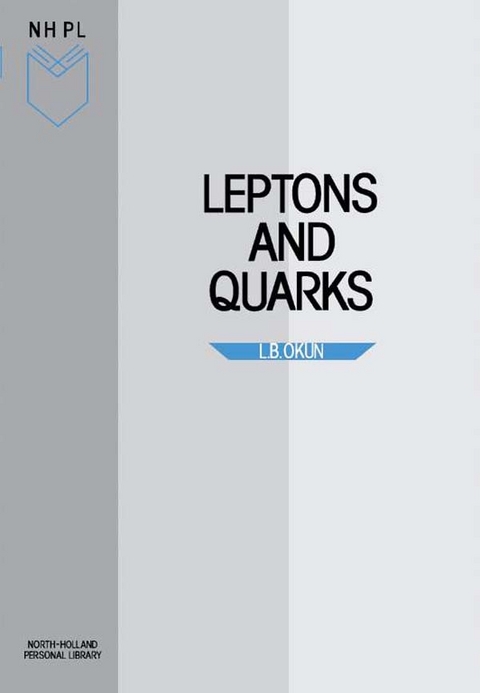
Leptons and Quarks (eBook)
362 Seiten
Elsevier Science (Verlag)
978-0-444-59621-5 (ISBN)
This book comprises an introduction to the theory of the weak interaction of elementary particles.The author outlines the current situation in weak interaction theory and discusses the prospects for the coming decade. The reader is familiarized with simple theoretical techniques for the calculation of decay rates, interaction cross-sections and angular and spin correlations.
Introduction
Publisher Summary
This chapter outlines the theory of weak interactions of elementary particles. The standard theory of weak interactions is based on the analogy with the electromagnetic interaction that is produced by the electromagnetic current coupled to the photon. Moreover, in contrast to stronger interactions, namely the strong and electromagnetic, the weak interaction violates a number of conservation laws. It presents an introduction to the quark currents and the color of weak currents. According to quark theory, all known hadrons consist of quarks, which are of five types—u, d, s, c, and b. However, the theoretical arguments point to the existence of a sixth quark—t so that in analogy to the six leptons, the six quarks form three pairs. There are no neutral currents transforming quarks of one type into quarks of a different type. The chapter explains that quarks are characterized by color. It describes various currents and process discussed in the quark theory. There are 12 charged currents coupled to W-bosons and 12 neutral currents coupled to Z-bosons.
The weak interaction is responsible for a large number of physical processes: nuclear β-decay, numerous decays of elementary particles, reactions induced by neutrinos from accelerators and nuclear reactors, and also some subtle effects involving parity violation in γ-decays of nuclei and in atomic optical spectra. All known leptons and hadrons are subject to the weak interaction. It plays an important role in such astrophysical phenomena as the sun’s burning and supernova explosions. Some of the weak processes were already put to use (for example, the angular asymmetry in the muon decay is a promising new tool in chemistry). Mainly, however, our interest in the weak interaction is rooted not in its possible applications but in the hope that its study will ultimately yield a unified theory of elementary particles and of the interactions between them. And although it would be very difficult today to predict any practical consequences of such a unified theory, there can be no doubt of their utmost importance.
In contrast to “stronger” interactions, namely the strong and electromagnetic, the weak interaction violates a number of conservation laws. Among the quantum numbers that are not conserved are, space parity P, charge conjugation parity C, combined inversion parity CP, strangeness, charm, and some others.
The standard theory of weak interactions is based on the analogy with the electromagnetic interaction which is produced by the electromagnetic current coupled to the photon (see fig. 1.1). Likewise, the weak interaction is postulated to result from weak currents being coupled to the so-called intermediate bosons W+, W−, Z. Intermediate bosons have not yet been found experimentally; however, this does not point to a defect in the theory since the expected masses are of the order of 100 GeV, the energies of the existing accelerators being well below their production thresholds. The W+ and W− bosons are coupled to charged currents which change the charges of particles involved. Such are the currents and their hermitian conjugate currents The last two currents, for instance, interact by exchanging a virtual W-boson and yield the muon decay (fig. 1.2). The Z0 bosons are created by neutral currents of the types , and so on, involving identical ingoing and outgoing particles. Neutral currents are responsible, for example, for the scattering (fig. 1.3). Both the charged and the neutral currents include a leptonic and a hadronic part. At present we know six leptons which are naturally grouped into three pairs:
Fig. 1.1
Fig. 1.2
Fig. 1.3
so that each lepton has its neutrino counterpart. Each lepton enters the charged current j with the appropriate neutrino:
This current emits W+ bosons and absorbs W− bosons. The hermitian conjugate current j+
emits W− bosons and absorbs W+ bosons. The neutral leptonic current contains six terms:
The two leptonic currents given above are responsible for the processes involving both leptons and antileptons This follows from the properties of the relevant operators. For example, the operator ē creates an electron and annihilates a positron, while the operator e creates a positron and annihilates an electron. Operators of other particles act in a similar manner.
1.1 Quark currents
Hadrons are represented in weak currents by quarks. According to quark theory, all known hadrons consist of quarks of five types (five flavors): u, d, s, c and b. Theoretical arguments, however, point to the existence of a sixth quark t, so that in analogy to the six leptons, the six quarks form three pairs:
We recall that the charges of quarks u, c, and t are , and those of quarks d, s, and b are The quark structure is uud for the proton, udd for the neutron, for the π+ meson, and so on. Strange particles include s-quarks (for instance, ), and charmed particles include c-quarks (for example, ). Particles with hidden charm, such as the meson, are represented by . The structure of the -meson is .
No hadrons with single b-quarks have so far been found, and only very scant indirect information is available on the weak interaction of the b- and t-quarks (see Chapter 15). Our knowledge of the first two pairs of quarks is, on the other hand, quite substantial. We know, first of all, that a quark may enter charged currents both with its paired partner and with a partner from another pair. For instance, in addition to the currents and , the current exists as well. If it did not, strange particles would be absolutely stable whereas in fact they undergo decays; for example, the current is responsible for neutron decay (fig 1.4), while the current is responsible for the decay of the Λ-hyperon (fig. 1.5).
Fig. 1.4
Fig. 1.5
If it is assumed that each of the upper quarks can go over to any of the lower quarks, then in the general case the charged hadronic current jh must contain nine terms: the picture is similar for the picture is similar for the hermitian conjugate current As for the neutral hadronic current , it must have six terms: . There are no neutral currents transforming quarks of one type into quarks of a different type, such as , and so on (see Chapter 2).
1.2 On the color of weak currents
In addition to flavor, quarks are characterized by color. The same flavor characterizes three non-identical quarks differing in a quantum number quoted as color, so that we shall refer to yellow (y), blue (b), and red (r) u-quarks, d-quarks, and so on. The total number of quarks is therefore 18. Physical hadrons are singlets in color space, and are termed colorless or white. Color symmetry is absolute, and weak quark currents are, just as hadrons, white. This means, for example, that is in fact a sum of three terms:
where suffices 1, 2, 3 stand for yellow, blue, and red colors, respectively. The same is true for other quark currents. Hereafter, unless stated otherwise, summation over color suffices in quark currents is omitted.
1.3 Currents and processes
The theory thus contains twelve charged currents coupled to W-bosons (see fig. 1.6) and twelve neutral currents coupled to Z-bosons (fig. 1.7). Underlined in figs. 1.6 and 1.7 are the currents verified by experiment.
Fig. 1.6
Fig. 1.7
A symbol du in fig. 1.6 denotes either the current u or the hermitian conjugate current d; the same is true for other currents in this figure. In some cases this condensed notation proves convenient.
As each of the twelve currents can interact with each current of the diagram, the total number of possible interactions must equal 78 both for fig. 1.6 and for fig. 1.7. So far only fourteen such current × current interactions are experimentally detected for charged currents, and seven for neutral ones. Let us make a list of these interactions, indicating in square brackets the processes in which they are experimentally observed. These processes are usually classified into three groups: pure leptonic, semi-leptonic (involving both leptons and hadrons), and non-leptonic (involving hadrons only). Four leptonic, seven semi-leptonic, and three non-leptonic interactions were found for charged currents:
(Where the subscripts of neutrinos and the antiparticle bar − were not essential, they were dropped in order to avoid overloading the formulas).
In the case of neutral currents, two leptonic, four semi-leptonic, and three non-leptonic interactions were found:
In two of the above cases, the same physical phenomenon results both from charged and from neutral currents. These are the scattering process , and the nuclear parity-violating interaction between nucleons. A special analysis is required to separate the contributions of charged and neutral currents to these processes.
Each of the 156 interactions...
| Erscheint lt. Verlag | 10.5.2013 |
|---|---|
| Sprache | englisch |
| Themenwelt | Naturwissenschaften ► Physik / Astronomie ► Atom- / Kern- / Molekularphysik |
| Naturwissenschaften ► Physik / Astronomie ► Quantenphysik | |
| Technik | |
| ISBN-10 | 0-444-59621-6 / 0444596216 |
| ISBN-13 | 978-0-444-59621-5 / 9780444596215 |
| Informationen gemäß Produktsicherheitsverordnung (GPSR) | |
| Haben Sie eine Frage zum Produkt? |
 EPUB (Adobe DRM)
Kopierschutz: Adobe-DRM
Adobe-DRM ist ein Kopierschutz, der das eBook vor Mißbrauch schützen soll. Dabei wird das eBook bereits beim Download auf Ihre persönliche Adobe-ID autorisiert. Lesen können Sie das eBook dann nur auf den Geräten, welche ebenfalls auf Ihre Adobe-ID registriert sind.
Details zum Adobe-DRM
Dateiformat: EPUB (Electronic Publication)
EPUB ist ein offener Standard für eBooks und eignet sich besonders zur Darstellung von Belletristik und Sachbüchern. Der Fließtext wird dynamisch an die Display- und Schriftgröße angepasst. Auch für mobile Lesegeräte ist EPUB daher gut geeignet.
Systemvoraussetzungen:
PC/Mac: Mit einem PC oder Mac können Sie dieses eBook lesen. Sie benötigen eine
eReader: Dieses eBook kann mit (fast) allen eBook-Readern gelesen werden. Mit dem amazon-Kindle ist es aber nicht kompatibel.
Smartphone/Tablet: Egal ob Apple oder Android, dieses eBook können Sie lesen. Sie benötigen eine
Geräteliste und zusätzliche Hinweise
Buying eBooks from abroad
For tax law reasons we can sell eBooks just within Germany and Switzerland. Regrettably we cannot fulfill eBook-orders from other countries.
aus dem Bereich