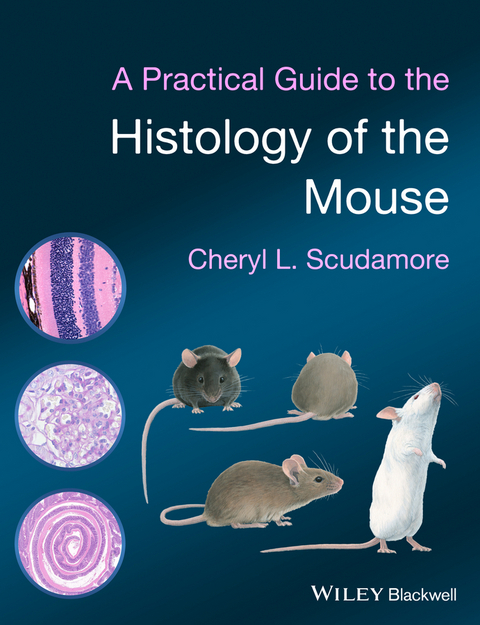
A Practical Guide to the Histology of the Mouse (eBook)
John Wiley & Sons (Verlag)
978-1-118-78947-6 (ISBN)
This book is aimed at veterinary and medical pathologists who are unfamiliar with mouse tissues and scientists who wish to evaluate their own mouse models. It provides practical guidance on the collection, sampling and analysis of mouse tissue samples in order to maximize the information that can be gained from these tissues. As well as illustrating the normal microscopic anatomy of the mouse, the book also describes and explains the common anatomic variations, artefacts associated with tissue collection and background lesions to help the scientist to distinguish these changes from experimentally- induced lesions.
This will be an essential bench-side companion for researchers and practitioners looking for an accessible and well-illustrated guide to mouse pathology.
- Written by experienced pathologists and specifically tailored to the needs of scientists and histologists
- Full colour throughout
- Provides advice on sampling tissues, necropsy and recording data
- Includes common anatomic variations, background lesions and artefacts which will help non-experts understand whether histologic variations seen are part of the normal background or related to their experimental manipulation
Cheryl L Scudamore is currently Head of Pathology at Mary Lyon Centre, MRC Harwell and an Honorary Professor in Experimental Pathology at the Royal Veterinary College. She has worked extensively as a pathologist in academia and industry in the UK and is known for her interest in and promotion of postgraduate training in laboratory animal pathology and histological techniques.
Cheryl L Scudamore is currently Head of Pathology at Mary Lyon Centre, MRC Harwell and an Honorary Professor in Experimental Pathology at the Royal Veterinary College. She has worked extensively as a pathologist in academia and industry in the UK and is known for her interest in and promotion of postgraduate training in laboratory animal pathology and histological techniques.
"Overall this is a clearly written and well
illustrated guide to the histology of the mouse, but also goes a
step further by providing information on selected techniques,
background pathology, potential artefacts and additional procedures
associated with the examination of this commonly used laboratory
species. It should prove a useful reference for any scientist
examining mice as part of their work or research."
(BTS News, 1 September 2014)
"The hardcover earns a recommendation as a practical
addition to a reference library through the text's succinct
coverage of a complex topic to illustrate the basic histopathology
of the mouse." (Veterinary Pathology, 31 October
2014)
Chapter 2
Practical approaches to reviewing and recording pathology data
Cheryl L. Scudamore
Mary Lyon Centre, MRC Harwell, UK
Pathology is often thought of as a descriptive subject generating observational data in the form of a narrative report (Holland 2011). This is based on the approach that is commonly used in diagnostic pathology where a pathology report comprises a paragraph describing the morphological features of any findings present usually for a single or limited number of tissues from one patient. The report will conclude with a diagnosis and often some prognostic interpretation. This is the commonly used approach familiar to most conventionally trained veterinary and medical diagnostic pathologists reporting on necropsy (macroscopic post mortem observations and follow up microscopic samples) or biopsy (microscopic preparations) material. In experimental pathology, the scientist or pathologist will usually be evaluating a large number of tissues from many animals and will be looking for differences in the incidence and severity of any changes present. A descriptive approach to pathology reporting can be used in this situation but it leads to the generation of qualitative and ordinal data, which can be difficult to manipulate and analyse statistically (Table 2.1). In addition, if consistent lesion terminology is not rigorously applied it can be very difficult to compare individual or groups of animals. Narrative descriptions are also time consuming to produce and can significantly slow down the reporting of experimental results and so more simplified and efficient approaches are needed for experimental pathology.
Table 2.1 Comparison of diagnostic and experimental approaches to reporting pathology data adapted from Holland 2011.
| Diagnostic approach | Experimental approach |
| Expecting to find pathology to support a ‘diagnosis’ | No expectation of identifying specific findings. Testing an hypothesis |
| Pathologist ‘compares’ findings with historical memory | In addition pathologist compares findings with concurrent controls |
| Uses knowledge of similar lesions in same species/strain or different species (e.g. from the literature and previous experience) | Also uses knowledge from concurrent controls and historical controls from similar strain |
| May produce a definitive, differential diagnosis or a diagnosis based on exclusion | Result is a list of difference between controls and treatment group animals |
| Rarely peer reviewed, but may request second opinion | Often peer reviewed (toxicological pathology) |
| Qualitative narrative report | Semiquantitative data presented in form of incidence and severity tables |
| No statistical analysis required or feasible | Statistical analysis is feasible and may be applied/necessary |
Two approaches can be used to help generate data more quickly from pathology specimens and in a form that can be more easily statistically manipulated. The first technique is to use standardized terminology for the description of lesions and the second is to apply some form of scoring or quantitative methodology to enrich the data. These approaches also help to ensure the quality of pathology data, which can be evaluated using three parameters: thoroughness, accuracy and consistency (Shackleford et al. 2002). ‘Thoroughness’ relates to the recording of all observations including background lesions and requires that the pathologist or scientist is aware of the range of normal anatomical and histological appearances of tissues. Observations or ‘findings’ can include anatomical variations, such as ectopic splenic nodules, physiological changes, such as those seen in the reproductive tract during the oestrus cycle, or background lesions, which are nonanatomical changes commonly seen in a given species, strain or age of animals (McInnes 2011a). Correctly recognizing changes equates to ‘accuracy’ and requires a familiarity with, and understanding of, the pathological changes that may occur, which can be aided by reference to the available published glossaries and nomenclatures. Consistency refers both to the correct use of terms for any given finding and the application of comparable terms for severity each time—that is, the use of a grading or quantitation system if required. The usefulness of these techniques are also greatly assisted by consistent sample selection and tissue trimming patterns.
2.1 Sample selection and trimming patterns
In any experimental system there is a necessity for controls and defined protocols to ensure repeatable and valid results. Histology is no different from any other laboratory technique in this respect and standardization of tissue sampling, trimming and sectioning greatly improves the quality and reproducibility of data that can be obtained from tissue sections. Consistent presentation of tissue sections on slides also reduces the amount of time taken to read the slides, reduces pathologist fatigue and reduces the risk of lesions being missed. For any given study a subset of tissues of interest will usually be identified in advance and harvested systematically at necropsy (Chapter 1). Once adequately fixed, tissue samples must then be selected, trimmed and embedded prior to sectioning. Standardization of the site of tissue to be sampled, amount of tissue to be evaluated and orientation of the tissue to be sectioned all help to improve consistency. The specific requirements of the study will determine what tissue type is examined but in general the probability of observing a specific lesions relates to how much tissue is examined. In practice the amount of tissue that is examined is inevitably constrained by the costs of histology and pathologist time and so, in practice, it is useful to have standardized techniques that maximize the chances of identifying lesions while minimizing the cost. Published guides for sampling and trimming most mouse tissues are available (Ruehl-Fehlert et al. 2003; Kittel et al. 2004; Morawietz et al. 2004) but it may be useful to produce in-house guides that detail the requirements of a specific study (Figure 2.1).
Figure 2.1 Example of a pictorial guide for identification of organ at necropsy and sampling of tissue for histology.
A tissue trimming guide should include:
- tissue to be sampled;
- site of sampling—may specify region, such as kidney cortex or liver lobe;
- number of samples—for example, single section, multiple sections from different lobes/areas;
- plane of sampling—cross section or longitudinal;
- size of sample;
- orientation of tissue in block—for example, which tissue or region is closest to slide label or which face of the tissue (up or down) is sectioned of the tissue;
- whether left or right samples should be identified separately—for example, unilateral lesions;
- separation of tissues that look the same when fixed/processed—for example, identification of the individual lymph nodes.
There is often a temptation to try to reduce costs by presenting as many tissues as possible in a single wax block. This is often a false economy as tissues may be lost or poorly orientated and the blocks may be more difficult for histologists to produce. The numbers of wax blocks that are needed can be reduced by grouping tissues of similar density into a single block—for example, liver, kidney, spleen and thymus (an example is given in Table 2.2). For complex or very small tissues, such as eyes, ovary, pituitary and adrenal glands, it may be difficult to orientate tissues to get representative sections of all the tissue components if they are blocked with other tissues, for example to achieve a good section of adrenal cortex and medulla it is best to place the adrenals in a separate cassette. Specific regions of intestine may be difficult to identify, particularly when modified by pathological changes and so the embedding schedule should be organized to aid identification. This can be achieved through a number of approaches, including placing the different sections of small or large intestinal regions that have histological similarities in separate blocks (see Table 2.2), using cassette dividers to separate tissues or ensuring that tissues are always orientated in a set pattern on the slide. Hard tissues which have been decalcified will also be better in a separate block as it is hard to section tissues of different densities without creating artefacts such as folds and wrinkles (McInnes 2011b).
Table 2.2 Example of a blocking pattern for full phenotypic evaluation of mouse tissues. Blocks 1–15 give a good overview of tissues and 16–19 are advisable for completeness. LS = longitudinal section. TS = transverse section (Kittel et al. 2004; Moraweitz et al. 2004; Ruehl-Fehlert et al. 2004). More detailed guidance for specific investigations of individual organs is provided in the relevant chapters.
| Block number | Tissues | Orientation/comments |
| 1 | Thymus, mesenteric lymph node, salivary glands | Thymus—representative LS sample Mesenteric lymph... |
| Erscheint lt. Verlag | 24.12.2013 |
|---|---|
| Sprache | englisch |
| Themenwelt | Studium ► 1. Studienabschnitt (Vorklinik) ► Histologie / Embryologie |
| Naturwissenschaften ► Biologie ► Mikrobiologie / Immunologie | |
| Naturwissenschaften ► Biologie ► Zoologie | |
| Schlagworte | Analysis • BEnefiT • biomedical • Biowissenschaften • Cell & Molecular Biology • Disease • extensively • fullcolour atlas • Guide • histologic • Histologie • Histology • hundreds • Life Sciences • many • Maus • Medical Science • Medizin • Models • Mouse • mouse tissues • New • Pathologists • phenotypic • Practical • provides • Research • Review • scientists • Tissues • year • Zell- u. Molekularbiologie |
| ISBN-10 | 1-118-78947-4 / 1118789474 |
| ISBN-13 | 978-1-118-78947-6 / 9781118789476 |
| Informationen gemäß Produktsicherheitsverordnung (GPSR) | |
| Haben Sie eine Frage zum Produkt? |
 PDF (Adobe DRM)
Größe: 15,5 MB
Kopierschutz: Adobe-DRM
Adobe-DRM ist ein Kopierschutz, der das eBook vor Mißbrauch schützen soll. Dabei wird das eBook bereits beim Download auf Ihre persönliche Adobe-ID autorisiert. Lesen können Sie das eBook dann nur auf den Geräten, welche ebenfalls auf Ihre Adobe-ID registriert sind.
Details zum Adobe-DRM
Dateiformat: PDF (Portable Document Format)
Mit einem festen Seitenlayout eignet sich die PDF besonders für Fachbücher mit Spalten, Tabellen und Abbildungen. Eine PDF kann auf fast allen Geräten angezeigt werden, ist aber für kleine Displays (Smartphone, eReader) nur eingeschränkt geeignet.
Systemvoraussetzungen:
PC/Mac: Mit einem PC oder Mac können Sie dieses eBook lesen. Sie benötigen eine
eReader: Dieses eBook kann mit (fast) allen eBook-Readern gelesen werden. Mit dem amazon-Kindle ist es aber nicht kompatibel.
Smartphone/Tablet: Egal ob Apple oder Android, dieses eBook können Sie lesen. Sie benötigen eine
Geräteliste und zusätzliche Hinweise
Zusätzliches Feature: Online Lesen
Dieses eBook können Sie zusätzlich zum Download auch online im Webbrowser lesen.
Buying eBooks from abroad
For tax law reasons we can sell eBooks just within Germany and Switzerland. Regrettably we cannot fulfill eBook-orders from other countries.
 EPUB (Adobe DRM)
Kopierschutz: Adobe-DRM
Adobe-DRM ist ein Kopierschutz, der das eBook vor Mißbrauch schützen soll. Dabei wird das eBook bereits beim Download auf Ihre persönliche Adobe-ID autorisiert. Lesen können Sie das eBook dann nur auf den Geräten, welche ebenfalls auf Ihre Adobe-ID registriert sind.
Details zum Adobe-DRM
Dateiformat: EPUB (Electronic Publication)
EPUB ist ein offener Standard für eBooks und eignet sich besonders zur Darstellung von Belletristik und Sachbüchern. Der Fließtext wird dynamisch an die Display- und Schriftgröße angepasst. Auch für mobile Lesegeräte ist EPUB daher gut geeignet.
Systemvoraussetzungen:
PC/Mac: Mit einem PC oder Mac können Sie dieses eBook lesen. Sie benötigen eine
eReader: Dieses eBook kann mit (fast) allen eBook-Readern gelesen werden. Mit dem amazon-Kindle ist es aber nicht kompatibel.
Smartphone/Tablet: Egal ob Apple oder Android, dieses eBook können Sie lesen. Sie benötigen eine
Geräteliste und zusätzliche Hinweise
Buying eBooks from abroad
For tax law reasons we can sell eBooks just within Germany and Switzerland. Regrettably we cannot fulfill eBook-orders from other countries.
aus dem Bereich