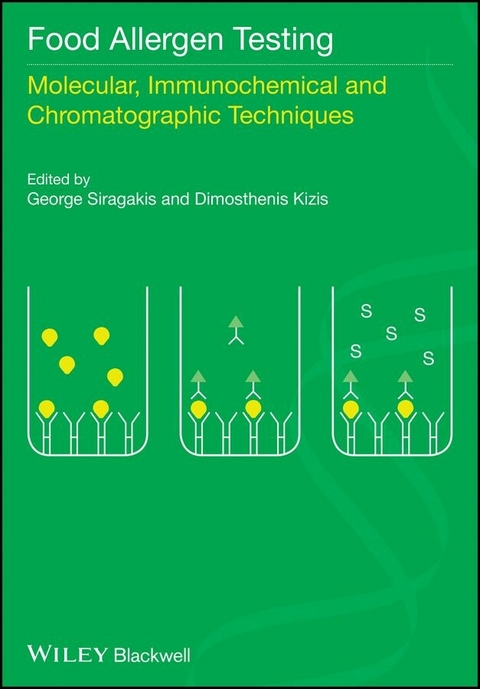
Food Allergen Testing (eBook)
John Wiley & Sons (Verlag)
978-1-118-51924-0 (ISBN)
Food allergens are a series of agents, mainly proteins, which cause various unpleasant and sometimes clinical symptoms in humans through consumption of foods.
Perhaps surprisingly, there are no treatments against food allergies which have been found to be 100% effective. The scope for individual difference in terms of how a person reacts to a given allergen is massive, making it incredibly difficult and complex to try and medicate against allergies.
Food Allergens Testing takes a thorough look at modern molecular biology and immunochemical techniques used to detect food allergens. The eleven chapters constitute an in-depth review of the current scientific knowledge on food allergens, covering the major methodologies and techniques used in validated analytical approaches.
The book is aimed at scientists and technical staff in the food industry and analytical laboratories who need an up-to-date treatment of both fundamental and applied research goals on food allergens, as well as a report on the validated methods currently in use for food allergens testing.
George Siragakis is Technical Director of Food Allergens Laboratory in Athens, Greece.
Dimosthenis Kizis is Research Associate of Food Allergens Laboratory in Larnaca, Cyprus.
An in-depth review of the current scientific knowledge on food allergens testing, covering the major methodologies and techniques used to detect food allergens. Food allergens are a series of agents, mainly proteins, which cause various unpleasant and sometimes clinical symptoms in humans through consumption of foods. Perhaps surprisingly, there are no treatments against food allergies which have been found to be 100% effective. The scope for individual difference in terms of how a person reacts to a given allergen is massive, making it incredibly difficult and complex to try and medicate against allergies. Food Allergens Testing takes a thorough look at modern molecular biology and immunochemical techniques used to detect food allergens. The eleven chapters constitute an in-depth review of the current scientific knowledge on food allergens, covering the major methodologies and techniques used in validated analytical approaches. The book is aimed at scientists and technical staff in the food industry and analytical laboratories who need an up-to-date treatment of both fundamental and applied research goals on food allergens, as well as a report on the validated methods currently in use for food allergens testing.
George Siragakis is Technical Director of Food Allergens Laboratory in Athens, Greece. Dimosthenis Kizis is Research Associate of Food Allergens Laboratory in Larnaca, Cyprus.
2
Immunodiagnostics in Food Allergen Testing
Jennifer Anne Rice and Anthony Joseph Lupo
Neogen Corporation, Lansing, MI, USA
The importance of food-induced allergic responses has increased over the last decade. One can debate if this rise in importance is due to an increased awareness or an increase in sensitivity [1]. However, since true immediate hypersensitivity reactions to more than 160 different foods have been noted [2], sensitivity to food can be problematic for an allergic individual and hazardous and life threatening for some individuals. Some of this reactivity, such as seen in coeliac disease, is food intolerance rather than true food allergy (IgE mediated), but the outcome for the patient is similar: an unacceptable reactivity to ingested food. It is estimated that 90% of all food hypersensitivity is caused by eight major foods. These include peanuts, tree nuts, milk, eggs, wheat, fish, shellfish and soybeans [3]. The importance of these major allergens is also evidenced by the type of testing that is requested at allergen testing laboratories. Figure 2.1 illustrates the allergen testing requested and completed (as a percentage of total by allergen type) at the Food Allergy Research and Resource Program (FARRP, Lincoln, NE) during fiscal year 2012 (1 July 2011 to 30 June 2012) [4].
Figure 2.1 Percentage of testing by allergen that was completed at FARRP between 1 June 2011 and 31 May 2012. Reproduced from FARRAP FY12 Testing Figure published in FARRP Annual Report by the Food Allergen Research and Resource (FARRP) with permission from FARRP, University of Nebraska.
Although avoidance of these allergenic foods might be a method to protect against an allergenic event, this methodology poses some major hurdles. For many individuals, the presence of minute traces of the offending allergen can trigger a dramatic response, and therefore knowledge of the presence of a food allergen is critical.
Hidden allergens are a major concern for both the allergenic consumer and the food manufacturer. Ingestion of food containing a hidden allergen such as peanut has been documented to be the cause of fatality in severely allergic individuals [5]. These allergens gain access to food products through either unintentional or unknown contamination of raw materials or cross-contamination during the manufacturing process, including contamination due to processing aids, reworked product or allergen carry-over from shared equipment [6]. In order to ensure that risk of potential allergenicity is minimized, food manufacturers have two choices: they must either label food as having a potential risk if it was produced in a facility that may contain known allergens, thus limiting consumer choices by default, or they must ensure that adequate testing including raw material testing and environmental monitoring [7] is performed to confirm that unwanted proteins are not inadvertently present in the food and to validate the effectiveness of the manufacturing control measures. Therefore, for any food manufacturer, it is essential that sensitive, accurate, reliable and rapid methodologies are available to analyse raw materials, manufacturing equipment and environments, and food matrices to ensure that allergenic components are not present.
2.1 Immunoassays for Detection of Food Allergens
There are several different analytical methods available for the detection of food allergens, and the choice of testing method is driven not only by the needs of the end user but also by the characteristics of both the testing methodology and the sample to be analysed.
- An analytical assay utilized for the detection of allergenic components must be sensitive enough to detect minute amounts of the allergen even in the presence of other components, which may inhibit reactivity. In order to safeguard the consumer, an ideal assay would never generate a false negative result at the desired limit of detection (LOD). Although a threshold for each allergen has not been established, it is accepted that assays should detect the presence of the allergen at concentrations as low as 5 ppm for peanut, since this has been found to be the lowest dose that produces an adverse effect (LOAEL) in clinical testing [8].
- An analytical assay utilized for the detection of allergenic components must be specific and have limited cross-reactivity to ensure that false positive results are not obtained. High rates of false positives are costly for the food manufacturer and cause waste of otherwise acceptable food ingredients.
- An analytical assay utilized for the detection of allergenic components must be reliable and robust for use in the manufacturing environment. The assay must deliver repeatable results and must be able to withstand differences in the testing environment, including but not limited to temperature, humidity and light.
- An analytical assay utilized for the detection of allergenic components must be cost effective for the end user. This means that the assay utilized must not require highly trained personnel to perform the assay, nor must the method require the use of high-cost equipment.
Based on these criteria, the most commonly utilized analytical methods for detection of food allergens are immunoassays. Immunoassays are chosen because of their ease of use and cost effectiveness. Additionally, many of these assays are highly sensitive and specific, providing an accurate analysis of the test sample [9]. There are several different assay forms that utilize antibody for detection of allergenic components, including western immunoblot, radioallergosorbent test (RAST), enzyme-linked immunosorbent assay (ELISA) and lateral-flow devices (LFDs). ELISA and LFDs are the most commonly utilized immunoassays, since they are readily formatted as ready-to-use kits and therefore allow for rapid and robust testing. Western immunoblot and RAST methods are effective; however, they are technically challenging, have multiple steps and for western immunoblot assays require specialized equipment. Of the two most commonly utilized immunoassays, ELISA and LFDs, ELISAs are usually more sensitive than LFDs and allow for quantification at very low LODs. The ELISA format requires higher level of technical expertise, equipment and a longer time to result. LFDs are rapid and easy to perform and require no equipment for a semiquantitative or qualitative result.
2.2 Enzyme-Linked Immunosorbent Assay (ELISA)
ELISA is a very useful tool for the detection of allergenic substances in food, and because of its precision and quantification capabilities it is the most commonly utilized method for analysis of food allergens [10]. In an ELISA, the targeted protein binds to a specific antibody, which is enzyme labelled [11]. A substrate specific to the enzyme produces a colorimetric reaction that can be detected. The ELISA can be either a direct sandwich format or competitive format. Both formats allow for a quantitative value based on comparison with a standard curve. In a direct sandwich format the allergen of interest is ‘sandwiched’ between two antibodies, a capture antibody and a detector antibody, which is tagged with an enzyme. In the presence of the allergen, colour is generated from the antibody:allergen:antibody complex and the amount of colour generated is directly proportional to the amount of allergen present (Figure 2.2).
Figure 2.2 Example of a direct sandwich ELISA, where one antibody is used to capture the substance of interest and another antibody is used to detect the substance of interest.
In a competitive ELISA, the antibody is immobilized to a solid surface. The enzyme-labelled antigen is mixed with the sample and then exposed to the surface containing the immobilized antibody. If the allergen of interest is present in the sample, it will bind to the antibody and block the binding of the labelled antigen to the antibody immobilized on the plate. In a competitive format the amount of colour generated is inversely proportional to the amount of allergen in the sample, as the allergen in the sample and the labelled antigen compete for binding to the antibody immobilized on the plate (Figure 2.3). Competitive ELISAs are most commonly used to detect small molecules and are less commonly used for detection of larger protein molecules, which are the primary target for food allergen analysis. However, for some smaller allergens or hydrolysed peptide fragments it is not possible to bind two immunoglobulin molecules to produce an antibody:allergen:antibody sandwich [12]. In these situations, the competitive format allows for the use of one specific antibody for analysis.
Figure 2.3 Example of a competitive ELISA. In a competitive ELISA only one antibody is used in the assay for capture. The target substance in the sample competes with a labelled competitive substance, which has specificity to the antibody similar to that of the substance of interest. When there is no substance of interest in the sample, the labelled competing substance binds to the antibody and color is generated when substrate is added.
2.3 Lateral-Flow Devices (LFDs)
LFDs exist in both sandwich and competitive formats, although sandwich-format LFDs are most common in food allergen testing. These assays are qualitative or semiquantitative, and in most instances provide a presence or absence result and not a specific concentration. Commercially, there are two different types of sandwich LFD utilized: those with an overload line and those without an overload line. The sandwich-format LFD functions as follows (Figure 2.4): An extracted sample is wicked onto the device through a...
| Erscheint lt. Verlag | 24.12.2013 |
|---|---|
| Sprache | englisch |
| Themenwelt | Medizin / Pharmazie ► Medizinische Fachgebiete ► Dermatologie |
| Naturwissenschaften | |
| Technik ► Lebensmitteltechnologie | |
| Weitere Fachgebiete ► Land- / Forstwirtschaft / Fischerei | |
| Schlagworte | Agents • Allergen • allergenic • allergens • Alternative • APPROACHES • cause • Chemie • Chemistry • Chromatographie / Trennverfahren • Chromatography / Separation Techniques • consumption • Detect • Fields • Food • Food Management • Foods • Food Science & Technology • humans • immunology • Lebensmittelallergie • Lebensmittelanalyse • Lebensmittelforschung u. -technologie • Lebensmittel-Management • levels • Microbiology, Food Safety & Security • Mikrobiologie u. Nahrungsmittelsicherheit • molecular • offered • Products • series • Symptoms • techniques • Trace • unpleasant • various • years |
| ISBN-10 | 1-118-51924-8 / 1118519248 |
| ISBN-13 | 978-1-118-51924-0 / 9781118519240 |
| Informationen gemäß Produktsicherheitsverordnung (GPSR) | |
| Haben Sie eine Frage zum Produkt? |
 PDF (Adobe DRM)
Größe: 6,6 MB
Kopierschutz: Adobe-DRM
Adobe-DRM ist ein Kopierschutz, der das eBook vor Mißbrauch schützen soll. Dabei wird das eBook bereits beim Download auf Ihre persönliche Adobe-ID autorisiert. Lesen können Sie das eBook dann nur auf den Geräten, welche ebenfalls auf Ihre Adobe-ID registriert sind.
Details zum Adobe-DRM
Dateiformat: PDF (Portable Document Format)
Mit einem festen Seitenlayout eignet sich die PDF besonders für Fachbücher mit Spalten, Tabellen und Abbildungen. Eine PDF kann auf fast allen Geräten angezeigt werden, ist aber für kleine Displays (Smartphone, eReader) nur eingeschränkt geeignet.
Systemvoraussetzungen:
PC/Mac: Mit einem PC oder Mac können Sie dieses eBook lesen. Sie benötigen eine
eReader: Dieses eBook kann mit (fast) allen eBook-Readern gelesen werden. Mit dem amazon-Kindle ist es aber nicht kompatibel.
Smartphone/Tablet: Egal ob Apple oder Android, dieses eBook können Sie lesen. Sie benötigen eine
Geräteliste und zusätzliche Hinweise
Zusätzliches Feature: Online Lesen
Dieses eBook können Sie zusätzlich zum Download auch online im Webbrowser lesen.
Buying eBooks from abroad
For tax law reasons we can sell eBooks just within Germany and Switzerland. Regrettably we cannot fulfill eBook-orders from other countries.
 EPUB (Adobe DRM)
Kopierschutz: Adobe-DRM
Adobe-DRM ist ein Kopierschutz, der das eBook vor Mißbrauch schützen soll. Dabei wird das eBook bereits beim Download auf Ihre persönliche Adobe-ID autorisiert. Lesen können Sie das eBook dann nur auf den Geräten, welche ebenfalls auf Ihre Adobe-ID registriert sind.
Details zum Adobe-DRM
Dateiformat: EPUB (Electronic Publication)
EPUB ist ein offener Standard für eBooks und eignet sich besonders zur Darstellung von Belletristik und Sachbüchern. Der Fließtext wird dynamisch an die Display- und Schriftgröße angepasst. Auch für mobile Lesegeräte ist EPUB daher gut geeignet.
Systemvoraussetzungen:
PC/Mac: Mit einem PC oder Mac können Sie dieses eBook lesen. Sie benötigen eine
eReader: Dieses eBook kann mit (fast) allen eBook-Readern gelesen werden. Mit dem amazon-Kindle ist es aber nicht kompatibel.
Smartphone/Tablet: Egal ob Apple oder Android, dieses eBook können Sie lesen. Sie benötigen eine
Geräteliste und zusätzliche Hinweise
Buying eBooks from abroad
For tax law reasons we can sell eBooks just within Germany and Switzerland. Regrettably we cannot fulfill eBook-orders from other countries.
aus dem Bereich